REVIEW · ATHENS
Athens & Sounio Full Day Private Sightseeing Tour
Book on Viator →Bookable on Viator
Sculpted stone and sea air in one day. This private Athens and Sounio outing strings together the Acropolis highlights in the morning and ends with wide-open Aegean views at the Temple of Poseidon. Along the way, you ride the Athenian Riviera with time to breathe, snack, and take photos without playing logistics Tetris.
I love how much is handled for you: pickup and drop-off, a luxury air-conditioned vehicle, and an English-speaking driver who brings serious context to what you’re seeing. I also like the practical touches like bottled water, Wi-Fi, and USB charging, plus the setup for skip-the-line site tickets so you don’t lose prime daylight in queues.
One thing to plan for: entrance fees cost extra (Acropolis and the Temple of Poseidon are not included), and you’ll pay about €40 per person on the spot. Also, you’ll do a good amount of walking on uneven ancient surfaces, so comfortable shoes matter.
In This Review
- Quick hits before you book
- The value of a truly private Athens-to-Sounio route
- Inside the Acropolis: Parthenon, Erechtheion, and the big “wow” moments
- Parthenon: more than an iconic photo
- Propylaea: the formal entrance you’ll remember
- Temple of Athena Nike: the Ionic elegance
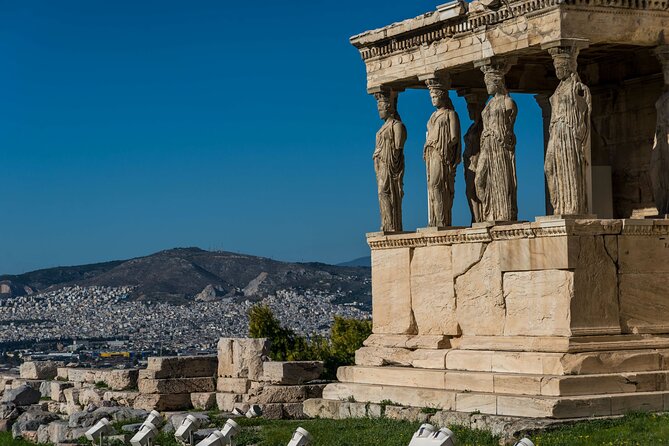
- Erechtheion: the story behind the north side
- Dionysus Theater and Herod Atticus Odeon: where performance met power
- Beyond the rock: Olympian Zeus and Hadrian’s Gate
- Temple of Olympian Zeus (Olympeion)
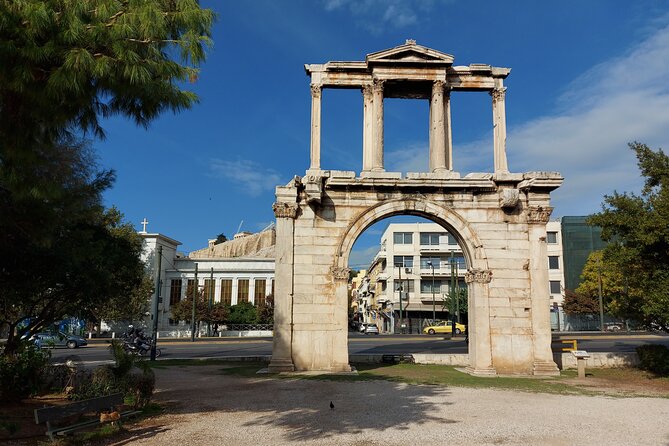
- Arch of Hadrian
- Panathenaic Stadium and Syntagma: modern Athens, right where you are
- Panathinaiko Stadium (Kallimarmaro)
- Changing of the Guard at Syntagma
- Unknown Soldier, Parliament, Syntagma Square, and the Old Parliament
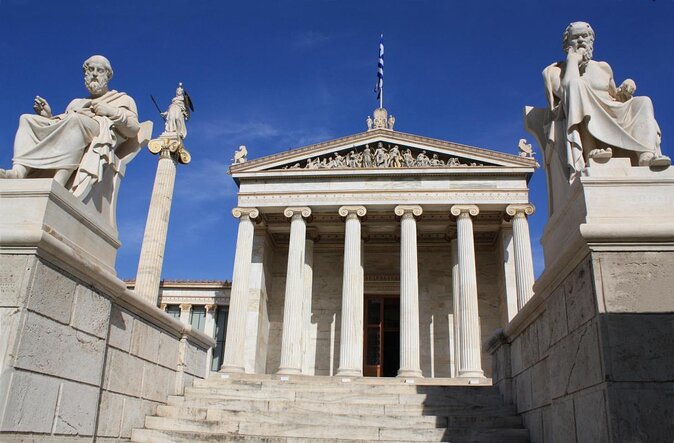
- Neo-classical Athens: Academy, University, and the National Library
- Short scenic stops: Lycabettus and Lake Vouliagmeni
- Mount Lycabettus viewpoint time
- Lake Vouliagmeni
- Cape Sounio finale: Temple of Poseidon and Aegean Sea views
- Lunch at Palaia Fokaia
- Price and what you’re really paying for (plus the extra €40)
- Who this private tour suits best
- Should you book the Athens & Sounio private day tour?
- FAQ
- What does the tour price include?
- Are entrance fees included in the price?
- Which sites have admission charges?
- Is lunch included?
- Do I get pickup from my hotel?
- Is this a private tour or a group tour?
- How long is the day?
- Can I cancel and get a full refund?
Quick hits before you book
- Private, door-to-door convenience with pickup and drop-off from your hotel, port, airport, or apartment
- Driver-led explanations (English-speaking with deep historical knowledge, though not a certified site guide)
- Skip-the-line ticket setup for the paid sites, paid simply on the spot
- Full-day pacing that moves through Athens and then to Sounio without feeling rushed
- Panoramic Temple of Poseidon payoff after the coastal drive down to Cape Sounio
The value of a truly private Athens-to-Sounio route
This is built for people who don’t want to spend their day solving transportation puzzles. You get pickup, a dedicated private vehicle, and a driver who stays with you for the whole loop. That means you’re not juggling metro lines, finding cabs at each stop, or trying to coordinate group tours on your own schedule.
The vehicle setup is also part of the value. You’ll travel in a luxury air-conditioned vehicle with Wi-Fi and USB chargers. Athens is warm and sunny more often than not, so having cold air and the ability to keep your phone alive makes a surprisingly big difference. You also get bottled water, which helps you keep energy for the walking portions.
A small but important point: this isn’t just a driver who says, Go here. The driver is English-speaking and comes with deep historical knowledge, plus the flexibility to adjust the pace. That’s how you end up spending your time better—standing where the story makes sense, not just where it’s easiest.
Inside the Acropolis: Parthenon, Erechtheion, and the big “wow” moments
The day starts with the Acropolis, the ancient sanctuary that still dominates central Athens. Expect a focused visit of about 1 hour 30 minutes here, with Acropolis admission paid on the spot. If you like your sightseeing with context (and not just a checklist), the driver’s explanations really help you connect the dots: this was a major religious center, dedicated primarily to Athena, and the architecture was meant to impress.
Here’s what you’ll hit within the Acropolis area, in practical terms:
Parthenon: more than an iconic photo
The Parthenon is the star of the show. It’s known as one of the most significant cultural sites in the world, tied to ancient Greece, democracy, and what became Western civilization. You’ll see why it has stayed a symbol for centuries. Don’t rush past it; spend time looking at the scale and the way the structure sits on the rock.
Propylaea: the formal entrance you’ll remember
You’ll also pass through the main entrance area (Propylaea). It’s the kind of doorway design you usually only notice if someone tells you what it was doing there. In ancient Greek religious architecture, having a primary gate for major sacred places was standard—and this is the kind of “ritual approach” detail that makes the Acropolis feel like a designed experience, not just ruins.
Temple of Athena Nike: the Ionic elegance
The Temple of Athena Nike is dedicated to Athena and Nike. It was built around 420 BC and is described as the first full Ionic temple on the Acropolis. If you’re the type who likes small-to-mid size monuments, this is your reward stop. It’s easier to take in than the Parthenon from a distance, and it gives you a different look at the religious architecture.
Erechtheion: the story behind the north side
The Erechtheion is especially interesting because it’s tied to a legend about Poseidon and Athena fighting over the city’s name. You’ll be able to notice the distinctive architectural elements on the north side of the Acropolis rock. It’s the kind of site where a driver’s background helps you understand why people cared so much.
Dionysus Theater and Herod Atticus Odeon: where performance met power
Acropolis time isn’t only about temples. You’ll also see:
- The Theatre of Dionysus, described as the most important open-air theater in ancient Athens and regarded as the world’s first theater.
- The Odeon of Herodes Atticus, described as the final great structure in antiquity in the Acropolis area and a Roman amphitheater from imperial times, with a capacity of at least 5,000 people.
These stops work well if you want Athens to feel like a living culture, not just a stone museum. You can almost picture gatherings and performances, and then your driver ties that back to how public life worked.
Beyond the rock: Olympian Zeus and Hadrian’s Gate
Once you come down from the Acropolis, the Athens vibe shifts from sacred heights to grand city-scale monuments.
Temple of Olympian Zeus (Olympeion)
You’ll see the Temple of Olympian Zeus, also called the Olympeion. It was built in honor of Zeus, described as the father of gods living on Mount Olympus. Even if you know the myth already, this is one of those places where the physical scale and location help you understand why Zeus mattered so much in public symbolism.
Arch of Hadrian
Right after, you’ll find the Arch of Hadrian, the Roman gateway created in honor of him during his stay in 131 AD. It’s a nice “Roman Athens” contrast to the earlier Greek monuments. The arch also provides entrance to the Temple of Olympian Zeus, so it’s not just decoration—it’s part of how the monumental space was organized.
If you’re a photo person, this is a good area to slow down. The arch gives you a clean frame for the broader view of the temple area, and it breaks up the day’s heavier walking with something more “stand and look.”
Panathenaic Stadium and Syntagma: modern Athens, right where you are
The tour then moves into the central Athens core, where classical Greece meets today’s government and street life.
Panathinaiko Stadium (Kallimarmaro)
You’ll stop at the Panathenaic Stadium, also known as Kallimarmaro. It survives in very good condition and is described as one of Greece’s most important cultural monuments. Even though your visit time is around 30 minutes, it’s a meaningful detour: it shows how Olympic identity and ancient athletic ideals still echo here.
Changing of the Guard at Syntagma
Then comes one of Athens’ most recognizable daily moments: the Evzones perform the changing of the guard on Syntagma Square in front of the monument of the Unknown Soldier, every hour. You’ll spend about 30 minutes on this, and it’s a great break from the long stretch of monuments.
This isn’t a “hidden” stop. It’s popular for a reason: it’s easy to follow, it’s right in the center of town, and it gives you a strong sense of Greek national rituals without needing a ticket or reservation.
Unknown Soldier, Parliament, Syntagma Square, and the Old Parliament
You’ll also see the Monument to the Unknown Soldier and the Greek Parliament, plus a stop at the National History Museum (Old Parliament). The Unknown Soldier monument is tied to remembrance for the dead Greek soldiers on two national celebrations of Greece: 25/3/1821 and 28/8/1940.
Syntagma Square itself is Athens’ central staging ground—useful for your bearings if you’re staying in the city. Then the nearby buildings—the Parliament complex and the historic assembly location—make the modern political Athens feel real and anchored, not just abstract.
Neo-classical Athens: Academy, University, and the National Library
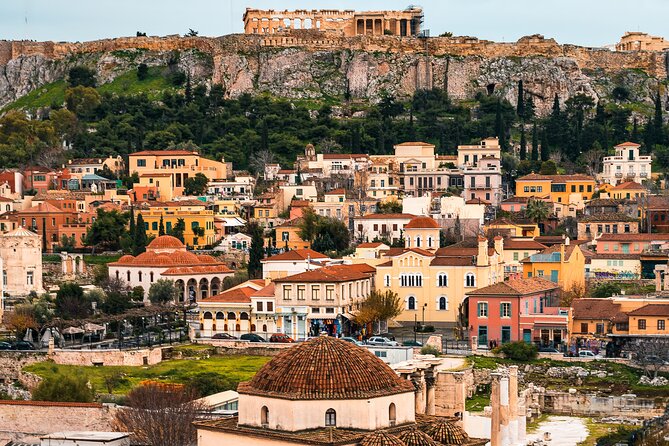
From the square, the tour continues with several institutional stops that are worth it if you like architecture that tells you what a city values.
You’ll visit the Academy of Athens, created in 1926 as the country’s most prestigious research institute, supervised by the Ministry of Education. You’ll also see the National and Kapodistrian University of Athens, established in 1837 and described as Greece’s first university.
Then there’s the National Library of Greece, created by the Danish architect Theophil Hansen as part of his neo-classical Trilogy that included the Academy and University buildings. Even if you only glance at the façades, it helps to know you’re looking at a deliberate architectural “team,” not random important buildings placed on the map.
This cluster is a good example of why a private day tour works: you get to see multiple “spotlight buildings” with context, rather than bouncing around alone trying to figure out what matters and why.
Short scenic stops: Lycabettus and Lake Vouliagmeni

Not everything needs to be a ticketed site to be worthwhile. You’ll get two shorter, calmer breaks:
Mount Lycabettus viewpoint time
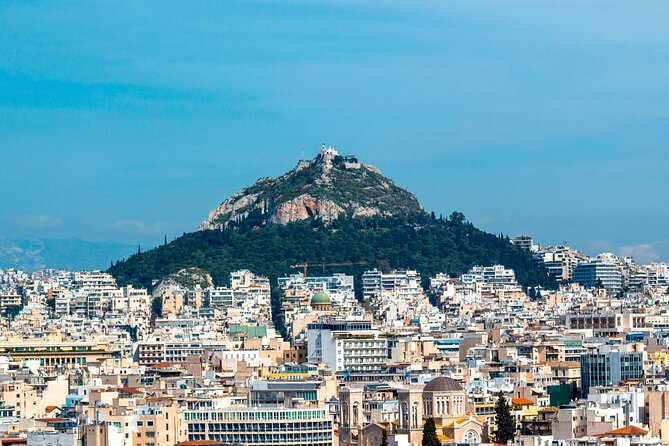
You’ll spend about 15 minutes at Mount Lycabettus. It’s tied to a myth involving Athena and a crow carrying bad news. At the top, you’ll find the church of Agios … (the tour description references it), and even the brief stop can help you see Athens from a new angle.
This is also a practical moment. If you’ve been walking for hours, a short pause like this resets your brain for the final stretch.
Lake Vouliagmeni
Then you’ll stop at Lake Vouliagmeni, described as a lake near the sea at the southern end of Ymittos, contained within an elliptical cavity. It measures about 260 meters long and 145 meters wide, and there’s a subterranean tunnel connecting to the Aegean Sea.
Your visit time is about 15 minutes, so you’re not treating it like a beach day. Think of it as a scenic breather before the coastal drive and the Temple of Poseidon.
Cape Sounio finale: Temple of Poseidon and Aegean Sea views
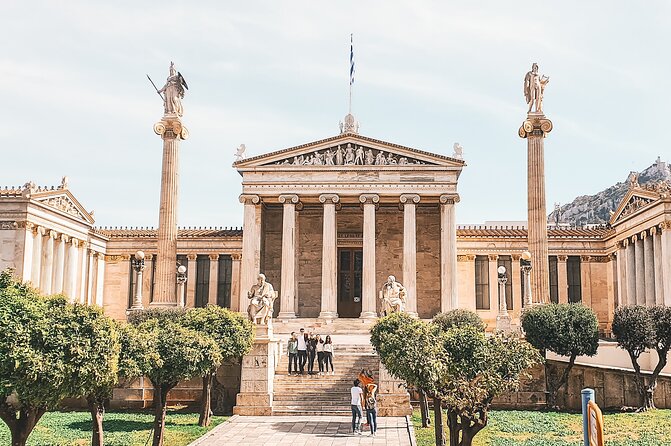
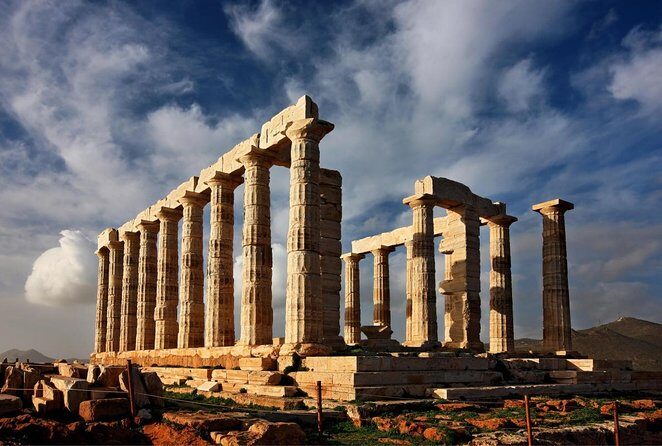
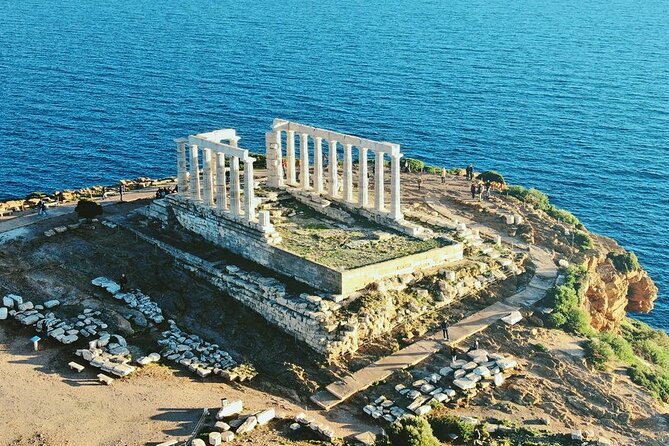
The main event of the Sounio half is the Temple of Poseidon. You’ll spend about 1 hour here, and Poseidon admission is not included. This is where the whole day starts to feel like it has a payoff: after spending time with Athens’ classical monuments, you shift to sea-level drama.
The Temple of Poseidon sits at Cape Sounio and is dedicated to the god of the sea. The description promises panoramic views over the Aegean Sea, and that’s exactly the kind of moment you want at the end of a long day. Even if you’ve seen plenty of photos online, seeing the horizon in real light is different. The driver-led timing and flexible pacing are what help you land in the right mood for the view.
Lunch at Palaia Fokaia
Before (or around) the Poseidon stop, there’s about 1 hour in Palaia Fokaia, where the tour description points out restaurants near the sea. This is your practical lunch window. Since lunch isn’t included, use the time to pick something that doesn’t slow you down for the final temple stop.
Tip for planning your energy: keep your lunch lighter than you think. You’re ending with a major viewpoint, and it’s nicer to enjoy it than to nap in the shade.
Price and what you’re really paying for (plus the extra €40)
At $234.98 per person for roughly 9 hours, this isn’t a budget grab. You’re paying for private transport, private driver attention, and a day plan that connects Athens’ top hits to the coast without you working for it.
Here’s the breakdown that matters:
- Included: pickup/drop-off, luxury air-conditioned vehicle, Wi-Fi, USB chargers, bottled water, and skip-the-line ticket setup for the sites you need to pay.
- Not included: entrance fees, lunch, and an optional licensed tour guide.
You should budget €40 per person for entrances (paid on the spot, no pre-purchase required). The Acropolis admission and the Temple of Poseidon admission are specifically listed as not included, while many other stops are marked free.
That makes the cost feel more reasonable if you compare it to how expensive it would be to line up multiple taxis, add entry tickets yourself, and still pay someone to bring meaning to the monuments. If you care about both logistics and context, the pricing starts to make sense.
Who this private tour suits best
This fits best if you want:
- A one-day Athens plan that doesn’t force you into group pacing
- The comfort of a dedicated driver plus a relaxed itinerary
- A mix of major monuments (Acropolis, Olympian Zeus, Panathenaic Stadium) and a coastal finale (Sounio, Poseidon temple)
It’s also a smart pick for people who have limited time in Athens. Instead of choosing only the city or only the coast, you get both—and you get them in the order that builds naturally toward the sea views.
If you’re traveling with family or friends and you want everyone to move as a unit, the private format is a big win. The tour is described as a private activity where only your group participates.
Should you book the Athens & Sounio private day tour?
Book it if you want a smooth, high-impact day: Acropolis monuments in the morning, central Athens landmarks and ceremonies in the middle, then a coastal drive that ends with the Temple of Poseidon’s panoramic payoff. The private setup, the luxury vehicle, and the driver’s explanations are what make it feel worth the money.
Skip it (or look for a different style) if you prefer to spend long, slow hours inside a few museums or if you want zero walking. This day is designed to cover a lot of ground efficiently, with a flexible pace—but it still includes significant sightseeing.
FAQ
What does the tour price include?
The price includes pickup and drop-off, a luxury air-conditioned vehicle, bottled water, Wi-Fi and USB charging, and English-speaking drivers with historical knowledge. It also includes skip-the-line ticket setup for the sites that require admission.
Are entrance fees included in the price?
No. Entrance fees are not included. You pay about €40 per person on the spot for tickets that are not included.
Which sites have admission charges?
The Acropolis and the Temple of Poseidon are listed as admission ticket not included. Many other stops on the route are marked free.
Is lunch included?
No. Lunch is not included. There is time to stop near restaurants in Palaia Fokaia.
Do I get pickup from my hotel?
Yes. Pickup and drop-off are offered from hotel, port, airport, Airbnb, and apartments.
Is this a private tour or a group tour?
This is a private tour/activity, and only your group will participate.
How long is the day?
The duration is about 9 hours.
Can I cancel and get a full refund?
Yes. You can cancel for a full refund up to 24 hours in advance of the experience start time.