A big ancient hit, without the driving headache. This private tour stitches together Ancient Corinth and UNESCO-listed Mycenae with pick-up and drop-off from your Athens-area address, plus onboard Wi‑Fi so you’re not hunting for signal all day. I like that it’s set up for real pacing—time at key ruins—without the self-drive stress.
I also love the practical comfort details: onboard Wi‑Fi and bottled water, delivered in an air-conditioned car, make the long day feel manageable. The main drawback to note is that you won’t get a separate licensed guide inside each archaeological site, so you’ll mainly rely on the tour driver’s history talk and on-site signage for the depth.
In This Review
- Quick Highlights You’ll Actually Feel
- Setting Off: Private Athens (or Piraeus) Pickup With a Real Time Plan
- Isthmus of Corinth: The Canal View That Explains Greek Maritime History Fast
- Ancient Corinth and Paul’s Connection: Temples, Forums, and Letters Without the Rush
- Corinth Museum Stop: Why Artifacts Make the Ruins Click
- Mycenae’s Hilltop World: Lion Gate, Cyclopean Walls, and the 1225 BC Fountain Tunnel
- Mycenae Museum: Gold Masks and Weapons That Put Faces Back on the Story
- Treasury of Atreus: Quick, Free, and Architecturally Impressive
- Nafplio Arrival and Palamidi Fortress: Finish With Views Over the Argolic Gulf
- The Driver Experience: What “In-Depth Knowledge” Means in Practice
- Price and Value: When $226.99 Makes Sense (and When It Doesn’t)
- Should You Book This Private Corinth–Mycenae–Nafplio Day Trip?
- FAQ
- How long is the Private Tour of Ancient Corinth, Mycenae and Nafplio?
- What is the price per person?
- Are entrance fees included in the tour price?
- Is Wi-Fi available during the tour?
- Do we have a licensed guide inside the archaeological sites?
- Where will I be picked up?
- Is airport pickup included?
- Is the tour private?
- Is the tour suitable for families and kids?
- What happens if the weather is bad?
- What’s the cancellation policy?
Quick Highlights You’ll Actually Feel
- Door-to-door private pickup and drop-off from Athens, the Riviera, or Piraeus Port
- Onboard Wi‑Fi + bottled water to keep your phone working and your energy up
- Corinth + Mycenae in one day, linking Paul’s setting with Mycenaean legends
- Time at the big archaeology, including a Mycenae museum stop for context
- A driver-led tour with flexibility, so you’re not rushed by a large group pace
- Nafplio and Palamidi views to end the day on a high point
Setting Off: Private Athens (or Piraeus) Pickup With a Real Time Plan
This is built as a true private experience. Your group rides together, and the car size depends on your numbers—groups of 1 to 4 use a sedan—so you’re not squeezed into a big bus. Pickup is offered from your hotel or apartment address, or from the Piraeus Port arrival area with a name sign, and the driver waits outside until you’re ready.
The other smart touch is that the “9 to 10 hours” includes the driving time. That matters because Peloponnese distances add up fast, and you want the estimate to reflect the whole day. It also helps you plan food and timing: expect a long, active outing with a couple of museum breaks and solid walking.
Practical note: your tour driver is English speaking and brings in-depth history, but there is no separate licensed guide included for entering archaeological sites. So if you’re the type who loves a very formal guided walkthrough inside every ruin, you’ll want to be comfortable reading the site context at each stop.
Isthmus of Corinth: The Canal View That Explains Greek Maritime History Fast
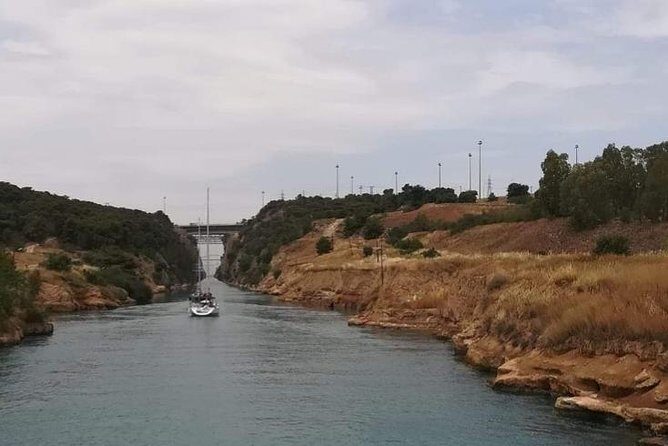
The day starts at the Isthmus of Corinth, the narrow land bridge that connects the Peloponnese to mainland Greece. This is one of those stops where the geography does the storytelling. You’ll see the Corinth Canal—an impressive 19th-century engineering project that cuts a route between the Aegean and Ionian Seas.
The practical win here is the short time commitment. You’re there about 15 minutes, and admission is free. That makes it an ideal “warm-up stop” before you jump into longer museum and ruin visits.
If you like maritime history, you’ll appreciate the way this area explains why Corinth mattered so much. Even if you’re not a history nerd, it’s still a strong perspective shift: Greece isn’t just islands and beaches—movement of ships and trade routes shaped whole civilizations.
Ancient Corinth and Paul’s Connection: Temples, Forums, and Letters Without the Rush
Next comes Ancient Corinth (Archaia Korinthos), the site tied to both ancient Greek power and early Christianity. You’ll walk through parts of the ancient city, including the Archaic Temple of Apollo, the Roman Forum, and the remains of public baths and fountains. The site also connects directly to Apostle Paul, including the idea that he preached here and later wrote letters to the early Christian community.
This stop is about 35 minutes, and it’s not free. The admission fee is not included in the tour price, so it’s part of your paid entrance budget.
Here’s how I’d think about it: you’re not trying to “complete” Ancient Corinth in half an hour. Instead, you’re getting a guided orientation—enough to understand what you’re looking at and why it matters. You’ll likely spend more time appreciating the layout and key structures than trying to match every detail from guidebook to stone.
The best approach is to slow down at the temple and forum areas. Use your driver’s context to label what you’re seeing: where civic life happened, where the city worshipped, and why this location became a spiritual stop. With the short time window, that’s what makes it feel satisfying instead of rushed.
Corinth Museum Stop: Why Artifacts Make the Ruins Click
After the ruins, you’ll visit the Archaeological Museum of Corinth, about 30 minutes. This stop is where the day stops feeling like random ruins and starts turning into a story you can follow.
You’ll see objects from multiple periods—Greek, Roman, and Byzantine. Typical highlights include statues, mosaics, pottery, and ancient sarcophagi. The value here is simple: when you return to the ruins in your mind later, you’ll have something to “attach” the architecture to.
This is also the most forgiving part of the day if the weather is hot. Museums are still walking, but you’re not exposed in the same way as outdoor sites.
If you like museums, don’t skip scanning the labels. In a short visit, the captions and dates are often the difference between seeing artifacts and understanding why those objects survived.
Mycenae’s Hilltop World: Lion Gate, Cyclopean Walls, and the 1225 BC Fountain Tunnel
Then you reach the heavy hitter: the Archaeological Site of Mycenae. This is UNESCO-listed for a reason. Mycenae sits on a hill overlooking the Argolic Gulf, and the ruins are tied to the Late Bronze Age and the legendary Mycenaean civilization.
You’ll see the Cyclopean Walls—massive stonework that still makes people stop and stare. The Lion Gate is the iconic moment for many visitors, and you’ll also encounter the royal Grave Circle A and remaining parts of the palace complex.
One of the standout elements is the subterranean fountain tunnel, dating back to 1225 BC. It’s the kind of feature that makes ancient engineering feel real, not just theoretical. It also helps explain how a fortified settlement functioned day to day, not just how it looked in myths.
This stop is about 1 hour. That’s enough to get a strong sense of the site, especially if you keep your energy for climbing and uneven ground. Still, pace yourself. Mycenae is exposed in places, and you’ll likely feel the heat.
Mycenae Museum: Gold Masks and Weapons That Put Faces Back on the Story
Right after the hilltop ruins, you’ll visit the Archaeological Museum of Ancient Mycenae for about 30 minutes. This museum is where the famous objects become more than legends.
You can expect artifacts such as gold masks, weapons, pottery, and jewelry discovered from the site. The value is context. Ruins show structure, but the museum helps you imagine the people tied to that structure—what they wore, what they carried, and what power looked like on the ground.
This museum stop also smooths out the timeline. Mycenae has layers, and the museum gives you a more coherent sense of what’s Bronze Age, what’s later, and what each discovery represents.
If you’re only going to do one museum “extra” on this kind of day trip, make it this one. It turns monuments into a civilization.
Treasury of Atreus: Quick, Free, and Architecturally Impressive
You’ll also visit the Citadel and Treasury of Atreus, also called the Tomb of Agamemnon. This is one of the strongest architectural highlights in the Mycenae area.
It dates to around 1250 BC and is known for its tholos shape, often described as a beehive tomb. You’ll notice the massive stone doorway and the corbelled dome. Admission for this stop is listed as free, and the visit time is about 20 minutes.
What makes this worth your time on a packed day is that it’s visually self-explanatory. Even if you’ve never studied Mycenaean architecture, the proportions and construction technique give you instant appreciation. It’s also a perfect short pause before you head toward the final stretch of the day.
Nafplio Arrival and Palamidi Fortress: Finish With Views Over the Argolic Gulf
After the ruins and museums, you end in Nafplio, about 1 hour. Nafplio is known as the first capital of Greece and blends Mycenaean roots, Venetian influence, and modern Greek life. It’s a nice contrast: you go from hilltop monuments to streets and scenery where you can breathe.
Before or around your time in town, you’ll also explore Palamidi Fortress, an 18th-century Venetian stronghold. It sits high above Nafplio, and the main reward is panoramic views over the Argolic Gulf and surrounding mountains. You’ll climb along well-preserved ramparts and use winding staircases leading to strategic bastions.
This part is physically harder than the earlier museum stops, so wear good shoes. If your day includes a lot of sun, plan shade breaks when you can. Palamidi is also the kind of place where you’ll want a phone camera ready, because the angles get better the higher you go.
The Driver Experience: What “In-Depth Knowledge” Means in Practice
Since the tour does not include a separate licensed guide inside the archaeological sites, the driver becomes your key interpretive tool. The good news is the setup is designed for you to learn as you go, not just sit in a car.
An English-speaking driver with history know-how can help you connect the dots quickly: what you’re looking at, why it was built that way, and how the ancient setting connects to later stories. That matters on a day like this, where you’re moving from city ruins to Bronze Age tombs to a modern town.
You’ll also benefit from the private format. If your group moves slower, if someone wants extra minutes at a viewpoint, or if you’re stopping for photos, the flexibility is part of the value. The goal isn’t to perform a checklist—it’s to give you a coherent day.
Price and Value: When $226.99 Makes Sense (and When It Doesn’t)
The price is $226.99 per person for the private experience, with air-conditioned transport, bottled water, and onboard Wi‑Fi included. There are also pickup and drop-off options from Athens or the Riviera, plus Piraeus Port, so you’re not paying extra for basic logistics.
Then there’s the added budget piece: entrance fees to archaeological sites and museums are not included, listed at €35 per person. Some stops are free (like the Corinth Canal-area quick visit and the Treasury of Atreus), but you should still budget for the overall entrance total. Airport pickup is optional at an additional €50 per booking.
So when does this feel like good value?
- If you want a private car and a structured route without self-driving
- If you’ll use the Wi‑Fi for maps, translation, and staying organized
- If your group size fits the private sedan setup (1–4 people tends to be the sweet spot)
When might it not be the best deal?
- If you’re happy with DIY travel and already have a car
- If you need a fully licensed guide inside every site for very deep interpretation
For most visitors who want a full Peloponnese day with less stress, the cost looks reasonable once you factor in transport + comfort + a driver-led history flow.
Should You Book This Private Corinth–Mycenae–Nafplio Day Trip?
Book it if you want one packed day that connects the big names: Corinth (and the setting for Paul), Mycenae (Cyclopean walls and legendary tombs), and Nafplio (finish with views and town wandering). The private pickup/drop-off and onboard Wi‑Fi are the kind of small comforts that matter when your day is long.
I’d especially recommend it if:
- You’d rather not drive in Greece’s traffic and parking maze
- You like the idea of museums paired with ruins
- You want a guided narrative without joining a huge group
Skip or compare if you:
- Plan to spend your time reading every label slowly at each site (you may find 35–60 minute windows tight)
- Want a licensed site-by-site guide for every entrance
If you’re aiming for a smooth, meaningful day with minimal hassle, this route is one of the better ways to do it.
FAQ
How long is the Private Tour of Ancient Corinth, Mycenae and Nafplio?
It runs about 9 to 10 hours, and the duration includes transportation time.
What is the price per person?
The price is $226.99 per person.
Are entrance fees included in the tour price?
No. Entrance fees to archaeological sites and museums are listed as €35 per person.
Is Wi-Fi available during the tour?
Yes. Wi-Fi is included on board.
Do we have a licensed guide inside the archaeological sites?
No. A licensed guide to accompany you into the archaeological sites is not included.
Where will I be picked up?
Pickup is offered for Athens hotel/apartment addresses, Riviera addresses, and Piraeus Port. If you’re staying outside a hotel, the driver waits outside for hotel/apartment pickup.
Is airport pickup included?
Airport pick-up is optional and costs an additional €50 per booking.
Is the tour private?
Yes. It’s a private tour/activity with only your group participating.
Is the tour suitable for families and kids?
Most travelers can participate. A child seat is available upon request.
What happens if the weather is bad?
The experience requires good weather. If it’s canceled due to poor weather, you’ll be offered a different date or a full refund.
What’s the cancellation policy?
Free cancellation is available up to 24 hours in advance for a full refund. If you cancel less than 24 hours before the experience starts, the amount you paid will not be refunded.