REVIEW · CORINTH
Ancient Corinth: Self-Guided Audiovisual Tour with 3D Models
Book on Viator →Operated by Culture App · Bookable on Viator
Ancient Corinth feels closer with a 3D map. This self-guided audiovisual walk uses audio narration and AR-style 3D reconstructions to help you make sense of the site’s Greek, Roman, and Byzantine remains, with Christian tradition woven in too. You’ll be cued to look for specific highlights, including the Bema tied to Apostle Paul and the Peirene Fountain and its running water story, then wrap up with a change of viewpoint toward Acrocorinth.
What I like most is the way the tour is built around concrete moments you can stand in front of. The app pairs 15 monument audio/text segments with 13 360° panoramas and 3D models, so you’re not just wandering and hoping it clicks. You also get an interactive map with GPS location tracking, which makes it easier to follow the main routes inside the archaeological area.
One thing to plan for: the tour needs internet access, and GPS/geolocation can be picky if your phone permissions aren’t granted at setup time. Also, the archaeological site ticket and your own smartphone/headphones are not included, so budget for that up front.
In This Review
- Key things to know before you start
- Entering Ancient Corinth with a phone in your hand
- Start point at the Archaeological Museum of Ancient Corinth
- The app experience: audio, text, GPS map, and 3D visuals
- Walking the route through Corinth’s Greek, Roman, Byzantine layers
- Highlight moment: standing at the Bema and hearing Apostle Paul’s story
- Peirene Fountain and the sound of running water
- 3D models and 360 panoramas: why they’re worth the screen time
- Acrocorinth rock: a viewpoint that changes your perspective
- Price and value: paying for the app, not the ticket
- Logistics that decide whether this tour feels smooth or frustrating
- Who should book this self-guided Corinth audio tour
- Should you book Ancient Corinth with this 3D audio tour?
- FAQ
- How much time should I plan for this tour?
- Is the archaeological site ticket included in the price?
- Where does the tour start and end?
- Do I need a smartphone and headphones?
- Does the tour work offline?
- What languages are available?
Key things to know before you start
- 15 audio/text monument stops so you get structure instead of aimless roaming
- 13 AR-style 3D models and 360° panoramas to visualize what you’re seeing
- Interactive GPS map with location tracking to help you follow the route
- Multilingual support across many languages, including English and several European options
- Designed for about 1–1.5 hours, keeping your visit efficient
- Ends with viewpoint time toward Acrocorinth rock for a big-sky wrap-up
Entering Ancient Corinth with a phone in your hand
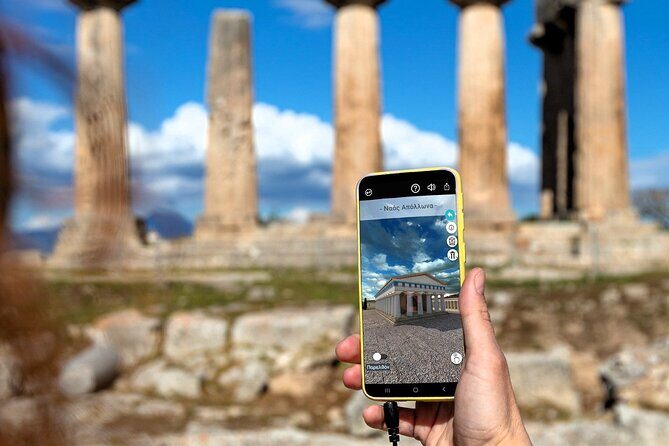
Ancient Corinth is the kind of place where the stonework can look impressive but still feel hard to place. This tour helps you connect the dots by guiding you along the main routes inside the archaeological site and timing your stops to match what you’re actually looking at.
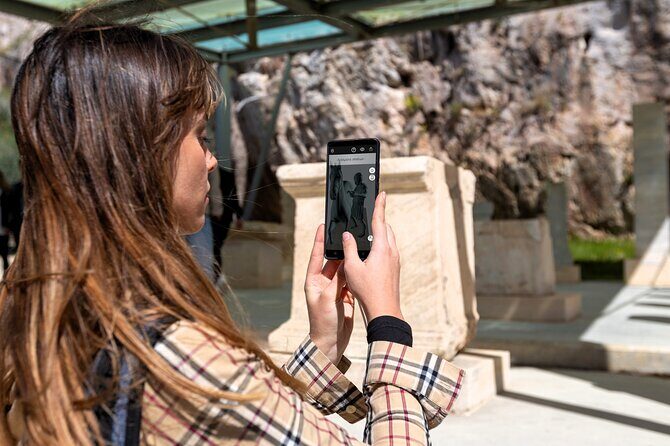
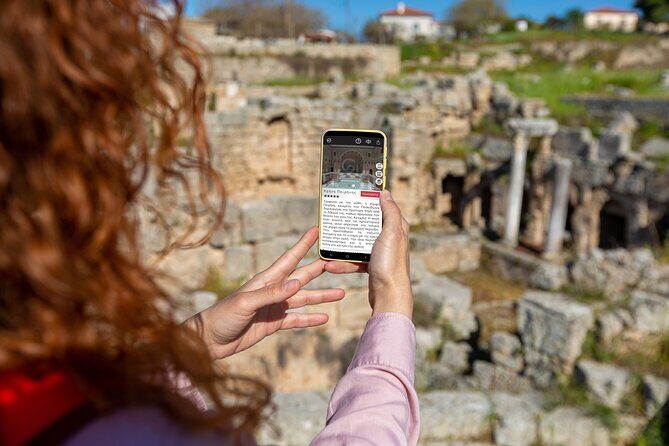
The big idea is simple: your phone becomes a companion that explains what those remains likely looked like in different eras. The tour doesn’t just talk history in general terms. It points you at specific monuments and gives you visual upgrades—3D models and 360° panoramas—so you can compare the physical ruins with reconstructed views.
You also get a mix of cultural layers in the narration: ancient Greek and Roman Corinth, then Byzantine-era monuments, plus references to Christian tradition. That’s useful because Corinth isn’t only about one “time layer.” It’s about how the meaning of the place shifts over centuries, even when the setting stays the same.
You can also read our reviews of more guided tours in Corinth
Start point at the Archaeological Museum of Ancient Corinth
You begin at the Archaeological Museum of Ancient Corinth, at Argous 105, in Archaia Korinthos. That’s convenient because the museum area is easy to orient to before you step into the site itself.
The tour’s walk is self-guided, but it’s not a free-for-all. You’re meant to follow the routes through the key monuments, starting from the site entrance. When you finish, you end at Odos Apollonos 825, also in Archaia Korinthos. The tour notes that the archaeological site’s only exit is near the central square, and you’ll be back at the meeting point within about a two-minute walk.
Timing-wise, plan for about 1 hour to 1 hour 30 minutes. That’s a comfortable slot if Corinth is a main stop on your itinerary but you don’t want to lose the whole day.
The app experience: audio, text, GPS map, and 3D visuals
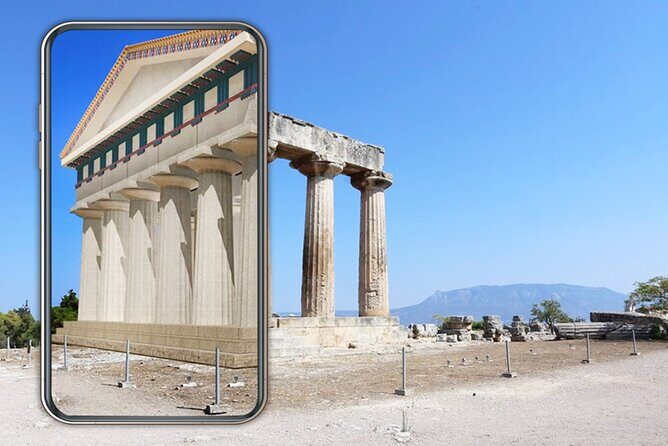
This is an audiovisual tour delivered through a downloadable app from Culture App. After booking, you’ll get an email with instructions to download the tour app and choose your language. Once you open it on your smartphone, the content downloads automatically, which is helpful because you’re not stuck hunting for files.
Included features are what make this workable in real life:
- A GPS-based interactive map with location tracking
- Audio narration and text information for 15 monuments
- 3D models and 360° panoramas for 13 monuments
- Immersive videos for 13 monuments
The route guidance is the part that matters most. GPS can’t magically fix poor navigation on a complex site, but it can help you get oriented fast and avoid wandering in circles. The downside is also clear: you need internet access for the tour to function properly, and your phone needs the right permissions to make geolocation work.
If you’re the kind of traveler who likes to read as you walk, the audio plus on-screen text pairing is a strong format. If you prefer to listen and keep moving, you can do that too—just be ready to occasionally stop and look where the app directs you.
Walking the route through Corinth’s Greek, Roman, Byzantine layers
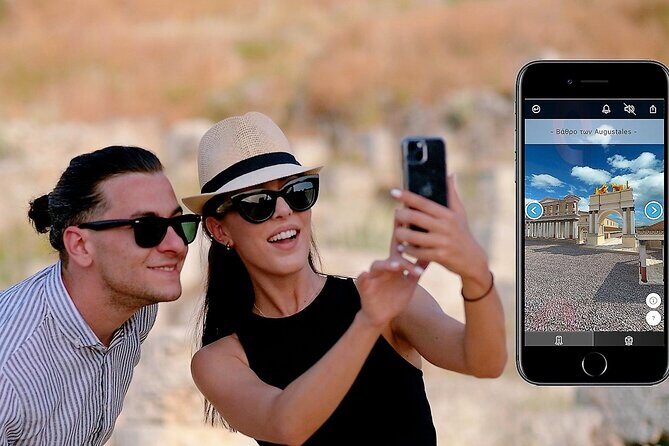
Inside the site, the tour follows the main routes through monuments connected to multiple periods: Greek, Roman, and Byzantine. This matters because the remains you see can feel confusing if you only know one “version” of Ancient Corinth.
The tour’s 3D reconstructions are built to make those layers legible. You’ll see reconstructions using AR-style presentation on the phone screen, then compare that with what’s actually in front of you. That’s particularly helpful for ruins where your brain is trying to guess the original shapes from partial stone fragments.
Because the tour is self-guided, you also control pacing. You can linger at a monument long enough for the story to stick. Or you can move quickly if you’re just trying to get the big picture before heading toward the viewpoint.
One practical point: you’ll get the most out of this if you’re willing to stop a few times and actually look at the phone as a tool—not just an audio source. The 3D elements and panoramas are where the tour earns its keep.
Highlight moment: standing at the Bema and hearing Apostle Paul’s story
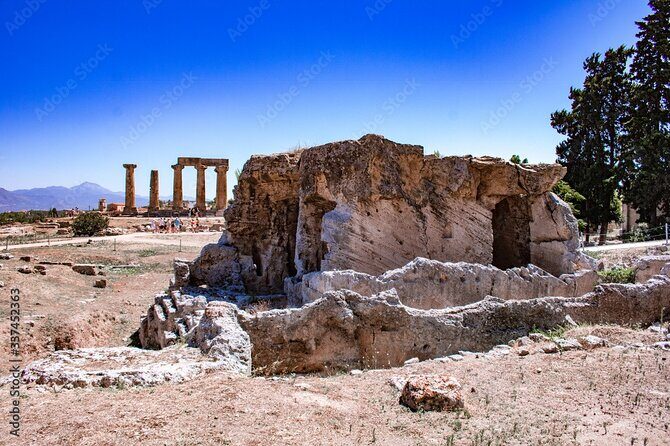
One of the emotional anchors mentioned in the tour is the Bema, tied to the Apostle Paul. The tour encourages you to stand there—so you’re not just hearing a story from a distance—and the narration frames it as a place where Paul defended himself about 2,000 years ago.
Even if you already know the basic Christian connection to Corinth, I like how the tour treats this as a physical moment. It pushes you to locate yourself in the space, then listen. That’s the kind of structure that turns a stop from “I saw it” into “I understood what it meant here.”
You can think of the Bema moment as the tour’s “story peak.” The earlier parts help you orient around different monuments. Then the Paul/Bema segment gives you a clear, human-centered reason to pay attention.
As with all historic sites, your experience will depend on how still you can stand for a minute and how closely you follow the app cues. If you’re in a rush, you’ll miss that payoff.
You can also read our reviews of more tours and experiences in Corinth

Peirene Fountain and the sound of running water
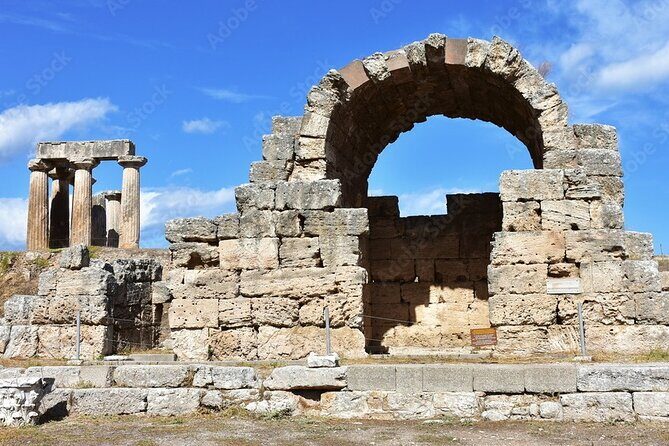
Another named highlight is the Peirene Fountain, where the tour asks you to listen to the water that is still running. It even references the Nymph’s lament as part of the atmosphere.
This is where a self-guided audio tour can score big. Water is not something you can fully “see” from a photo. Listening changes the experience, and the narration is timed to invite you to notice what’s still happening in the present.
If you like sensory travel—texture, sound, the feel of place—this kind of cue is exactly why the audio format works here. The fountain becomes more than a stop on a route. It becomes a pause.
The watch-out is simple: keep your expectations realistic. You may or may not hear water clearly depending on wind, distance, and where you position yourself. But the tour’s prompt helps you aim your attention in the right direction.
3D models and 360 panoramas: why they’re worth the screen time
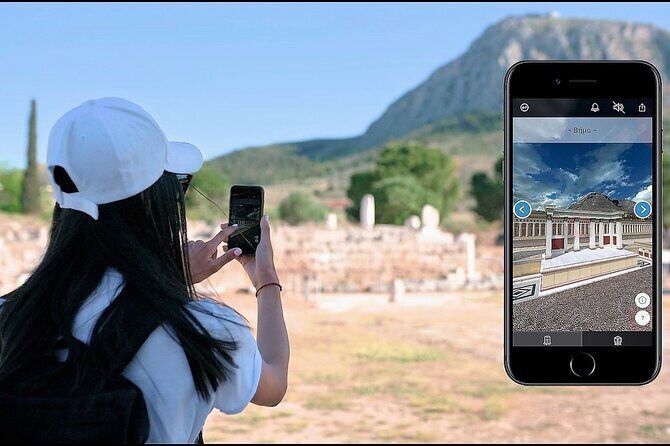
The tour includes 3D models and 360° panoramas for 13 monuments. The value here isn’t just “cool tech.” It’s interpretation. Many ruins are hard to mentally reconstruct without a visual scaffold.
In a place like Ancient Corinth, your brain is constantly guessing:
- What was missing?
- What was the original height?
- Where did sightlines go?
- What did this look like when it was whole?
The reconstructions help reduce that guesswork. You’re able to compare today’s remains to a reconstructed idea of the past. That makes it easier to understand why specific monuments mattered and how they fit into a larger city plan.
Here’s the practical tip: don’t let the 3D view replace the real one. Use the phone as a guide, then look at the stone in front of you. The best moments come when you do both—rotate your head, check the phone, then look back up.
Acrocorinth rock: a viewpoint that changes your perspective

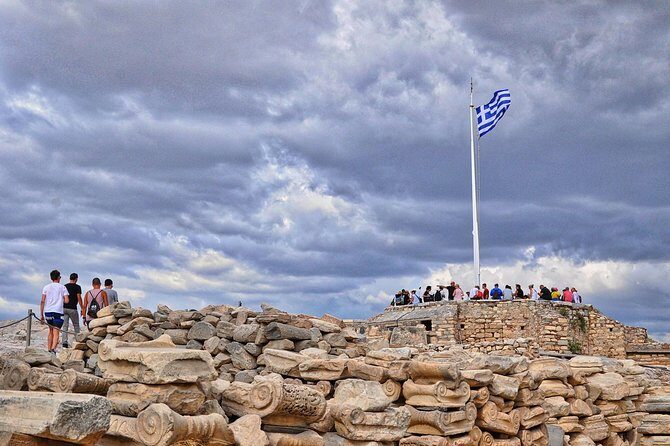
The tour ends by moving you toward Acrocorinth rock, encouraging you to let your gaze wander over the scenery. That’s a smart finish because it gives your brain a final “big picture” check.
After you’ve been focused on monuments and stories, the viewpoint helps you understand scale and setting. Even if you’re not tracing a timeline anymore, you can appreciate the geography that made Corinth strategic and memorable.
If you’re only using the tour casually, you might rush the last leg. I wouldn’t. The ending is designed to shift you from detail to environment, which is one reason these tours feel satisfying when they work.
Price and value: paying for the app, not the ticket
This tour costs $8.13 per person, and the archaeological site admission ticket is not included. The listed site entry fees are €8 full price and €4 reduced.
So what are you actually paying for? You’re paying for the guided content format:
- audio and text for 15 monuments
- 3D/360 models and videos
- a GPS map experience
- multilingual support across multiple languages
For a 1–1.5 hour visit, that’s reasonable—especially if you’d otherwise have to rely on guesswork or bring your own printed guides. The cost becomes less of a bargain if you’re traveling with limited data, an undercharged phone, or you know you prefer human interaction over tech-based interpretation.
Also factor in what you must bring: your own smartphone and headphones. The tour doesn’t provide them, so plan for that like you would for any self-guided audio experience.
Logistics that decide whether this tour feels smooth or frustrating
This is mostly a tech-powered experience, so the small practical details matter.
Internet access is required. If your phone struggles to connect, you might lose the function of the tour at key moments. Downloading and auto-downloading happens through the app process, but the tour’s requirement is still clear.
Geolocation permission matters. The app needs permission to enable geolocation during the download process. If you skip that permission, the GPS tracking and map experience may not work as intended. There’s even an example of someone finding orientation difficult when geolocation didn’t work, with the map and 3D not helping much with navigation.
Here’s how I’d set yourself up for success:
- Give location permission when prompted during setup
- Bring headphones so you’re not forced to listen in noisy overlap zones
- Keep your phone charged; you’re using GPS plus audio plus visuals
- Expect to pause a few times to get the most out of the 3D and 360 elements
The good news: the starting museum location and the fact that the site’s exit is near the central square make it hard to get truly lost in a way that derails your day.
Who should book this self-guided Corinth audio tour
I’d aim for this tour if you:
- want a structured visit but don’t want to follow a group schedule
- enjoy audio storytelling paired with maps and visuals
- like the idea of 3D reconstructions for ruins that are hard to interpret
- prefer to control your pace at key monuments like the Bema and Peirene Fountain
It might be less satisfying if you:
- dislike phone-based navigation and audio prompts
- tend to ignore apps once you arrive onsite
- have unreliable internet and no way to fix connectivity quickly
- expect a fully guided, human-led explanation
If you like having both a physical site and a “what it might have looked like” layer, this is a strong match.
Should you book Ancient Corinth with this 3D audio tour?
Book it if you want an efficient, self-paced way to connect monuments to stories, with audio + GPS + 3D/360 doing the heavy lifting. For about $8.13 plus the entry ticket, it’s a solid value if your phone setup goes smoothly and you’re willing to stop and look.
Skip or reconsider if you’re worried about internet reliability or you don’t want to deal with geolocation permissions. In that case, you’ll probably spend time troubleshooting instead of enjoying Corinth.
If you’re traveling light, curious, and comfortable using your smartphone as a guide, this tour can make Ancient Corinth feel much less like scattered stones and much more like a lived-in city across time.
FAQ
How much time should I plan for this tour?
The experience runs about 1 hour to 1 hour 30 minutes.
Is the archaeological site ticket included in the price?
No. The app/tour price does not include admission. The site entry fee is €8 full price and €4 reduced.
Where does the tour start and end?
It starts at the Archaeological Museum of Ancient Corinth (Argous 105) and ends at Odos Apollonos 825 in Archaia Korinthos.
Do I need a smartphone and headphones?
Yes. You’ll need your own smartphone and headphones.
Does the tour work offline?
The tour requires internet access to function properly.
What languages are available?
The audio/text tour is available in English, Greek, Spanish, German, French, Italian, Dutch, and Chinese.