REVIEW · ATHENS
“Tour of Ancient Corinth:Follow in the footsteps of Apostle Paul”
Book on Viator →Operated by Greece Athens Taxi GAT · Bookable on Viator
Corinth feels close to Paul’s story. This private tour ties the Isthmus of Corinth to Akrokorinthos with comfortable A/C rides and real time at each place, not a drive-by. I love how the route stays centered on the locations connected to Paul’s era, including the marked stop at Apostle Paul’s step.
I also like the hotel pickup convenience and the calm comfort of a Mercedes with WiFi, bottled water, and power for your phone. One thing to plan for: site entry fees are not included, and the driver is not a licensed guide inside the museums and archaeological sites.
In This Review
- Key highlights worth your attention
- Ancient Corinth Tour From Athens: Why Paul’s Footsteps Work Here
- Pickup, Ride Time, and How the 4–5 Hour Plan Works
- Stop 1: Isthmus of Corinth, the Canal Cut, and the Hexamilion Wall
- Stop 2: Archaia Korinthos Ruins and the City-State Geography
- Stop 3: Archaeological Museum of Ancient Corinth for the Pieces You Miss Outside
- The Temple of Apollo and Corinth’s Sacred Zones (What You See on Site)
- Stop 4: Akrokorinthos Castle Rock and the Marked Apostle Paul Stop
- What You’re Paying For: Value at $204.50 Per Person
- Who This Tour Fits Best (and When Another Option Might Be Better)
- Should You Book This Ancient Corinth Tour?
- FAQ
- What language is the tour offered in?
- How long is the Ancient Corinth tour?
- Is hotel or port pickup included?
- Are entrance tickets included in the price?
- Is the driver a licensed tour guide inside museums?
- Can I cancel for a full refund?
Key highlights worth your attention
- Private pacing: Your group sets the rhythm across the key Corinth stops in 4–5 hours.
- Comfort-first transport: A/C vehicle, WiFi, bottled water, and mobile chargers make the ride painless.
- Isthmus Canal + ancient defenses: You’ll see why this narrow strip mattered, then connect it to the later fortress at Akrokorinthos.
- Museum breadth: The Archaeological Museum covers periods from prehistoric material through Byzantine finds, including the Twin Kouroi.
- Akrokorinthos viewpoints and “Paul’s step”: The castle rock gives you the best big-picture setting for the story.
Ancient Corinth Tour From Athens: Why Paul’s Footsteps Work Here
Ancient Corinth has a way of feeling both big and specific. You’re not just seeing ruins at random—you’re following a geography that mattered for trade, travel, and the spread of ideas. This is the kind of route where the setting helps you understand the story, especially because you spend time at the Isthmus and then climb up to Akrokorinthos, the fortress above the city.
The tour’s theme is Apostle Paul, and that shows up most clearly at Akrokorinthos with the stop labeled Apostle Paul’s step. Even if you already know the broader background, the marked stop gives you a physical place to anchor the narrative. I also like that the driver uses history as a way to connect the dots—so the day doesn’t feel like a stack of unrelated stops.
And because this is a private tour, you can pause for the views or adjust the pace if your legs need a breather. That’s a real value in a place like Corinth, where the angles and distances matter.
You can also read our reviews of more tours and experiences in Athens.


Pickup, Ride Time, and How the 4–5 Hour Plan Works
This is built for a half-day outing, usually 4 to 5 hours. It’s a smooth setup if you’re using your Athens time wisely and want more than a quick museum stop.
Pickup is one of the easiest parts of the experience. You can be collected from your hotel or Airbnb, and pickup/drop-off at Port Piraeus is included without extra charge. If you’re working from Rafina Port or Laurio Port, there’s an additional charge, so it’s worth checking that detail before you lock in your date.
On the road, you’ll be in an air-conditioned Mercedes-Benz with WiFi, bottled water, and mobile chargers. In plain terms: you won’t waste the best part of your day overheating in traffic or fumbling with your phone battery. The day also moves with a guided-by-a-driver format—an English-speaking driver with historical knowledge covers context, but you’ll still be responsible for walking through sites at your own pace.
One practical consideration: because the driver isn’t a licensed tour guide in the museums and archaeological sites, if you want a licensed interpretation inside each venue, you’ll need to request that option (availability varies). For many people, the driver’s on-the-move storytelling is plenty, and you’ll appreciate the freedom to wander.
Stop 1: Isthmus of Corinth, the Canal Cut, and the Hexamilion Wall
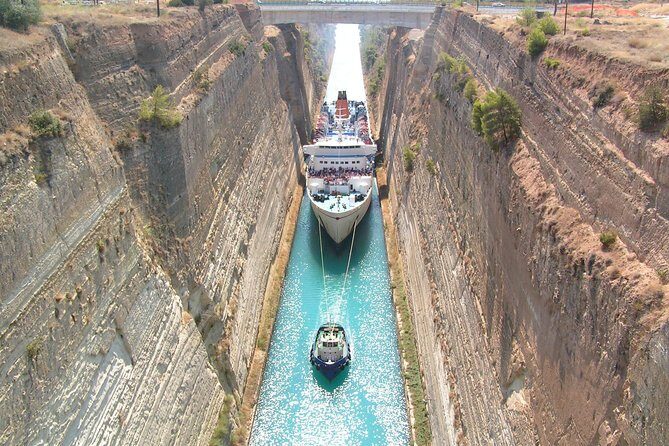
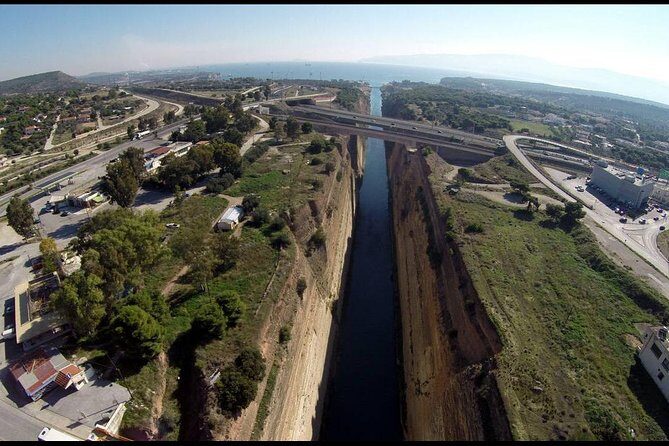
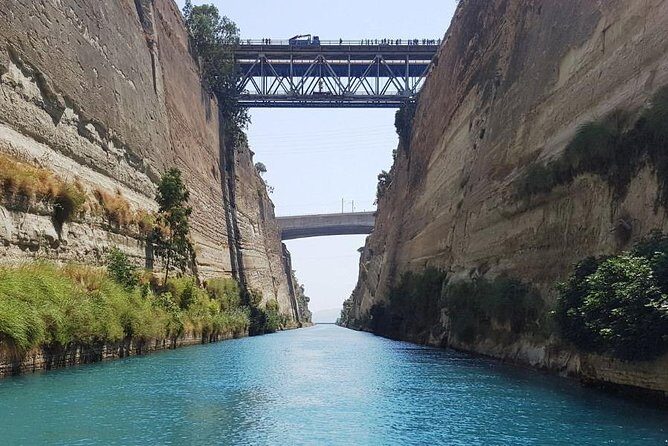
You’ll start at the Isthmus of Corinth, a narrow strip that links central Greece to the Peloponnese. The canal that modernizes this crossing matters here because it’s still the “why” behind the area’s long strategic importance. The canal route connects the Saronic Gulf and the Gulf of Corinth, and it’s about 6 kilometers long.
This stop is short—about 30 minutes—but it’s designed to give you orientation fast. The narrowest point is where the Corinth Canal was built (construction dates 1880–1893). That detail matters because it shows how long people have been looking at this geography and thinking about movement: land routes, sea routes, and control of the chokepoint.
Then you get the ancient layer: a wall built since the end of the 5th century BC, known today through what was preserved into the Byzantine period as the Hexamilion. Even if you don’t memorize the dates, seeing the defensive thinking in the terrain helps. The Isthmus isn’t just scenery; it’s a reason history kept coming back here.
Admission for this stop is listed as free, so you’re not spending your half-day wrestling with ticket lines at the start.
Stop 2: Archaia Korinthos Ruins and the City-State Geography
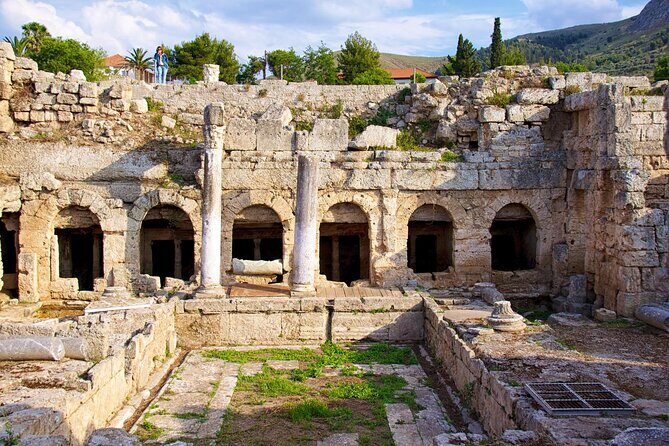
Next comes Ancient Corinth (Archaia Korinthos), the heart of the story. Corinth was a polis on the Isthmus—halfway between Athens and Sparta. That “between” location is a big deal. It meant Corinth lived in the middle of movement and influence, not tucked away from the world.
The modern city is about 5 kilometers northeast of the ancient ruins, which helps you visualize how the present sits above the past. When you stand on the site, it’s easier to picture how people would’ve experienced Corinth as a real place they lived in, traded through, and defended.
What makes this stop feel more than just scenic ruins is the excavation story. Since 1896, the American School of Classical Studies at Athens has done systematic archaeological investigations here. More recently, the Greek Ministry of Culture has brought new details to light. You don’t need to treat that like a trivia lesson, but it supports why the site is still actively interpreted.
This stop runs about 30 minutes and is also listed as free for admission. So you get a solid look at the key ancient area without adding another ticket expense or time-drain early in the day.
Stop 3: Archaeological Museum of Ancient Corinth for the Pieces You Miss Outside
If you only visit ruins, you can still understand Corinth. But you’ll understand it better with the museum. The Archaeological Museum of Ancient Corinth is built in 1932 by the American School of Classical Studies that excavated the area. It’s located at the archaeological site of ancient Korinthos, so it stays tightly connected to what you’re seeing outside.
The museum is where you catch the timeline—from Prehistoric collections through finds tied to the Asklepieion and artifacts spanning Geometric times through the Byzantine period. In a half-day tour, this breadth is a practical win. You’re not losing time to a long detour; you’re compressing a lot of context into one building.
One highlight inside is the mention of the Twin Kouroi from ancient Tenea. That kind of find helps you connect how Corinthian culture sat within broader Greek art and influence.
Plan for 1 hour at the museum. The entry fee is not included, and the data lists €20 per person. Also, the museum has seasonal closures (including specific major dates), so if you’re traveling around those times, it’s smart to double-check your calendar.
Inside the museum, you’ll also find an Atrium, which gives a bit of breathing space if you’ve been walking in sun and heat outside.
- All Day Cruise -3 Islands to Agistri,Moni, Aegina with lunch and drinks included
★ 5.0 · 4,958 reviews



The Temple of Apollo and Corinth’s Sacred Zones (What You See on Site)
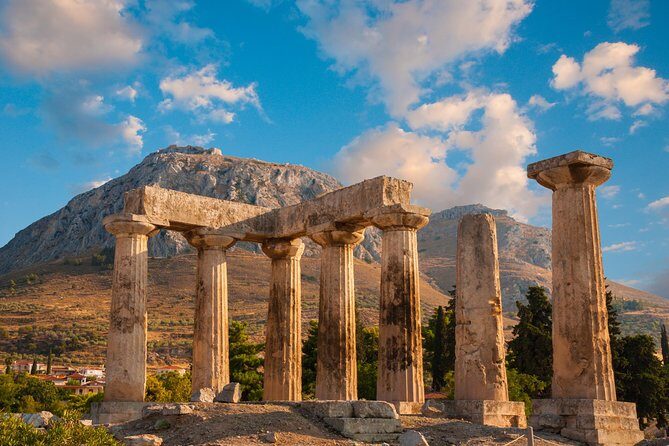
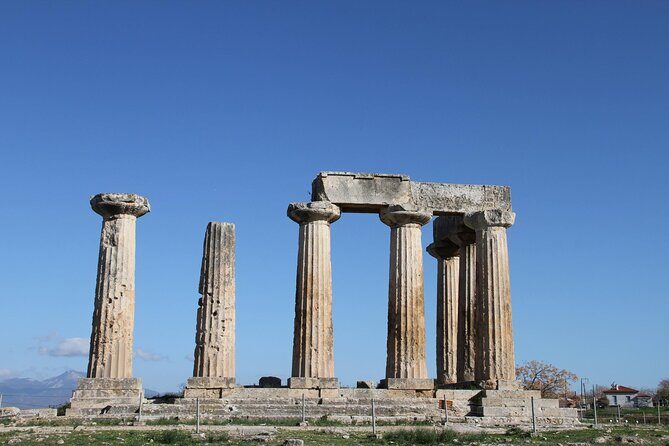
On the site portion, you’ll encounter the Temple of Apollo—a structure with dramatic proportions even when so much is gone. The original temple was built with 40 monolithic Dorian columns, and only seven remain over the ruins of the ancient market area.
The temple dates to between the early 7th and early 6th centuries BC. It was built with a mix of materials—stone, bricks, and wooden beams—and it carried a complex four-pitched roof made of clay tiles. The tour description also notes it was likely a simple construction without external columns in the way you might expect from later temples.
Why this matters on your day: the Temple of Apollo gives you a clear “anchor point” so the later stops on Akrokorinthos don’t feel like they’re jumping randomly between sacred sites. You’ll also see references to major sacred areas such as the Asklepieion (a healing sanctuary), plus the idea of Corinth as a Roman colony—helpful framing when you realize this place kept changing rulers and functions over time.
This part is where you’ll appreciate having a driver who can connect what you see now to what it meant then, especially if you want explanations without turning the whole day into a lecture.
Stop 4: Akrokorinthos Castle Rock and the Marked Apostle Paul Stop
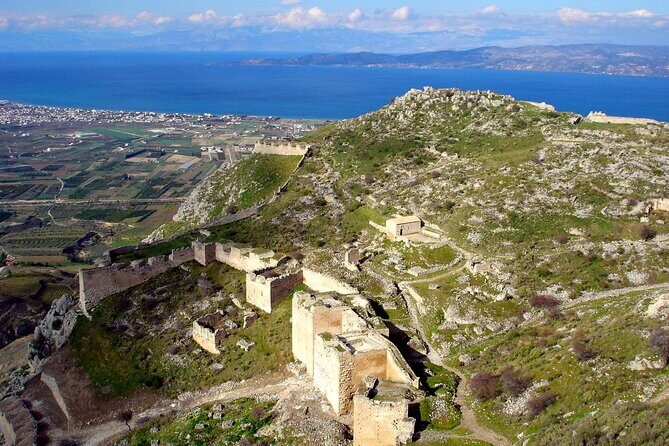
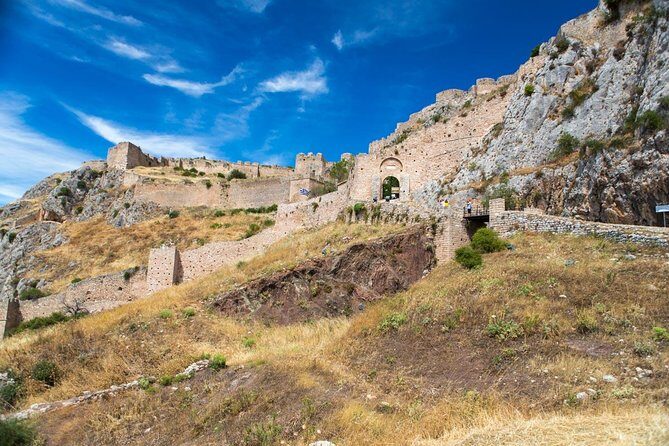
This is the showstopper stop. Akrokorinthos is a steep rock—about 575 meters high. Because of its shape, it was used as a lookout or acropolis in ancient times, especially in the case of a raid coming either from central Greece or by sea.
The view is the point, even if you don’t get lost in details. George Forrest is quoted in the tour description saying it’s the most impressive acropolis of mainland Greece, and the reason is obvious once you’re there: it dominates the area.
You’ll also learn why the fortress kept getting used as a last line of defense. The rock had a secure water supply, which is the difference between a monument and a working stronghold. From Akrokorinthos, it commanded the Isthmus, making it harder for enemies to enter the Peloponnese peninsula.
This stop lasts about 1 hour, and tickets are listed as not included. So if you’re budgeting, treat Akrokorinthos as a likely ticket expense you’ll pay directly when you arrive or through the skip-the-line assistance process.
What you actually walk past includes a long list of named areas and monuments, such as:
- Amphitheater and a theater
- Apostle Paul’s step (the Paul connection point)
- Sanctuary of Asclepius
- Sanctuary of Demeter and Koris
- Fountain Glavki
- Temple of Apollo and the Temple of Octavia
- Early Christian sites including the Basilica of the Skull and Basilica of Lechai
- Pirine and a Conservatory
That’s a lot for one hour, but the private format helps. You can skim the high points if you’re tired, or linger if something grabs you. Either way, Akrokorinthos gives you the best “big picture” of why Corinth mattered.
What You’re Paying For: Value at $204.50 Per Person
At $204.50 per person, this tour isn’t the cheapest way to see Corinth. But it’s also not trying to be. The value is in how much friction it removes and how much comfort you get for a half-day.
Here’s where your money goes:
- Private transportation in an A/C Mercedes
- Hotel/Airbnb pickup and drop-off, plus included pickup/drop-off at Port Piraeus
- WiFi, bottled water, and mobile chargers
- A driver who provides historical context in English
- Skip-the-line ticket assistance, where you cover the ticket cost but the process is eased
The main “price gotcha” is that entrance tickets are not included—and the museum is specifically priced at €20 per person. Also, the driver isn’t licensed to lead inside each museum or site, though they can explain while you travel and observe.
So who is this best for? It’s best for you if:
- You want a calmer day than a group bus outing
- You care about comfort and timing, especially if you’re matching a cruise schedule
- You like the idea of flexible pickup and the ability to linger
- You prefer a conversation-style guide rather than a formal “walk with the historian every step” approach
From the tour feedback, one of the most praised aspects is how drivers like Spyros, Andreas, and Ted balance information with normal human pacing—plus the extra care, like being on time and handling small needs (even a phone charger request). That kind of service is hard to quantify, but you feel it when your day stays smooth.
Who This Tour Fits Best (and When Another Option Might Be Better)
This works well for lots of people, but it’s especially smart for:
- Cruise days and tight schedules, since pickup/drop-off at Port Piraeus is covered
- First-time visitors who want the “Paul theme” without renting a car
- Anyone who doesn’t want to fight ticket lines or coordinate multiple taxis
It can also be a good fit if you want flexibility. Pickup times can be customized, and there’s an option to extend the tour for a fee if you want a longer stay.
On the other hand, consider another option if:
- You want a licensed tour guide inside museums and archaeological sites as standard
- You’re trying to keep costs ultra-low, because site entry fees are on you and the museum is €20
- You have trouble with walking and climbing, since Akrokorinthos is on a steep rock and you’re seeing multiple monumental areas in a short window
A practical tip based on real experience from earlier days: if you travel during the off season, you may get a less crowded feel, which makes it easier to take in details without rushing.
Should You Book This Ancient Corinth Tour?
If you want a smart, comfortable, half-day way to connect Isthmus of Corinth, Archaia Korinthos, a well-rounded museum stop, and the fortress at Akrokorinthos—this is a strong choice. The private setup, hotel/port pickup, and A/C comfort make it feel like your day is under control.
Book it if you:
- Like the idea of a focused Paul-themed route
- Want the convenience of pickup and an air-conditioned vehicle
- Are okay paying site ticket costs (especially the museum)
Skip it or adjust your expectations if you need a licensed guide at every site. In that case, you’ll want to arrange that option in advance where available.
If you’re looking for a day that feels both practical and meaningful—this is the kind of route that helps you see Corinth as a real place, not just a name on a map.
FAQ
What language is the tour offered in?
The tour is offered in English.
How long is the Ancient Corinth tour?
The duration is about 4 to 5 hours.
Is hotel or port pickup included?
Yes. Hotel/Airbnb/Port Piraeus pickup and drop-off are included without extra charge. Pickup/drop-off at Rafina Port or Laurio Port has an additional charge.
Are entrance tickets included in the price?
Tickets are not included. The Archaeological Museum of Ancient Corinth is specifically listed as not included, with an entrance fee of €20 per person.
Is the driver a licensed tour guide inside museums?
No. The driver speaks English and has historical knowledge, but they are not licensed to accompany you in any site. A licensed tour guide can be requested depending on availability.
Can I cancel for a full refund?
Yes. You can cancel up to 24 hours in advance for a full refund. If you cancel less than 24 hours before the start time, the amount paid is not refunded.



More Tours in Athens

More Tour Reviews in Athens
- All Day Cruise -3 Islands to Agistri,Moni, Aegina with lunch and drinks included
★ 5.0 · 4,958 reviews