REVIEW · ATHENS
Visit Delphi the famous oracle! Explore the mysteries of the ancient world!
Book on Viator →Operated by Athens Tours Greece · Bookable on Viator
Delphi feels like a living classroom. This private shore excursion strings together Delphi’s oracle world with a scenic drive through central Greece, plus an easy lunch stop near Arachova before you settle into the archaeological site at your own pace.
I especially love how much time you get at Delphi itself, and how the day mixes myth and real ruins with a thoughtful human-history moment on the road. One thing to plan for: entrance fees and the museum are extra, and the driver guide accompanies you up to the site so you won’t automatically have a licensed guide inside every building.
In This Review
- Key things I’d plan for before you go
- The big idea: Delphi plus real logistics that work
- From Piraeus to Delphi: the Roúmeli road trip vibe
- Arachova: lunch near Mt. Parnassos, not just a quick photo stop
- The Delphi archaeological site: where the oracle story becomes walkable
- Temple of Apollo: what you’re looking at and why it mattered
- Delphi Museum: why your ticket brain should include it
- Tholos of Athena Pronaia: the circular stop that surprises people
- Karakolithos memorial: a necessary reminder on the route
- Modern Delphi town: where you can pause after the ruins
- Price and value for a private group up to 3
- A practical day-of checklist (so you don’t lose time)
- Who should book this Delphi Oracle shore excursion?
- Should you book it?
- FAQ
- How long is the Delphi shore excursion?
- Does the price include pickup and transport from Athens and the cruise port?
- Are entrance fees and the museum included?
- Is this tour private?
- Will the guide walk with me inside museums and archaeological sites?
- Can I cancel and get a full refund?
Key things I’d plan for before you go
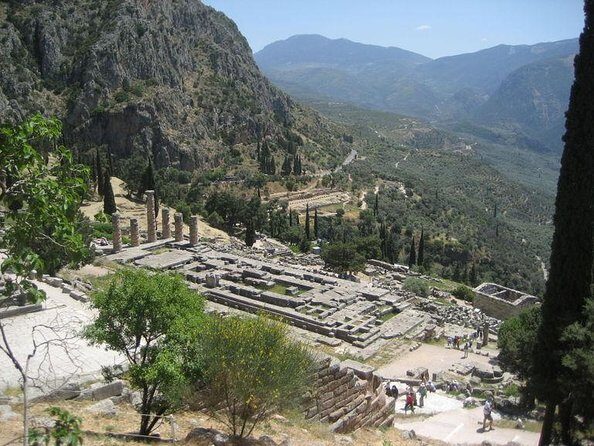
- Ample Delphi time: enough breathing room to wander the ruins and landmarks without feeling rushed
- UNESCO Delphi visit focus: you’re there for the Pan-Hellenic sanctuary and the Apollo-centered complex
- Arachova area lunch break: a chance to eat locally near Mt. Parnassos before the main event
- Karakolithos memorial stop: a short, heavy history pause tied to April 25, 1944
- Delphi Archaeological Museum add-on time: great for connecting sculptures and objects to what you see outside
- Small group setup: private for your group up to 3, with pickup and a cruise-port shuttle
The big idea: Delphi plus real logistics that work
A Delphi day can go two ways. Either you cram in the highlights and sprint around, or you actually see how the place is laid out and why it mattered. This experience is built for the second option, with a long enough stretch at the archaeological zone that you can follow the story in layers: sanctuary, temple area, museum context, then time in the modern village area afterward.
The “private shore excursion” part matters more than it sounds. You’re not relying on public schedules or guessing your way out of Athens. You’re met at the Piraeus port, transported in an air-conditioned vehicle, and returned the same way, so the day feels controlled even when cruise timing gets tight.
The day also earns points for balance. Yes, you’re chasing the famous Oracle of Delphi and the myth of the navel of the world. You also stop at Karakolithos, remembering events linked to ELAS resistance actions and German executions in 1944—brief, but important, and handled as a stop rather than an afterthought.
You can also read our reviews of more tours and experiences in Athens.


From Piraeus to Delphi: the Roúmeli road trip vibe
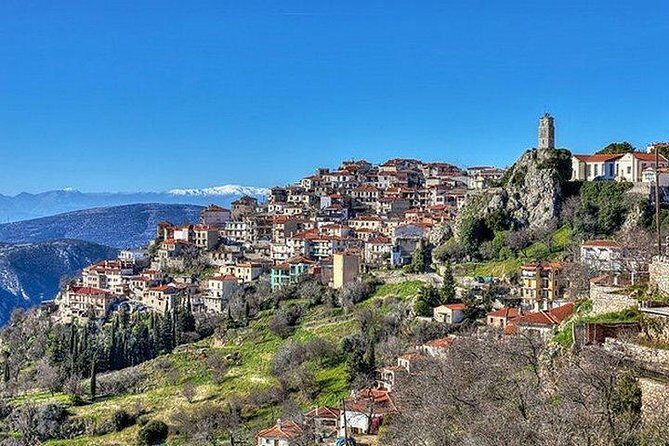
You start the day out of Athens at Piraeus Port, then ride northwest through mainland Greece. The route passes through central Greece regions and towns like Thiva (Thebes), Livadia (Levadia), and Arachova. The drive itself gives you a “view of place” feeling—mountain towns show up along the way, and you get that shift from city rhythm into countryside pace.
There’s a practical reason I like this kind of routing. Delphi sits in a steep, mountainous area at the foot of Mount Parnassos, so you’re not just traveling to a point on a map. You’re traveling into the same setting that shaped ancient movement and pilgrimage—people didn’t show up by car and smartphone. They made a day of it.
Also, the group size is small (up to 3), so you’re not stuck playing calendar Tetris with a large crowd. If you want to stretch your legs at a stop, you can do it without waiting for ten different plans to settle.
Arachova: lunch near Mt. Parnassos, not just a quick photo stop

One of the best ways to make a long day feel human is to include a real meal break, and this trip does. You get a traditional Greek lunch near Arachova, a mountainous village at the foot of Mt. Parnassos. It’s described as a winter favorite for ski lovers and celebrities, and a popular escape for Athenians—so even if you’re not there in peak season, you still feel the “mountain hub” energy.
What you should know: lunch isn’t included, but the stop is built in so you can eat without scrambling. If you like having a plan, this is nicer than the usual “grab something whenever you see it” approach.
Consider what you’ll wear on this part of the day. Delphi is outdoors and often cooler at elevation. Arachova area stops can also mean more walking than you expect if you wander for one extra viewpoint before lunch.
The Delphi archaeological site: where the oracle story becomes walkable
Once you reach Delphi, the focus stays on the ancient sanctuary complex. Delphi is presented as the most famous oracle of ancient Greece, a Pan-Hellenic sanctuary regarded as the center of the world. The myth angle is part of the experience you’ll carry as you walk—especially the idea that the sacred “navel of the earth” symbolism comes from Zeus sending out eagles from the ends of the universe to meet here.
You’ll also hear the foundational storyline used to explain why this place was sacred. It starts with the site being linked to Mother Earth and the serpent Python guarded there, then moves to Apollo’s sanctuary being built here and the cult of divination tied to that setting. You don’t need to be a classics expert. Even if you’re more of a “show me how it feels” traveler, the ruins give you the structure for the myths.
The experience is also designed so you’re not only staring at stones. You have time to explore the town area and the site’s key zones at your own pace. That matters because Delphi is spread out. If someone tries to run you through everything in one long line, you miss the slow way it rewards attention.
Temple of Apollo: what you’re looking at and why it mattered
The Temple of Apollo dominates the sanctuary area, and this is the heart you’ll keep circling back to—positioned in the central spot of the temenos. This was where statues and offerings were kept, and where cult rituals including divination took place.
You’ll also be pointed toward the idea of the chresmographeion, described as an archive connected with lists of victors of the Pythian games, and you’ll notice how the site’s layout keeps bringing you back to Apollo’s zone.
A helpful mindset: think of Delphi as a set of connected “use cases.” People didn’t just come to look. They came to participate in a religious system, and the architecture helped structure that participation—rituals, offerings, and the idea that divine messages flowed through this space.
- All Day Cruise -3 Islands to Agistri,Moni, Aegina with lunch and drinks included
★ 5.0 · 4,958 reviews



Delphi Museum: why your ticket brain should include it
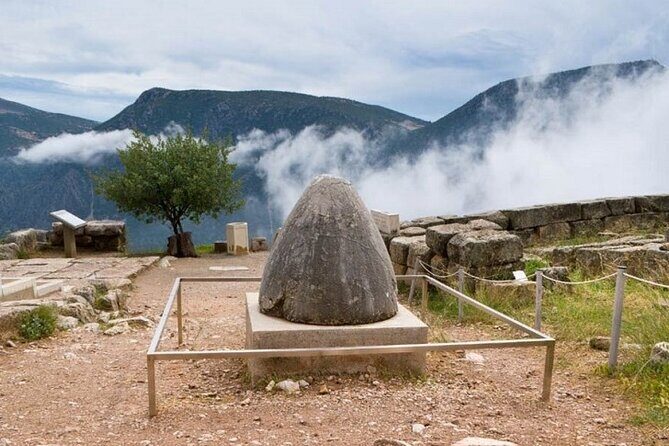
At some point, the Delphi story clicks harder in the museum. The Archaeological Museum of Delphi is described as one of the most important museums in Greece, covering the history of the Delphic sanctuary from the early eighth century BC through decline in Late Antiquity.
What makes this museum useful after walking the ruins is that it’s not only big objects. It’s a place for architectural sculptures, statues, and smaller finds donated to the sanctuary that reflect religious, political, and artistic activities. You can see how what you stood near outdoors relates to what the sanctuary collected and displayed.
The museum’s layout and scale are also outlined in the information you’re given: it’s a two-story building with fourteen exhibition rooms, plus storerooms and conservation labs. You’ll also find a new lobby, cafeteria, and gift shop from refurbishment. Translation: it’s set up for an actual visit, not just a “quick look and leave” stop.
Budget note: the museum entrance is not included, so bring a bit of cash or be ready to handle ticketing in advance. The experience provider even suggests pre-purchasing because availability can be tight.
Tholos of Athena Pronaia: the circular stop that surprises people
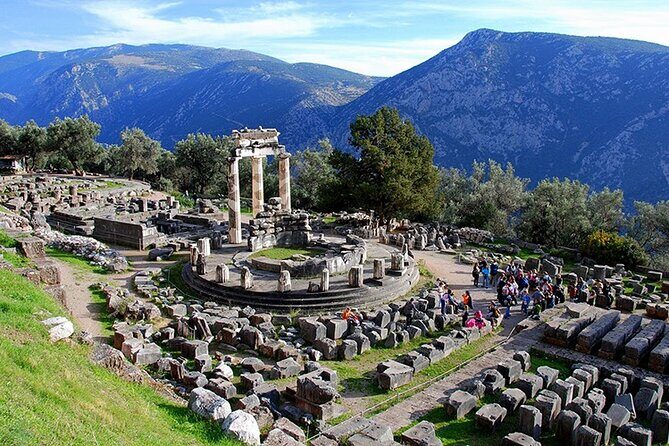
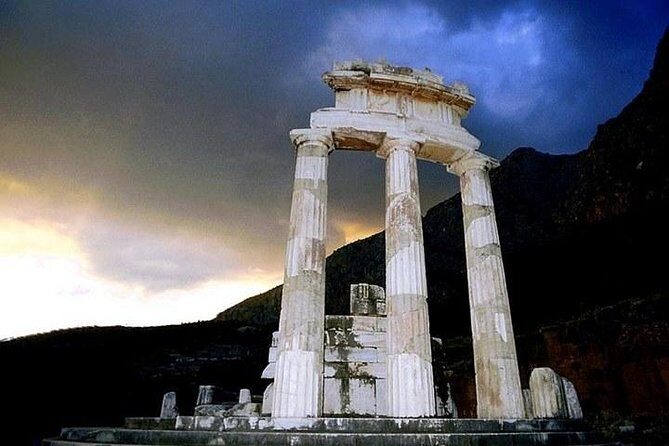
If you love that moment when a site reveals something unusual, don’t skip the Tholos of Athena Pronaia stop. It’s described as perhaps the most characteristic monument at Delphi, clearly visible from above, and an important building in the sanctuary of Athena Pronaia.
This structure is circular, called a tholos, and it’s framed as a masterpiece of Classical architecture. You’re also told it may connect with “chthonic cults,” while Pausanias didn’t refer to it as a temple in the second century AD. That kind of uncertainty is part of archaeology’s charm: sometimes the ruins leave room for interpretation.
The building is also dated in the supplied description to 380 BC, and connected to plans by an architect named Theodoros of Phocea/Phocis, mentioned as having written a book about building methods. Even if you don’t care about dates, the circular architecture is the kind of detail that helps Delphi feel real, not like a one-note museum display.
Karakolithos memorial: a necessary reminder on the route
Between the bright promise of Delphi myths and the calm of mountain towns, the day includes a short stop at Karakolithos (Mnimio Pesonton). The story is tied to April 25, 1944, when ELAS partisans managed to capture German officers on the road connecting Livadia with Distomo.
Then comes the brutal turn. The ELAS men sent a letter demanding release of Greek prisoners. The response was execution: within hours, Nazi forces transported 136 Greek prisoners, mostly in their 20s, and executed them at Karakolithos.
This isn’t a long detour, but it’s heavy. If your trip style is “I want meaning, not just sights,” you’ll likely appreciate that the tour includes it as a visible, specific memorial—not a vague mention.
Modern Delphi town: where you can pause after the ruins
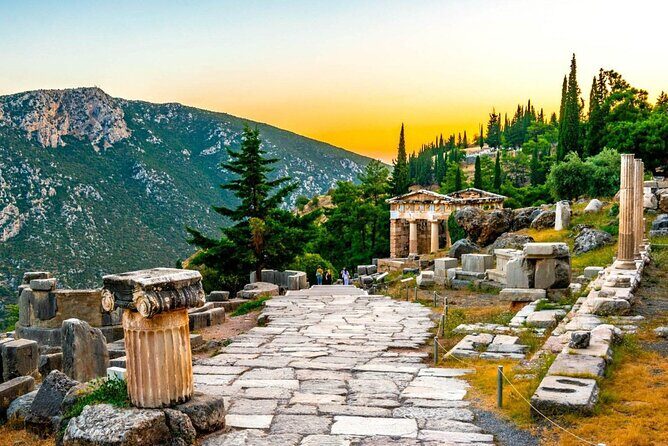
After the archaeological site, you also get time in the modern village of Delphi. The information describes optional local dining with views over Itea and the Ionian Sea, set near an olive grove. Even if you don’t stay for a long sit-down, the area is positioned at the foot of Mt. Parnassus near Arachova, so it makes sense as a decompression point.
This is also where the trip’s “own pace” structure becomes real. You’re not forced to keep moving the second you finish the ruins. If you want a calm walk, a drink, or to just let the site settle in your head, this is the slot to do it.
Price and value for a private group up to 3
The price is $497.43 per group (up to 3) for about 8 hours. That’s the biggest value argument on this trip: you’re paying for a private day with pickup and drop-off from hotel in Athens and Piraeus port transfers, plus transport in an air-conditioned vehicle and a professional English-speaking driver/guide for the program until you enter sites.
Now, the honest part: entrance fees and museum entry are not included, and lunch and drinks aren’t included. So the real cost is the base price plus those add-ons.
Still, for many small groups, this works out well because you’re buying convenience and time savings. You’re not hunting buses. You’re not negotiating taxis for a long drive. You’re also getting guidance that helps you understand what you’re seeing before you start wandering on your own.
If you’re traveling solo or as a couple, the “up to 3” structure can feel pricey per person. If you can share the group price, it becomes a lot more sensible.
A practical day-of checklist (so you don’t lose time)
A few small things make this type of day smoother:
- Tickets: the information suggests pre-purchasing admission tickets because availability may be limited. If you forget, the provider says tickets can be bought in advance with a small service fee.
- Dress code: it lists a formal dress code. I’d treat this as “dress a bit more neatly than beach casual,” especially if you’re coming from a cruise setting.
- Walking comfort: you should have moderate physical fitness. Delphi’s terrain is outdoors and uneven in places.
- What the guide can do: you’ll have the driver/guide for explanation up to the point you enter sites and museums. The driver isn’t licensed to accompany you inside. If you want a licensed state tour guide inside, it’s offered for an extra cost depending on availability.
- Bring layers: Delphi and the mountain route can feel different from Athens, especially around spring or fall. If the day is drizzly, you’ll appreciate having a jacket even if you think you won’t need it.
Who should book this Delphi Oracle shore excursion?
I’d book this if you want a day that feels organized but not rushed, with serious time at Delphi and enough flexibility to wander. It’s especially good for couples or families of up to three who prefer private logistics over group tours.
You’ll also appreciate the stop mix if you like variety: myth and sanctuary space at Delphi, archaeology in the museum, a mountain village lunch near Arachova, and a grounded historical memorial stop at Karakolithos.
If you’re the type who wants every minute guided inside museums and every step explained by a licensed state guide, you may want to plan for the extra option for indoor guiding.
Should you book it?
Yes, if your goal is Delphi done properly rather than checked off quickly. The combination of transport from Piraeus, small-group private setup, and time at the Delphi archaeological site plus museum options makes this a strong value for a cruise day. It also gets high marks for the on-the-road experience—good pacing, professional service, and the kind of planning that keeps the day from turning stressful.
Skip it only if you hate paying extra for entrances and museum entry, or if you need a licensed guide inside every space without any additional cost. For most people, though, this is a smart way to see the Oracle of Delphi while still enjoying the journey there.
FAQ
How long is the Delphi shore excursion?
The tour runs about 8 hours.
Does the price include pickup and transport from Athens and the cruise port?
Yes. Hotel pickup and drop-off in Athens are included, along with Piraeus port pick-up and drop-off, plus transport by air-conditioned vehicle.
Are entrance fees and the museum included?
No. Entrance fees to the archaeological sites and the Delphi Archaeological Museum are not included.
Is this tour private?
Yes. It’s private, and only your group participates (up to 3 people).
Will the guide walk with me inside museums and archaeological sites?
You will have a professional English-speaking driver/guide for the program according to the schedule until you enter the archaeological sites and museums. Drivers are not licensed to accompany you inside those places. A licensed state tour guide inside can be arranged for an extra cost, subject to availability.
Can I cancel and get a full refund?
Yes. You can cancel up to 24 hours in advance for a full refund.


More Tour Reviews in Athens
- All Day Cruise -3 Islands to Agistri,Moni, Aegina with lunch and drinks included
★ 5.0 · 4,958 reviews