REVIEW · ATHENS
Ancient Agora and Acropolis Private Tour with Licensed Expert
Book on Viator →Operated by WARMPENGUIN · Bookable on Viator
Two UNESCO sites in one tight plan.
This private tour is designed for people who want the highlights without getting stuck in the usual crowd shuffle. You’ll hit the Acropolis first, then shift down to the Ancient Agora, all with a licensed expert meeting you at a super-practical spot near the Acropolis Museum. It’s built for an efficient visit in about 3 hours, and it’s offered in English with a mobile ticket.
I especially like the pacing and focus. The Acropolis portion is aimed at the big names you came for, including the Parthenon area and the Theater of Dionysus, plus key stops like the Propylaea gateway and the Erechtheion. I also like that the tour is built for interaction, not just listening, with a whisper communication system if you’re in a larger party.
One consideration: there’s some walking between the Acropolis area and the Agora, so this isn’t suitable for reduced mobility.
In This Review
- Key highlights to expect on this Acropolis + Agora private tour
- Private Athens Classics: Why this Acropolis + Agora combo works in 3 hours
- Meeting at Acropoli Metro (7 Makrygianni Street) and getting oriented fast
- Acropolis highlights in a tight route: Parthenon area, Propylaea, Athena Nike, and more
- Don’t skip New Acropolis Museum time: original artifacts with the myths attached
- Ancient Agora: trading life, workshops, and a temple you can still read
- Price and value: how $185.86 makes sense when admission is separate
- Pacing, questions, and the whisper communication setup
- What this tour is like for different traveler types
- Should you book this Acropolis and Ancient Agora private tour?
Key highlights to expect on this Acropolis + Agora private tour
- Licensed expert guide meeting at the Acropoli Metro station (street level, near 7 Makrygianni Street and the Acropolis Museum)
- Acropolis highlights packed into one flow, including Parthenon area, Propylaea gateway, and major temple stops
- The Theater of Dionysus as an early stop, tied to the world’s oldest known theater setting and major Greek drama history
- New Acropolis Museum time so you see originals and context, not only views and ruins
- Ancient Agora centerpiece with a commerce-and-workshops feel and a standout preserved temple structure
- Private format so you can go at your pace and ask questions during the whole route
Private Athens Classics: Why this Acropolis + Agora combo works in 3 hours
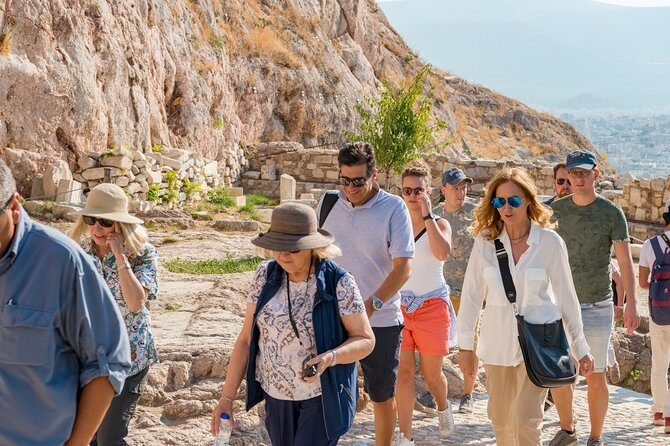
If you only have half a day in Athens, this kind of tour plan makes sense. You’re not trying to do everything on your own, and you’re not spending your time waiting for other people to finally find their shoes.
What I like about pairing these two sites is the way they connect. The Acropolis gives you the public face of classical Athens: temples, ceremony, and the sense of power. The Ancient Agora gives you the daily engine underneath that power: markets, workshops, and the places where civic life actually happened.
The “private” part matters here. On a normal group tour, you end up following someone else’s stop list and photo plan. Here, the route is still efficient, but the guide can slow down when you stop to notice something, or move you along when the route gets crowded.
You can also read our reviews of more private tours in Athens


Meeting at Acropoli Metro (7 Makrygianni Street) and getting oriented fast
The meeting point is one of the smartest parts of the experience. Your guide waits at the Acropoli Metro station at street level, at 7 Makrygianni Street, close to the Acropolis Museum. That’s helpful because it gets you onto the right side of the hill early, with an easy landmark to find.
Before you even climb, the plan includes a quick intro from this area. You’ll get a perspective on the surrounding wall of the Acropolis, built by the earlier Mycenean civilization, plus an overview of why the Acropolis mattered so much in ancient Greek life. That short orientation is not filler. It makes the first temple views click faster because you’re not guessing what you’re looking at.
Practical tip: aim to arrive a few minutes early. Metro stairs and street crossings can take longer than you think, especially if you’re wearing shoes you regret.
Acropolis highlights in a tight route: Parthenon area, Propylaea, Athena Nike, and more

The Acropolis portion is structured to show you the most important stops without sending you in circles. Expect about 80 minutes dedicated to Acropolis sights and associated temples, theaters, and buildings.
You typically start with a major landmark that many people miss when they rush: the Theater of Dionysus. Built in the 4th and 5th century BC in a natural amphitheater on the slopes of the Acropolis, it’s considered the world’s oldest. The scale is mind-bending: it could hold around 25,000 people. This is the kind of detail that turns ruins into something you can picture—especially if you remember that many famous Greek plays premiered in settings like this.
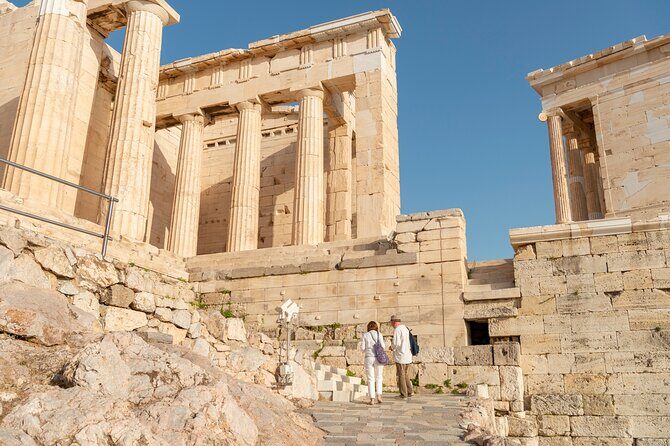
From there, you ascend toward the monumental gateway, the Propylaea. This is the formal entrance route that frames how visitors would have approached the sacred space. As the temples start to appear, the guide will also talk about a dramatic legendary image: the enormous bronze statue of the goddess Athena, whose spear tip was said to be visible to incoming ships in sunlight. Even if you treat it as legend, it tells you how the Greeks wanted the Acropolis to communicate from far away.
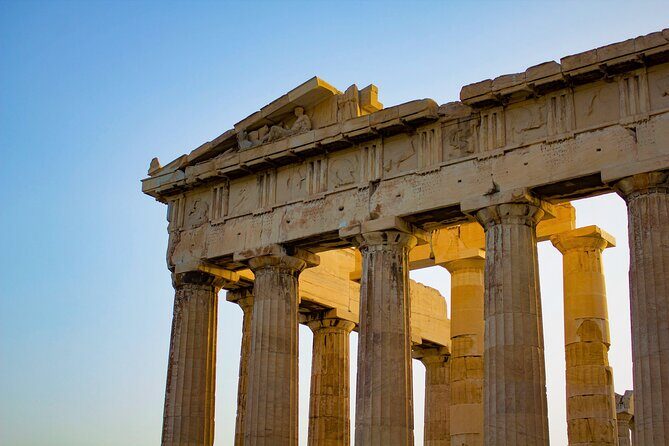
Then comes the temple sequence that anchors the classical “great age” feeling. You’ll see the Temple of Athena Nike, described as a classical Ionic temple dedicated to Athena and positioned to overlook the city. Next is a slower moment at the Parthenon area—framed as the pinnacle of the Golden Age—where you’ll get context on construction, mythology, and why it mattered for ceremony and worship.
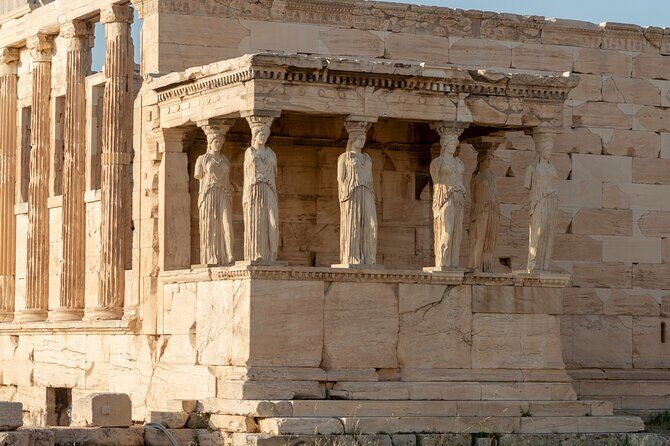
You also stop at the Erechtheion, the second major temple noted on the route. It’s dedicated to both Zeus and the goddess Athens, and the guide points out mythology and major aspects you can see in the statues and details. The plan also includes the Odeon of Herodes Atticus, a marble amphitheater built in AD 161 in memory of his wife, and still used as a working theater today.
Even if you already know the names, what makes this work is the flow. The guide connects what you’re looking at to what it was for: entrances, worship, public performance, and civic symbolism. That connection is what helps the Acropolis feel less like a checklist.
Don’t skip New Acropolis Museum time: original artifacts with the myths attached
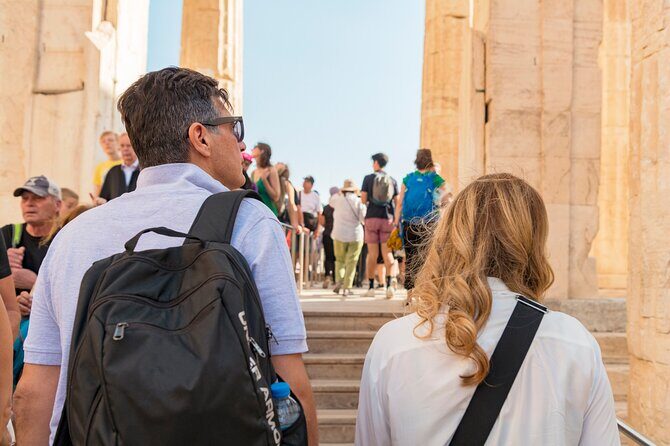
After the Acropolis sights, the route includes the New Acropolis Museum. The itinerary lists about 80 minutes for the museum portion, but remember this tour is still about 3 hours total. In other words, your museum time is likely to be selective rather than a full read-every-gallery visit.
Still, even a focused pass can be a big upgrade over only seeing ruins outdoors. The museum houses original masterpieces, plus models, videos, and interactive installations. The guide highlights the most significant pieces and ties them to the stories of myth and legend behind them.
Why that matters: a temple fragment sitting in an outdoor spot can be hard to interpret. Inside the museum, you can connect scale, original placement, and the themes those objects carried. It’s one of the reasons this combo tour is popular with people who want meaning, not just photos.
Practical advice: wear a layer. Athens can be warm outside and cool inside, and you’ll walk in and out of air-conditioned spaces.
Ancient Agora: trading life, workshops, and a temple you can still read
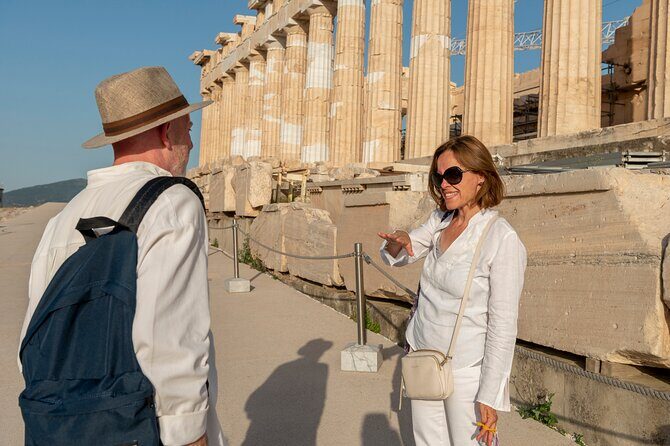
The Agora stop is about 80 minutes, and it’s a shift in pace in the best way. At the base of the Acropolis, the Ancient Agora served as the marketplace and center of life for ancient Greeks. Think commerce, civic business, and local workshops—not just monuments.
The experience includes a recreation of an ancient center of commerce, showing the kinds of traders and activity that would have taken place. It’s paired with a look at an on-site museum housing artifacts uncovered from the area. That museum context helps you move beyond “columns in a field” into something more specific.
One standout detail: the tour notes the most complete remaining temple of Greek antiquity. Even if you don’t catch the exact historical nickname, it’s the kind of structure that feels sturdier and more legible than many other ruins. You can actually follow what’s left and why it’s still meaningful.
The main value here is that the Agora adds the everyday layer to the Athens you’re seeing. The Acropolis is the ceremonial high point. The Agora is the working heart.
- All Day Cruise -3 Islands to Agistri,Moni, Aegina with lunch and drinks included
★ 5.0 · 4,958 reviews





Price and value: how $185.86 makes sense when admission is separate
At $185.86 per person for a private 3-hour tour, the price looks high on paper—until you break down what you get.
First, you’re paying for a licensed expert guide and a private format, not just a ticket and an audio app. Second, the tour aims to cover two UNESCO sites plus museum context in one single block of time. For many visitors, that time-saving is the real value.
That said, admissions are not included. Archaeological site entrance tickets and their costs are listed as not included, and the tour operator may help organize hassle-free tickets after booking at extra cost. The important part for your planning: tickets can sell out weeks or even days in advance, and you’ll need a specific date and time slot if you want smooth entry.
If you hate logistical friction, this tour’s ticket support can be worth it. Just be sure you respond to the message asking if you want them to purchase skip-the-line tickets, and double-check you’re confirmed for the right time.
Pacing, questions, and the whisper communication setup
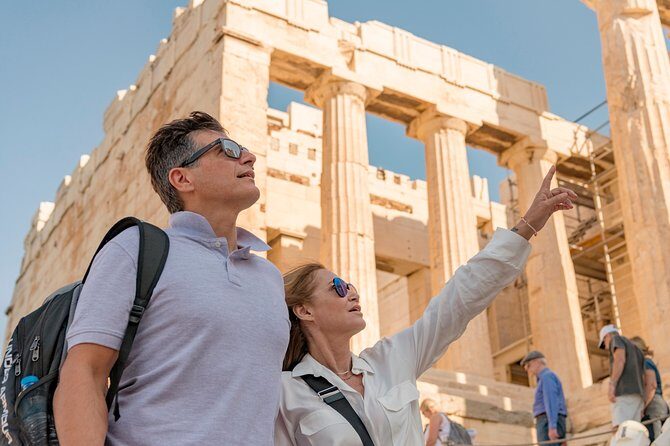
This is the kind of tour where pacing matters, because Athens can overwhelm you fast. The Acropolis hills create physical effort, and the major sites attract crowds, which can turn a “quick look” into a slow shuffle if you’re on your own.
The private format helps, and so does the communication system. A whisper communication system is included for groups of 6 or more, which keeps the guide’s instructions clear without constant shouting. Even if you’re a small group, the idea is the same: fewer delays, more information per minute.
Based on guide styles connected to past departures, the tour is praised for being interactive, with guides who answer lots of questions and make room for photos. Names that have shown up in standout guides include Mandio, Manto, Shorty, and Vicky. You can’t guarantee which guide you’ll get, but it does suggest the experience is built around lively explanations and real back-and-forth.
What this tour is like for different traveler types
This tour is a good match if you want structure without feeling boxed in.
I’d especially recommend it for:
- First-timers who want the big Acropolis names plus the Agora’s daily-life angle
- Couples and small groups who prefer a shared conversation over headsets
- Families with kids who do better with guided pacing and frequent question breaks
- People who want to avoid wasting a half day figuring out entrances, routes, and what to prioritize
I’d think twice if:
- You need low-walking access. The tour specifically notes there’s walking between the Acropolis and the Agora and it is not suitable for reduced mobility.
- You want a slow museum-only day. This is built to cover a lot in a short window.
Should you book this Acropolis and Ancient Agora private tour?
I’d book it if you want the smartest use of limited time in Athens. The combination of Acropolis highlights plus Ancient Agora context, with the New Acropolis Museum added to connect ruins to real artifacts, is a strong use of 3 hours. The meeting point is clear, the route is compact, and the guide format is designed for interaction.
I’d skip it or switch to another plan if walking access is a problem for you, because the tour relies on movement between sites. Also, plan your entrance tickets early since admission is not included and timed entry matters.
If your goal is to leave Athens feeling like you understood what you saw—temples, theaters, daily life, and the stories behind them—this private setup is a solid bet.


More Private Tours in Athens


More Tours in Athens

More Tour Reviews in Athens
- All Day Cruise -3 Islands to Agistri,Moni, Aegina with lunch and drinks included
★ 5.0 · 4,958 reviews