REVIEW · ATHENS
Ancient Corinth Half Day Tour
Book on Viator →Operated by H.P.Tours - Hellenic Private Tours · Bookable on Viator
Corinth hits fast, in the best way. This is a four-stop day that trades endless driving for Corinth Canal and Acrocorinth in a tight Athens schedule. You’ll see how this region shaped ancient shipping, trade, worship, and power, all without losing half your day to transfers.
I also love how easy the logistics feel: private pickup and drop-off, plus WiFi and bottled water in an air-conditioned car. Even if your time is limited, you’re not stuck negotiating public transport or waiting around.
One thing to keep in mind: entrance costs and site rules are partially on you. The driver can explain the monuments, but a licensed English tour guide inside the sites is optional (extra cost), and there’s an entrance fee for Ancient Corinth.
In This Review
- Quick hits before you go
- A 5-hour Corinth plan that fits real life
- Corinth Canal: the cut that solved a shipping headache
- Ancient Corinth: Temple of Apollo, the Agora, and Roman street theater
- Acrocorinth: medieval fortress views from a monolithic rock
- Kechries port remains: trade routes and Apostle Paul’s arrival
- Private transport value: what you actually get in the car
- Price check: $363.71 per group up to 2 is a real calculation
- Who this Ancient Corinth half-day tour suits best
- Should you book it?
- FAQ
- How long is the Ancient Corinth half-day tour?
- What’s included in the tour price?
- Are entrance tickets included?
- Do I need a licensed guide to visit the sites?
- Where do pickups happen for this tour?
- Is this tour private?
- Can I cancel for free?
Quick hits before you go
- Four stops, one streamlined route: canal, ancient city, hilltop fortress, then Kechries port.
- Private by design: up to 2 people in your own group with no strangers added.
- Air-conditioned transport plus WiFi: long day comfort sorted from the start.
- Driver narration, not site guiding: helpful context en route, with optional licensed guiding for the ruins.
- A mix of time periods: shipping engineering, classical temples, Roman streets, and medieval fortifications.
A 5-hour Corinth plan that fits real life
You’re looking at about 5 hours total, and it’s built for visitors who want major highlights without turning the day into a marathon. The day moves in a logical sequence: first you cross into the Isthmus area with the canal, then you work your way through Ancient Corinth and its setting, finish with the big fortress viewpoint at Acrocorinth, and then slide over to what’s left of the port at Kechries after lunch.
Because it’s private transportation, the pacing can work better than a larger group tour. You can take a beat when a view hits, or slow down when you want to read a bit more. The tradeoff is that the whole day stays “efficient,” so you won’t have hours to wander every corner of the ruins.
You can also read our reviews of more tours and experiences in Athens.
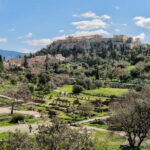


Corinth Canal: the cut that solved a shipping headache
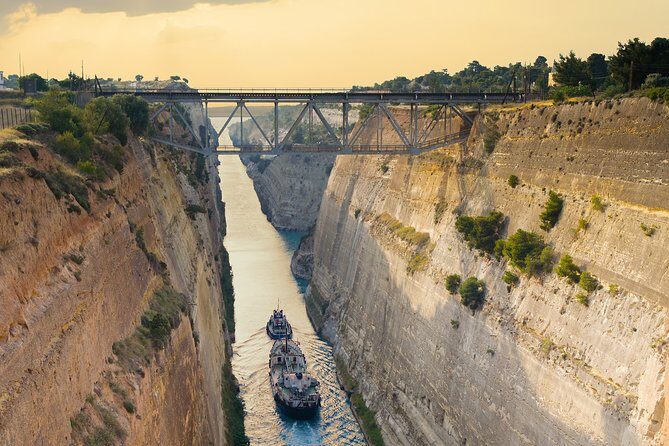
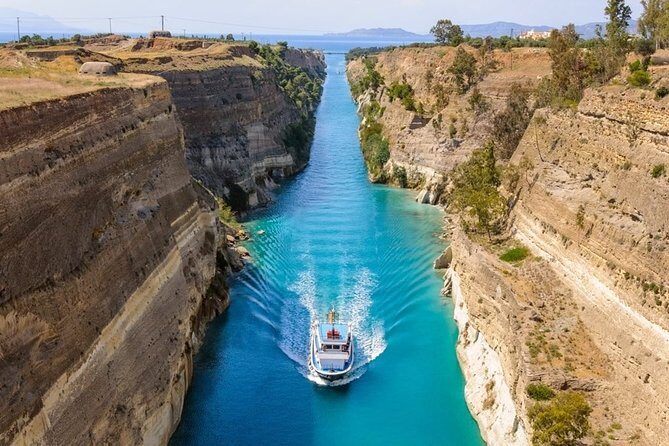
Your first stop is the Corinth Canal area, reached by about a 45-mile drive. You get around 20 minutes, and the timing is short on purpose. Think of it as orientation + wow-factor: you’ll see the famous narrow waterway connecting the Saronic Sea and the Corinthian Sea, with the Isthmus acting like the hinge between regions.
What makes the canal interesting is that the idea was around for centuries before it became real. The concept is described as a “2000-year-old dream,” because ships that wanted to move between the Aegean side and the Adriatic direction previously had to sail around the Peloponnese, adding roughly 185 nautical miles to the trip. In the background, you’ll hear about:
- Periander (602 BC): he’s linked with the earliest dream of digging the canal, plus the diolkós, a stone road where ships could be hauled on wheeled platforms.
- Nero (67 AD): he attempted construction with a huge slave workforce, but he was murdered before the plans were finished.
- Late 19th century completion: the actual canal work finally concluded much later, once the technology caught up.
When you’re there, don’t rush the moment. Even in a brief stop, I’d focus on the scale and the geometry—this canal is basically a shortcut made visible, and that’s the point.
Ancient Corinth: Temple of Apollo, the Agora, and Roman street theater
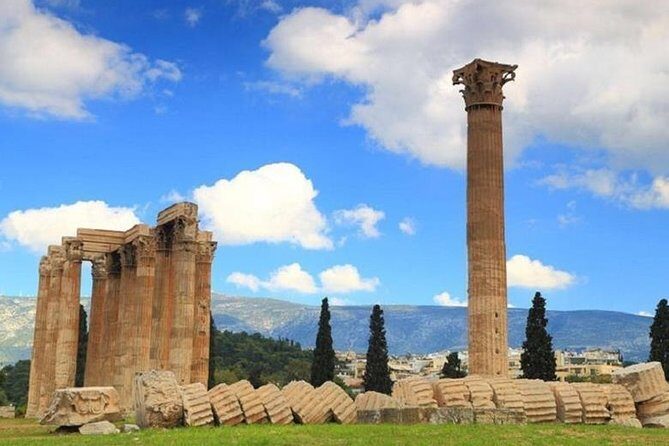
This is the main stop, with about 1 hour at the archaeological site. The entrance fee for Ancient Corinth is listed as €15.00 per person, and it’s not included in the tour price.
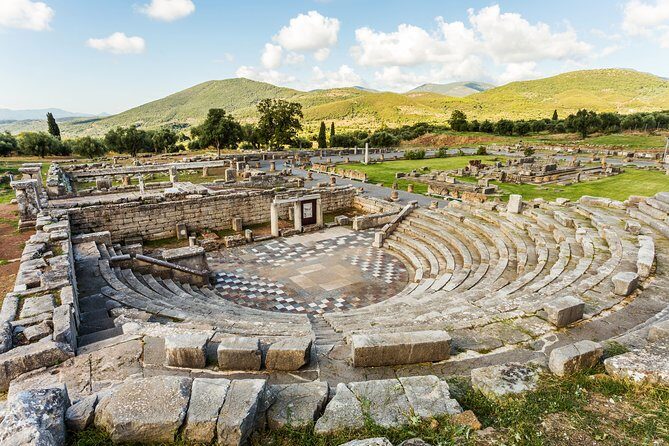
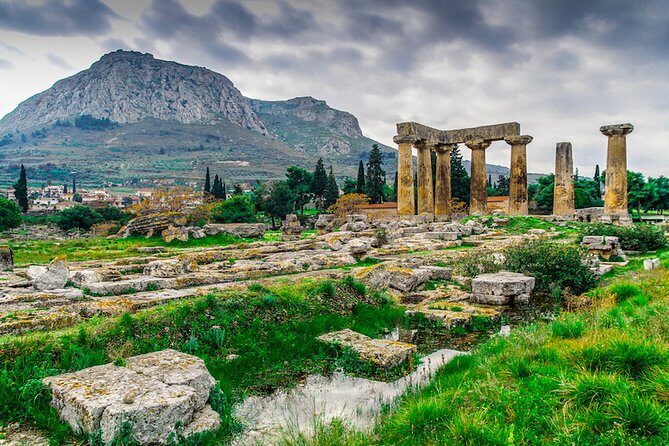
The ruins here feel big, even with limited excavated areas. The standout anchor is the Temple of Apollo, built in the middle of the 6th century BCE. What I like about this temple is the engineering detail: it’s known for monolithic columns instead of the more common stacked drums. Seven columns remain standing today, so you get a strong visual sense of what the structure tried to be.
From there, the site opens into a layered walk through different eras:
- The Agora (market and civic center): the ruins include a large public space that likely dates back to the 4th century BCE. It stayed important across later centuries.
- The bēma / rostrum: a platform where major political and legal announcements were made. There’s a popular Christian tradition that Paul was questioned here by Gallio, proconsul of Achaia, but the information provided notes that archaeological and historical research doesn’t support that claim strongly.
- Lechaion Street: an impressive preserved Roman-era “shopping mile,” with galleries that once housed shops. It’s especially worthwhile because it’s not only walls and columns—you can picture daily commerce. The information also points out a well-preserved latrine nearby, which is a very real reminder that this city was lived in.
- Peirene fountain: famous for clear water, with poetic associations linked to Pegasos. It’s the kind of spot where the scale isn’t huge, but the story sticks.
- Stoa and civic buildings: the 154 m Stoa is tied to Philip II of Macedonia and later functions connected to the games.
- Odeion and theatre/arena: to the north-west, there’s an Odeion (concert hall) from the 1st century CE, later enlarged by Herodes Attikos. The theatre area has Roman changes, including the possibility of naumachiai (naval-battle performances), which is the sort of detail that makes you look at the remains a little differently.
With just an hour, your best strategy is to pick what you’ll actually look at closely. If you’re a temple-and-streets person, start with Apollo and the Lechaion Street direction. If you love the civic layout, spend time on the Agora area. Either way, the site is packed with meaning—you’ll just have to choose your emphasis to avoid feeling rushed.
Acrocorinth: medieval fortress views from a monolithic rock
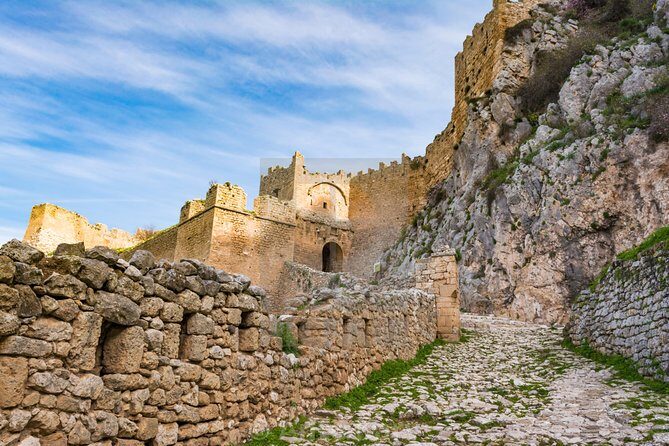
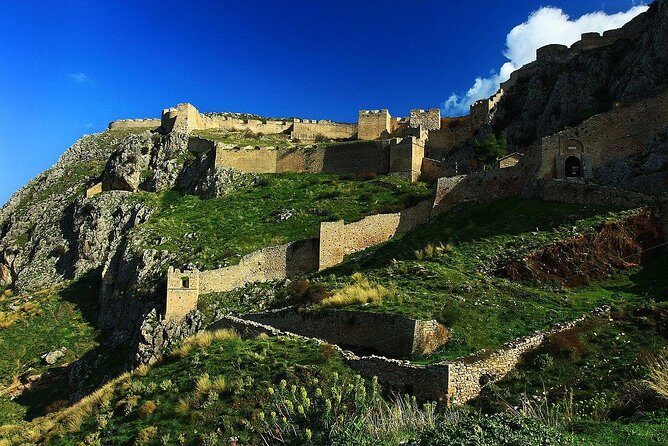
After Ancient Corinth, you head up to Acrocorinth, the hilltop rock that towers over the ruins. This stop is about 1 hour, and admission ticket details are listed as not included.
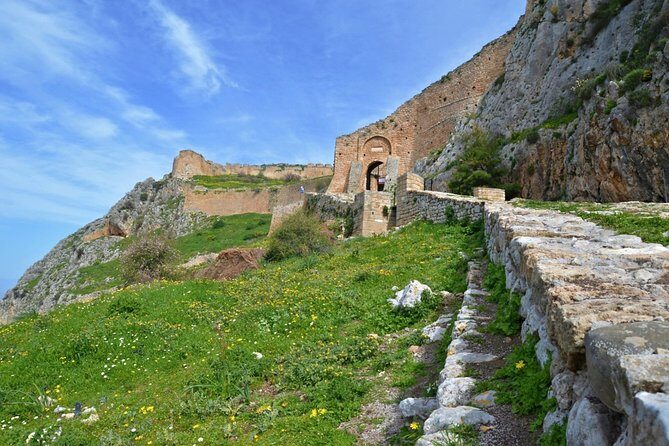
What makes Acrocorinth special is that it’s described as occupied continuously from archaic times to the early 19th century, and today it’s one of Greece’s important medieval castle sites. So you’re not just visiting a viewpoint. You’re walking through layers of occupation that left behind a fortress form.
The information also credits George Forrest with calling Acrocorinth the most impressive acropolis on mainland Greece. Even without taking that as a competition, the logic is easy: when you’re on the rock, you can understand how this place controlled the region. The walls and layout exist because location did the heavy lifting for centuries.
Practical tip for your comfort: wear shoes you trust. Castle sites tend to be uneven, and the day already includes some walking. If it’s warm, you’ll feel it faster up there, so water from the vehicle helps.
Kechries port remains: trade routes and Apostle Paul’s arrival
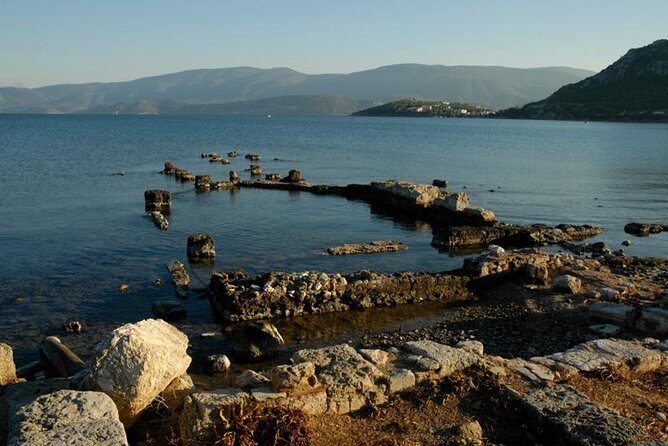
Next comes Kechries, the remains of the ancient port connected with eastern trade routes via the Saronic Gulf. You’ll have about 15 minutes here, and entry is listed as free.
This stop works best as a “closing chapter.” After walking the civic and religious heart at Ancient Corinth, Kechries gives you the maritime angle: the city’s importance wasn’t just temples and politics. It was also ships and movement—goods, people, and messages.
The details provided here include a direct tie to Christianity: Apostle Paul arrived at Kechries during his second missionary. Even if you don’t know the exact routes, seeing the idea of port and coastline helps you place those events in geography rather than just reading them as names on a page.
Because the time is short, I’d aim to see the setting quickly, then move on. You don’t need to try to turn Kechries into a long archaeological session.
- All Day Cruise -3 Islands to Agistri,Moni, Aegina with lunch and drinks included
★ 5.0 · 4,958 reviews



Private transport value: what you actually get in the car
Here’s where this tour can feel better than you’d expect from a “half-day” label. Included items are solid and practical:
- Air-conditioned vehicle
- Bottled water
- WiFi on board
- Professional drivers
- Private transportation with pickup and drop-off
Pickup can work from Athens hotels or from Piraeus Port, and the meeting details are specific. For airport arrivals, your driver meets you at Athens International Airport (Eleftherios Venizelos) at the customs exit holding an H.P. Tours sign with your name.
One detail worth knowing: your driver is English-speaking, and they’ll explain about the monuments and history. But they’re not allowed by law to accompany you inside the sites. If you want a licensed English guide for inside-the-ruins commentary, it’s available for an additional €260 payable in cash, subject to availability.
How that shapes your experience:
- If you’re happy with a guided drive and self-guided ruins time, you can enjoy the day without extra cost.
- If you want deeper, inside-the-site interpretation for Agora details, temple symbolism, and fortress layers, budgeting for a licensed guide may be the difference between seeing ruins and really understanding them.
Also, the tour operator is directed by Frank Kotsiopoulos (manager director). One operational detail noted is that the team may help with practical needs, such as arranging a rapid antigen test in some situations.
Price check: $363.71 per group up to 2 is a real calculation
The price is $363.71 per group (up to 2), with about 5 hours on the ground. That means the cost is not per person. For a couple, it can work out as good value because you’re paying for:
- private transport across the Isthmus area,
- a schedule that hits major highlights,
- and an English-speaking driver explanation while you travel.
If you’re traveling alone, the price is still capped by the group size rule, so you might feel it more. And if you’re a family of three or four, the “up to 2” structure could force you to compare options carefully.
One more practical clue: this tour type is commonly booked about a month in advance on average. If your dates are tight, I’d plan to lock it sooner rather than later.
Who this Ancient Corinth half-day tour suits best
This is a strong fit if you:
- want a high-impact history day without committing to a full day,
- like seeing multiple time periods in one route (canal engineering, temple ruins, Roman street life, medieval fortress),
- prefer privacy and control over joining a larger bus tour,
- and can handle a moderate pace with about an hour per main site.
It’s also a good option if you’re staying in Athens or near Piraeus and want a straightforward plan. The route is built around getting you out of Athens traffic, into the Corinth zone, and back again without complexity.
Should you book it?
I’d book this tour if your priority is smart efficiency: canal + Ancient Corinth + Acrocorinth + Kechries, wrapped into one private, air-conditioned ride. The value is strongest for couples, because the price is per group and you avoid extra logistics.
I’d think twice if you hate paying entrance fees on top of the base price, or if you strongly want a licensed English guide inside every site. In that case, decide up front whether the €260 licensed guide option is worth it for you.
If you like ruins, viewpoints, and a day that feels like it has a purpose, this one has that. It’s not a slow, pick-your-moment adventure—it’s a well-run highlights sprint with enough context to make the stops click.
FAQ
How long is the Ancient Corinth half-day tour?
It runs for about 5 hours (approx.).
What’s included in the tour price?
You get bottled water, an air-conditioned vehicle, WiFi on board, and private transportation with pickup and drop-off from Athens Hotel/Piraeus Port. It’s also set up for a private group (only your group participates).
Are entrance tickets included?
Entrance fees are not included. Ancient Corinth has an entrance fee of €15.00 per adult. Corinth Canal and the port of Kechries are listed as free for admission.
Do I need a licensed guide to visit the sites?
Your English-speaking driver will explain the monuments and history, but they are not allowed to accompany you inside the sites. An optional licensed English-speaking tour guide is available for €260 payable in cash, subject to availability.
Where do pickups happen for this tour?
Pickup is available from Athens hotels or from Piraeus Port (you’ll meet the driver at the correct terminal exit). Airport pickup is also offered, with the driver meeting you at the customs exit at Athens International Airport holding an H.P. Tours sign with your name.
Is this tour private?
Yes. It’s totally private, and only your group participates. The group size is up to 2.
Can I cancel for free?
Yes. Free cancellation is available up to 24 hours in advance for a full refund.



More Tours in Athens

More Tour Reviews in Athens
- All Day Cruise -3 Islands to Agistri,Moni, Aegina with lunch and drinks included
★ 5.0 · 4,958 reviews