REVIEW · ATHENS
Athens Half-Day Tour: Acropolis, Parthenon & All Major Landmarks
Book on Viator →Operated by Greek Heritage: Private Tours & Transfers · Bookable on Viator
Athens can feel huge. This private half-day circuit keeps it manageable, packing the Acropolis, Parthenon views, Plaka, and Greece’s modern civic landmarks into one smooth, air-conditioned drive. I like the door-to-door pickup (your driver arrives about 5 minutes early) because it removes the stress of figuring out transit and where to meet. I also like that you get a fluent English-speaking driver who shares context on the ride, yet you still have control once you’re at each site.
The main thing to know up front: entrance tickets are not included for major stops like the Acropolis Hill, and the driver isn’t licensed to accompany you inside. That means you’ll still do the queue and ticket counter part yourself, and if you want extra time in places like the Acropolis Museum or Ancient Agora, those add their own ticket costs too.
In This Review
- Key highlights worth your attention
- What you’re really buying: a focused highlights loop, not a slow museum day
- Price and value: what $145.12 covers (and what it doesn’t)
- Pickup, comfort, and timing that keeps the day from slipping
- Acropolis and Parthenon: the only half-day that really matters
- What to look for once you’re at the top
- Plaka, Arch of Hadrian, and the “old city meets new city” feeling
- Syntagma Square landmarks: Parliament, Evzones, and the Unknown Soldier
- Panathenaic Stadium and Olympian Zeus: Athens flexing its scale
- Academy, University, and National Library: the Athenian Trilogy in one sweep
- Optional add-on time: Acropolis Museum and Ancient Agora (when they’re worth the extra ticket)
- Lycabettus and the modern Athens twist: viewpoints plus Dromeas
- Who this tour suits best (and who should consider a different format)
- Should you book this Athens half-day tour?
- FAQ
- How long is the Athens Half-Day Tour?
- Is hotel pickup and drop-off included?
- Are entrance tickets included in the price?
- Is this tour private or shared?
- Do I get to visit the Acropolis and Parthenon on foot?
- What sites are included besides the Acropolis and Parthenon?
- Are any stops free to enter?
- What about Panathenaic Stadium admission?
- Can I add the Acropolis Museum or Ancient Agora?
- What’s the best tip for tickets before you go?
Key highlights worth your attention
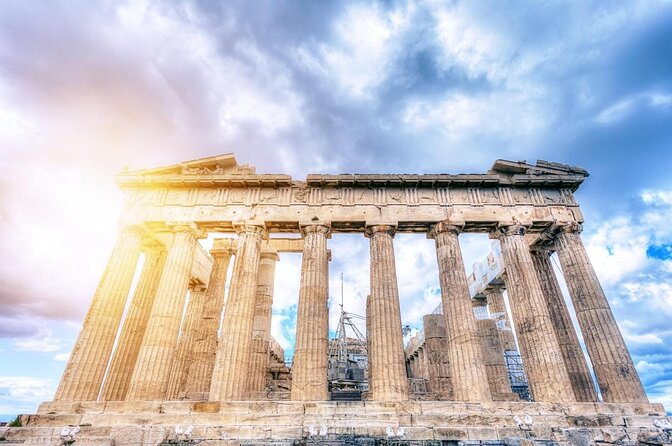
- Acropolis first, with enough time to actually look rather than speed-walk and hope.
- Fluent English driving guide with history background, plus bottled water and WiFi on board.
- Most of the city-center stops are free, including the Arch of Hadrian, Temple of Olympian Zeus ruins, Hellenic Parliament area, and the Tomb of the Unknown Soldier.
- Optional upgrades like the Acropolis Museum and Ancient Agora let you go deeper when you want.
- A lot of Athenian landmarks in one loop, including the Athenian Trilogy buildings (Academy, University, National Library).
What you’re really buying: a focused highlights loop, not a slow museum day
This tour is built for one thing: getting you oriented fast in Athens. You’re not spending hours bouncing between neighborhoods on your own. Instead, you’re riding in an air-conditioned vehicle with a driver who handles traffic, drop-offs, and pacing, while you enjoy the sights at your own speed once you’re there.
The format works especially well if you only have a day or if you want a solid first taste before choosing where to return. The payoff is that your brain starts building a map: ancient Athens on the hill, Roman Athens nearby, and the democratic Athens around Syntagma Square—all in one afternoon.
You can also read our reviews of more tours and experiences in Athens.



Price and value: what $145.12 covers (and what it doesn’t)
At about $145.12 per person for roughly 5 hours, you’re paying mostly for transport plus a history-minded English driver and door-to-door convenience. You’re also paying for the private setup—only your group rides in the vehicle—so you don’t feel like a numbered ticket in a big bus herd.
What you’ll still pay separately are entrance fees for the sites that require them. The tour notes the Acropolis Hill ticket as €30 per person. The Acropolis Museum (optional) is listed at €20 per person, and the Ancient Agora (optional) is €20 per person. Also, admission at the Parthenon area is not included, and Panathenaic Stadium admission is not included either.
So here’s the real value equation: if you plan to see the Acropolis/Parthenon properly, you should budget those ticket costs anyway. This tour’s strength is that it gets you there with a clear plan and sensible stop times, so the extra cost doesn’t feel like wasted money on logistics.
Pickup, comfort, and timing that keeps the day from slipping
Pickup and drop-off are included from any location in Athens, and the driver arrives about 5 minutes before your start time. That sounds small, but it matters in Athens where heat and waiting time can drain your energy fast.
On the ride, you’ll have practical comforts: an air-conditioned vehicle, WiFi on board, and bottled water. A lot of past guests specifically liked how comfortable the van felt, including seating designed for people to face each other, plus storage space for luggage.
One more practical tip from how this is run: the operator suggests using WhatsApp to communicate with your driver. If you’re meeting at a hotel lobby or you need to adjust where you’re standing, that can save time and confusion.
Acropolis and Parthenon: the only half-day that really matters

The day starts at the Acropolis, and that choice is smart. It’s the kind of place where you get your best payoff when you arrive with fresh energy, because you’ll be standing, looking up, and walking the hill in the Athens sun.
You get about 30 minutes at the Acropolis area, and about 30 minutes tied to Parthenon time. That’s not “read every inscription” time. It is enough to do the big visual priorities: orient yourself on what you’re seeing and understand the building layout from the parts that are still visible.
A realistic consideration: there can be a long queue at the Acropolis. Plan your mindset for waiting, not just sightseeing. Your driver can’t fix the line, but the private setup usually means you’re not juggling the extra confusion of a large group.
What to look for once you’re at the top
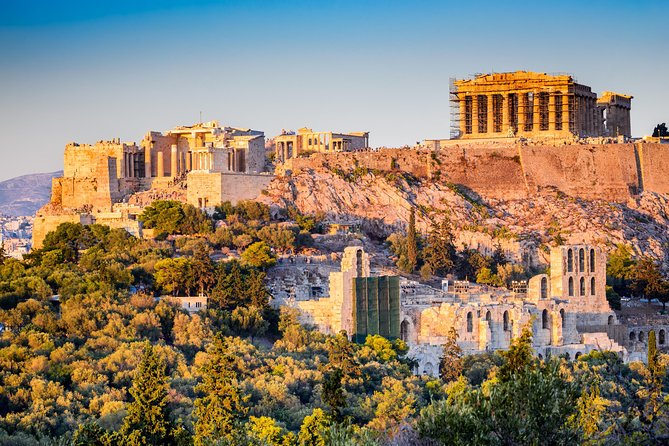
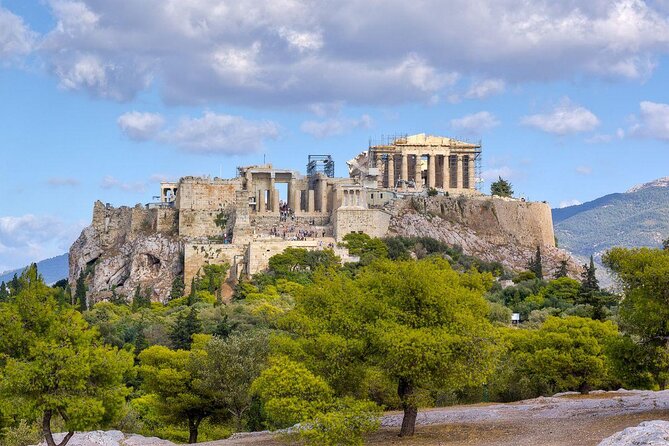
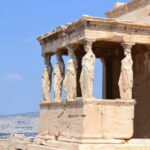
The Acropolis isn’t just one building. You’ll see the larger ensemble: the Propylaea (the monumental gateway), the Erechtheion, and the Temple of Athena Nike. Even if you’re not a classicist, you’ll feel the design logic—columns, symmetry, and the way the hilltop space was meant to impress.
Then comes the Parthenon itself. It was dedicated to Athena and built in the mid-5th century BCE (447–432 BCE). The tour context emphasizes the Doric columns and the Pentelic marble construction, plus the famous frieze concept. The Parthenon has damage and restoration history, but it still works as the visual anchor of ancient Athens.
If you want an easy, no-stress tactic: spend a few minutes looking outward first for the city view, then come back and focus on the building details. That back-and-forth helps your brain connect what’s below to what you’re seeing above.
- All Day Cruise -3 Islands to Agistri,Moni, Aegina with lunch and drinks included
★ 5.0 · 4,958 reviews





Plaka, Arch of Hadrian, and the “old city meets new city” feeling
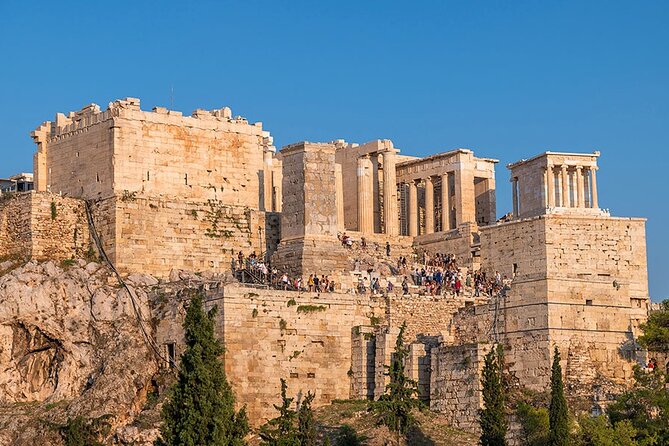
After the hill, you drop toward Plaka, the neighborhood beneath the Acropolis. Plaka is known for narrow streets, tavernas and cafés, shops, and bits of ancient ruin woven into the streetscape. The main value here isn’t a long museum-style stop—it’s the atmosphere and the walkability. Even in a short time, it helps you picture how the modern city grew around ancient remains.
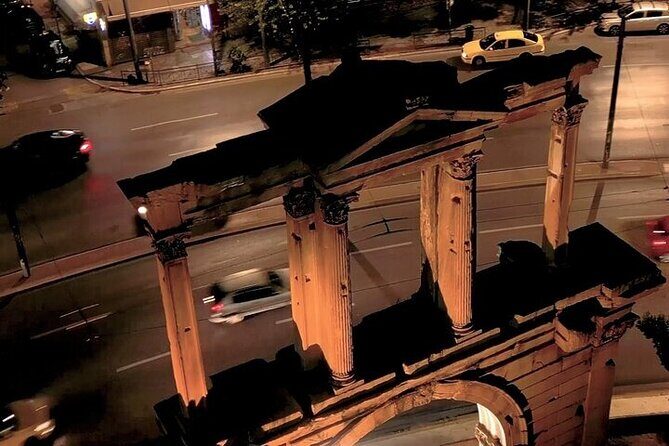
Next up is Hadrian’s Arch, built in 131 AD. It’s about 18 meters tall and made of Pentelic marble, and the tour gives you the idea behind it: it marked a boundary between the older city associated with Theseus and a newer section linked to Hadrian. You can treat this like a quick orientation checkpoint—one of those stops that helps you understand Athens as layered, not frozen.
Syntagma Square landmarks: Parliament, Evzones, and the Unknown Soldier
This portion of the route is a contrast to the Acropolis. It’s about modern Greece showing itself in public space.
You’ll spend time around the Hellenic Parliament in Syntagma Square, in a neoclassical building originally constructed as a royal palace in 1843. Since 1934, it has been the seat of Parliament. This stop is also tied to the Tomb of the Unknown Soldier, which is guarded by the Evzones in traditional attire.
The standout moment here is the solemn symbolism: an eternal flame and sculpted relief scenes around the marble tomb. The changing of the guard happens regularly, and it’s the kind of ritual that makes you pause even if you’re not normally into ceremonies.
If you want to catch a strong viewing experience, arrive calmly and don’t treat it like a quick photo run. The best payoff is watching the guard ceremony with enough time to settle your focus.
Panathenaic Stadium and Olympian Zeus: Athens flexing its scale
Two stops here deliver the “wow, that’s big” effect in different ways.
Panathenaic Stadium (Kallimarmaro) is built entirely of white marble and has a horseshoe shape. It was originally built in the 4th century BCE, then rebuilt in the 2nd century CE in the form you see today. It hosted the Panathenaic Games in ancient times, and it later became the venue for the revival of the modern Olympic Games in 1896. The tour notes a seating capacity around 50,000, which helps you understand why it has that grand, open-feeling scale.
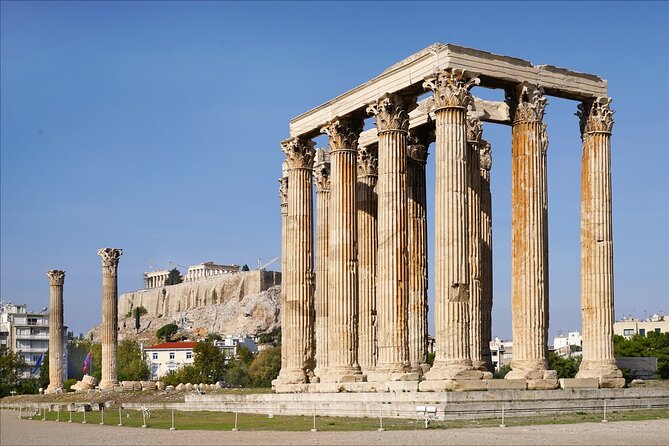
Then you head to the Temple of Olympian Zeus. Construction began under Athenian rulers in the 6th century BCE, then stretched across centuries, finishing in the 2nd century CE. Corinthian columns there can be as tall as 17 meters, and the tour notes that the temple once housed a massive chryselephantine statue of Zeus. Even in ruins, the site gives you a strong sense of ancient ambition.
Both stops are great for photos, but the real value is perspective. You’ll start comparing what was meant for religion and what was built for public events—different purposes, same architectural seriousness.
Academy, University, and National Library: the Athenian Trilogy in one sweep

After the ancient-world stops, you’ll see a trio of buildings that help explain modern Athens as an education and research center.
The Academy of Athens (founded in 1926) is inspired by Plato’s ancient academy and sits in a neoclassical building with statues of Athena and Apollo. It’s described as Greece’s premier research institution, and the exterior makes it easy to understand why it’s considered a cultural landmark.
Next is the National and Kapodistrian University of Athens, established in 1837. The tour places its historic main building in the famous Athenian Trilogy grouping along with the Academy and National Library. This stop won’t feel like a “must-see monument” the way the Acropolis does, but it’s useful because it shows you Athens beyond ruins.
The National Library of Greece, founded in 1832 and designed by Theophil Hansen, rounds it out. If you’re the type who likes the slow architectural vibe, this one is for you. It’s also described as housing major collections of manuscripts, rare books, and documents, plus modern digital archives.
Even if you only glance at the facades, this trio helps the city feel like a living place, not just a photo set.
Optional add-on time: Acropolis Museum and Ancient Agora (when they’re worth the extra ticket)
This tour offers optional upgrades. The big one is the Acropolis Museum for 60 minutes. If you add it, you’ll get a modern architectural setting designed to house Acropolis artifacts, opened in 2009. The tour highlights the Parthenon Gallery, which uses glass walls to create a sightline back to the Parthenon. It also mentions the Caryatids (original statues from the Erechtheion) and an approach where parts of the floor reveal ancient ruins underneath.
If you love context—how objects were used, how sculptures tell stories—this is often the best upgrade to choose. The museum is where the Acropolis becomes less about silhouettes and more about details.
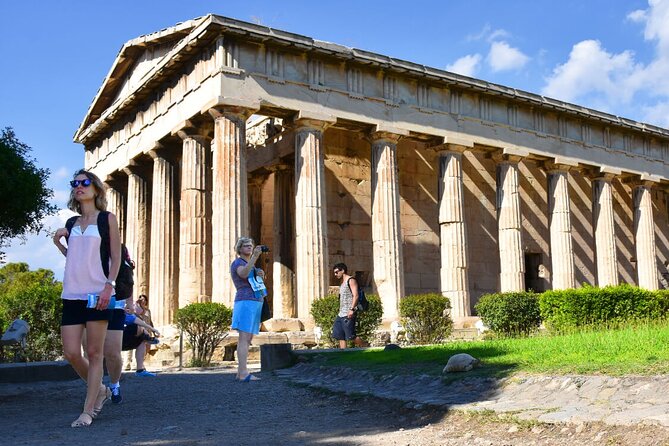
The Ancient Agora add-on is another 60 minutes, and it changes the angle of the story. The Agora is described as the civic heart of ancient Athens: political, social, and commercial activity starting from the 6th century BC. You’ll hear about the Stoa of Attalos and the Bouleuterion (council meeting area), plus temples like the Temple of Hephaestus and the Altar of the Twelve Gods. The tour also notes that philosophers such as Socrates were known to frequent the Agora.
Pick the Agora if you want to feel how people lived and argued, not just how temples were built.
One note: in both cases, the museum and Agora tickets aren’t included. So treat these as “depth options” rather than automatic upgrades.
Lycabettus and the modern Athens twist: viewpoints plus Dromeas
If you want a breather between ancient sites and civic buildings, Lycabettus Hill is a nice move. It’s about 300 meters above Athens, with a Chapel of St. George at the top. The tour also includes a legend involving Athena dropping a rock there, which adds a myth layer to the view.
The payoff is panoramic: you can look across the city and toward the Aegean Sea and mountains. Even if you only get a short stop time, it helps reset your eyes and your pace.
Then there’s a modern art touch: Dromeas (The Runner), created by Costas Varotsos in 1994. It’s described as a 12-meter sculpture made of layered glass and iron, showing motion and speed. Nearby is the idea of the Marathon Run, tied to Pheidippides’ legendary run from Marathon to Athens in 490 BCE, which connects directly to the origin story of the modern marathon race (included in 1896 Olympics in Athens). It’s a clever way to bridge past and present without turning the day into a lecture.
Who this tour suits best (and who should consider a different format)
This works best if you want:
- a first-day orientation that covers the big names without getting lost,
- a comfortable ride and a driver who explains what you’re seeing along the way,
- private pacing where you can choose to linger during stops.
It may not be ideal if you want a true guide who stays with you inside the major ticketed sites. Since the driver isn’t licensed to accompany you inside, you’ll do the site entry yourself and explore on your own once you’re in.
Also, if you’re only interested in one or two places in deep detail, you might be happier with a longer, more focused itinerary—because this is designed to keep moving.
Should you book this Athens half-day tour?
I’d book it if your priority is to see the Acropolis/Parthenon area and get your bearings fast, without spending your day managing transit. It’s good value for the private transport piece, especially with the door-to-door pickup and the practical comforts like bottled water and WiFi.
I’d think twice if you hate ticket lines or you were hoping for a fully guided, inside-the-doors experience everywhere. The tour is structured so the driver explains on the ride, then you take over on-site.
My practical call: if you’re first-time in Athens, this is a smart way to start. If you can add the Acropolis Museum, do it—then your half-day stops feeling like just a silhouette chase and becomes a more complete story.
FAQ
How long is the Athens Half-Day Tour?
It runs for about 5 hours.
Is hotel pickup and drop-off included?
Yes. Pickup and drop-off are included from any location in Athens, and the driver arrives about 5 minutes before the start time.
Are entrance tickets included in the price?
No. Entrance fees are not included. The Acropolis Hill ticket is listed as €30 per person, and the Acropolis Museum and Ancient Agora have separate ticket prices when you choose those options.
Is this tour private or shared?
It’s a private tour/activity. Only your group participates.
Do I get to visit the Acropolis and Parthenon on foot?
Yes. You’ll stop at the Acropolis and the Parthenon area, but you enter and explore on your own (the driver is not licensed to accompany you inside).
What sites are included besides the Acropolis and Parthenon?
In addition to those, you’ll also visit stops such as Plaka, Hadrian’s Arch, Panathenaic Stadium, the Hellenic Parliament area, the Temple of Olympian Zeus, and several education landmarks (Academy of Athens, University of Athens, National Library), plus the Tomb of the Unknown Soldier.
Are any stops free to enter?
Yes. For example, Hadrian’s Arch is listed as free, the Hellenic Parliament area is free, and the Temple of Olympian Zeus ruins are free. The tour also lists free access for the Academy of Athens, University of Athens, National Library, and the Tomb of the Unknown Soldier.
What about Panathenaic Stadium admission?
Admission for Panathenaic Stadium is listed as not included.
Can I add the Acropolis Museum or Ancient Agora?
Yes, those are optional add-ons for 60 minutes each when you select the matching option. Tickets are not included.
What’s the best tip for tickets before you go?
The tour suggests pre-ordering tickets a few days before you arrive at hhticket.gr, and wearing comfortable shoes for exploring.



More Tour Reviews in Athens
- All Day Cruise -3 Islands to Agistri,Moni, Aegina with lunch and drinks included
★ 5.0 · 4,958 reviews