REVIEW · ATHENS
Blue Lake, Sanctuary of Hera, Mycenae, Ancient Corinth, Canal
Book on Viator →Operated by Ancient Greece Tours & Transfers · Bookable on Viator
A day trip that feels like two classics. This private Athens escape strings together Mycenae’s legendary Bronze Age sites, Corinth’s big historical moments, and then ends with a real break from sightseeing: Perachora’s Blue Lake swim under the Temple of Hera. It’s built for comfort with hotel pickup and a driver who shares context as you travel.
What I like most is the balance: you get major ruins and museums, but you also get breathing room at the end. I also like that the ride is in a private luxury vehicle with bottled water, refreshing wipes, and WiFi, so the long route doesn’t feel like a slog. The main drawback to plan for is time: with 9 hours and many stops, most site visits are shorter, so this works best for people who want highlights, not deep study.
In This Review
- Key Things I’d Prioritize on This Day
- A Stress-Free Private Day Beyond Athens
- Corinth Canal and Ancient Diolkos: Boats Past the Rocks
- Mycenae’s Grave Circles, Cyclopean Walls, and Palace Rooms
- The Lion Gate and the Royal Tombs (Treasury of Atreus + Clytemnestra)
- Mycenae Museum Time: Gold Grave Goods and Burial Masks
- Acrocorinth (Akrokorinthos) Views: Walls, Towers, and Aphrodite Traces
- Upper Peirene Fountain and Geraneia: Two Quick Breaks With Big Payoff
- Ancient Corinth on Foot: Apollo, the Agora, the Bema, and St. Paul’s Mosaic
- Lunch and souvenirs without derailing the day
- Heraion (Perachora) and the Blue Lake Swim: The Day’s Reward
- Price and Value: What $337.15 Buys You (and What It Doesn’t)
- Who This Tour Is Best For
- Should You Book This Private Corinth, Mycenae, and Blue Lake Day Trip?
- FAQ
- How long is the tour?
- Is hotel pickup and drop-off included?
- Is the tour private?
- Are entrance fees to the archaeological sites included?
- Are food and drinks included?
- Is the Blue Lake swim included?
- What language is the tour offered in?
- Can I cancel for a full refund?
- Is there WiFi and water on board?
Key Things I’d Prioritize on This Day
- Door-to-door pickup from your Athens hotel (or apartment arrival contact), with a private car and WiFi
- A packed-but-logical route from the Corinth Canal to Mycenae, then up to Acrocorinth and down to Ancient Corinth
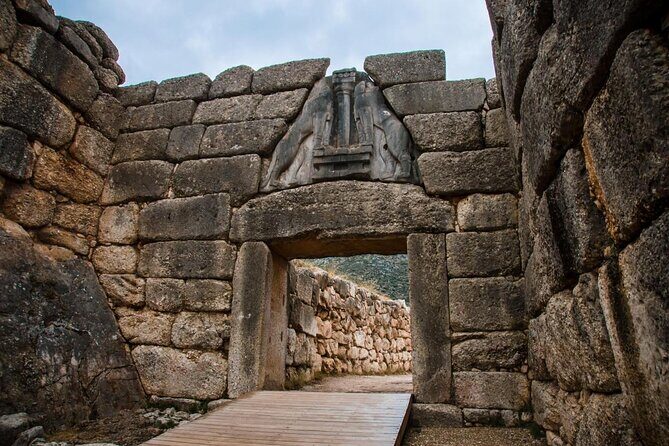
- Cyclopean stone + royal tombs at Mycenae, including Grave Circles and the Treasury of Atreus
- Great viewpoints from Acrocorinth, plus the Frankish Tower and Temple of Aphrodite traces
- Ancient Corinth on a walkable track, including the Temple of Apollo, Agora, Bema, and St. Paul’s mosaic
- A proper end-of-day swim at the Sanctuary of Hera in Perachora’s Blue Lake (entrance fees still extra)
A Stress-Free Private Day Beyond Athens
This is a fully private 9-hour outing with hotel/port pickup and drop-off, so you’re not dealing with group shuttles or forced meeting points. You’ll ride in a private luxury vehicle with WiFi, bottled water, and refreshing wipes—small stuff that matters on a long day in Greece.
I also like that your driver is the key to the day. You’re not just chauffeured; you get history and context while you’re on the road, which helps the ruins make sense once you step out. In a few of the same journeys, drivers like Yannis and Panos are called out for being especially attentive and informative, and even for flexible timing.
One practical note: this is not a full-day “wandering” itinerary. It’s a highlights tour, with set time windows at each stop. If you love lingering in museums or walking every side path, you’ll want to be selective about where you slow down.
You can also read our reviews of more tours and experiences in Athens.


Corinth Canal and Ancient Diolkos: Boats Past the Rocks
The day kicks off at the Corinth Canal, a modern engineering landmark tied to Mediterranean trade routes. Standing near the water, you get that immediate sense of how geography can steer history—this is one of the places where ships literally and figuratively choose their path.
Then you’ll also see Ancient Diolkos, a paved trackway used in ancient times to move boats overland across the Isthmus of Corinth. It’s one of those “wait, they did that?” stops. Boats didn’t always sail around the long route; they could be hauled across here, turning the rough geography into a shortcut.
Time-wise, this part is short (about 45 minutes), but it works as a mental warm-up. You start with a big, easy-to-grasp story before heading into the heavier Bronze Age sites later.
Mycenae’s Grave Circles, Cyclopean Walls, and Palace Rooms
Mycenae is the centerpiece of this trip, and it’s easy to see why. You’re walking around a royal world that shows up in Homer’s epics, but you’re also seeing the real stone evidence that powered late Bronze Age power.
At the Grave Circles A and B, you’re looking at royal cemeteries outside the citadel walls. Even though these aren’t “complete” structures in the way a standing temple is, they set the tone: this was a culture that treated burial like ceremony and status.
Next, you’ll run into the Cyclopean Walls. These are famous for the huge limestone boulders used in construction—massive blocks that make you do the math on how hard building must have been. It’s one thing to read about it; it’s another to stand near the scale.
Then comes the Royal Palace complex, with areas that include domestic apartments, the Throne Room Suite, and the Grand Staircase. Your time here is short, so focus on getting your bearings: notice how the palace rooms connect, and let your driver’s explanation help you map what you’re seeing.
A helpful bonus: Mycenae also includes time at the site where admission can be free in the planned windows, and then it pairs with the museum later (more on that next). This makes the day feel like it progresses from “power and walls” to “objects from the burials.”
The Lion Gate and the Royal Tombs (Treasury of Atreus + Clytemnestra)
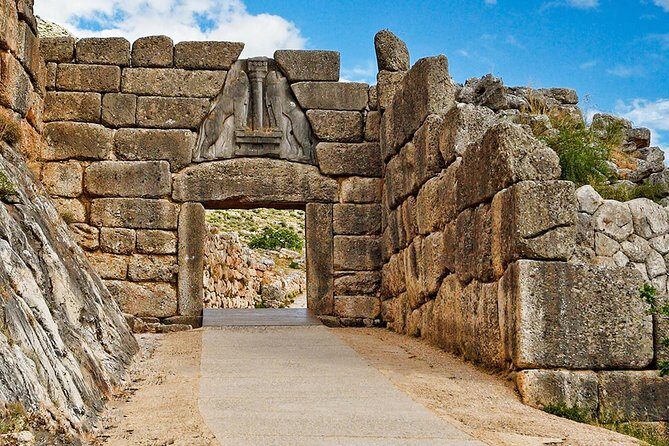
After the palace area, the route shifts toward the citadel’s iconic entrance: the Lion Gate. It’s brief (about 15 minutes), but it’s the kind of landmark that instantly anchors your understanding of the whole site. When you see the gate, you stop thinking of Mycenae as a scatter of ruins and start thinking of it as a controlled defensive system.
Then you’ll head to the Citadel and Treasury of Atreus. The Treasury is a tholos, often described as a beehive tomb style, built around 1250 BC. The scale is the point. Even without standing inside every chamber, the structure’s shape and construction make the site feel engineered, not casual.
Right near it, you’ll also have time at the Tomb of Clytemnestra, another tholos type tomb built around the same period. The names are tied to myth and tradition, but the big value for you is how these tomb forms show what people believed about death and status.
These tomb stops are short on paper, but they’re powerful on the ground. If you’re short on energy, this is one of the spots where a little extra attention pays off.
Mycenae Museum Time: Gold Grave Goods and Burial Masks
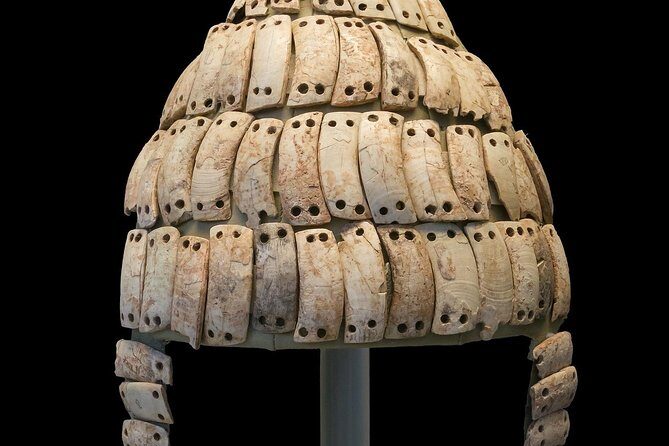
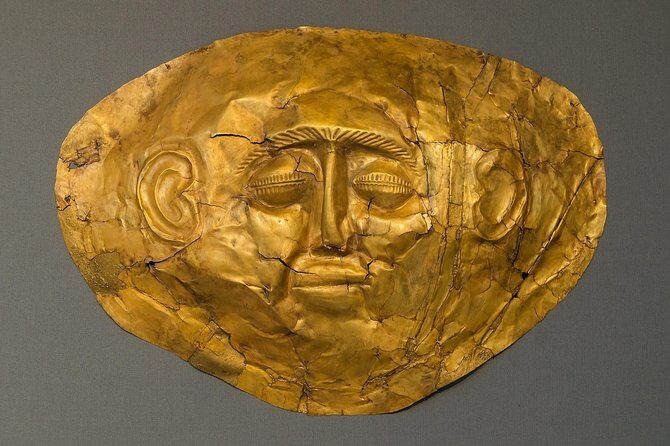
If you want the Bronze Age to “click,” the Archaeological Museum of Ancient Mycenae helps a lot. Your museum time is about 30 minutes, and that’s enough to get the gist if you focus on the most famous categories of artifacts.
Expect to see gold grave goods, burial masks, jewelry, weapons, worship idols, and even frescoes. Even in a limited visit window, you’ll start to connect what the tombs and palace spaces imply about wealth and belief.
Since the museum entry isn’t included, plan for the extra cost. Still, it’s often the part of the day where you understand what power actually looked like.
- All Day Cruise -3 Islands to Agistri,Moni, Aegina with lunch and drinks included
★ 5.0 · 4,958 reviews



Acrocorinth (Akrokorinthos) Views: Walls, Towers, and Aphrodite Traces
From Mycenae you’ll head to Akrokorinthos, the acropolis of Corinth, built on a towering rock above the city. The views alone are a reason to come. You’re looking over the Corinthian Gulf and the Peloponnese coast, and the whole area reads differently once you’re up high.
This part includes key fortification elements, like a system of circuit walls reinforced by towers. You’ll also see the Frankish Tower at the southwest edge, fortified during Frankish times. Even if some structures are ruins, you’re still looking at layers of occupation—Greek, then later medieval-era reuse.
There are also traces of the Temple of Aphrodite on the higher peak. You won’t expect full walls and a complete roof, but the location helps you understand why people built sacred spaces where they could also control sightlines.
Your time here is about an hour. Wear comfortable shoes. This is the kind of place where stopping for pictures is easy, and where rushing can make you miss the scale.
Upper Peirene Fountain and Geraneia: Two Quick Breaks With Big Payoff
Between the big “heavy” sites, the itinerary adds smaller pauses that help you feel human again.
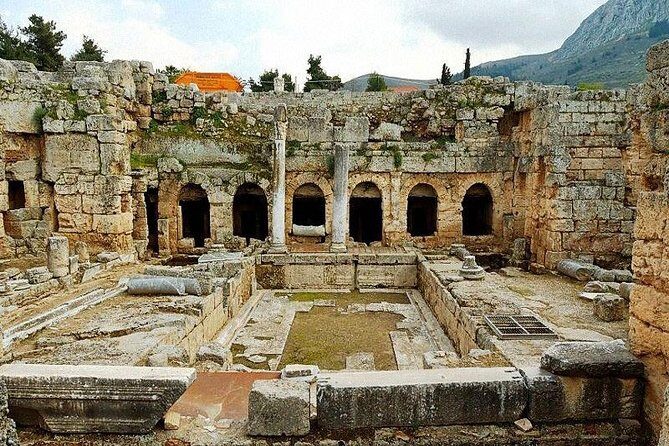
At Upper Peirene Fountain, you’re in the area associated with Peirene Spring, tied to the myth of Asopus and Sisyphus. It’s quick (around 15 minutes), but it gives you a myth-and-water connection that feels very Greek.
Then you’ll stop at Geraneia for views of Mount Geraneia and the wider gulf area. This is another short stop (about 15 minutes), and it’s also a smart reset before you switch gears again to Ancient Corinth.
Ancient Corinth on Foot: Apollo, the Agora, the Bema, and St. Paul’s Mosaic
Next you’ll get a longer stretch at Ancient Corinth (Archaia Korinthos), about 3 hours. This is where the day turns from “monuments” to “town life,” with temples, market space, meeting areas, and religious moments.
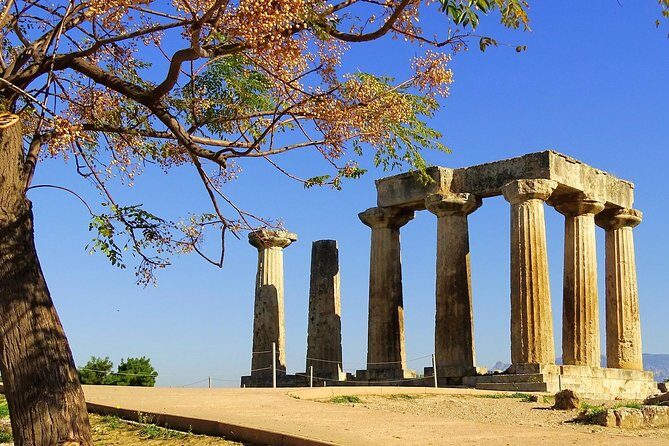
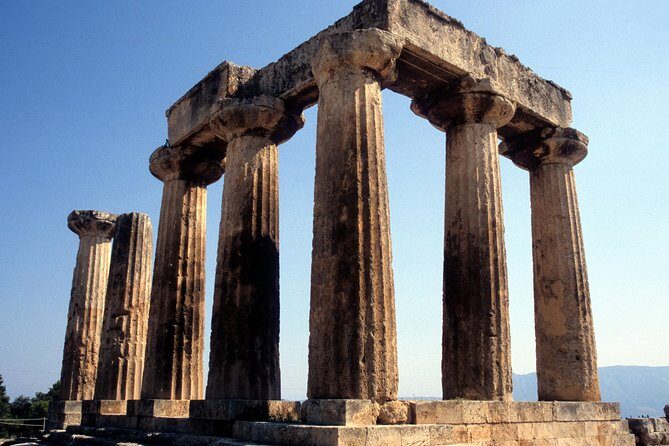
You’ll see the Temple of Apollo, one of the earliest Doric temples in the Peloponnese and Greek mainland with monolithic columns. That’s a rare feature, and it makes the temple visually different from many later Doric examples.
Then comes the Agora, described as a long rectangular space with central shops, small temples, and altars. A key piece is the podium / Bema, the platform from where Apostle Paul addressed the Corinthians in 52 AD. Even if you’re not a biblical history person, this is a useful “why people came here” anchor.
You’ll also have time for Roman buildings and for the Theatre and Odeon/Asklepieion complex area. These add the sense that Corinth kept evolving long after the Bronze Age.
One very specific stop you’ll appreciate is St. Paul’s church, where you can admire a mosaic mural depicting Saul’s vision as he traveled to Damascus. It’s not the same type of artifact as temple columns, but it gives you a different kind of historical continuity.
Lunch and souvenirs without derailing the day
This stretch includes a built-in chance to do a more local-style break: a village-style lunch on a terrace overlooking the archaeological site and the Temple of Apollo. It’s also a good moment to browse village shops for handmade souvenirs for friends and family.
Even though food isn’t included, the timing here is smart: you’re not eating in transit. You’re eating with views and with context.
Heraion (Perachora) and the Blue Lake Swim: The Day’s Reward
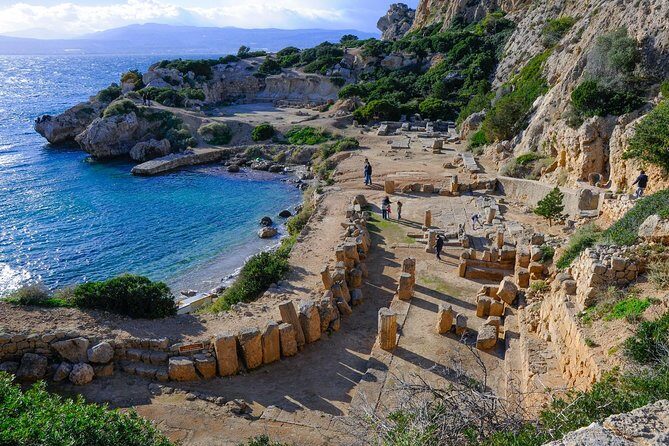
The final highlight is Heraion, the Sanctuary of Hera in Perachora, plus time near the Malagavi Lighthouse and then your swim at the Blue Lake. Your water time is about an hour.
This part is special because it changes the rhythm of the day. After stone, museums, and uphill views, you get a physical reset. A swim here is the payoff for the long itinerary.
Important detail: the swim time is planned, but entrance fees are not included. So budget for the access cost if you’re counting the real total.
This is also where good drivers shine. In at least one similar journey, Yannis was noted for pushing for a sunset-style visit to the Temple of Hera when time allowed. That’s the kind of timing tweak you’ll appreciate if you like your photos with softer light.
Price and Value: What $337.15 Buys You (and What It Doesn’t)
At about $337.15 per person for a roughly 9-hour day, the value is mostly about logistics, not just sites. You’re paying for a fully private car, hotel pickup/drop-off, and a driver with in-depth Greek history who can explain what you’re seeing.
You also get comfort extras that reduce day-trip fatigue: bottled water, refreshing wipes, WiFi, and fresh handmade Greek biscuits. Skip-the-line ticket help is available on request, which can save time at busy entrances, even if you still pay separate site admissions.
What’s not included is the usual add-on list: entrance fees, food and drinks, and tips. Also, a licensed tour guide who walks into sites with you is not included, though it’s available for an extra cost on request.
So here’s the honest math. If you value stress-free door-to-door transport, want a driver to make the ruins understandable, and you’ll actually use the swim at Perachora, this cost can feel fair. If you’d rather do everything independently by public transport, you may be able to spend less—at the cost of time and planning.
Who This Tour Is Best For
This is a good fit if you:
- Want a one-day sampler of Mycenae, Ancient Corinth, and Corinth Canal without navigating between cities
- Like having a driver explain context while you drive, especially for complex sites like Mycenae and Acrocorinth
- Appreciate a real break at the end with the Blue Lake swim
It may not be the best fit if you:
- Hate moving on quickly between stops
- Prefer slow museum time and long, unhurried walking
- Want a guaranteed full-time site guide inside every museum room (that’s extra)
Should You Book This Private Corinth, Mycenae, and Blue Lake Day Trip?
I’d book it if you want one day that hits the big names around Athens and ends with a swim. The combination of Corinth Canal + Mycenae + Ancient Corinth + Perachora is a rare package that keeps the story moving, and the private transport makes it feel doable instead of exhausting.
I’d hesitate if you know you’ll be frustrated by shorter site windows. This is a packed route designed for highlights, not for deep, slow exploration of every room.
If you do book, pack the basics for comfort: solid shoes for uneven ground at Acrocorinth, a swim-ready kit for the Blue Lake, and a bit of patience for a long day.
FAQ
How long is the tour?
The tour runs about 9 hours.
Is hotel pickup and drop-off included?
Yes. You’ll get hotel pickup and drop-off in Athens (or meet your driver at your apartment entrance).
Is the tour private?
Yes. It’s a private tour/activity, and only your group participates.
Are entrance fees to the archaeological sites included?
No. Entrance fees to sites and museums are not included.
Are food and drinks included?
No. Food and drinks are not included, though lunch stops are built into the day.
Is the Blue Lake swim included?
The plan includes time for a refreshing swim at the Sanctuary of Hera in Perachora. Admission fees for the activity are not included.
What language is the tour offered in?
The tour is offered in English.
Can I cancel for a full refund?
Yes. You can cancel up to 24 hours in advance for a full refund.
Is there WiFi and water on board?
Yes. The vehicle includes WiFi, bottled water, and refreshing wipes.


More Tour Reviews in Athens
- All Day Cruise -3 Islands to Agistri,Moni, Aegina with lunch and drinks included
★ 5.0 · 4,958 reviews