REVIEW · DELPHI
Delphi: Audiovisual self-guided tour with 3D models
Book on GetYourGuide →Operated by Culture App · Bookable on GetYourGuide
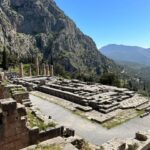
Delphi can feel like a time machine. This self-guided experience uses 3D models, 360° panoramas, videos, and audio to help you understand what you’re looking at—without needing a live guide.
I especially love how the content is built around the place itself: you get an integrated map for monument ID, then audio and visuals tied to what’s in front of you. I also like the sheer range of formats—written facts, spoken narration, and visual reconstructions—so you’re not stuck reading small plaques for everything.
The main drawback is also the biggest one: it’s only useful if your smartphone is ready. You’ll need charged battery, internet for effective use, and you may want headphones/earphones—plus entrance fees are not included.
In This Review
- Key highlights at a glance
- Why Delphi’s oracle still pulls people in
- How the self-guided audiovisual format works on-site
- Your oracle trail: Pythia, Apollo, and Delphi’s 1,000+ year reputation
- 3D models and 360° views: what you’ll actually gain
- Apollo’s temple: where the story meets the stones
- Charioteer of Delphi and the Sphinx of Naxos: art you can understand faster
- The Pythian Games: a festival, not just a footnote
- Practicalities: getting there, using your phone, and pacing yourself
- Price and value: why $7.89 can be a smart deal here
- Who should choose this Delphi audiovisual tour
- Should you book this Delphi self-guided experience?
- FAQ
- Is the entrance fee included in the $7.89 price?
- How long is the tour?
- What content is included for monuments?
- Are there audio guides in multiple languages?
- Do I need internet to use the tour?
- Do I need to download the content before arriving?
- How much storage does the tour require?
- Can I use the tour after my visit?
- What should I bring?
- FAQ (booking and logistics)
- Is free cancellation available?
- Can I reserve without paying right away?
Key highlights at a glance
- Oracle-focused storytelling that explains the 1,000+ year reputation of Delphi and its oracle system
- Pythia and bay-leaf predictions as a central scene, tied to Apollo’s sanctuary
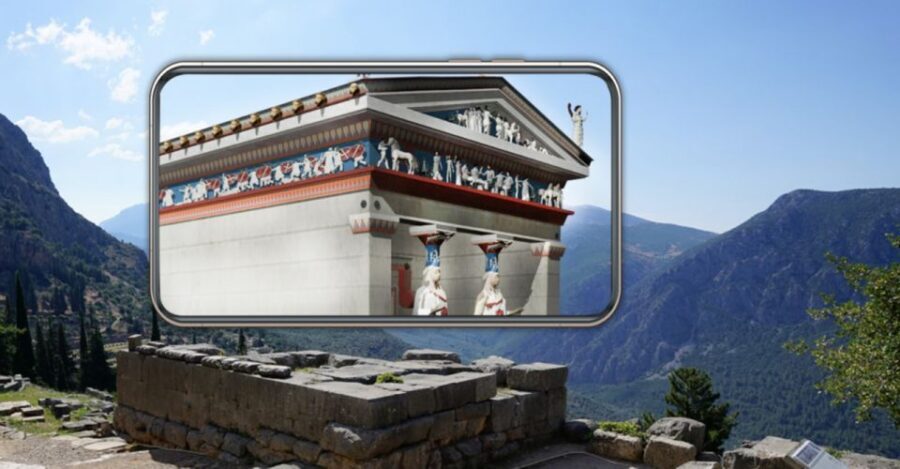
- 3D models and 360° panoramas at multiple monuments so you can see beyond what’s physically in ruins
- Delphi’s famous art moments like the Charioteer of Delphi and the Sphinx of Naxos
- Festival context for the Pythian Games, one of antiquity’s biggest panhellenic events
- A low price for a big content bundle (plus a gift of 68 written and audio culture facts)
Why Delphi’s oracle still pulls people in
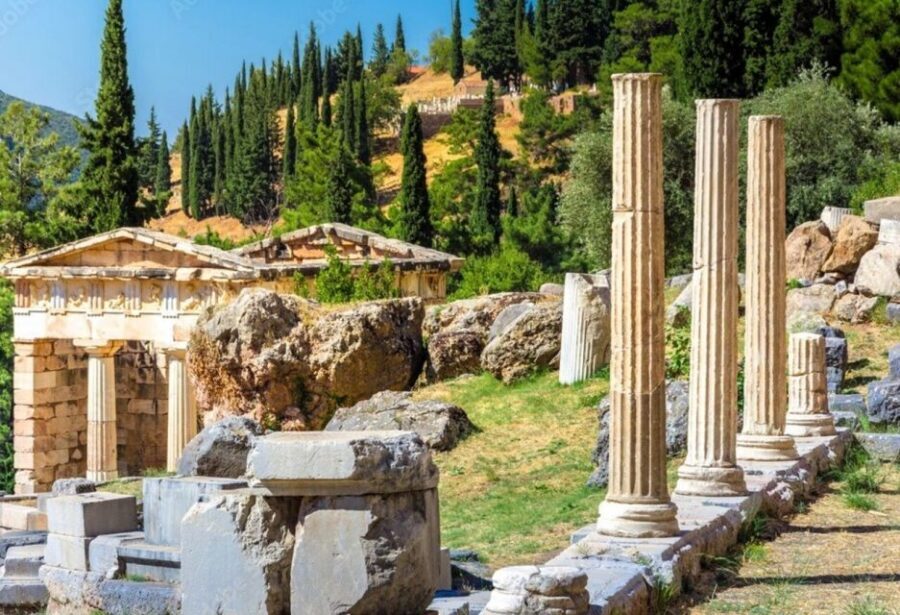
Delphi sits on the slopes of Mount Parnassos, and in antiquity it was treated like the center of the world. The legend says Zeus sent two eagles that met at Delphi, which is why the site became known as the navel of the world. That idea isn’t just poetic—people acted on it, traveling from far away to consult the oracle.
This tour’s angle is simple: it wants you to understand Delphi as a living system, not just a pile of stones. You’ll connect the worship of Apollo with the sanctuary’s role as an oracle, and then you’ll see how people shaped decisions around what Pythia said.
If you like travel that’s part culture, part detective work, you’ll appreciate this approach. You’re given the story framework so your eyes can do more than admire ruins.
You can also read our reviews of more guided tours in Delphi
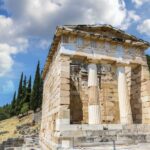

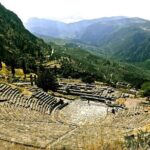
How the self-guided audiovisual format works on-site
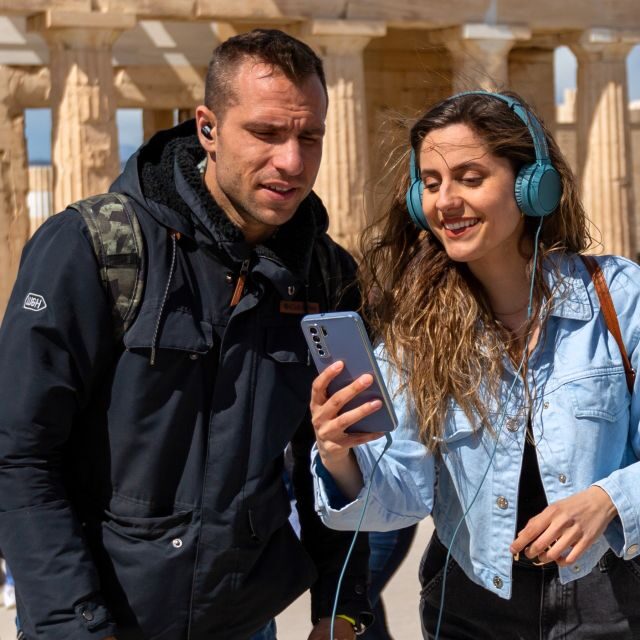
This experience is self-guided, built around your phone and the archaeological setting. You use an integrated map to identify monuments, then you tap into written info for 16 monuments and audio for 14. On top of that, you get 3D models, 360° views, and immersive videos for 14 monuments each, plus related stories for 12.
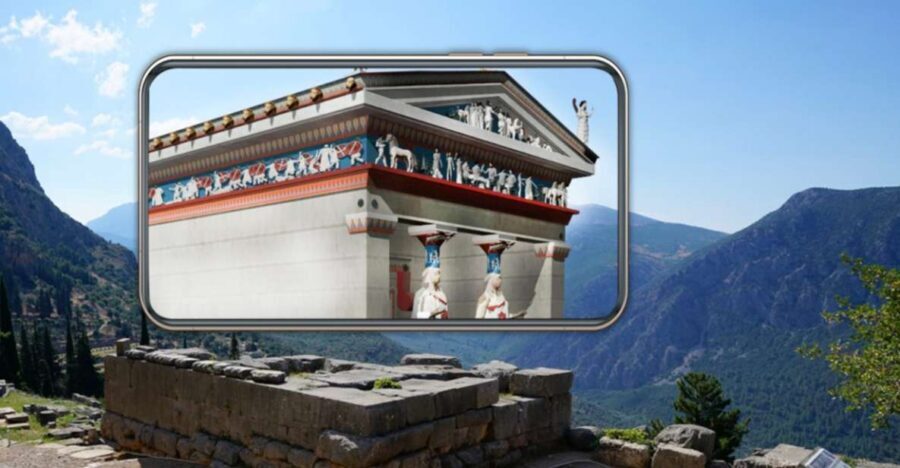
Here’s why that matters in practice. Delphi’s ruins can be confusing if you only read labels. With 3D reconstructions and 360° panoramas, you’re not just learning names—you’re learning how the space likely looked and how the sightlines may have worked.
A big advantage of a self-guided format is flexibility. The tour content can be used anywhere anytime—before, during, or after your visit—so you can do a quick warm-up at your hotel, then go slower once you’re standing in front of the stones.
Just keep your expectations realistic: this is a digital experience, not a guided walking tour with a person steering the pace. If you want someone to answer questions on the spot, you’ll need to provide that curiosity yourself.
Your oracle trail: Pythia, Apollo, and Delphi’s 1,000+ year reputation
Delphi’s oracle isn’t a side note here—it’s the heart of the story. The sanctuary was devoted to Apollo, the god linked with the sun and music, and it also functioned as a place where people came to ask for answers. Over the years, Delphi developed a reputation that lasted for more than a thousand years.
The most memorable part of the narrative is the role of Pythia, the seeress who foretold the future. You’ll get storytelling that frames her as an essential character, not just a name in a textbook. The bay-leaf detail is also included, and it’s the kind of small ritual touch that makes the whole oracle scene feel more concrete.
As you move through the monuments, you can use the audio narration to keep the storyline connected. Instead of hopping from one fact to another, you get a thread: Apollo’s sanctuary → oracle function → Pythia’s predictions → why people traveled and returned.
One thing to watch: because it’s self-guided, your experience depends on how often you stop and press play. If you keep walking nonstop, you’ll miss the best payoff—those stories are built for short pauses at each monument.
3D models and 360° views: what you’ll actually gain
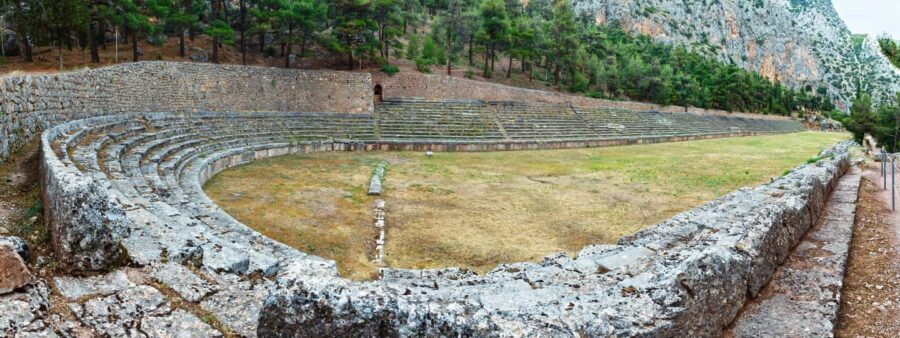
Delphi is famous, but it’s also hard to “read” with your eyes alone. Ruins don’t automatically explain scale, layout, or the original look of temples and sculptures. That’s exactly where the tour’s 3D models and 360° panoramic views do the heavy lifting.
At 14 monuments, you’ll have:
- 3D representations to help you visualize structures and artworks as they may have appeared
- 360° views so you can look around from meaningful viewpoints
- videos and audio so context doesn’t rely only on your imagination
If you’ve ever stood in front of an archaeological site thinking, I get that it’s important, but what am I seeing, this format is built for you. You’re not required to be a history expert. The visuals help you make sense of the site’s geography and design—so your photos turn into memories with meaning.
The downside is practical: all this content depends on your phone working properly. Have your battery, storage, and attention ready. The “wow” moments happen when the tech loads quickly and you take a few seconds to watch what’s on screen.
Apollo’s temple: where the story meets the stones
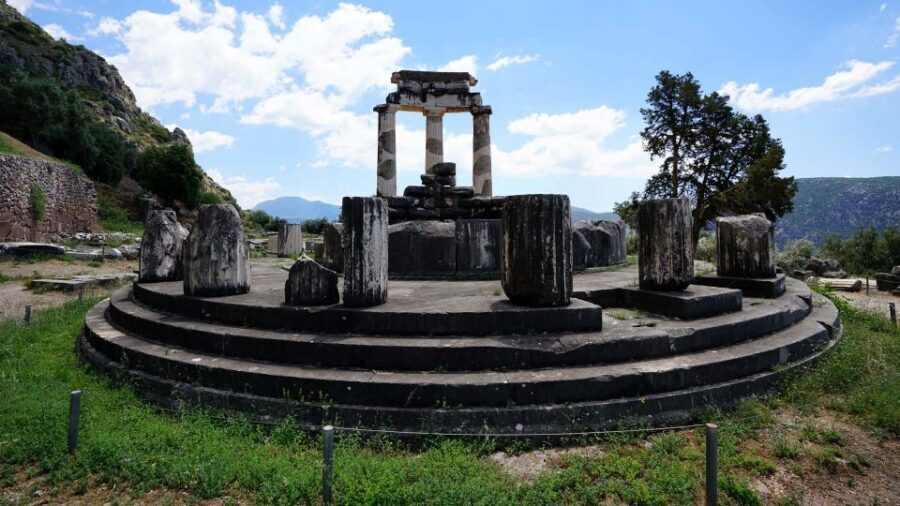
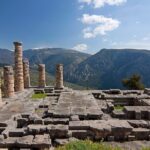
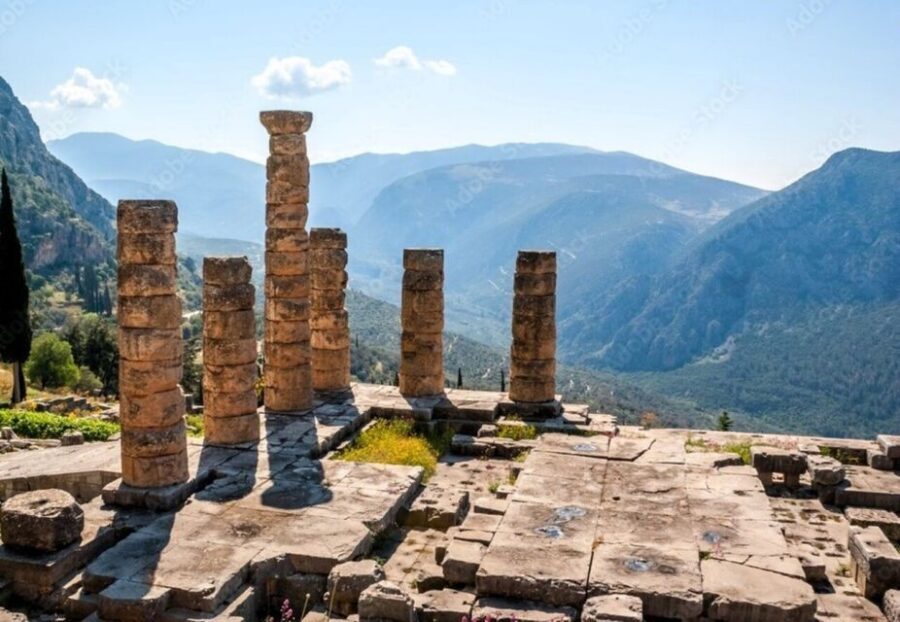
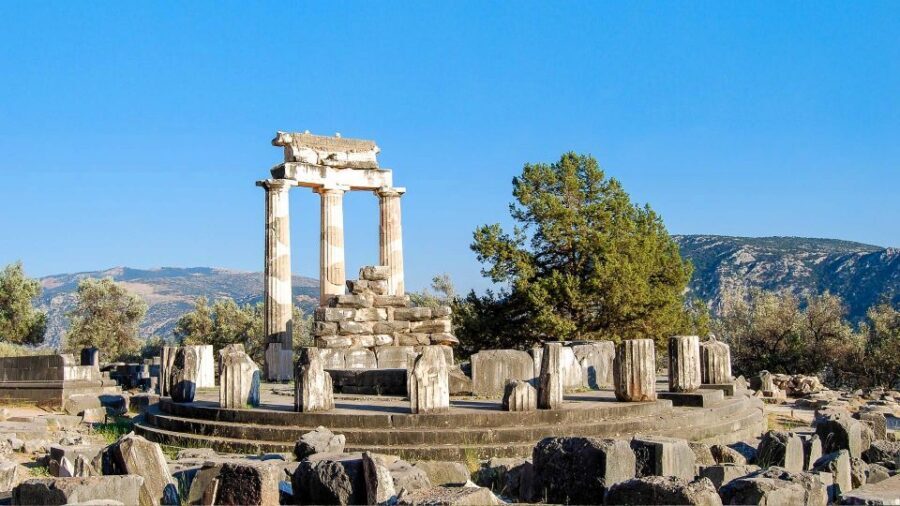
Apollo’s temple area is a must-do focus of the experience. The tour highlights the place where worship and oracle activity connected to the larger sanctuary complex. That connection is key, because Delphi wasn’t only about asking questions—it was about ritual and authority.
When you reach the Apollo-related areas, treat it like a story checkpoint. Use the audio narration to lock onto the meaning of what you’re seeing, then use the visual content to understand the environment around it. Even if the buildings are only partly present, you can still orient yourself through panoramas and videos.
I also like how the tour doesn’t force you to choose between art and story. It links them: the oracle system is tied to Apollo, and Apollo’s presence ties the whole sanctuary together. That makes the site feel less like separate exhibits and more like one cultural machine.
You can also read our reviews of more tours and experiences in Delphi
Charioteer of Delphi and the Sphinx of Naxos: art you can understand faster
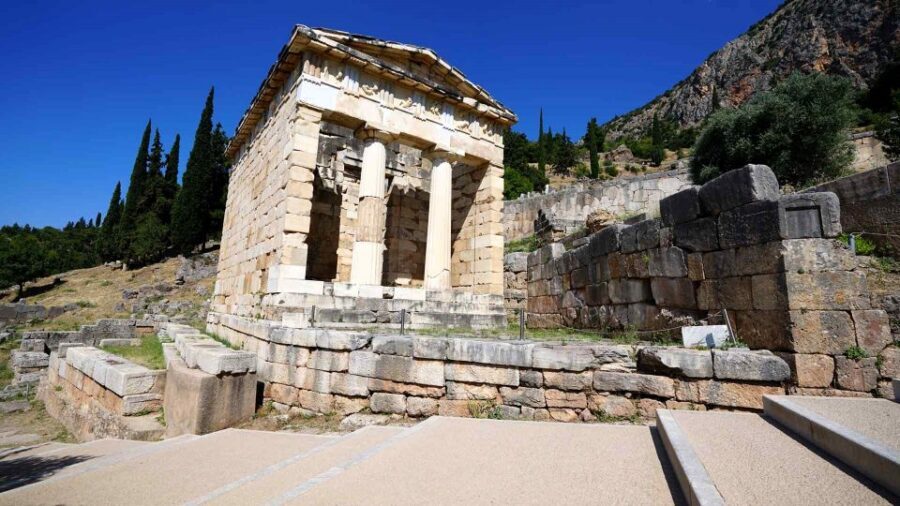
The tour calls out two famous art works: the Charioteer of Delphi and the Sphinx of Naxos. Even if you only catch them for a short moment, it helps that the experience isn’t treating them like random masterpieces. You’re given context for why these items mattered at Delphi.
The value of including these specific monuments is that they represent more than decoration. They’re tied to the prestige of the sanctuary and the kinds of offerings and symbols ancient Greeks brought into this high-visibility religious space.
How to get more out of these stops:
- Slow down before you start your screen content, just to look for shapes, proportions, and surviving details
- Then use the audio or videos to interpret what you’re seeing
- Finally, re-check the object with the new context in mind
If you rush, you’ll still enjoy the sculptures—but you’ll miss the “now I see why it was significant” feeling that comes from pairing visuals and narration.
The Pythian Games: a festival, not just a footnote
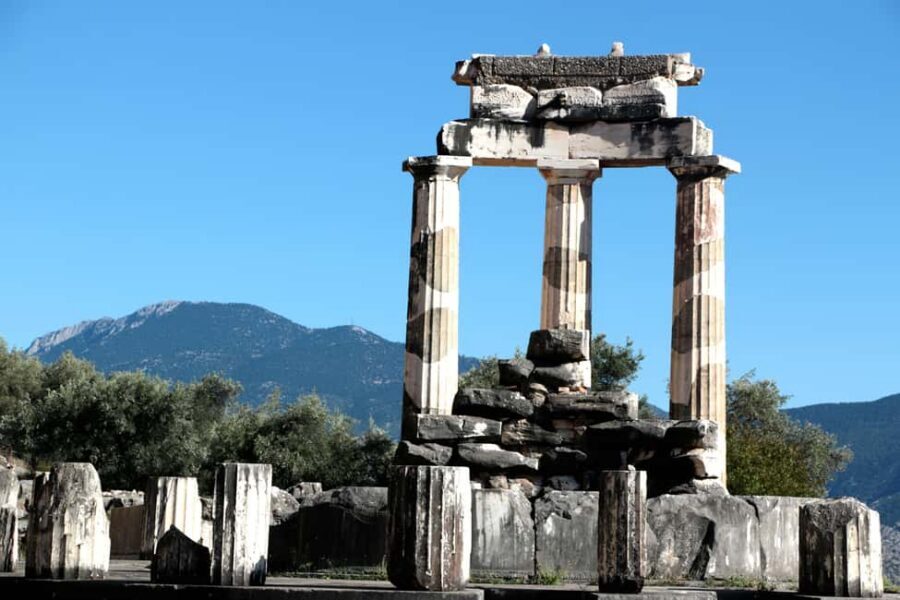
Delphi wasn’t only about prophecy. It also hosted the Pythian Games, described here as one of the biggest panhellenic festivals in antiquity. That’s important because it broadens your mental map of Delphi.
Instead of thinking of the site solely as a place for spiritual consultations, you can see it as a public stage—where competition, culture, and shared Greek identity met in one spotlight location. That helps explain why so many people cared about Delphi and why it attracted visitors from across the ancient world.
When you reach the Games-related content, treat it as a second layer of meaning. It changes the tone of your visit: Delphi becomes not just a sacred center but also a major event hub. That dual role is one of the reasons the oracle era lasted so long—religion and public life reinforced each other.
Practicalities: getting there, using your phone, and pacing yourself
This is a self-guided tour focused on the archaeological site near Central Greece. The easiest way to reach it is by car or taxi. You’ll follow the Athens–Thessaloniki motorway and take the exit to Livadia, and then use other routes shown in maps or GPS. Public transport is also an option via bus, depending on schedules.
On the ground, plan around comfort and heat. Bring sun protection and comfortable shoes. Delphi is a place where the ground can be uneven, and you’ll want to stop frequently for audio and visuals.
Phone and tech checklist (don’t skip this):
- You’ll need a charged smartphone and ideally earphones
- Internet access is required for effective use
- Download the content while on Wi-Fi before you go if you don’t have enough data
- You’ll need about 200MB of storage space
- The self-guided tour works with iOS 11.0 or later and Android 5.1 or later
Also, expect an email after booking with instructions to download the content, and check your spam folder. It’s a small thing, but it can save you from arriving and finding your app isn’t ready.
Pacing tip: don’t try to do every monument in one long sprint. With this style of content, you’ll get more by doing fewer stops with attention at each one. Think short pauses, then move on.
Price and value: why $7.89 can be a smart deal here
At $7.89 per person, this sits in the “budget-friendly” zone—but the real value is what you receive for that price. You’re not just buying access to a few audio tracks. You get:
- Written info for 16 monuments
- Audio for 14 monuments
- 3D models for 14 monuments
- 360° panoramas for 14 monuments
- Immersive videos for 14 monuments
- Related stories for 12 monuments
- A gift of 68 written and audio culture facts about ancient Greece
Entrance fees are not included, so you’ll still want to budget for the archaeological site entry. But if you already plan to pay that anyway, the $7.89 is mainly funding the interpretation layer—the parts that help ruins make sense.
This is also good value because language coverage is broad. The audio guide includes English, Spanish, Greek, German, Italian, Dutch, French, Chinese. So if you’re traveling with someone who doesn’t want to rely on a single language, this format can handle it.
Where you should be cautious is where many digital tours fail: battery life, internet access, and device compatibility. If your phone struggles, you’ll feel that price quickly evaporate into frustration.
Who should choose this Delphi audiovisual tour
This works best if you fit one of these travel styles:
- You like learning on the move, with short story stops instead of long museum sessions
- You’re comfortable using a smartphone as your guide
- You want art context and oracle context woven together, not separated into different visits
- You’d rather control pacing than follow a group
It may not be the best fit if you want a live guide to field questions, because this experience doesn’t include guide services. It also isn’t designed to handle food planning or transit pickup/drop-off, so you’ll plan those separately.
If you like structure but hate rigid schedules, this hits a sweet spot. You get a set of monuments and content, but you decide how long to linger.
Should you book this Delphi self-guided experience?
I’d book it if your goal is to understand Delphi quickly and meaningfully, without needing a guidebook the size of a brick. The combination of oracle storytelling, named art highlights like the Charioteer of Delphi and the Sphinx of Naxos, and the heavy visual support (3D, 360, video) is exactly what makes a self-guided format work at an archaeological site.
Skip it or think twice if you’re traveling with a phone battery that can’t reliably handle a day outdoors, or if you don’t want to depend on internet access. Also note that entrance fees and your own device/earphones are on you.
If you can handle the basics, this tour is a strong way to turn Delphi from famous ruins into a place with clear ideas.
FAQ
Is the entrance fee included in the $7.89 price?
No. Entrance fee is not included.
How long is the tour?
It’s listed as lasting 5 days. You should check availability to see starting times.
What content is included for monuments?
You get monument identification with an integrated map, written historical info for 16 monuments, and audio for 14 monuments, plus 3D models, 360° panoramic views, and videos for 14 monuments. You also get related stories for 12 monuments.
Are there audio guides in multiple languages?
Yes. Audio is available in English, Spanish, Greek, German, Italian, Dutch, French, and Chinese.
Do I need internet to use the tour?
Yes. Internet access is required to use the tours effectively.
Do I need to download the content before arriving?
Yes, you should download the content while on Wi‑Fi prior to your visit unless you have sufficient data.
How much storage does the tour require?
You’ll need about 200MB of storage space on your phone.
Can I use the tour after my visit?
Yes. The self-guided tour can be used anywhere anytime—before, during, or after your visit.
What should I bring?
Bring a charged smartphone, sun hat, water, and comfortable shoes (earphones are also recommended so audio is usable).
FAQ (booking and logistics)
Is free cancellation available?
Yes. You can cancel up to 24 hours in advance for a full refund.
Can I reserve without paying right away?
Yes. The option says reserve now & pay later.