REVIEW · ATHENS
Acropolis monuments & Parthenon Walking Tour with Optional Acropolis Museum
Book on Viator →Operated by Athens Walks Tour Company · Bookable on Viator
The Acropolis reads like a live textbook. I love the way you start early, walk right up to the hill, and get skip-the-line help so you can spend your time where it counts: the stone. And I really like how a licensed guide turns the ruins into stories, with details you miss when you’re just scanning from the ground.
You’ll also enjoy the small-group feel (max 20) and the sound support. You’ll likely hear everything through an audio/whisper-style system, which matters on windy days and crowded paths. The main drawback is physical: expect steep climbs and lots of standing while you listen. Also, the price can jump if you don’t choose the option that includes entry fees for the Acropolis and the Acropolis Museum.
In This Review
- Key highlights at a glance
- Entering the Acropolis with a guide instead of a map app
- Meeting at Porinou 5 and getting tickets handled quickly
- Theatre of Dionysus and Herod Atticus: Athens before the temples
- Propylaea as your checkpoint into sacred space
- Temple of Athena Nike: the “Victory” temple you’ll notice more once explained
- Parthenon time: what you should focus on besides the photos
- Erechtheion and the caryatids: why the details feel special
- Optional Acropolis Museum: the fastest way to make the ruins stick
- Price and value: how $42.33 becomes a full-day decision
- Who should book this Acropolis walk, and who should rethink it
- Final call: should you book this tour?
- FAQ
- How long is the Acropolis monuments and Parthenon walking tour?
- Where do we meet, and where does the tour end?
- Are tickets included in the price?
- Do we have to buy museum tickets separately?
- Is the tour very physically demanding?
- Can I cancel if plans change?
Key highlights at a glance

- Early-morning start near the Acropolis so you’re walking while the city is still waking up
- Small groups (20 max) that keep the pace human and photo stops actually workable
- Clear audio support using a whispered/headphone style system for groups larger than 5
- Guided stop-by-stop route across the Acropolis hill from theater sites to the Parthenon
- Optional Acropolis Museum add-on to match what you saw above ground with artifacts
Entering the Acropolis with a guide instead of a map app

The Acropolis hits you fast. Even before you reach the big names, the hilltop setting makes everything feel more serious. This tour is designed to help you understand what you’re looking at while you’re still standing in the exact spot where it happened.
A huge part of the value is interpretation. Guides like Lisa, Aidli, Anna, Dionysus, Dorina, and John D come across as people who study the site, then translate it into plain language. You don’t just get dates. You get why the buildings matter, how the Greeks used space on the hill, and what later eras changed or repurposed.
You also avoid the common beginner mistake: wandering in circles. A good route helps you “read” the hill from one viewpoint to the next, and you finish with a clearer sense of what’s older, what’s rebuilt, and what’s preserved.
You can also read our reviews of more walking tours in Athens


Meeting at Porinou 5 and getting tickets handled quickly
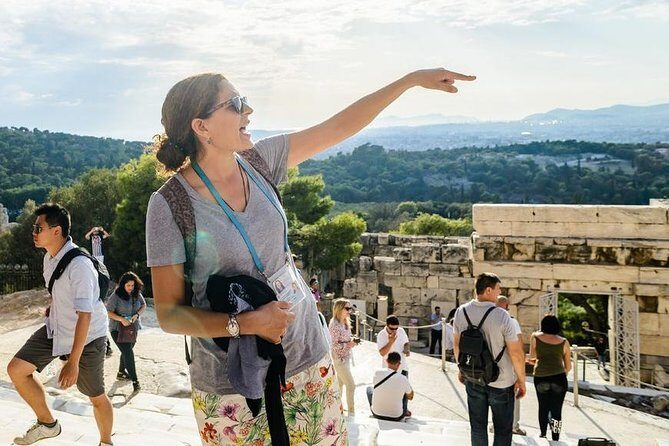
You meet at Porinou 5 (close to the Acropolis). It’s a practical start point, and there’s even WIFI nearby for last-minute sanity checks. From there, you walk the short distance up to the site.
The tour includes “skip the line” with a professional, licensed guide. If you book the version that includes admission, your guide helps with the ticket process (so you aren’t fumbling at the entrance). If you didn’t include tickets, you’ll need to purchase online in advance through the official website, since the Acropolis and museum entry can’t be treated like a same-day casual purchase.
Why this matters for your day: the Acropolis is popular, and small delays add up fast when you’re on a timed tour. The whole point is to spend energy on the ruins, not on logistics.
Theatre of Dionysus and Herod Atticus: Athens before the temples
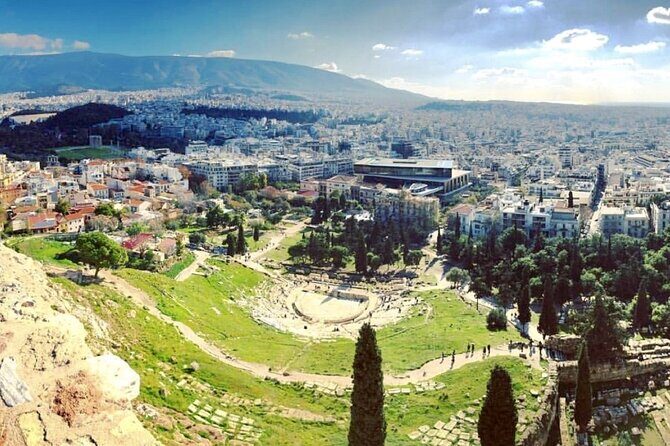
Your walk begins at the edge of the Acropolis story, not with the Parthenon. First up is the Theatre of Dionysus Eleuthereus, built into the south slope of the hill. It’s tied to the City Dionysia festivals, where performance and public life blended in a way that shaped how Athenians thought and celebrated.
Next you pass the Herod Atticus Odeon, a Roman-era stone theater structure completed in 161 AD and renovated in the 1950s. Standing near these spaces helps you notice something: the Acropolis wasn’t only about worship. It also hosted civic and cultural life. That context makes the later temple architecture feel less like random monuments and more like part of a living city.
These early stops are also a good warm-up. They get your eyes into “ancient Athens mode” before the climb and before the most famous structures.
Propylaea as your checkpoint into sacred space

When you reach the Propylaea, you’re basically crossing the threshold into a different world. This monumental entrance is designed to function like a gateway into sacred Athens, and it frames the hill’s interior views in a way that’s hard to recreate on your own.
This is one of those areas where the guide’s role really clicks. You learn what the entrance does visually and symbolically, not just what it’s called. If you’re the type who likes to understand how buildings guide your movement, you’ll appreciate this stop.
It also sets you up for the famous photography moment later. When you know where to look, pictures turn into understanding.
Temple of Athena Nike: the “Victory” temple you’ll notice more once explained
You’ll spend time at the Temple of Athena Nike, which people often describe as the “Victory” temple. It dates to around 420 BC and is considered the earliest fully Ionic temple on the Acropolis.
This is a compact stop, but it’s not a throwaway. The style and design details matter, especially if you’ve spent the morning trying to figure out the difference between Greek architectural orders and why the Greeks bothered. A guide can point out how the form supports the temple’s meaning and how it fits into the hill’s bigger layout.
If you’re into architecture, this stop is a win because it teaches you to look at craftsmanship, not just mass and size.
You can also read our reviews of more museum experiences in Athens



Parthenon time: what you should focus on besides the photos
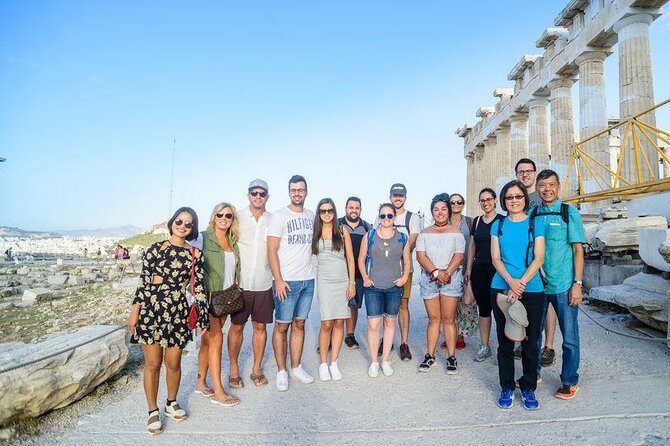
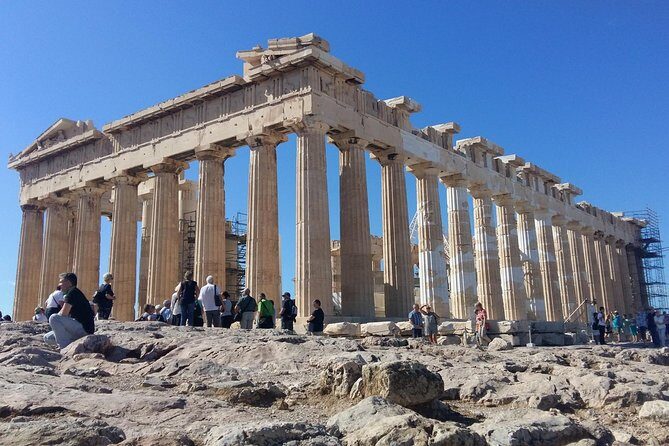
Then comes the Parthenon, the star of the show. Plan for a longer stop here, because the place rewards attention. Even if you’ve seen it in postcards, you’ll get more out of it if you slow down and listen to the building’s story.
A guided explanation helps you understand the Parthenon not as a single object, but as a design built for specific purposes—religious, political, and artistic. The Parthenon also works best when you know where your eye should go. The guide’s job is to get you past the “look at the big temple” stage and into the “what is the system of the building” stage.
Practical tip: this is a spot where standing still gets tiring. If you need breaks, don’t wait until you’re frustrated—take a quick pause as you transition between viewpoints.
Erechtheion and the caryatids: why the details feel special
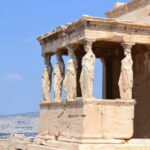
Next is the Erechtheion, famous for its caryatid statues. If you’ve ever wondered why people react strongly to this building, it’s because the figures are not passive decoration. They’re part of the architecture’s structure and its emotional impact.
At this stage, your understanding from earlier stops starts paying off. When you connect the theater, the gateway, and the “Victory” temple to the Erechtheion, the Acropolis feels like a single designed world instead of scattered landmarks.
This stop is short compared to the Parthenon, but it tends to linger in memory. If you enjoy characterful sculpture and want to see how Greek art shows up in architecture, you’ll like this part.
Optional Acropolis Museum: the fastest way to make the ruins stick
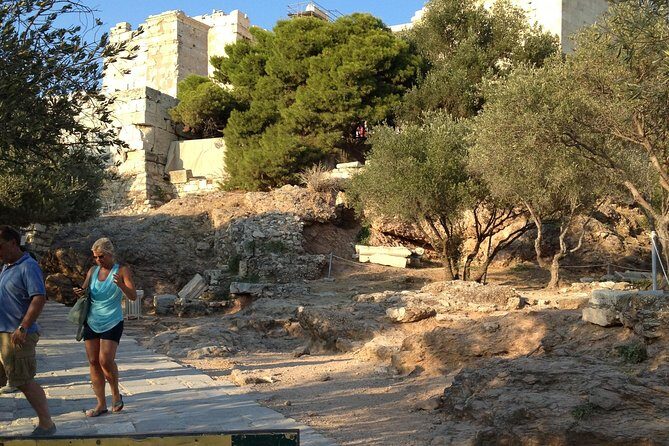
The optional Acropolis Museum visit is where a guided walk turns into real comprehension. After you’ve spent time up on the hill, the museum lets you see artifacts that explain what you just stood beside.
The museum visit is about an hour in length (when you choose the museum option). That time is typically spent on the most important pieces that connect directly to the Acropolis buildings—especially items tied to the Parthenon.
This is also a good reality check. Ruins are inspiring, but they can be hard to interpret when you can’t see what the original decoration looked like. The museum helps you “complete the picture” without you needing to research for hours.
And it’s practical: many people find the museum a better place to linger after the uphill effort. You’re not climbing anymore; you’re learning with comfortable pacing.
Price and value: how $42.33 becomes a full-day decision
The tour price is $42.33 per person for the guided experience (about 4 hours). That’s not just someone walking you around. You’re paying for a licensed guide, skip-the-line support, and a small group format (max 20). You’re also paying for the audio system that keeps you from missing key explanations.
The tricky part is that entry fees can be separate depending on the option you choose. If you book without tickets, you’ll need to buy Acropolis entry online in advance. The Acropolis entry can be €30 per adult from April 2025 and €10 per adult from November to March. The Acropolis Museum is €20 per adult from April 2025.
So what’s the “value” math? If you include tickets, you’re paying one bundled price for a full guided package plus access. If you skip tickets, you can manage costs if you already know you’ll qualify for discounts or you’re comfortable buying timed tickets online ahead of time.
If you’re short on time or you hate planning admin, the ticket-included option usually makes more sense.
Who should book this Acropolis walk, and who should rethink it
This is a great choice for first-time Athens visitors and history fans who want more than a self-guided photo hunt. If you like hearing the myths and the architectural reasoning in the same conversation, you’ll probably enjoy the flow.
It also suits solo travelers fine. The small-group size and audio system make it easy to follow along without feeling lost.
The main consideration is physical effort. You should have moderate fitness. Expect steep climbs and plenty of standing while the guide talks. If stairs and long uphill walks drain you fast, plan your breaks carefully—or consider a less walking-heavy format.
Final call: should you book this tour?
I’d book it if you want the Acropolis to make sense quickly. The combination of skip-the-line help, small-group pacing, and guided interpretation at the Parthenon and Erechtheion is exactly what turns this site from impressive to memorable.
I’d hesitate only if you’re very sensitive to uphill walking and standing. Also, if you’re the type who forgets to buy tickets online ahead of time, pick the option that includes admission so you don’t scramble.
FAQ
How long is the Acropolis monuments and Parthenon walking tour?
It runs about 4 hours (approx.). If you add the Acropolis Museum option, the museum visit adds about 1 hour.
Where do we meet, and where does the tour end?
You meet at Porinou 5, Athina 117 42, Greece. If you book the option with the museum, the tour ends at Acropolis Museum, Dionysiou Areopagitou 15, Athina 117 42. If you book only the Acropolis monuments, you end at the Acropolis monuments.
Are tickets included in the price?
Tickets are included only if you choose the option with entrance tickets. If you do not choose tickets, you must purchase Acropolis entry online in advance. Acropolis entry is listed as €30 per adult from April 2025 and €10 per adult from November to March. Acropolis Museum entry is listed as €20 per adult from April 2025.
Do we have to buy museum tickets separately?
If you select the option that includes the Acropolis Museum, museum admission is handled as part of that option. If you don’t select it, the museum visit is not included.
Is the tour very physically demanding?
It requires moderate physical fitness. Expect steep climbs and lots of standing and walking on the paths around the hilltop.
Can I cancel if plans change?
Yes. Free cancellation is available up to 24 hours in advance for a full refund. If the tour is canceled due to poor weather, you’ll be offered a different date or a full refund. If minimum traveler numbers aren’t met, you’ll also be offered a different date/experience or a full refund.




More Walking Tours in Athens


More Tours in Athens


More Tour Reviews in Athens
- All Day Cruise -3 Islands to Agistri,Moni, Aegina with lunch and drinks included
★ 5.0 · 4,958 reviews