REVIEW · ATHENS
Acropolis: Acropolis and Parthenon Guided Walking Tour
Book on GetYourGuide →Operated by Athens Walks Tour Company · Bookable on GetYourGuide
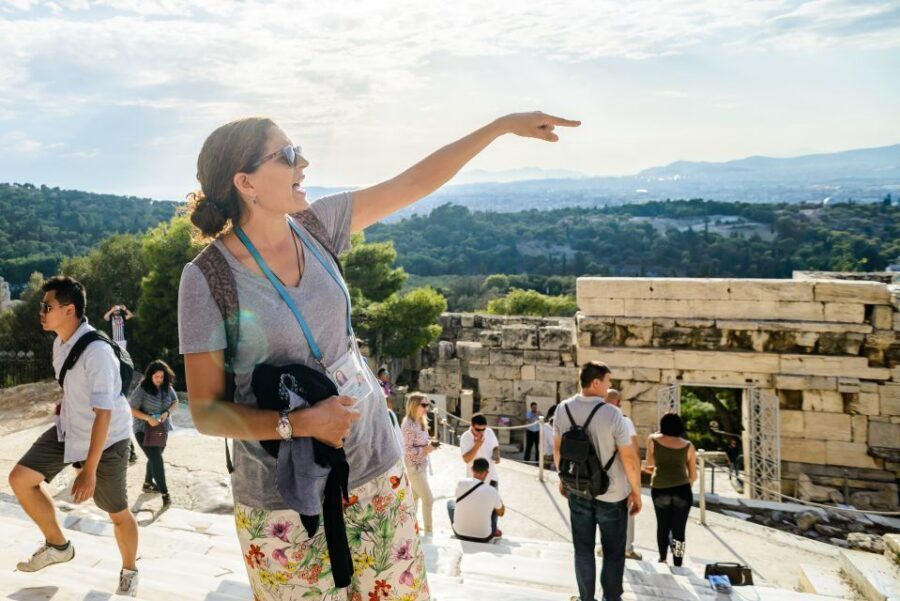
The Acropolis hits you like a movie set. This guided walk strings together the key sights of ancient Athens, from the Theatre of Dionysus up toward the Parthenon, with a licensed guide who explains what you’re seeing and why it mattered. I especially liked the wireless hearing devices (you can actually hear the guide on a crowded hill) and the skip-the-line approach that helps you spend time on stone and views instead of ticket queues. The one catch: it’s a climb, and it’s not suitable for wheelchair users, so bring comfortable shoes and expect some uphill walking.
I also like how the route balances big icons with meaningful stops, including places like the Odeon of Herodes Atticus and the Erechtheion with its famous Caryatids. You’ll get panoramic Parthenon views over Athens at the top, and if you choose it, the tour can tie in the Acropolis Museum (English option). The meeting point at Porinou 5 is just a short walk from the Acropolis metro station, so you can start without a headache.
In This Review
- Key tour takeaways (what matters on the ground)
- Why the Acropolis-Parthenon route feels different from a random walk
- Porinou 5 to the Acropolis: meeting smart and entering fast
- Theatre of Dionysus and the Asklepieion: setting the stage for ancient Athens
- Odeon of Herodes Atticus: where the guide gives the ruins context
- Temple of Athena Nike and Propylaea: the approach that changes your perspective
- Erechtheion and the Caryatids: myth you can point at
- Parthenon time: precision, purpose, and the view over Athens
- Acropolis Museum add-on: when you want the story to continue
- Pacing, crowds, and what to bring for an easier climb
- Price and value: what you get for $36.14
- Should you book this Athens Acropolis and Parthenon guided walk?
- FAQ
- FAQ
- How long is the Acropolis: Acropolis and Parthenon Guided Walking Tour?
- Where do I meet the guide?
- What languages is the tour offered in?
- What’s included in the tour price?
- Does the tour include the Acropolis Museum?
- Which monuments are visited during the tour?
- Do I need to buy entry tickets, or are they included?
- What should I bring to the tour?
- Are there any restrictions on who can join?
- What is the cancellation policy?
Key tour takeaways (what matters on the ground)
- Wireless hearing devices so you don’t miss the story while groups bunch up
- Skip-the-line entry that saves real time during peak hours
- Myth + architecture at the Erechtheion (Caryatids and Athena vs Poseidon)
- Propylaea Gates before the Parthenon moment, like an entrance scene
- Parthenon panoramas that connect ancient ruins to modern Athens
- Optional Acropolis Museum add-on for extra context and a smoother ending
Why the Acropolis-Parthenon route feels different from a random walk
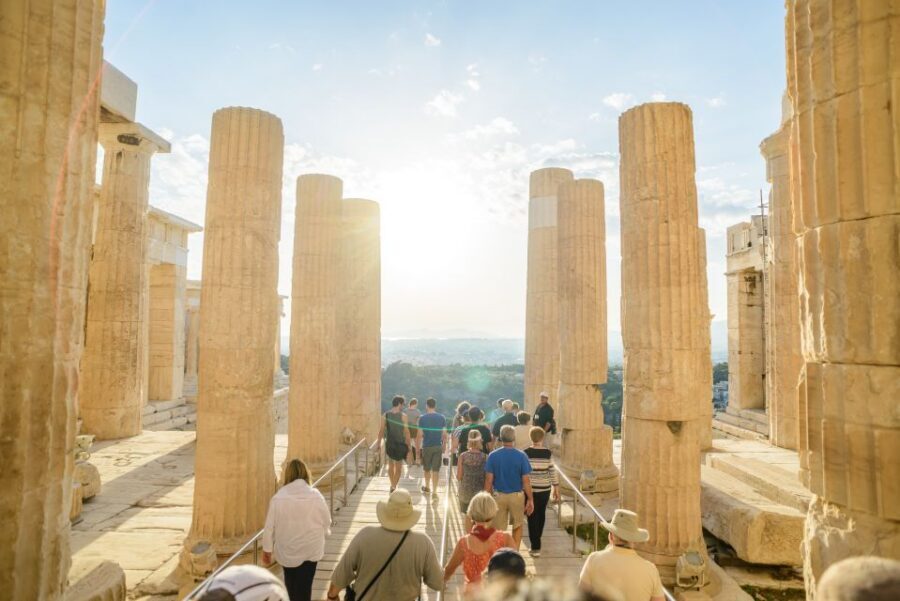
Athens’ Acropolis can feel like one long photo stop if you show up without context. This tour gives you a guided line to follow, so the stones make sense as you move. You start down with the Theatre of Dionysus, then work your way up through iconic gateways and temples before landing at the Parthenon.
What makes this work is the way the guide connects architecture to everyday life in ancient Athens: theater as civic culture, temples as places of worship and power, and the Parthenon as a statement about the city. It’s not just history as facts on a wall. It’s history as a path you walk.
Value-wise, $36.14 per person is a practical deal for what you get: a licensed guide, included wireless audio, and skip-the-line access depending on your selected option. For a visit built around a 2-to-4-hour window, it’s one of the easier ways to get more meaning per hour (and fewer wrong turns).
You can also read our reviews of more walking tours in Athens


Porinou 5 to the Acropolis: meeting smart and entering fast

The tour meets at the Athens Walks tour office at Porinou 5, 11742, and it’s listed as about a two-minute walk from the Acropolis metro station. That matters more than it sounds. In central Athens, you don’t want to spend your best light hour hunting for the correct corner.
From there, the group’s goal is simple: get you moving with a clear plan. A big part of that is the skip-the-line entrance. Even when you’re at the front of the crowd crush, lines can turn into a slow-motion eternity. The separate entrance and pre-arranged process help you avoid that fate.
You’ll also be using wireless hearing devices, which is a lifesaver on the Acropolis. The terrain and crowding make normal conversation useless. One more small tip: if the group bunches up, try to stay close enough to your guide so the audio stays crisp.
Theatre of Dionysus and the Asklepieion: setting the stage for ancient Athens

Before you reach temples and viewpoints, you start at the Theatre of Dionysus. This stop is the perfect warm-up because it reminds you that classical Athens wasn’t only about marble. It was also about public life, stories, and performances.
The tour specifically frames the Theatre of Dionysus as the birthplace of drama and notes it as the oldest Greek theatre still in existence. When you’re standing among ancient stone seats, it’s easier to picture the audience and the energy of performances—rather than treating the Acropolis as a collection of monuments with no connection to real people.
Next comes a guided visit to the Asklepieion of Athens for about 10 minutes. Asklepios was tied to healing in ancient Greek culture, and this quick stop helps you see the Acropolis area as more than just a religious summit. You’re building a bigger map of what mattered to Athenians.
The trade-off here is time. These opening stops are short, so wear comfortable shoes and keep your camera ready. You’ll move quickly, and the reward is that the climb feels purposeful instead of random.
Odeon of Herodes Atticus: where the guide gives the ruins context

After the theatre energy, you’ll spend time at the Odeon of Herodes Atticus (listed as a guided stop). The highlights here are less about sitting still and more about learning how this space fits into the broader world of gatherings and culture.
The guide’s job is to turn the remains you see into something you can understand. With a good guide, the Odeon stop becomes a bridge between the Theatre of Dionysus at the start and the temple-heavy sections higher up.
One practical point: the Acropolis area can be crowded, and groups from multiple tours overlap. The advantage of a guided flow is that you don’t waste time trying to figure out what to see next. You just follow the logic.
Temple of Athena Nike and Propylaea: the approach that changes your perspective
Once you’re above the first cluster of sights, the tour hits two momentum builders.
First is the Temple of Athena Nike. This is a guided stop and helps set the tone for what comes next: the Parthenon area isn’t a single building. It’s a whole sacred zone, shaped for worship and civic symbolism.
Then you reach Propylaea, the imposing entrance gateway, guided for about 15 minutes. The tour description emphasizes the grandeur and symmetry of the gateway, and that’s exactly how it feels when you’re walking toward it: like the entrance to an important chapter.
This is also where you’ll start noticing the rhythm of the climb. People underestimate how quickly your legs tire once you’re moving uphill with pauses for photos and explanations. The good news is that the stop lengths are designed so you’re not stuck in one place too long.
You can also read our reviews of more guided tours in Athens




Erechtheion and the Caryatids: myth you can point at
If the Parthenon is the headline, the Erechtheion is the scene-stealer.
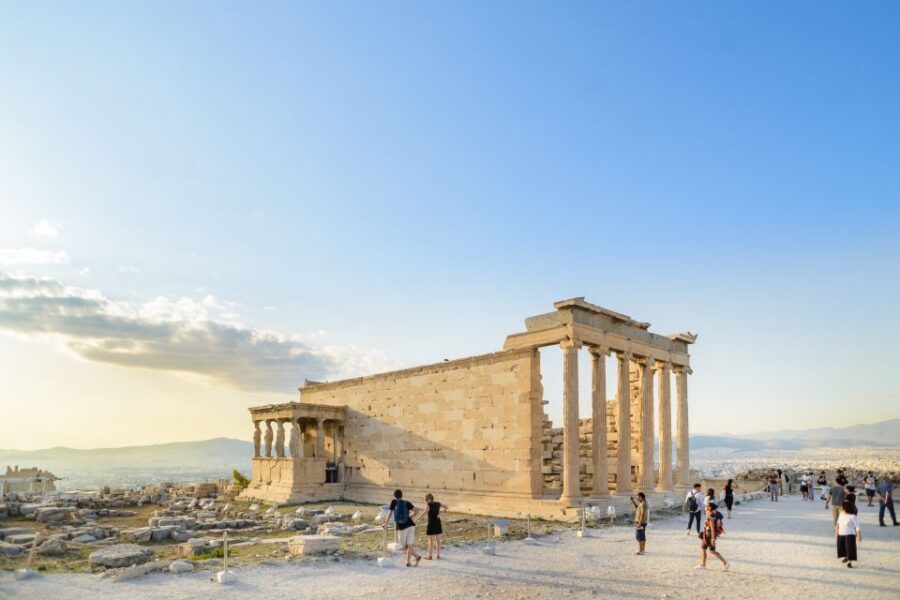
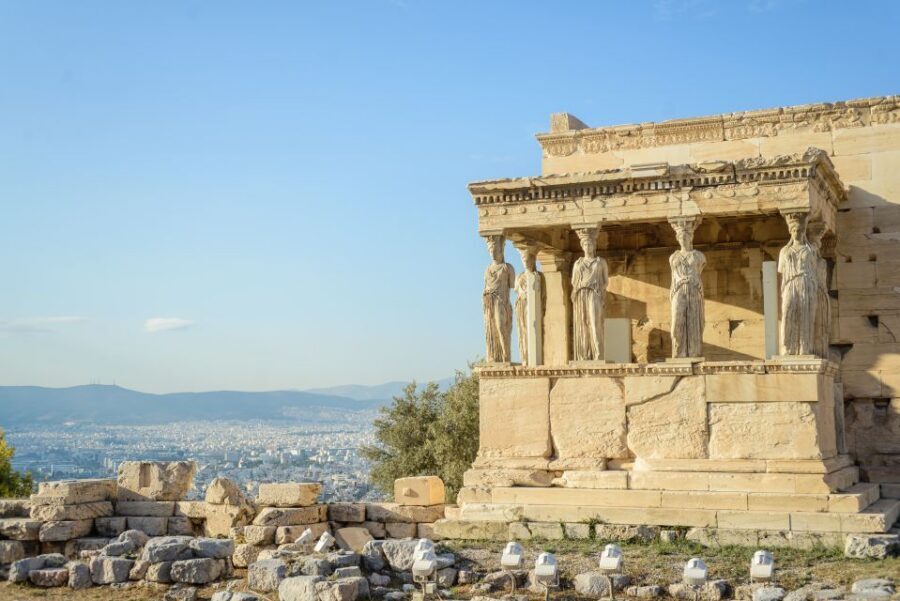
This guided stop (about 15 minutes) focuses on the temple’s distinctive design and, most importantly, the Caryatids—the carved female figures used as supporting columns. Even if you don’t memorize names and dates, you’ll remember the shapes and poses. They’re like stone stand-ins for characters in a story.
The tour also ties the Erechtheion stop to mythology, including the contest between Athena and Poseidon for patronage of the city. When you connect that myth to the temple’s sacred setting, it stops being abstract. You start understanding why these myths were told and retold: to make the city feel chosen and meaningful.
One consideration: this part is a photo favorite, so the area can get busy. If you’re fast with your shots, you’ll be glad you’re moving with the group instead of lingering alone.
Parthenon time: precision, purpose, and the view over Athens

The tour’s peak is the Parthenon stop, guided for about 30 minutes. This is where you get the most “how did they do that” energy, because the guide highlights the Parthenon’s purpose as a sanctuary for the goddess Athena and frames it as a symbol of Athens’ power and influence over the ancient world.
The description also points out the ancient Athenian architects’ precision and skill. That matters because the Parthenon isn’t only a landmark. It’s proof that the city invested serious effort into creating a structure that reads as both sacred and political.
Then the timing improves the whole experience: after you take in the building itself, you’re set up to enjoy panoramic views of Athens from the Acropolis hill. This is the moment when the ruins and the modern city stop being separate worlds. You can actually see how the Acropolis dominates the city’s geography, even now.
If you’re sensitive to heights or crowds, arrive with a calm plan. Stay with the group where you can hear your guide clearly. Take a breath. Let the view do its work.
Acropolis Museum add-on: when you want the story to continue

The tour lists the Acropolis Museum as part of the experience only when you select that option. If you choose the English version, you can get a guided visit there with skip-the-line entry to the museum.
This add-on is useful if you want objects and context that your eyes can’t fully reconstruct on the hill. The museum tends to help you “translate” what you saw at the monuments into something more tangible: materials, details, and interpretation.
One confusing detail to watch: the activity end note says it ends back at the meeting point, but the listed end point also mentions the Acropolis Museum. The safest move is to confirm what your selected option does for timing and where you finish.
Either way, the Acropolis Museum can be a strong follow-up because it extends your understanding instead of ending with a single, final panorama.
Pacing, crowds, and what to bring for an easier climb
This is a walking tour, and it’s not designed for people who want zero exertion. The Acropolis can feel steep, and you’re walking a circuit of multiple monuments plus guided stops.
A few practical tips from how the tour runs:
- Wear comfortable shoes. You’ll walk and stand on stone surfaces.
- Bring a sun hat and sunscreen. Athens sun doesn’t care about your itinerary.
- Expect crowding, especially around popular stops. One day can feel fine; another day can feel like a school field trip reunion.
- The wireless hearing devices help a lot, but they work best when you’re reasonably close to your guide, since distance and noise can affect clarity.
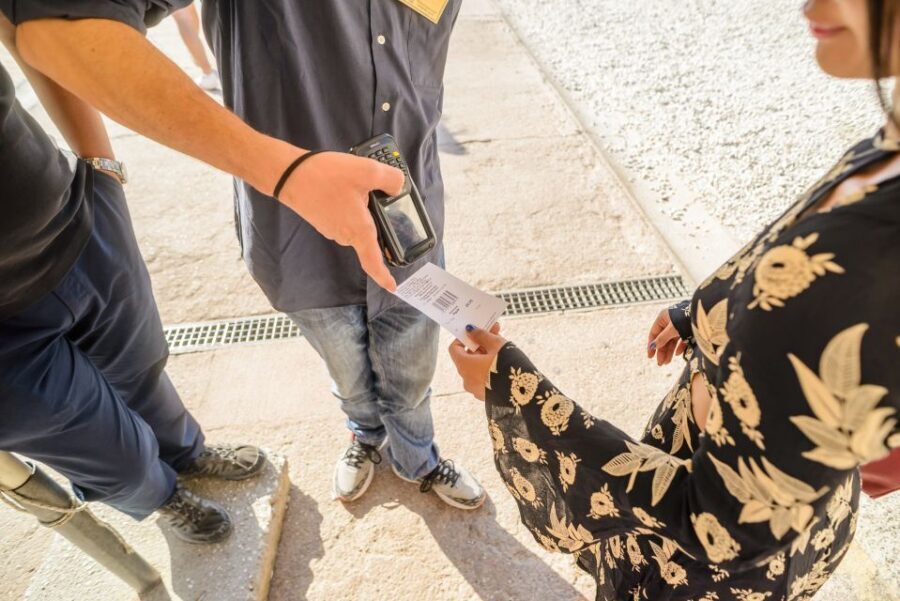
Passport matters too. The tour asks you to bring a passport or ID card. If you’re under 25, you may need to show a photo of your passport or ID to access reduced ticket fees. Also noted: entry is free for those with an EU Disability Card, and in that case you should choose the option without an entry ticket.
Restrictions are straightforward: no pets, no smoking, and no luggage or large bags. And again, it’s not suitable for wheelchair users.
Price and value: what you get for $36.14
At $36.14 per person, this tour prices like a serious value if you want a guided experience you can trust. You’re paying for three things that matter on the Acropolis:
- A licensed guide who explains what you’re seeing and keeps the story moving.
- Wireless hearing devices that help you actually understand the tour instead of guessing.
- Skip-the-line access, plus entry tickets and museum access only if you select those options.
The key value choice is in the options. The tour notes that there are two ticket paths: you can buy online from the official site or pre-buy them as part of the tour option. It also strongly suggests buying options with tickets because it’s common not to find available entrance tickets.
So here’s the practical way to decide: if your dates are fixed and you want peace of mind, pick the option that includes tickets and any museum add-on you want. If your schedule is flexible, you can choose differently, but just know the Acropolis has limited access and sells out.
Should you book this Athens Acropolis and Parthenon guided walk?
You should book if you have a short Athens stay and you want the Acropolis to make sense fast. This tour is a strong fit for first-timers because it hits the major monuments in a logical climb: Theatre of Dionysus, Asklepieion, Odeon of Herodes Atticus, Temple of Athena Nike, Propylaea, Erechtheion with the Caryatids, and the Parthenon.
It’s also a good choice if you hate missing details. The wireless audio and licensed guide format help you keep up even when the hill is crowded. And if you like stories, you’ll appreciate how the guide ties architecture to mythology, including the contest between Athena and Poseidon.
Skip it if you need a fully accessible route (it’s listed as not suitable for wheelchair users), or if you have extremely limited mobility for uphill walking. Also, go in with realistic expectations about time at each stop: you’re getting an efficient, guided sweep, not a slow museum-style linger at each stone.
FAQ
FAQ
How long is the Acropolis: Acropolis and Parthenon Guided Walking Tour?
The duration is listed as 2 to 4 hours. Starting times vary, so you’ll want to check availability for your date.
Where do I meet the guide?
Meet your guide at the Athens Walks tour office at Porinou 5, 11742. The meeting point is about a two-minute walk from the Acropolis metro station.
What languages is the tour offered in?
The live guide is available in English, French, and German.
What’s included in the tour price?
It includes a tour with an expert licensed guide and wireless hearing devices. Depending on the option you select, it may also include skip-the-line entrance tickets and an entry ticket to the Acropolis, plus a guided visit to the Acropolis Museum.
Does the tour include the Acropolis Museum?
Only if you choose the option that includes the Acropolis Museum. The English museum option includes skip-the-line entry to the museum and a guided tour.
Which monuments are visited during the tour?
You’ll visit the Theatre of Dionysus, the Asklepieion of Athens, the Odeon of Herodes Atticus, the Temple of Athena Nike, Propylaea, the Erechtheion, and the Parthenon. The listed finish includes the Acropolis Museum.
Do I need to buy entry tickets, or are they included?
It depends on the option you choose. The activity notes that you can either buy tickets online from the official website or pre-buy them as an option, and it strongly suggests choosing options with tickets because it can be hard to find available entrance tickets.
What should I bring to the tour?
Bring a passport or ID card, plus comfortable shoes, a sun hat, and sunscreen.
Are there any restrictions on who can join?
The tour is not suitable for wheelchair users. Pets are not allowed, smoking is not allowed, and luggage or large bags are not allowed.
What is the cancellation policy?
Free cancellation is available up to 24 hours in advance for a full refund.

More Walking Tours in Athens



More Tours in Athens


More Tour Reviews in Athens
- All Day Cruise -3 Islands to Agistri,Moni, Aegina with lunch and drinks included
★ 5.0 · 4,958 reviews