REVIEW · ATHENS
Private 4-hour Walking Tour of Acropolis and Acropolis Museum in Athens
Book on Viator →Operated by Tour Travel & More · Bookable on Viator
If you only have one day, this tour helps you make it count. I like how it pairs the Acropolis Museum first with the outdoor monuments, so the stories you hear connect directly to what you’re looking at on the hill. I also like that it’s truly private, with a guide who can move at your pace instead of herding you through like part of a stampede.
The biggest heads-up is simple: the Acropolis involves real walking and an uphill climb. You’ll want comfortable shoes and water, especially if you get moving at a steady pace for the full 4 hours.
In This Review
- What really makes this tour work
- Why starting at the Acropolis Museum pays off
- Museum highlights: what to focus on before you climb
- The five museum sectors (and what each one helps you see)
- Time tip
- Climbing to the Acropolis: what you’ll feel and why it matters
- The west-side gate: a quick historical stop that teaches you how sites change
- Parthenon: the main event, explained so you can actually see it
- Propylaea and temple context: the “front door” concept
- Temple of Athena Nike: a small building with major messaging
- A note on the other Athena Nike remains
- Sanctuary of Artemis Brauronia: where women’s rites fit the sacred precinct
- Temple of Rome and Augustus: how empires left their stamp
- Monument of Agrippa: a story you can almost see in the pedestal
- Erechtheion: the caryatids stop feeling weird once you understand why they’re there
- A second pass at Temple of Athena Nike: seeing the remains, not just the facade
- What I think you should watch for during the 4 hours
- Value check: what you get for the price
- Who this tour suits best
- Should you book this private Acropolis walk?
- FAQ
- How long is the private Acropolis and Acropolis Museum walking tour?
- What does the tour cost per person?
- Is admission to the Acropolis and Acropolis Museum included?
- Where does the tour meet?
- Is pickup available?
- What language is the tour offered in?
- Does the price include local taxes and the private guide?
- Are food and drinks included?
- Is this tour private or group?
- Can I cancel for a full refund?
What really makes this tour work
- Admission included: no long ticket-line stress for the Acropolis or the museum.
- Museum first, ruins second: you learn the museum themes before you see the buildings.
- A guide who explains the myths in plain language: you’ll spend less time guessing what you’re looking at.
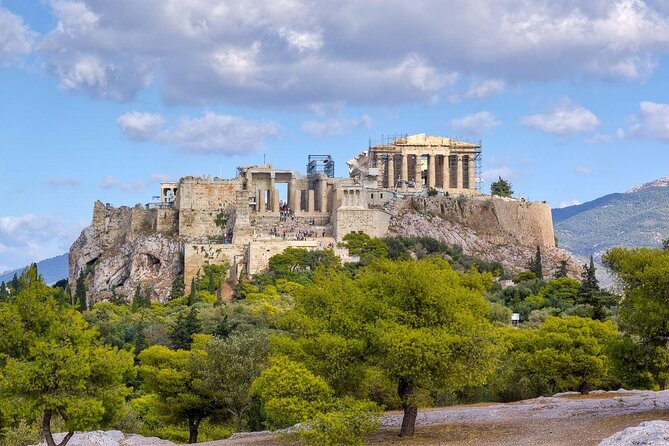
- Stops that match the key monuments: Parthenon, Temple of Athena Nike, Erechtheion, and more.
- Built for your group: private touring means fewer bottlenecks and better pacing.
- Guides with standout communication: names you may encounter include Anna, Kathy, Ioanna, Maria, and Nikos—known for being friendly and organized.
Why starting at the Acropolis Museum pays off
The Acropolis Museum is not a side quest. It’s the part where the site’s details stop being random stone and start becoming a clear story. The permanent exhibition is organized into five sectors, based on where the pieces came from—so you’re not just staring at artifacts, you’re learning how the finds relate to the hill they once decorated.
You’ll typically begin with the museum’s sectors, which is a smart way to avoid the classic Acropolis problem: you get to the Parthenon, and everything feels important but disconnected. Here, the guide helps you connect the sculpture and architectural pieces to the monuments above.
Also, the museum’s design is made to “talk back” to the Acropolis. You might notice how the building mirrors the Parthenon’s orientation and dimension, and how excavated ruins are made visible through the floors. It’s the kind of design that helps your brain line up here’s what we found with here’s where it belonged.
If you care about Greek myths and history, this is where they become practical. The guide can show you how items like reliefs, votive offerings, and larger sculpture pieces fit into real places and real periods—rather than myth as vague bedtime storytelling.
You can also read our reviews of more tours and experiences in Athens.


Museum highlights: what to focus on before you climb
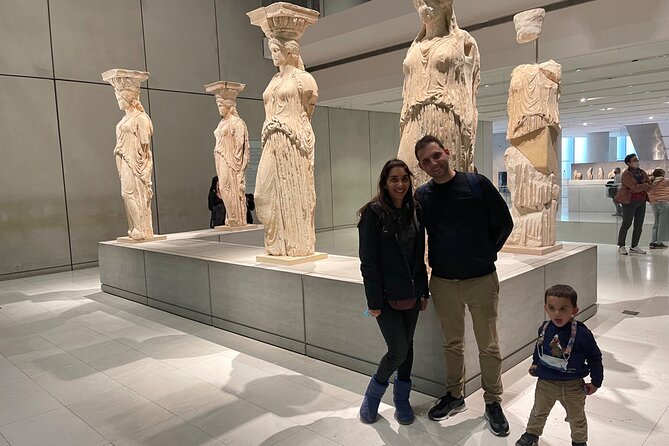
The museum portion is about one hour, and you’ll usually see key parts that frame the rest of the visit. With a guide, you can spend less time wandering and more time landing on what matters.
Here’s what you should expect to hear about as you move through the galleries:
The five museum sectors (and what each one helps you see)
- Acropolis Slopes: everyday objects, reliefs, votive offerings, and pottery details. This sector is great for understanding how devotion wasn’t only for kings—it was for ordinary people too.
- Archaic: earlier works before the Medical Wars, including notable statues like the Moskophorus and the collection of kores.
- Parthenon: the decoration linked to the Parthenon, including parts of the frieze, metopes, and pediments, plus related ancient inscriptions.
- Propylaea / Athena Nike / Erechtheion: the pieces connected to those buildings, which makes the outdoor segment easier to follow.
- 5th century BC to 5th century AD: inscriptions, reliefs, statues of famous people, gods and heroes, and remains from Classical, Hellenistic, and Roman periods.
By the time you step outside, you’re not just seeing monuments. You’re seeing monuments with names attached—and with the reasons behind their placement.
Time tip
Because the museum is admission included and the route is guided, you can focus on the key sectors rather than losing time with decision-making. Use the time to ask your guide the “what am I looking at” questions before your legs start to protest.
Climbing to the Acropolis: what you’ll feel and why it matters
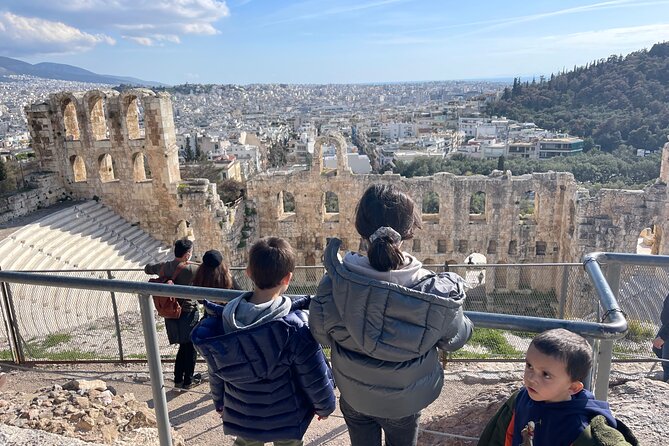
The outdoor portion is about one hour, and it includes a mix of major landmarks and smaller but meaningful stops. Yes, you’re walking uphill, and yes, you’ll want water—this is an efficient route, but it’s still the Acropolis.
That climb is part of the point. The Acropolis sits about 156 meters above sea level, in a strategic position that once dominated the city. Standing up there makes the site’s religious and civic power easier to understand. You start to see why Athens built such an elaborate sacred precinct and why so many monuments were designed to be viewed in sequence.
A guide also helps you avoid the biggest outdoor pitfall: thinking the site is just one big attraction. It’s really a layered complex—fortifications, gates, temples, and sanctuaries built and rebuilt over time.
- All Day Cruise -3 Islands to Agistri,Moni, Aegina with lunch and drinks included
★ 5.0 · 4,958 reviews




The west-side gate: a quick historical stop that teaches you how sites change
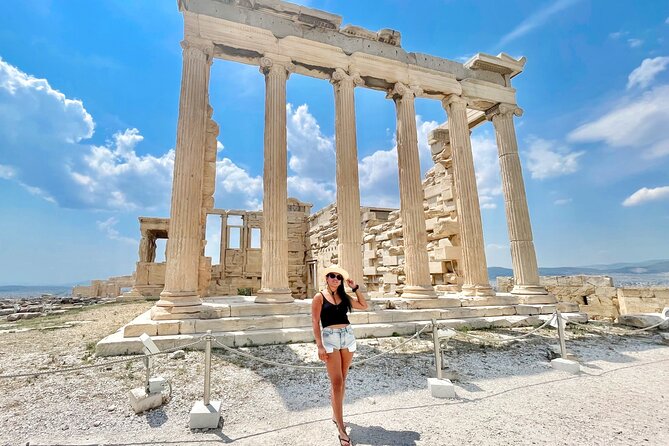
One of the most interesting “in-between” stops is a gate west of the Propylaea. This isn’t a temple you’ll admire from a postcard angle. It’s a protection story.
The gate was built in the 3rd century AD to help secure the sacred precinct after a destructive invasion (the Herulians are mentioned). It sits within a fortification wall erected to the west of the Propylaea.
What makes this stop worth it: you can see reused building material from earlier structures, including material tied to the choregic monument of Nikias (late 4th century BC). There’s also a votive inscription embedded in the wall above the gate’s epistle. In other words, the Acropolis wasn’t frozen in time—it was continually repurposed.
If you want the site to feel alive rather than museum-like, this kind of stop helps.
Parthenon: the main event, explained so you can actually see it
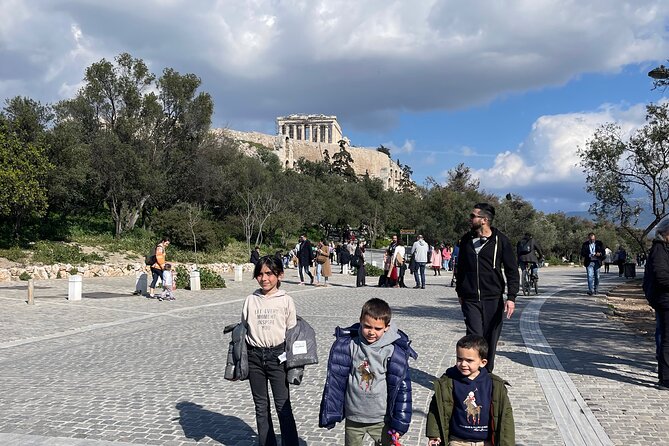
The Parthenon is the star of the Acropolis. It’s also the place where visitors most often get lost in big-name awe without understanding what they’re looking at.
Here, you’ll get a clear explanation of what the Parthenon was built to do. It was constructed between 447 and 432 BC, in Doric style, and created to house the colossal sculpture of Athena Parthenos—made from wood, ivory, and gold—described as twelve meters tall.
With a guide, you don’t just stand there. You learn how the monument’s architecture connects to the religion and politics of Athens at the height of its influence. Your time at the Parthenon is about 20 minutes—enough to orient yourself and learn what to notice, without exhausting yourself on the most crowded photo spot.
Propylaea and temple context: the “front door” concept
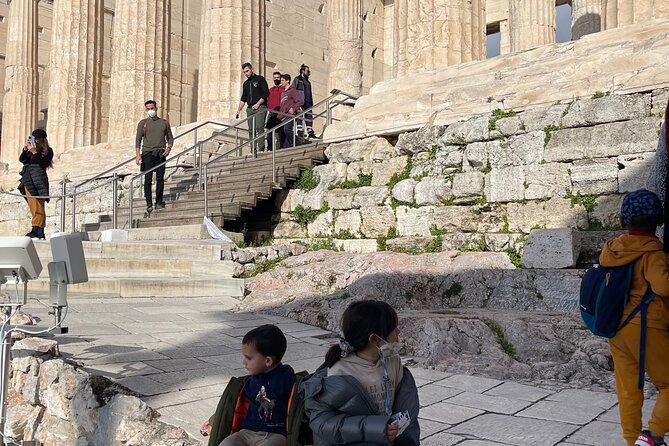
Near the Parthenon area, the guide helps you understand the Propylaea—monumental gates built on the west side of the hill by Pericles (between 437 BC and 431 BC), replacing earlier gates from the time of Pisistratus.
These gates weren’t simple entry points. They were covered with a giant double portico of Pentelic marble. The outer portico includes platforms and Ionic columns supporting a blue marble roof with stars. The front design uses Doric facades with a central intercolumnium wider than the rest, with the roadway passing through.
Even if you don’t study architecture formally, this kind of explanation turns the Propylaea into a roadmap for how the Acropolis was approached, experienced, and staged.
Temple of Athena Nike: a small building with major messaging
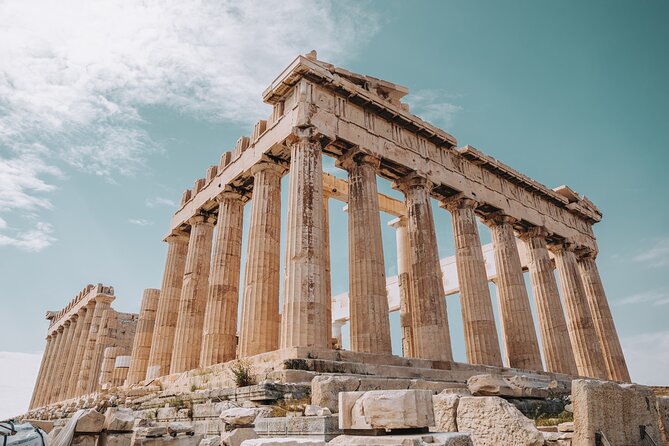
The Temple of Athena Nike is a compact Ionic temple, built between 426 and 421 BC to replace older temples whose remains are preserved nearby.
The frieze is a key focus. You’ll hear about how each side’s imagery tells a different story:
- one side shows a gathering of gods around Zeus enthroned
- other sides feature warfare scenes involving Greeks and Persians, and Greeks with other Greeks
- the south side is connected to the victorious battle at Marathon (490 BC)
Even with limited time—often around 15 minutes—you’ll understand why it mattered that this temple was both artistic and political.
A note on the other Athena Nike remains
Later, the guide may also point out the older temple context: an earlier structure tied to Athena Polias, damaged in 480 BC and again in 406 BC, and never rebuilt. You can see remains of the altar in the bedrock nearby. The description includes that the old temple was Doric peripheral and held a wooden cult statue, the xoanon of Athena.
It’s a good reminder that the Acropolis is not one “thing.” It’s a series of layers.
Sanctuary of Artemis Brauronia: where women’s rites fit the sacred precinct
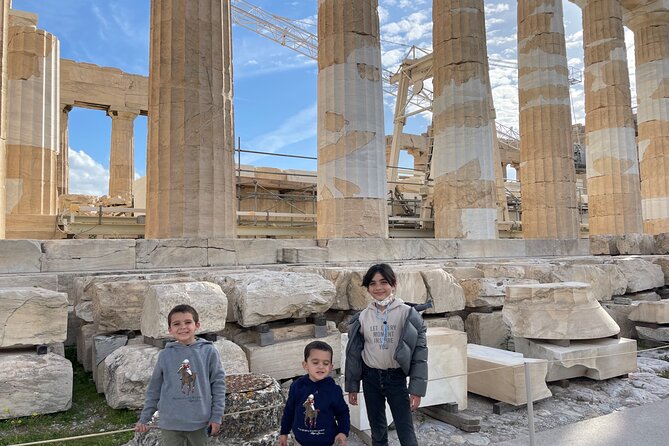
Just south of the Propylaea, within the sacred precinct, you’ll find the Sanctuary of Artemis Brauronion. The guide frames it as a protector of women who were about to give birth and those who had just given birth.
The sanctuary’s likely founded in the middle of the 6th century BC. Architecturally, it’s described as having a pi-shaped Doric stoa with ten columns along the façade, plus rear wall alignment with the southern fortification wall. At both ends, there were enclosed rectangular wings for treasures, and there was also a triangular courtyard with offerings.
Today, only foundation cuts may be visible, but the guide can explain how the shape and access would have worked. One of the notable connections is that a statue head linked to the sanctuary is exhibited in the museum.
This stop is great if you like seeing how worship on the Acropolis covered more than just the famous public myths.
Temple of Rome and Augustus: how empires left their stamp
This stop shifts the story from ancient Athens straight into Roman-era presence. The Temple of Rome and Augustus was erected in the late 1st century BC.
It’s described as small and circular, with a single row of nine Ionic columns, no interior wall, and a conical roof entirely of white marble. The inscription on the temple’s epistle says it was dedicated by the city of Athens to the goddess Rome and to Octavian Augustus.
Even if you don’t spend a lot of time here (around 10 minutes), it’s a useful reality check: the Acropolis kept being meaningful after Athens’ peak. People kept using the space and redefining it for their era.
Monument of Agrippa: a story you can almost see in the pedestal
Next up is the Monument of Agrippa, built on a scale comparable to the Temple of Athena Nike.
The description ties its origin to a victory celebration connected to the Panathenaic games. It was built in 178 BC to honor Eumenes II of Pergamon, commemorating his victory in the chariot race. A bronze quadriga (four-horse chariot) was placed on top. Later, the quadriga was replaced around 27 BC, dedicated by Athens to Marcus Agrippa.
The key detail: today, only the pedestal is preserved. It’s made of gray-blue Hymettus marble and stands 8.91 meters high on a stepped base of stone and tufa.
This stop is a good example of how the guide helps you “read what’s missing.” You look at what remains, and you learn what used to be on top.
Erechtheion: the caryatids stop feeling weird once you understand why they’re there
The Erechtheion is one of the most memorable stops on the tour, not just for its Caryatids but for how it was designed to respect a complicated sacred landscape.
The guide explains that the Erechtheion was built to house rituals tied to an earlier temple, and to accommodate uneven terrain without disturbing important shrines—like altars to Poseidon (Erechtheus) and Hephaestus, and the spot connected to Poseidon striking the Acropolis with his trident.
Architecturally, it includes two porticoes (protaseis):
- a northwest portico supported by tall Ionic columns
- a southwest portico supported by six female statues, the famous Caryatids, holding up the roof
This is where the guided pacing helps. If you rush, you’ll miss the “why this design makes sense” part. If you slow down, it clicks: these figures aren’t decorative filler. They’re part of how the architecture solves the problem of sacred ground and uneven space.
A second pass at Temple of Athena Nike: seeing the remains, not just the facade
Near the end, the tour may include another Temple of Athena Nike-related stop focusing on the older structure context and what remains in the bedrock. You’ll hear about:
- the old temple’s probable 6th-century BC origin
- damage during Persian invasions (including 480 BC)
- the later damage in 406 BC, after the Erechtheion was completed
- the altar remains visible east of the building
- the Doric peripheral structure with 6 columns on short sides and 12 on long sides
- the wooden cult statue (xoanon) of Athena
- how pediments linked to the Gigantomachy are represented in the museum
This is the value of the museum-plus-ruins pairing: you’re not stuck with a “see it once” sightseeing loop. You understand the layers and how earlier temples can become foundations for later eras.
What I think you should watch for during the 4 hours
This tour is paced to fit an efficient 4-hour window, but you still get time to absorb details. I’d keep an eye on three things.
First, listen for how the guide connects imagery to locations—Marathon scenes, gods around Zeus, warfare themes, and other frieze stories. Those details turn the monuments from generic “fancy ancient stuff” into specific messages.
Second, use the museum time to spot what you want to see again outside. When you recognize a sculpted motif or architectural element, the Acropolis stops feeling like a blur.
Third, plan your comfort. Since you’re walking and climbing, your experience improves a lot with shoes that don’t punish you. Bring water, and take it slow where the hill gets steep.
Value check: what you get for the price
At $383.55 per person for a private 4-hour tour, the cost isn’t cheap. But you’re paying for three practical advantages that matter at the Acropolis:
1) No ticket-line time for both the Acropolis and the museum, since admission is included.
2) A guide who can interpret what you’re seeing—especially helpful at the Acropolis, where signage can’t do all the heavy lifting.
3) Private pacing. When you’re not stuck in a big group flow, you can linger at the Erechtheion or spend a touch more time around the Parthenon context.
If you’re traveling with someone who likes learning (or even if they just like not getting confused), this is often better value than stacking separate, self-guided museum and Acropolis visits. You’re not only getting access. You’re getting meaning.
Who this tour suits best
This tour is a strong fit if you:
- want a guided experience at the Acropolis without feeling rushed
- like connecting museum objects to monuments outside
- prefer private touring rather than joining a large group
- have limited time and want the core sites covered well (Parthenon, Athena Nike area, Erechtheion, and key companion stops)
If you’re someone who loves completely free roaming with zero structure, you might find the planned flow a bit “tight.” But most people visiting Athens for the first time find a guided route saves energy and prevents that stuck-guessing feeling.
Should you book this private Acropolis walk?
I think you should book it if you want the Acropolis to make sense—fast. The museum-first approach is the killer feature, and the admission included part removes a lot of friction. Add in that guides like Anna, Kathy, Ioanna, Maria, and Nikos are known for being friendly and organized, and you’re set up for a visit that feels less like sightseeing chores and more like understanding a sacred space.
Skip it only if you’d rather wander on your own and don’t need help connecting what you’re seeing to why it was built.
FAQ
How long is the private Acropolis and Acropolis Museum walking tour?
It’s listed as approximately 4 hours.
What does the tour cost per person?
The price is $383.55 per person.
Is admission to the Acropolis and Acropolis Museum included?
Yes. Entrance tickets to the Acropolis and the Acropolis Museum are included.
Where does the tour meet?
It starts at the Acropolis Museum, at Dionysiou Areopagitou 15, Athina 117 42, Greece. Your guide meets you in front of the museum or nearby.
Is pickup available?
Yes, pickup is offered. Your guide meets you in front of the Acropolis Museum or at a place nearby.
What language is the tour offered in?
It’s offered in English.
Does the price include local taxes and the private guide?
Yes. Local taxes and a private official tour guide for 4 hours are included.
Are food and drinks included?
No. Food and drinks are not included.
Is this tour private or group?
This is private. Only your group participates.
Can I cancel for a full refund?
Yes. You can cancel for a full refund if you cancel at least 24 hours before the experience starts.

More Tour Reviews in Athens
- All Day Cruise -3 Islands to Agistri,Moni, Aegina with lunch and drinks included
★ 5.0 · 4,958 reviews