REVIEW · ATHENS
Acropolis Guided Tour with Skip-the-Line Access
Book on Viator →Operated by Olive Sea Travel · Bookable on Viator
Dusk turns the Acropolis into a living museum. This evening guided walk brings you to the Parthenon and the sacred entrances without the worst daytime lines, and the skip-the-line ticket saves time. I love that you get a licensed guide to translate what you’re seeing in real time, and I love the small-group pace that keeps the experience personal and clear. One consideration: you’ll be walking on marble and stairs, so choose shoes with real grip.
You meet at the Herodion Hotel area (Rovertou Galli 4) and the tour starts at 5:30 pm, returning you to the same meeting point. Expect about 2 hours of focused highlights, plus a mobile ticket in English, so you can roll in, scan, and get to the good stuff fast.
In This Review
- Key highlights worth knowing
- Why this 5:30 pm timing hits differently on the Acropolis
- Skip-the-line entry plus a small group: where the value comes from
- Start at Herodion: meeting point and how to prepare
- Stop 1: The Sacred Rock and the Parthenon backdrop
- Stop 2: Propylaea, the monumental gateway
- Stop 3: Temple of Athena Nike, the Wingless Victory
- Stop 4: The Parthenon, Doric order and what to spot
- Stop 5: Erechtheion and the Karyatides porch
- Stop 6: Theatre of Dionysus and the show-on-the-hill idea
- Practical tips that will help you enjoy the walk
- Price and value: is $156.20 worth it?
- Who should book this evening Acropolis tour
- Should you book this Acropolis guided tour?
- FAQ
- FAQ
- What time does the tour start?
- Where does the tour meet?
- How long is the tour?
- Is the tour offered in English?
- Does the price include skip-the-line access?
- Is the Acropolis admission ticket included?
- Is a licensed guide included?
- What is the group size?
- Is hotel pickup or drop-off included?
- What is the cancellation policy?
Key highlights worth knowing
- Evening timing for classic ruins with cooler temps and city views
- Licensed guide included, so stops feel connected instead of random
- Skip-the-line access with an Acropolis admission ticket built in
- Propylaea + Wingless Victory details you can actually find on-site
- Parthenon focus with practical notes on Doric order and sculptural themes
- Small group size (max 15) for easier questions and a smoother pace
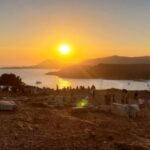
Why this 5:30 pm timing hits differently on the Acropolis
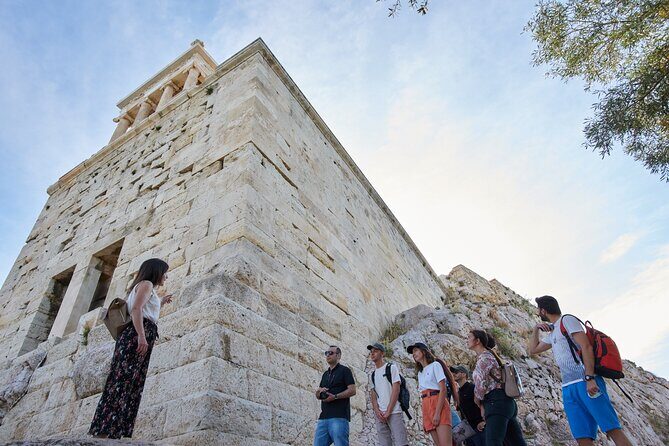
If you only know the Acropolis from daytime photos, you’re missing half the mood. This tour runs at 5:30 pm, which usually means the heat has eased and the hill feels less like a conveyor belt and more like a place people built for gods, ceremonies, and spectacle.
The payoff is simple: you spend your time when light and crowds are more forgiving. The Parthenon still dominates the scene, but you also get a better chance to see the shapes and edges of the temples instead of squinting through midday glare. It’s also the kind of timing that turns the city views into part of the show, not just a quick bonus.
And yes, you still have to climb. The incline and stairs are there. The good news is that with a guided route and a steady pace, the walk is manageable for most people who can handle normal sightseeing steps. I’d still treat it like a real walking tour and not a gentle stroll.
You can also read our reviews of more guided tours in Athens

Skip-the-line entry plus a small group: where the value comes from
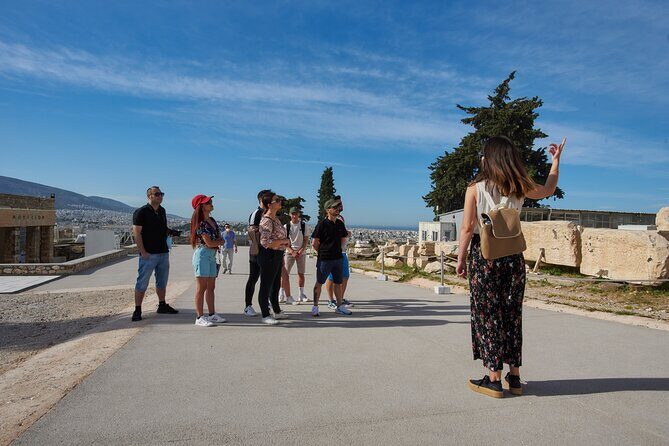
At $156.20 per person for about 2 hours, the price has to earn its keep. What makes it feel worth it is what you get bundled in: skip-the-line access, a licensed guide, and the Acropolis ticket.
Skip-the-line matters on this site because waiting can swallow your energy. Even if you’re fast at photos, the real risk is arriving, then losing the best part of your evening to queues. Here, you’re paying to reduce that waiting friction so you can use the time you paid for on actual monuments and the stories behind them.
The other value lever is group size. With a maximum of 15 travelers, you’re not just floating through ruins while the guide talks to someone else’s questions. The pace stays human. You’re more likely to notice small features when someone points them out, especially when the route moves from one key building to the next.
Also, the logistics are straightforward. There’s no hotel pickup and drop-off, and the meeting point is fixed at the Herodion Hotel area. So you’ll want to plan your own way there, but once you’re on-site, the experience is designed to be easy to start with a mobile ticket and on-the-ground guidance.
Start at Herodion: meeting point and how to prepare
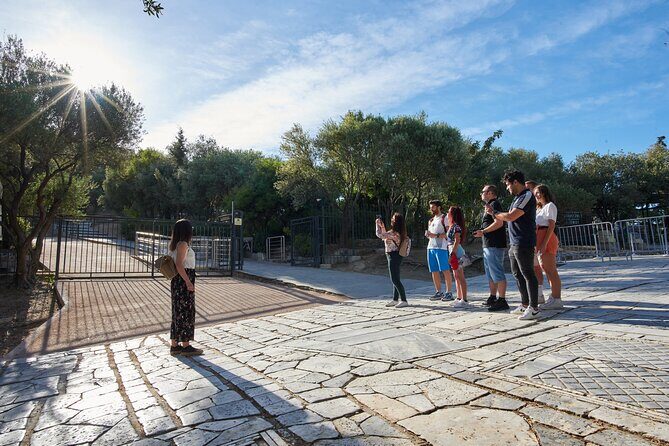
The tour begins at Herodion Hotel, on Rovertou Galli 4 in Athens. Since the group ends back at the same meeting point, you’re not stuck trying to navigate a finish location at the top of a hill.
Your best move is to arrive early enough to get oriented without rushing. The Acropolis area is a mix of slopes, steps, and marble surfaces. The most consistent practical advice is simple: wear comfortable walking shoes with good traction. Even when the climb feels gradual, the ground can be slippery or uneven depending on footwear.
From there, the schedule takes over. You’ll get about two hours to see the main buildings and key entrance structures, with short stop windows that keep the tour moving. That structure is great if you want highlights and context without spending a whole day.
Stop 1: The Sacred Rock and the Parthenon backdrop

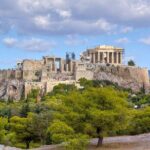
The first big moment is the Acropolis itself, often called the Sacred Rock of Athens. This hill is more than a view platform. It’s the symbolic center of ancient Greek civic life, tied closely to Athens’ cultural peak in the 5th century BCE.
Your guide’s job here is to help you connect the dots between buildings. Even though each temple looks like its own masterpiece, they were part of a single sacred landscape, planned for ceremonies, power, and religious symbolism. You’ll also hear how the Acropolis represents artistic and cultural “apogee” thinking from Perikles’ era.
This is where the evening timing earns points. The Parthenon and nearby structures look sharp against the sky. You’ll also get the sense that you’re standing inside a long story, not just looking at separate ruins.
One practical note: the Acropolis is stone, and you are climbing stone. Even if the walk isn’t brutal, your legs will notice it, especially late in the day when you’ve already done other walking.
Stop 2: Propylaea, the monumental gateway
Next comes the Propylaea, the monumental entrance to the sacred area dedicated to Athena. This is the kind of stop where details can disappear if you don’t know what you’re looking for.
The Propylaea were built by Mnesicles with Pentelic marble. The design is described as avant-garde for its time, which matters because it explains why this entrance feels more like a statement than a doorway. It’s a transition space: you’re moving from the city’s everyday rhythm into the religious center.
You’ll also connect Propylaea with the Temple of Apteros Nike, linked to the area south-west of the main entrance. That relationship matters because the route isn’t random. Your guide should help you see how one structure points you toward the next.
At this stop, the “drawback” is mostly about time. The stop is short. If you’re the type who loves lingering for 20-minute photo sessions, you may feel a pinch. The trade-off is that the tour keeps momentum and you still see a full set of key monuments.
You can also read our reviews of more tours and experiences in Athens


Stop 3: Temple of Athena Nike, the Wingless Victory
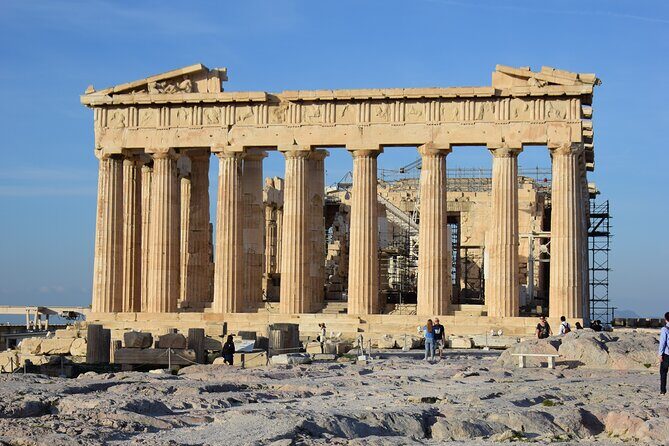
From the gateway, you move to the Temple of Athena Nike, a temple designed by Kallikrates and built between 426 and 421 BC. It sits on a bastion at the southwestern edge of the Acropolis.
What makes this stop memorable is the story behind the name. The temple originally honored Athena Nike through a statue of Athena Nike as a victory symbol. In your case, the key detail is that it was Athena Apteros, meaning wingless. You might think the “victory” part would need wings, but this wingless version gives the name its unique identity.
As you look around, remember that the architecture isn’t just for looks. It’s part of a message about victory, power, and the religious framing of Athens’ civic life.
This is also one of those stops where evening light helps. Even small structures can look crisp when the sun is lower and shadows are more defined. Still, the stop window is brief. Treat it like a concentrated museum moment, not a long lecture.
Stop 4: The Parthenon, Doric order and what to spot
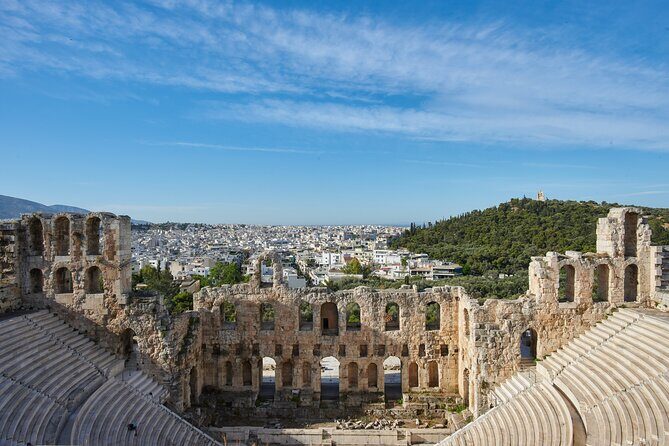
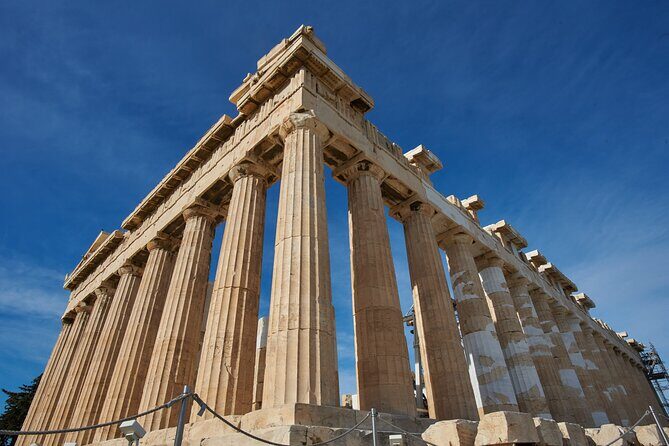
Then comes the main event: the Parthenon. It’s dedicated to Athena Parthenos, the Virgin, and it remains one of the strongest symbols of ancient Greek civilization in the modern world.
Built between 447 and 438 BC, the Parthenon is Doric in style and almost entirely in Pentelic marble. The temple’s structure is built around a clear rhythm: eight columns on each of the narrow sides and seventeen on each long side. Once you know those basics, it’s easier to see the building’s balance instead of just appreciating it as a big photo backdrop.
Your guide should point out how the sculptural decoration works as a connected system. You’ll hear about Doric metopes and triglyphs on the entablature, plus an Ionic frieze on the walls of the cella. That mix sounds technical, but on-site it becomes practical because it tells you where to look for the story panels.
You’ll also get direction on the themes tied to different sides:
- the Gigantomachy (east),
- the Amazonomachy (west),
- the Centauromachy (south),
- and scenes from the Trojan War (north).
That’s a lot to hold at once, but it’s exactly why a guide helps. Without context, you might walk around thinking it’s all “beautiful stone.” With context, you start seeing it as a carefully organized statement.
The stop duration is around 30 minutes, which is long enough to get oriented and then spend time noticing the building’s details. If you’re sensitive to crowds, the evening timing helps, but you’ll still be in a major sight area. Keep your expectations realistic: it’s famous for a reason.
Stop 5: Erechtheion and the Karyatides porch
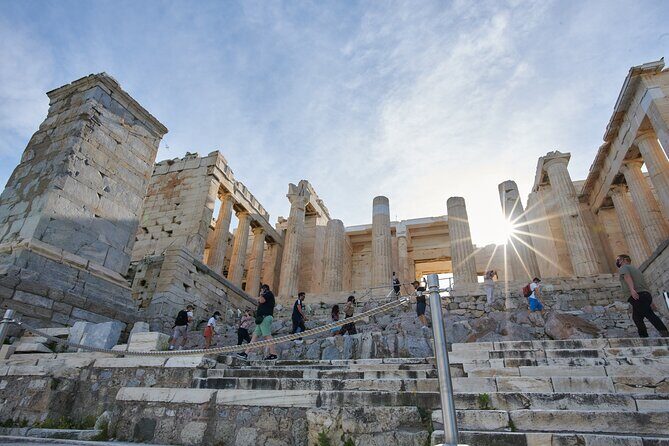
After the Parthenon, the tour turns toward the elegant Erechtheion. This building was erected between 421 and 406 BC. It connects to the mythical king of Athens, Erechtheus, and the space carries a feel that’s different from the more “public icon” vibe of the Parthenon.
The Erechtheion uses Pentelic marble, with frieze elements described as Eleusinian grey stone and relief figures attached. You’ll also hear about foundations made from Piraeus stone. The material story is part of the experience: different stones signal different functions and design choices.
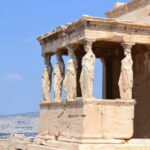
The Erechtheion is especially known for the porch of the Karyatides, where six female statues support the roof instead of columns. These figures are called the Karyatides. The tour context notes that while some are in place at major museums, the figures you see on-site are part of the wider story of preservation and replicas.
This stop is great if you like architecture that feels a little more human and sculptural. It’s also a good way to break the “giant temple” rhythm and get closer to character and symbolism.
As with other stops, time is limited. Fifteen minutes means you’ll want to choose what you focus on. If the Karyatides matter most to you, aim your attention there first and then allow a quick sweep around.
Stop 6: Theatre of Dionysus and the show-on-the-hill idea
The last stop is the Theatre of Dionysus, built on the south slope of the Acropolis hill. This site is part of the sanctuary for Dionysus Eleuthereus, and it hosted the City Dionysia.
The first orchestra terrace dates to the mid- to late-sixth century BC. That detail helps you picture this as a functioning space for performances, not just stone ruins. Even when the seats are gone or broken, the shape is still a clue. You can almost imagine how the area would have worked acoustically and socially.
If you’re the kind of traveler who likes the behind-the-scenes angle, this stop is a satisfying capstone. It reminds you that the Acropolis wasn’t only temples and politics. It was also a place for civic festivals and public culture.
The stop is short, so you won’t get a full “how theater worked” deep lesson. But you will leave with the idea that Athens’ cultural life stretched beyond religious monuments.
Practical tips that will help you enjoy the walk
This tour is built for people who can handle a moderate walk and stairs. The hill is steep enough that your legs will feel it, even though the climb can still feel manageable with a steady pace.
Based on the advice tied to this exact experience, here’s what you should do:
- Wear comfortable shoes with grip on marble and rocky surfaces.
- Expect stairs and uneven stone.
- If you’re visiting in warmer months, take the evening timing seriously because it helps with comfort.
A small group also helps. When you’re not fighting a giant crowd flow, you can keep your footing and your pace. That’s a big deal when you’re moving between sites quickly.
One more practical thing: hotel pickup isn’t included, so plan your arrival and return. It’s not hard, but you’ll want to know how you’re getting there before you set out.
Price and value: is $156.20 worth it?
Let’s look at what the price includes: a licensed tour guide, skip-the-line access, small-group pacing (max 15), and the Acropolis ticket. For many first-time visitors, the guide is the main value driver. The Acropolis is famous, but the difference between “I saw temples” and “I understand the layout and symbolism” is usually a good guide.
The other key value driver is time. A two-hour window at 5:30 pm is tight, but it’s designed to hit the essential monuments without consuming your whole day. Skip-the-line access also protects that time.
If you enjoy self-guided sightseeing, you can still do this without a tour. But if you want the Parthenon and the smaller sites explained in a way that makes you look more carefully, the bundled guide + ticket + access package often feels like a smarter use of your limited vacation hours.
Who should book this evening Acropolis tour
This tour fits best if you:
- Want the main monuments of the Acropolis in a tight 2-hour plan
- Prefer evening timing for comfort and views
- Like architecture and symbolism and want a guide to connect the dots
- Appreciate small-group energy, not a giant group herded through ruins
It might be less ideal if you:
- Need very long stops at each site to photograph or read every label
- Don’t do well with stairs and uneven stone surfaces
- Prefer hotel pickup and fully managed door-to-door logistics
Should you book this Acropolis guided tour?
If you want a clear, guided highlight route and you like the idea of seeing the Acropolis in the evening, this one is a strong pick. The combination of licensed guide, skip-the-line access, and a built-in Acropolis ticket makes the price easier to justify than tours that only hand you an audio device and a map.
I’d book it especially if you’re trying to balance a busy Athens itinerary with limited time. The evening slot helps you enjoy the hill without the midday squeeze, and the stop sequence covers the buildings most people come to see, plus a couple that make the visit feel more than a single-photo mission.
FAQ
FAQ
What time does the tour start?
The tour starts at 5:30 pm.
Where does the tour meet?
The meeting point is Herodion Hotel, Rovertou Galli 4, Athina 117 42, Greece.
How long is the tour?
It runs for approximately 2 hours.
Is the tour offered in English?
Yes, it is offered in English.
Does the price include skip-the-line access?
Yes. Skip-the-line Acropolis access is included.
Is the Acropolis admission ticket included?
Yes. The Acropolis ticket is included in the tour price.
Is a licensed guide included?
Yes. A licensed tour guide is included.
What is the group size?
The maximum group size is 15 travelers.
Is hotel pickup or drop-off included?
No, hotel pickup and drop-off are not included. The tour meets at Herodion Hotel and ends back at the same meeting point.
What is the cancellation policy?
You can cancel for a full refund up to 24 hours before the experience’s start time. After that point, the amount paid is not refundable.

More Guided Tours in Athens
More Tours in Athens



More Tour Reviews in Athens
- All Day Cruise -3 Islands to Agistri,Moni, Aegina with lunch and drinks included
★ 5.0 · 4,958 reviews