REVIEW · ATHENS
Acropolis Mythology & Food Tour
Book on Viator →Operated by Alternative Athens · Bookable on Viator
Athens has a way of grabbing you fast. This Acropolis Mythology & Food Tour strings the big-name sights together with the everyday food scenes around them, so you don’t just see monuments—you get the stories and the local pace that make Athens feel like Athens. I especially love the small group size (up to 15), and I like how the food stops are built into the walking route instead of feeling like a random add-on. One thing to plan for: archaeological-site entry fees are not included, so you’ll want to budget for them or arrange pre-purchase in advance.
The route also uses an early start to keep things comfortable, with an Athens map in your hands and a guide keeping the myth side tied to what you’re actually looking at. You get a mix of power landmarks and regular-neighborhood scenes, from the marble scale of Zeus to the market energy that locals treat as daily life. The only real drawback for light packers: at the Acropolis, strollers and big bags (plus backpacks) aren’t allowed, so travel light for the main sight.
In This Review
- Key things I’d plan around
- Meeting at the Arch of Hadrian and why an 8:00 start matters
- Zeus first: what you learn at the Temple of Olympian Zeus
- The Acropolis portion: how the guide makes the Parthenon area feel logical
- Syntagma: modern Athens in motion, not just a landmark photo
- Plaka and Monastiraki: where the old alleys turn into your food-and-shopping map
- Psiri: evening food energy and street art you can actually spot
- Varvakios Central Municipal Market: Athens food as daily life
- Price and value: what you pay for, and what you still control
- Who this tour fits best (and who should rethink it)
- Practical tips to make the day smoother
- FAQ
- FAQ
- What time does the tour start, and where do I meet?
- How long is the tour?
- What’s the group size?
- Is the tour offered in English?
- Are entrance tickets included for the archaeological sites?
- Are food tastings included?
- What should I know about bags at the Acropolis?
- Do I need ID for any discounts?
- Should you book this tour?
Key things I’d plan around
- Small group, big payoff: Up to 15 travelers means more time for questions and better pacing through the main sights.
- Myth connects to walking stops: Zeus and Athena aren’t treated like separate topics; the guide ties stories to what you’re seeing nearby.
- Food built into neighborhoods: Plaka, Monastiraki, Psiri, and a central market show up as part of the route, not as a detour.
- Entry fees need your attention: Archaeological-site tickets are extra (you can pre-purchase), so double-check timing.
- Pack smart for the Acropolis: Strollers, backpacks, and big bags are not allowed at the Acropolis.
Meeting at the Arch of Hadrian and why an 8:00 start matters

You meet at the Arch of Hadrian, near Leof. Vasilisis Amalias 50. It’s a good spot to orient yourself because it sits right in the Athens story—an easy landmark to find, and it sets you up for the walk toward the Acropolis area. The tour starts at 8:00 am, which is a smart move in Athens. Earlier light is nicer for photos, and the heat tends to be less punishing.
The end point is Monastiraki Square near Apollonos 21. That means you finish close to one of Athens’ most convenient bases for dinner and transit. If you’re trying to squeeze a lot into one day, this route is designed so you end in a lively area without having to backtrack.
This is an English-guided experience and uses a mobile ticket, so you’re not hunting for paper. Most people can participate, but you still want to keep your expectations realistic for walking. Also, because the Acropolis area has restrictions, it’s worth planning your bag situation before you leave your hotel.
You can also read our reviews of more food & drink experiences in Athens



Zeus first: what you learn at the Temple of Olympian Zeus
The tour begins with the Temple of Olympian Zeus, often called the Olympeion. Even if you only see it from the outside, it’s an impressive introduction: the site lies between the Acropolis and the Ilissos river, and it’s known for the scale of its marble construction. The guide focuses on the temple’s stories rather than making it a ticket-stop, so you get context without losing time.
In practical terms, this is a good warm-up. You’re not jumping straight into the steepest, most crowded part of Athens. You start with a big, open visual that helps your brain map the city’s ancient layout.
The main consideration here is time: the stop is about 15 minutes, so treat it like a story-and-photo moment. If you’re the type who loves lingering, you’ll want to save extra exploration for later on your own.
The Acropolis portion: how the guide makes the Parthenon area feel logical
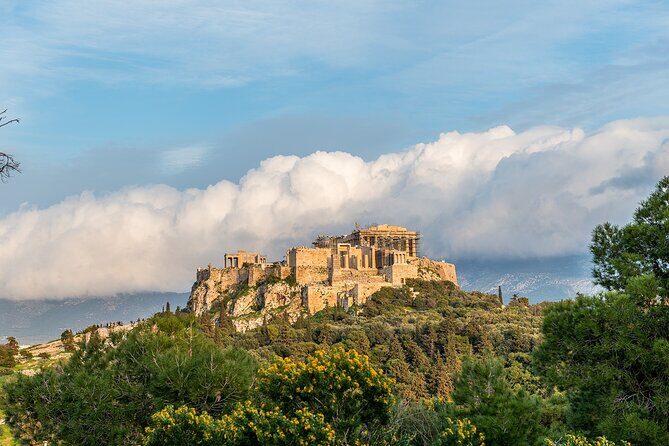
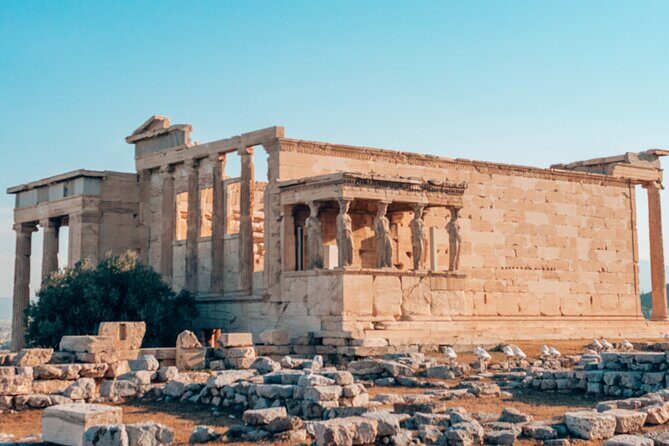
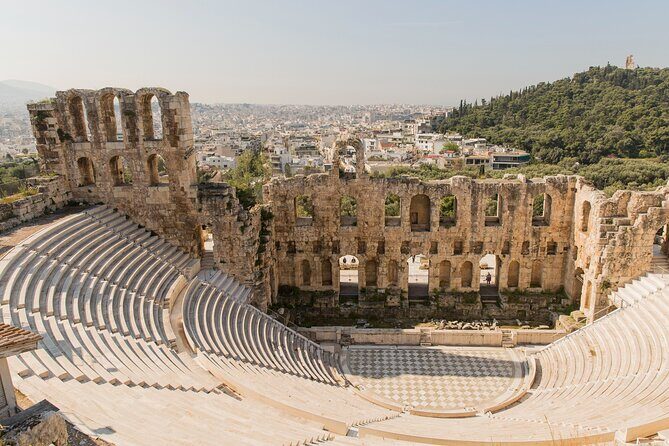
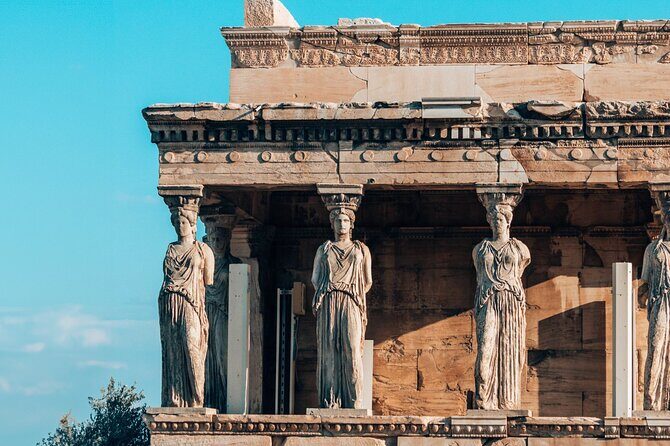
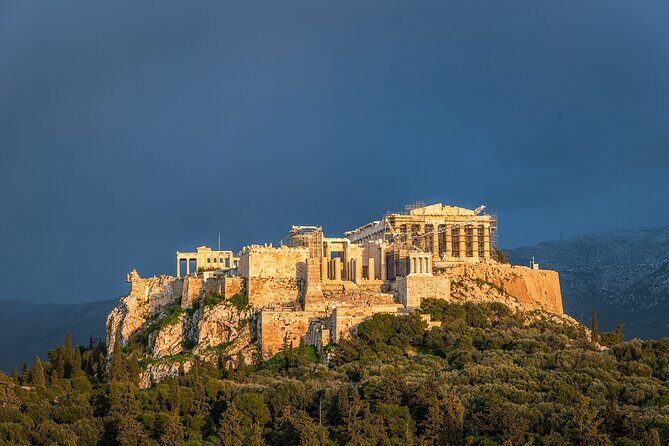
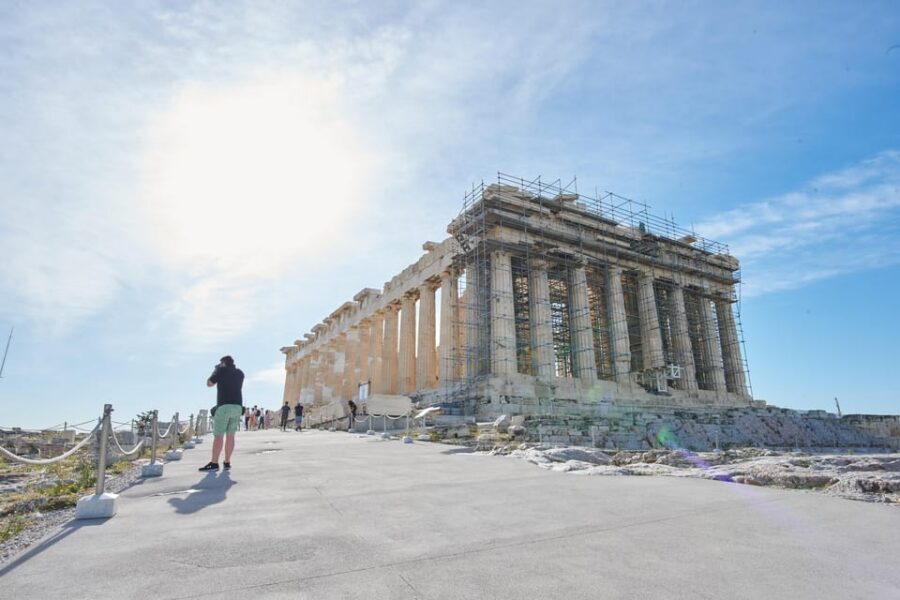
When the tour moves up to the Acropolis, you get around two hours to focus on the monuments that define ancient Athens. The highlights are the Parthenon, the Temple of Athena Nike, the Erechteion, the Propylae, and the Theater of Dionysus area. That’s a lot of names, but the point isn’t memorization for its own sake. The guide’s goal is to help you see how the parts relate to each other and to Athena’s role in the city.
One key detail: the Acropolis and other archaeological entrance fees are not included. The tour lists €30.00 per person for archaeological sites if you want help pre-purchasing tickets. If you wait until the last minute, you risk losing time (and patience). If you can, coordinate entry early so you don’t end up juggling ticket lines while everyone else is already moving through the site.
Also, plan for your bag. At the Acropolis, strollers, backpacks, and big bags aren’t allowed. You’ll want to travel with only what you can comfortably manage for several hours—think essentials, water, and a layer for morning breeze that might turn into sun.
What you’ll enjoy most is how the mythology is tied to what you’re seeing. Yes, the buildings are masterpieces, but the tour helps you connect the architectural symbols to the stories people told about Athens, gods, and identity. It’s the difference between viewing ruins and understanding why these places mattered.
Syntagma: modern Athens in motion, not just a landmark photo
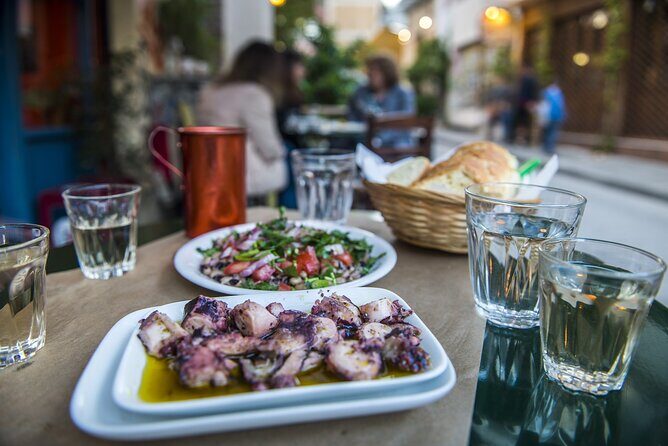
After the ancient heights, you drop into Syntagma, the central square dominated by the Greek Parliament. This stop is about 40 minutes, and it’s there for a reason: it shows you how Athens keeps moving. The square is characterized by heavy foot traffic through the city’s busiest crossroads, and you’ll feel the energy shift from archaeological silence to modern rhythm.
Even if you’re not a Parliament watcher, it’s useful for orientation. Syntagma is one of those places where you can understand the city’s geography—how downtown Athens connects to neighborhoods and transit lines. It’s also a good breather stop before you move into the more fun (and more crowded) market lanes.
The drawback, if you dislike busy streets, is that this part is not quiet. It’s a living square, so you’ll want to keep your eyes open and your schedule flexible. Use the time to reset your energy, especially if you’ve already done a lot of Acropolis climbing.
Plaka and Monastiraki: where the old alleys turn into your food-and-shopping map
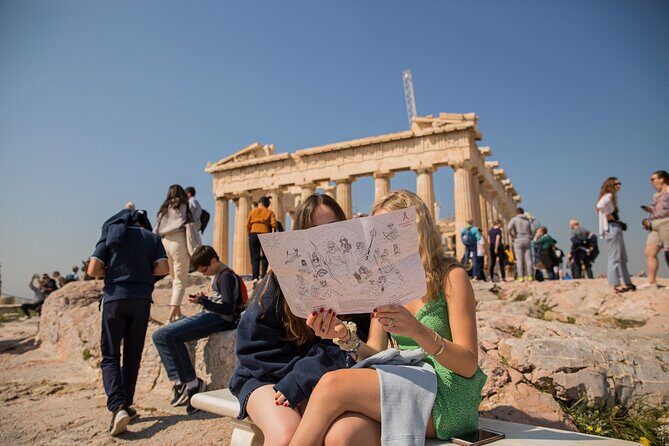
The tour then slides into Plaka, the area just below the Acropolis. Plaka is known for narrow lanes packed with souvenir shops and ancient monuments, and it’s often described as the oldest area you’ll encounter in this zone. The stop is about 45 minutes, which is perfect for getting your bearings. You can look for small side streets, get oriented around the hill, and use the guide’s myth context to understand why the neighborhood feels built around the Acropolis presence.
Plaka can get tourist-heavy, but that doesn’t mean it’s automatically a waste of time. What you’re using it for here is orientation plus atmosphere. You’re also getting that feeling of Athens as a layered city—ancient sites and modern commerce rubbing shoulders in the same few blocks.
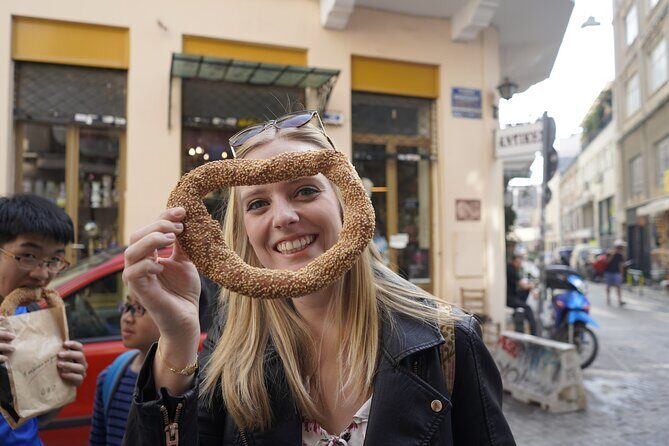
From Plaka, you move toward Monastiraki, a market area with serious character. Here you’ll hear about things like Hadrian’s Library, and you’ll also get a taste of street food culture. There’s a detail I like because it feels very Athens: an underground river is hidden in a metro station. It’s the kind of fact that turns a quick walk into a small “wait, what?” moment.
Monastiraki also ties in Ottoman-era presence, including one of the few surviving Ottoman mosques. Again, you’re not just collecting trivia; the guide uses these layers to help you read the city as a timeline. The stop is about 40 minutes, so you’ll have enough time to wander without turning it into a shopping marathon.
You can also read our reviews of more tours and experiences in Athens





Psiri: evening food energy and street art you can actually spot
Next comes Psiri, a neighborhood with a shift from old crafts to modern evening life. The tour time here is around 30 minutes, which is shorter than the earlier stops, but it’s focused. You’ll pass through streets known for street art, and you’ll also see the vibe that makes Psiri a go-to for food and drinks later in the day.
This is a great moment in the tour because you transition from daytime sightseeing into the kind of Athens that locals gravitate toward. The guide’s myth-and-food framing helps here, too. Instead of treating street art like random decoration, you start noticing how the city keeps telling stories in new ways.
If you’re hunting for street art specifically, don’t expect a full gallery tour. The value is that it shows you where to look next. After the guided part ends, you can keep exploring those streets with your eyes tuned.
Varvakios Central Municipal Market: Athens food as daily life
The last major food stop is the Varvakios Central Municipal Market, a lively local market where people go for fresh produce, meats, and fish. The timing is about 15 minutes, which can feel short, but for this kind of place, short can be smart. You get a snapshot of daily life without turning the tour into a long food crawl where you lose energy.
This is where the tour’s concept really pays off. A lot of Athens food tours focus on a few famous bites. This one also shows you the supply chain and the real-world setting: stalls, movement, people shopping like it’s Tuesday in any city. Even if you’re not planning to cook anything yourself, seeing how locals buy groceries tells you what kind of food culture you’re stepping into.
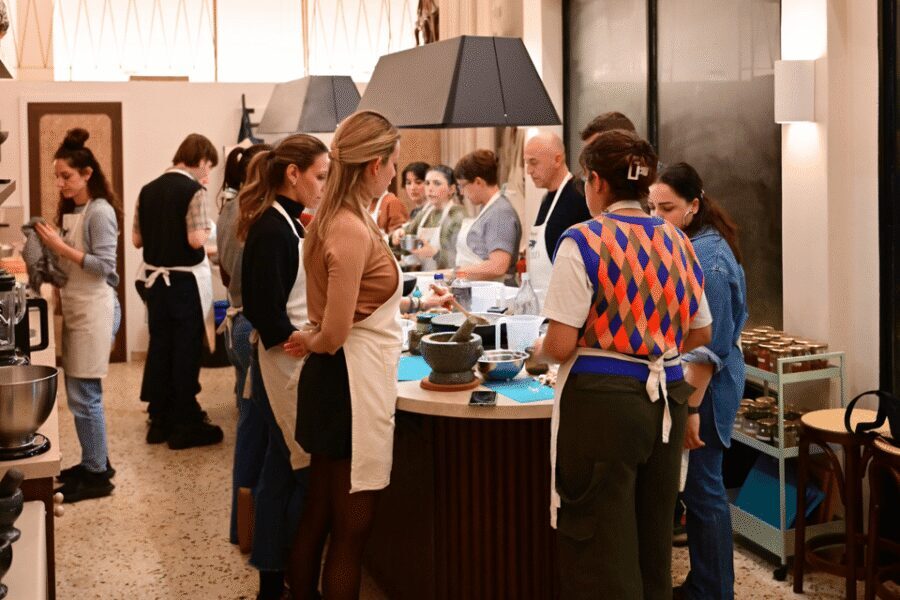
The guide includes food tastings as described in the tour, and the market setting makes it easier to understand what you’re tasting and why it fits the city. Since the tour also notes that guests can get their own food or drinks if they want, you can treat the tastings like a guided sampling and then decide what you’re craving for dinner after you finish.
Price and value: what you pay for, and what you still control
The price is $138.55 per person, and for a 5.5-hour small-group experience, that’s not an impulse buy if you’re on a tight budget. But it’s also not just “a walk with a guide.” You’re paying for a few things that add up quickly in Athens: an organized route across major landmarks, a guide who connects mythology to the places you’re seeing, and included food tastings.
Then there’s the big variable you control: archaeological entrance fees are not included. The tour indicates you can pre-purchase, listed at €30.00 per person. In practice, that means your final cost depends on whether you add entry and how you handle timing. If you prefer not to manage ticket logistics, pre-purchasing is your best friend.
One more value factor is group size. With a maximum of 15 travelers, you’re more likely to get real attention when you ask questions. It also helps the guide keep the group moving at a pace that works for sightseeing rather than a slow shuffle.
If you’re an anxious planner, you’ll appreciate the included fun ancient Athens map. It’s not just a souvenir. It helps you remember what you saw and where you want to return.
Who this tour fits best (and who should rethink it)
This tour is a strong fit if you want Athens in one day without turning the day into a pile of disconnected experiences. You’ll enjoy it if you like mythology, but you also care about food and neighborhood feel. The mix of Acropolis, Plaka, Monastiraki, Psiri, and a central market gives you a more complete sense of the city than a straight-sightseeing day.
It’s also a good fit for first-time visitors who want a route that minimizes guesswork. Meeting at a well-known landmark and ending at Monastiraki makes your day easier to structure.
You should rethink it if you hate crowds or want lots of free time. Some stops are long enough for wandering, but others are clearly designed to be focused. And because the Acropolis has bag restrictions, you’ll need to pack in a way that works for that rule.
If you’re a student in the EU, there’s a potential benefit to keep in mind: the tour notes that ID card or passport is required for people under 25 for possible discounts for paid archaeological sites. That can reduce the entrance fee cost if you qualify.
Practical tips to make the day smoother
Plan to start with a realistic packing strategy for the Acropolis. Since backpacks and big bags aren’t allowed, use what you can carry comfortably. A small crossbody or day bag is usually the kind of setup that works for restrictions, but follow what the site enforces on your visit.
Wear walking shoes. The route is spread across multiple neighborhoods, and the day includes moving between major sights and busy streets. Also bring a layer. Athens mornings can feel mild, then turn sunny fast.
For food, come hungry enough to enjoy the tastings, but not so hungry that you get frustrated if you want more than what’s included. The tour specifically says you can grab food or drinks you get on your own, so it’s easy to top up your meal preferences later.
If you’re sensitive to timing, plan your day so you’re ready at the start time. There are rules if a client misses the time slot, and in that scenario you might have to purchase new tickets on the spot.
FAQ
FAQ
What time does the tour start, and where do I meet?
It starts at 8:00 am. You meet at the Arch of Hadrian, Leof. Vasilisis Amalias 50, Athina 105 58, Greece.
How long is the tour?
The duration is about 5 hours 30 minutes.
What’s the group size?
The tour has a maximum of 15 travelers.
Is the tour offered in English?
Yes, it’s offered in English.
Are entrance tickets included for the archaeological sites?
No. Entrance fees to archaeological sites are not included, but you can have tickets pre-purchased for you for €30.00 per person.
Are food tastings included?
Yes. Food tastings are included as described in the tour. You can also get your own food or drinks if you want.
What should I know about bags at the Acropolis?
Strollers, backpacks, and big bags are not allowed at the Acropolis, and you shouldn’t take them on the tour.
Do I need ID for any discounts?
If you’re under 25, you need an ID card or passport for possible discounts related to paid archaeological sites.
Should you book this tour?
Book it if you want Athens in a single day with both myth and food woven into a walk that runs from the Acropolis area down through Plaka, Monastiraki, Psiri, and into a real market. The small-group format helps a lot, especially when you want explanations without being rushed.
Skip it or reconsider if you’re not willing to handle extra archaeological entry fees or if you’ll struggle with the Acropolis bag restrictions. If those two points are fine for you, this tour is a practical way to get more out of your Athens day than just postcard sightseeing.
More Food & Drink Experiences in Athens

More Tours in Athens



More Tour Reviews in Athens
- All Day Cruise -3 Islands to Agistri,Moni, Aegina with lunch and drinks included
★ 5.0 · 4,958 reviews