REVIEW · ATHENS
Ancient Athens E-Bike Tour
Book on Viator →Operated by AyoToursAthens · Bookable on Viator
Two hours. Zero sweat. This Ancient Athens standing e-bike tour is a smart way to hit the big-hitters—Acropolis, Plaka, Ancient Agora, and more—without spending your whole day walking uphill. I love the pace you get from a motorized Trikke-style ride, and I love that the tour keeps groups small so you’re not stuck behind strangers. One thing to plan for: archaeological tickets aren’t included, so you’ll pay extra for key sites.
I also like how the route is built around short, meaningful stops. You get the drama of Athens’ ancient theatre, the close-up feel of the Acropolis, and then quick transitions through the neighborhoods that make Athens feel like Athens.
The ride itself is the point. No pedaling is required, and the tour provides a helmet and customer insurance, so you can focus on the views and the stories instead of figuring out logistics.
In This Review
- Key highlights worth getting excited about
- Why a standing e-bike makes Athens feel doable
- Meeting point near Leof. Andrea Siggrou: start where it makes sense
- How the Trikke ride works (and why the helmet matters)
- Entering ancient Athens with the Theatre of Dionysus and the Odeon
- Acropolis without the long slog: close views and smart timing
- Pnyx: the democracy hill where Athens argues with itself
- National Observatory of Athens on the Nymphs hill
- Ancient Agora and Kerameikos: the market city behind the monuments
- Monastiraki and the Roman Agora: Athens past and present mix
- Plaka: the classic neighborhood moment
- Price, tickets, and value: what $72.09 really buys
- Who this tour fits best (and when to skip)
- The practical call: should you book this Ancient Athens e-bike tour?
- FAQ
- How long is the Ancient Athens e-bike tour?
- What does the tour price include?
- Are the archaeological site tickets included in the tour price?
- How much are the main archaeological tickets?
- How big is the group?
- Is the tour offered in English?
- Do I need to pedal the e-bike?
- Where is the meeting point?
- When does the tour operate?
- What if the weather is bad?
- Can I get a full refund if I cancel?
Key highlights worth getting excited about
- Standing e-bike pace: You cover major hills and distances fast, without working up a sweat.
- Small group size (max 12): Easier to hear the guide and keep together through the city.
- Acropolis views from a close side: You approach the hill in a way that saves time and walking.
- Roman and Classical layers: Odeon of Herodes Atticus, theatre traditions, and the Agora areas in one sweep.
- Built-in neighborhood hits: Plaka and Monastiraki get you grounded in modern Athens, not just ruins.
Why a standing e-bike makes Athens feel doable

Athens can be one of the most tiring cities in Europe—mostly because the sites are spread out and the ground keeps rising when you least want it to. This is where a standing e-bike approach feels clever. Instead of spending most of your limited time moving between islands of archaeology, you spend it at the viewpoints and key moments.
What you’ll notice right away is the “no pedaling required” design. That matters if you’re traveling with heat in mind, or if you just want your legs to enjoy the rest of your day. You still move like an active traveler—standing, steering, taking in the sights—but you’re not paying for every climb with fatigue.
The tour is also timed like a concentrated sampler: about 2 hours. That’s long enough to see the major anchors, but short enough that you can still plan a longer stroll later through Plaka or Monastiraki on your own.
You can also read our reviews of more cycling tours in Athens



Meeting point near Leof. Andrea Siggrou: start where it makes sense
The tour meets at Leof. Andrea Siggrou 22, Athina 117 42. The good news is that it’s listed as being near public transportation, which helps if you’re using metro or bus to get around Athens.
You’ll also have a mobile ticket, and you’ll get confirmation at booking. Practically speaking, that means less time hunting for paperwork, and more time arriving, getting briefed, and rolling out.
Sessions run Monday through Saturday, 10:00 AM to 4:00 PM. So if you want a daytime plan that lines up with museum hours and general sightseeing, this fits the typical rhythm of an Athens itinerary.
How the Trikke ride works (and why the helmet matters)

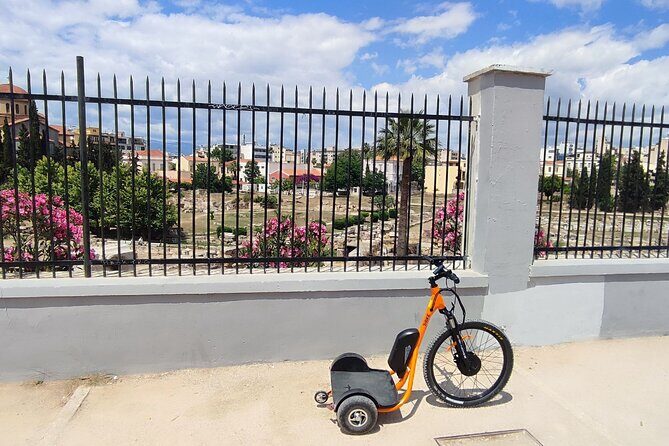
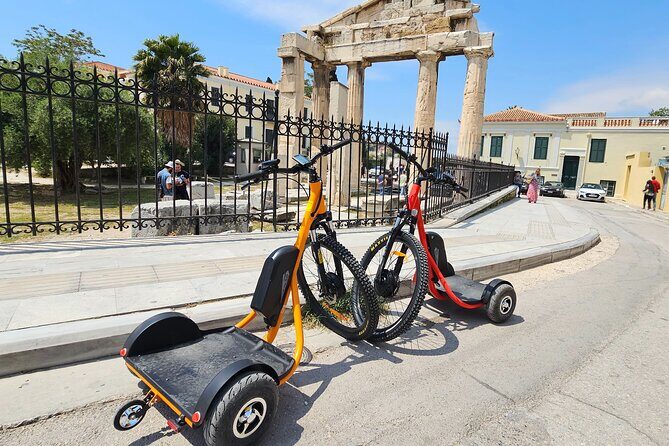
This tour uses Trikke-style e-bikes, and you get a helmet plus customer insurance. That combination is underrated. In a city like Athens—where traffic flow can be chaotic at times—knowing you’ve got safety gear and coverage makes the experience feel calmer.
Because the ride is motorized and designed for easy use, you’re not learning a complicated system before you see anything. The tour’s whole pitch is about getting you out to the viewpoints without turning your afternoon into a tech troubleshooting session.
Also, there’s a limit of 12 travelers, which helps in two ways. First, it keeps maneuvering through streets simpler. Second, it makes it more likely the guide can adjust the pacing based on what you already want to see.
Entering ancient Athens with the Theatre of Dionysus and the Odeon

The tour’s ancient start spot is the theatre tradition of Athens—specifically the Theatre of Dionysus. This is described as the first theatre of the world and the place where theatre began. Even if you don’t consider yourself a theatre person, this stop gives you context. Athens didn’t just invent ideas; it also invented how to perform them—publicly, dramatically, and in front of crowds.
One practical tip: the ticket logic here matters. The information you’re given notes that the Acropolis Hill ticket includes the Theatre of Dionysus. Tickets for the theatre are listed at 20€, but that inclusion detail can help you avoid buying twice. Since archaeology tickets aren’t included in the tour price, it’s worth thinking ahead about which ticket you’ll buy so you don’t pay for the same access more than once.
Next comes the Odeon of Herodes Atticus, a Roman theatre still used for shows. It was built in the 2nd century A.D. as a memorial gift connected to the death of Herod Atticus’s wife. This is one of those places where you can feel the continuity. The stones are ancient, but the purpose—gathering people to watch performances—still reads as modern.
Like the Theatre of Dionysus, the Acropolis Hill ticket includes the Odeon of Herodes Atticus as well, and the Odeon admission is listed at 20€. That’s your clue to check how your purchased ticket covers multiple sites, especially since the tour itself doesn’t bundle archaeological admissions.
Acropolis without the long slog: close views and smart timing
When you reach the Acropolis, you’re not just looking at a faraway silhouette. The plan is to watch the hill from a very close side, which is a big deal for saving time and getting that “I’m right here” feeling.
The Acropolis is framed around the Parthenon at the top, and this stop is built to make that sight feel immediate. If you’ve ever done Athens the hard way—walking, waiting, then realizing you spent too much energy getting there—this is the opposite. You’re guided into a position where the hill looks huge, but your day doesn’t drain out.
Admission for the Acropolis hill is listed as 20€, and again, this is part of why the ticket planning matters. If you’re going to buy the Acropolis Hill ticket anyway, it may cover more than you first assume, including the theatre sites mentioned earlier.
The stop length is short (about 10 minutes), so think of this as a viewpoint and orientation moment. If you want a longer, slow walk inside the complex, you can always extend later with your own exploration plan. For a 2-hour tour, the goal is to get you hooked and oriented, not to replace a full Acropolis visit.
You can also read our reviews of more tours and experiences in Athens


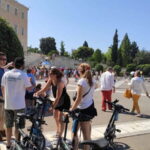


Pnyx: the democracy hill where Athens argues with itself
The tour then moves to Pnyx, described as the place where democracy started. This isn’t just a slogan stop. Pnyx sits in an archaeological area that’s also a park, which gives it a different feel from pure ruins. It’s a space where the setting helps you understand how civic life could happen outdoors, on hills, with crowds gathering to vote and speak.
The stop is about 15 minutes, and that timing is right for this kind of place. You need a little time to absorb the idea, look around, and connect it to the city below.
One of the best ways to use this moment is to ask yourself what democracy looked like in a real landscape: public meetings, speeches, and decisions made in front of neighbors. Pnyx is designed to trigger that mental image.
National Observatory of Athens on the Nymphs hill

Another stop heads to the National Observatory of Athens, tied to the Nymphs hill area. Like Pnyx, it’s within an archaeological park area. Admission is listed as included for this stop.
This part of the tour is less about one single landmark photo and more about atmosphere. When you ride the city, you notice how Athens stacks time in layers: ancient space, then later uses of the same hills, then the modern city pressing in around it. The observatory setting helps you feel that transition.
The stop is about 15 minutes, giving you enough time to look around without rushing.
Ancient Agora and Kerameikos: the market city behind the monuments
Then you hit the Ancient Agora of Athens, described as the most important side of Ancient Greece and the main market of ancient society. This is where Athens becomes less abstract. You’re no longer just looking at temples and theatres; you’re looking at the engine room—commerce, daily life, and public gathering.
Admission for the Ancient Agora is listed at 4€, and it’s about 20 minutes. That extra time helps here because the Agora is more of a “walk and understand” space than a single-point monument. Even if you only spend a short window here, the stop gives you a mental map of where everyday life happened.
Just nearby is Keramikos, described as an archaeological area tied to ceramics production. The neighborhood name even comes from that craft history. It’s a good pairing with the Agora because it reinforces that Athens wasn’t just politics and philosophy. It also depended on workshops, materials, and trade skills.
Admission for Keramikos is listed as free in the provided info, and the stop is short (about 10 minutes). It’s the kind of stop you’ll use to decide whether you want to return later on your own for deeper wandering.
Monastiraki and the Roman Agora: Athens past and present mix
The tour swings through Monastiraki, described as the heart of Athens because of the choices around it—bars, restaurants, and general life in the area. It’s also described as the second most crowded square in Athens, so it feels like real city Athens rather than a quiet museum district.
Admission is listed as included for the Monastiraki stop, and it lasts about 10 minutes. This is not a deep dive into shops. It’s more like a reset button: you get a sense of where you’ll want to return for snacks, people-watching, and flexible sightseeing.
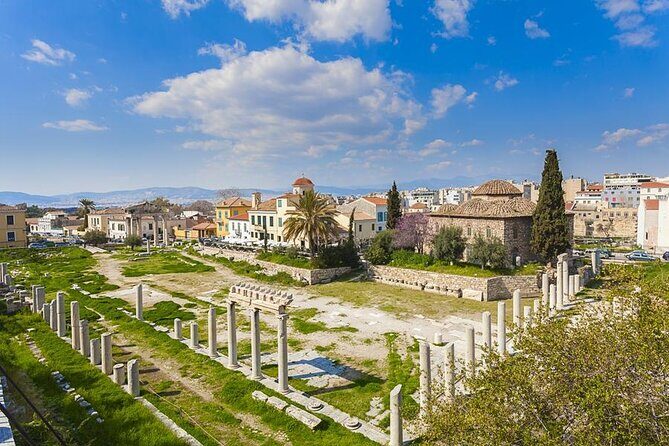
Next up is the Roman Agora, presented as Roman-era like the earlier Greek Agora, built in the 2nd century A.D. Inside, you can see the Tower of the Winds. Admission for Roman Agora is 4€, and the stop is about 10 minutes. Tower of the Winds is an especially memorable detail because it’s distinct—something you can recognize and remember after you leave.
Plaka: the classic neighborhood moment
The final major neighborhood stop is Plaka, described as the traditional neighborhood of Athens, with streets that look like a Greek island. It’s free in the provided info and lasts about 10 minutes.
Plaka is a good finisher for a ride tour because it gives you instant options for what to do next. When your two hours ends, you’re not standing in the middle of nowhere—you’re near one of the areas most people associate with Athens’ charm.
In other words, the tour doesn’t just transport you across ruins. It also hands you the start point for your evening.
Price, tickets, and value: what $72.09 really buys
The tour price is $72.09 per person, and it lasts about 2 hours. That’s not cheap in the way a city walking tour might be, but it’s also not a random fee. You’re paying for motorized equipment (standing e-bike/Trikke), helmets, and insurance, plus a guide and the route design that gets you to key sites quickly.
The catch is that archaeological tickets are not included. Based on the admissions listed, you should expect to add money for the major ancient areas. Here’s the clean way to think about it:
- The big-ticket item is the Acropolis Hill ticket (20€).
- Ancient Agora (4€) and Roman Agora (4€) are listed admissions you’ll pay.
- Theatre of Dionysus and Odeon are listed at 20€ each, but the info also says the Acropolis Hill ticket includes the Theatre of Dionysus and the Odeon of Herodes Atticus.
So you’ll likely be paying the Acropolis Hill access once, plus the smaller Agora fees. In practical terms, your total cost depends on whether you buy one “bundle” ticket that includes multiple sites, which is exactly why this matters.
If you hate ticket arithmetic and want a single all-in price, this may feel annoying. If you don’t mind a little planning and you want maximum sightseeing per hour, the value can be very strong.
Who this tour fits best (and when to skip)
This Ancient Athens e-bike tour is a strong match for you if:
- You want to see the big highlights fast, especially the Acropolis area.
- You prefer a small-group experience where you can actually hear the guide.
- You’re traveling during warm weather and don’t want to spend your entire afternoon climbing on foot.
- You like combining ancient sites with modern neighborhood energy like Monastiraki and Plaka.
It may feel less satisfying if:
- You want long, slow time inside major monuments. This is designed to move and orient, not to replace hours of museum-style wandering.
The practical call: should you book this Ancient Athens e-bike tour?
If your goal is to get your bearings and check off the essentials without turning Athens into a leg workout, I’d book it. The standing e-bike setup is central to the experience, and the route covers the kinds of places you’ll want to revisit later once you know where everything is.
Do book it if you’re comfortable handling separate archaeological tickets and you don’t need a fully all-in price. If you hate ticket planning or want zero extra costs, you might feel irritated later when you realize admissions aren’t included.
One more reason to time it well: the tour requires good weather. If conditions are rough, plans change and you may be offered a different date or a refund. So pick a day when you’re likely to get clear skies, and you’ll get the best return on those Acropolis viewpoints.
FAQ
How long is the Ancient Athens e-bike tour?
It runs for about 2 hours.
What does the tour price include?
The tour includes use of the Trikke (standing e-bike), a helmet, and customer insurance.
Are the archaeological site tickets included in the tour price?
No. Tickets to the archaeological areas are not included.
How much are the main archaeological tickets?
The Acropolis hill is listed at 20€. The Ancient Agora is listed at 4€, and the Roman Agora is listed at 4€. Theatre of Dionysus and Odeon of Herodes Atticus are each listed at 20€.
How big is the group?
The tour has a maximum of 12 travelers.
Is the tour offered in English?
Yes. It is offered in English.
Do I need to pedal the e-bike?
No. The tour is described as a standing e-bike experience with comfort, ease, and safety, no pedaling required.
Where is the meeting point?
The meeting point is Leof. Andrea Siggrou 22, Athina 117 42, Greece.
When does the tour operate?
It lists opening hours from 10:00 AM to 4:00 PM, Monday through Saturday, for 05/01/2023 – 12/22/2026.
What if the weather is bad?
The tour requires good weather. If it’s canceled due to poor weather, you’ll be offered a different date or a full refund.
Can I get a full refund if I cancel?
Yes. You can cancel up to 24 hours in advance for a full refund. If you cancel less than 24 hours before the start time, the amount paid is not refunded.

More Cycling Tours in Athens

More Tours in Athens




More Tour Reviews in Athens
- All Day Cruise -3 Islands to Agistri,Moni, Aegina with lunch and drinks included
★ 5.0 · 4,958 reviews