REVIEW · ATHENS
Footsteps of Apostle Paul from Athens to Corinth, Private Day Tour
Book on Viator →Operated by Private Greece Tours · Bookable on Viator
Paul’s trail turns Athens into a Bible lesson. On this private day, you’ll trace key steps connected to Apostle Paul while also hitting top Athenian landmarks, from the Areopagus to Ancient Corinth. I especially like the comfortable, A/C ride with easy pickup from Athens or Piraeus, and I love the way the stops are time-linked to real events and places.
There’s one thing to plan for: entrance fees and museums aren’t included, and your driver can’t go into the archaeological sites—so if you want full site-by-site guidance, you may want to add a licensed guide for Corinth.
In This Review
- Key highlights worth planning around
- A private Athens-to-Corinth day built for flexibility (and comfort)
- Areopagus and the Acropolis viewpoint: where Athens hosted the first big clash
- Ancient Agora: Paul’s first Greek preaching stop, plus a museum choice
- Zeus columns, the Panathenaic Stadium, and Hadrian’s Arch in one sweep
- The Temple of Olympian Zeus (with surviving columns)
- Panathenaic Stadium (free and built on layers)
- Hadrian’s Arch (the city speaks in two directions)
- Syntagma Square, the Tomb of the Unknown Soldier, and the Evzones
- Tomb of the Unknown Soldier
- Changing of the Guard ceremony
- Neo-classical Athens: Academy, University, and the National Library
- Academy of Athens
- University of Athens
- National Library of Greece (Theophil von Hansen)
- Corinth Canal: the ship shortcut that sets up the whole region
- Ancient Corinth: Paul’s 18 months and Gallio’s trial
- Kechries port: where Paul sailed toward Ephesus
- Price and value: what $286.02 covers, and what you’ll likely add
- Who should book this tour from Athens to Corinth?
- Should you book it?
- FAQ
- How long is the Apostle Paul from Athens to Corinth private day tour?
- Where does pickup happen, and is pickup included?
- Are entrance fees included?
- Does the driver go inside the archaeological sites?
- Is this a private tour?
- Can I cancel and get a full refund?
Key highlights worth planning around
- Areopagus and the Unknown God setting linked to Paul’s speech traditions
- Ancient Agora time that includes Paul’s first preaching stop in Greece (with museum add-on)
- Monuments with hard numbers (like Stadium dimensions and Zeus column survival)
- Syntagma Square rituals with the Tomb of the Unknown Soldier and the Evzones
- Corinth Canal facts that make the route click before you reach Ancient Corinth
- Kechries port stop tied to where Paul sailed toward Ephesus
A private Athens-to-Corinth day built for flexibility (and comfort)
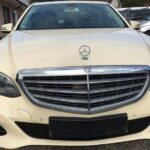
This is a private full-day tour starting at 8:00 am, running about 7 to 8 hours. You get pickup from Athens hotels, Piraeus hotels, or the Piraeus cruise port, and you’ll ride in a non-smoking, A/C vehicle that’s insured and certified for tourist use. Parking is covered, and the day runs on your timing more than on a rigid group schedule.
One detail I really like for value: the tour includes skip-the-line service to purchase appropriate entrance tickets in advance. That matters when you’re doing multiple stops in one day. You also get bottled water and professional English commentary en-route, delivered by the driver (with an important limitation—more on that below).
If you’re the type who wants big “wow” moments and context, this format works. It’s not a quick drive-by. It’s also not a multi-day mega-tour with endless museum time. It’s one long arc: Athens landmarks first, then the Corinth region, ending at the port area connected to Paul’s next journey.
You can also read our reviews of more tours and experiences in Athens.
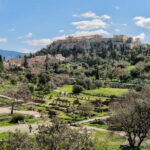


Areopagus and the Acropolis viewpoint: where Athens hosted the first big clash
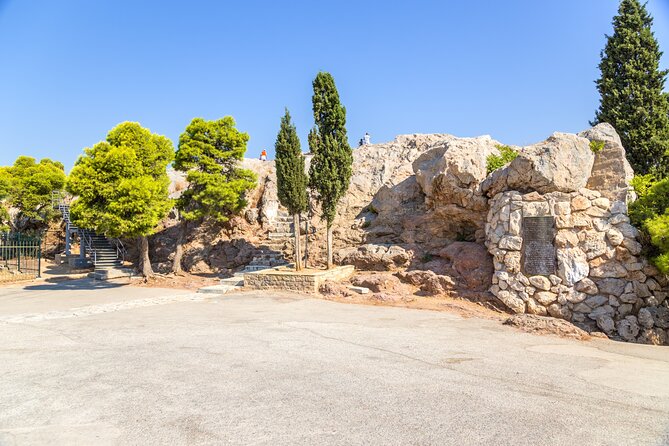
Your day’s Athens anchor is the Areopagus, a rock outcropping northwest of the Acropolis. In older eras, it served as a council site, and in classical times it functioned as a kind of court setting. In Roman times, it’s associated with the location where Paul is said to have delivered the famous speech referencing the altar to the Unknown God.
You’re scheduled for about 20 minutes here, and the admission is listed as free. That short window is exactly why this stop is worth doing with a private schedule: you can take in the viewpoint and key ideas without wasting time wandering. You also get those Acropolis-adjacent angles that help Athens make sense as a layered city rather than a single photo stop.
Practical note: since your driver doesn’t enter archaeological sites, the on-the-ground explanation here may depend on what you add for guidance. If your priority is biblical context with hands-on “stand right here” clarity, think about arranging extra help for the sites where you most want the details.
Ancient Agora: Paul’s first Greek preaching stop, plus a museum choice
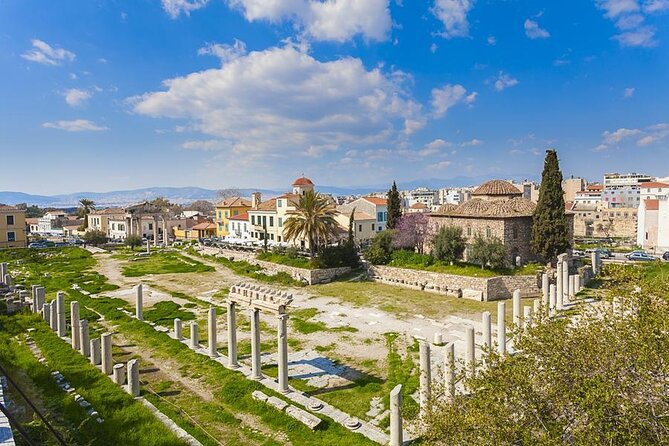
Next comes the Ancient Agora of Athens, the place that held political, commercial, administrative, social, religious, and legal life. It’s one of those sites where you can almost feel the city’s daily rhythm—even if what you see today is stone and layout rather than the crowds you imagine.
The important Paul link: this is where he preached Christianity to Greeks for the first time in 51 A.D. Your time here is about 1 hour 30 minutes, and the admission is not included. The museum add-on is explicitly priced: Agora museum entrance is €20 per person.
Here’s how I’d think about this stop for your visit. If you want the “where did it happen” experience, you can focus on the open-air parts and keep it simple. If you want more interpretation—especially if you’re traveling with teens or someone who likes visuals—budget for the museum. The museum option is one of the cleanest “upgrade levers” on this day because the itinerary already gives you time.
Also, the Agora’s long occupation across eras is part of the story. This isn’t a single-age ruin. It’s a living site used again and again, so it works well if you like connecting Bible-era events to the physical city that still shaped people’s lives.
Zeus columns, the Panathenaic Stadium, and Hadrian’s Arch in one sweep
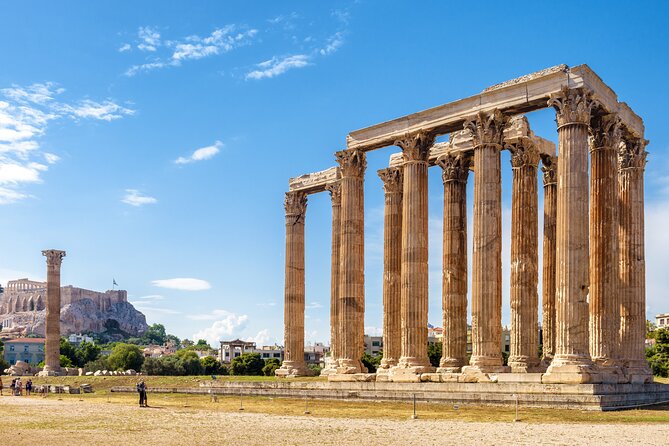
After the Agora, the day shifts into some big Athenian landmarks—many of them with free admission and very “built to impress” design.
The Temple of Olympian Zeus (with surviving columns)
The Temple of Olympian Zeus was built in the 2nd century AD (124–132 AD). The description is vivid about its original scale, including the column layout called tripteral octastyle and dipteral eikosastyle. Today, 16 columns survive, and the prompt notes that 13 are intact (mostly on the east side).
You get a quick stop here, so treat this as a framing moment. It’s not the place to expect “hour-long detail.” Instead, it gives you the Roman-Athens backdrop that makes the Paul timeline feel less like a floating story and more like a real life lived inside a massive empire.
- All Day Cruise -3 Islands to Agistri,Moni, Aegina with lunch and drinks included
★ 5.0 · 4,958 reviews

Panathenaic Stadium (free and built on layers)
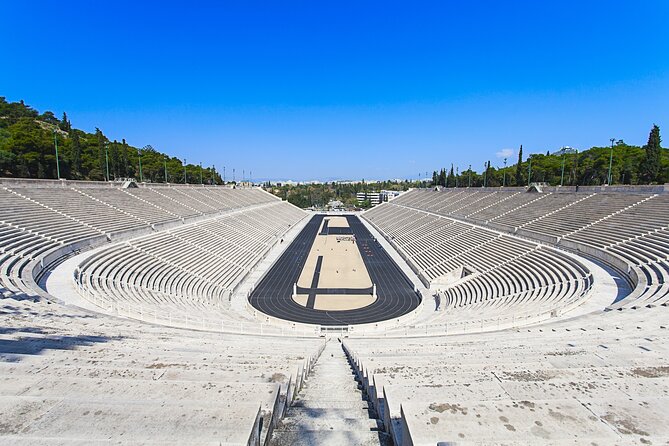
Your next landmark is the Panathenaic Stadium. It started as a natural hollow between two hills, then was transformed into a stadium in 330–329 BC for the Great Panathenaea. Later, Herodes Atticus restored it between 140 and 144 AD, giving it the form many people recognize from modern excavation references.
This stop is scheduled for about 15 minutes, and admission is free. What I like is the exactness: it’s 204.07 meters long and 33.35 meters wide, with a believed seating capacity around 50,000. Even if you’re not a sports-architecture nerd, those numbers help you imagine how large-scale public life worked in ancient Greece.
Hadrian’s Arch (the city speaks in two directions)
Then you pass Hadrian’s Arch, built by the Athenians in A.D. 131 to honor the benefactor emperor. The inscriptions are the kind of detail I love for understanding identity shifts: one side reads This is Athens, the ancient city of Theseus, while the other reads This is the city of Hadrian and not of Theseus.
This stop is short, but it’s smart. In a single minute you get the message that the city you’re walking in today has changed rulers, changed narratives, and still uses stone to tell you who it thinks it is.
Syntagma Square, the Tomb of the Unknown Soldier, and the Evzones
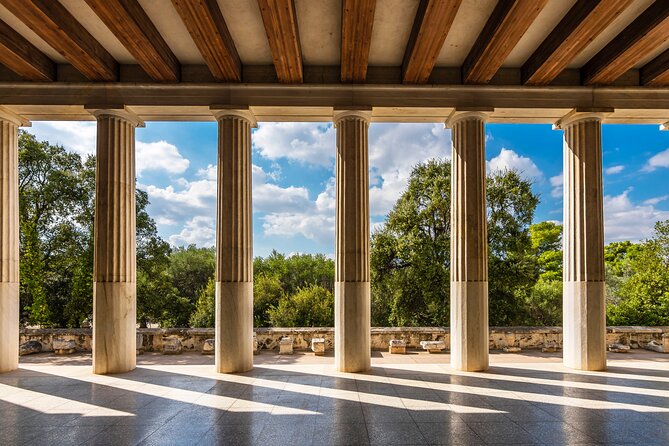
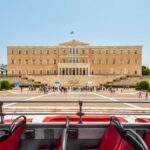
Syntagma Square is huge, marble-bright, and designed for ceremony. You’ll spend time around Syntagma Square (Constitution Square) in front of the Greek Parliament building, and then you’ll move to the Monument to the Unknown Soldier and the Changing of the Guard.
Tomb of the Unknown Soldier
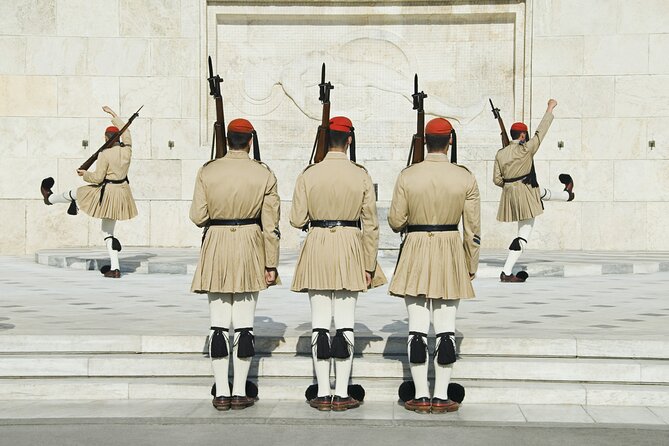
The tomb is a war memorial dedicated to Greek soldiers killed in war. It was sculpted between 1930 and 1932 by Fokion Rok. It’s guarded 24/7 by the Evzones, the presidential guards.
Your stop here is listed at about 15 minutes, and admission is free. If you’ve never seen the Evzones up close, it’s a strong pause in the day. It’s not “Bible history,” but it’s history you can watch in real time, with disciplined ritual and a clear sense of national identity.
Changing of the Guard ceremony
The Changing of the Guard happens at the Presidential Mansion and also at the tomb area off Syntagma Square. The itinerary lists another 15 minutes. The ceremony is marked as a popular tourist attraction, so timing matters.
One practical tip: since this tour is private, ask your driver to position you well and move you quickly when you’re done. Even a short viewing window feels better when you’re not stuck at the wrong angle.
Neo-classical Athens: Academy, University, and the National Library
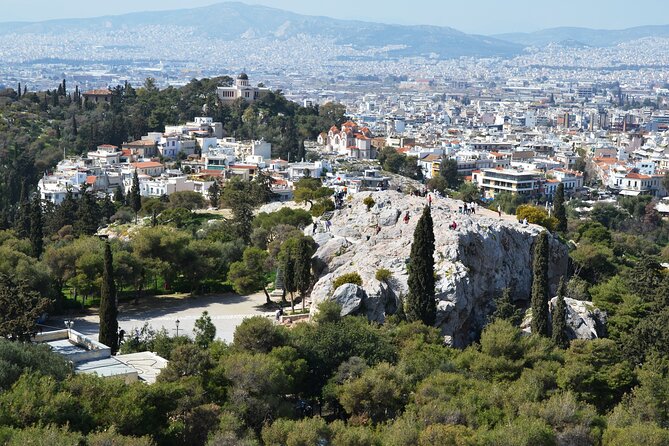
Your Athens script doesn’t end with ancient ruins. You also get a look at major institutions that define modern Athens in a very visual way.
Academy of Athens
The Academy of Athens is Greece’s national academy and was established in 1926. It’s described as the country’s highest research establishment.
University of Athens
You’ll pass the National and Kapodistrian University of Athens, often called the University of Athens.
National Library of Greece (Theophil von Hansen)
Near the city center is the National Library of Greece, part of architect Theophil Freiherr von Hansen’s neo-classical Trilogy along with the Academy and the original Athens University building.
These stops are likely brief, but they help you understand a key theme in Athens: the city keeps reusing ancient prestige as a blueprint. You’re not only looking backward; you’re seeing how Greece’s education and public culture expressed itself in stone and symmetry much later.
Corinth Canal: the ship shortcut that sets up the whole region
Once you leave Athens, you’ll hit the Corinth Canal, scheduled for about 30 minutes. The canal connects the Gulf of Corinth with the Saronic Gulf, and it’s described as one of the oldest man-made canals in the world and a vital navigation route.
This stop is more than a photo moment. The canal physically separates the Peloponnese peninsula from the mainland—so it helps your brain lock into the geography before you reach Ancient Corinth.
A few facts that make the scale real:
- Span of about 6.3 kilometers
- Depth about 26 feet
- Width changes, about 69 feet minimum at the bottom and 82 feet maximum at the surface
- Surrounded by walls about 170 feet high
- It can save ships about 185 nautical miles
If you’re someone who gets more invested when the geography clicks, this is the turning point in the day. It explains why Corinth mattered as a trading crossroads and why Paul’s journeys depended on routes like this.
Ancient Corinth: Paul’s 18 months and Gallio’s trial
Now you get the core religious-historical payoff: Ancient Corinth (Archaia Korinthos), with about 1 hour 30 minutes on site. Admission for Ancient Corinth and the museum is not included, and the museum entrance is explicitly listed as €15 per person.
The Paul timeline here is concrete:
- Paul first visited Corinth around AD 49 or 50, when Gallio (brother of Seneca) was proconsul of Achaia.
- Paul stayed about 18 months (linked to Acts 18:11).
- He worked with Priscilla and Aquila as tentmakers and attended the synagogue.
- Gallio presided over Paul’s trial in AD 51/52, which helps anchor the Bible timeline.
- Silas and Timothy rejoined Paul here after being elsewhere.
For me, that’s what makes Ancient Corinth feel more than just a ruin. The place is tied to names you can track: Gallio, Priscilla, Aquila. When you’re standing in the area, you’re not trying to guess the story—you’re holding it up to the ground.
A thoughtful caution: since the driver cannot enter the archaeological site, you’ll want to rely on the en-route commentary for your narrative connection, and possibly add a licensed guide if you want the strongest “stand here and learn” experience. The option is stated as available for Corinth, with an extra cost of €200 (and it depends on availability).
If your goal is to see where Paul “did his life,” this is the stop you should prioritize for questions.
Kechries port: where Paul sailed toward Ephesus
At the end of the day you’ll reach Kechries, described as one of Corinth’s two ancient ports. This is the port area connected to where St. Paul sailed to Ephesus.
Your scheduled time here is about 15 minutes, and admission is free. It’s a shorter stop, but it’s the emotional closing line of the day: a physical “departure” point after a long stretch of learning and imagining daily life and preaching.
For some people, this is the moment that makes the day feel personal. For others, it’s just the clean geography of the route. Either way, it’s a fitting way to end a Paul-focused tour without turning it into an all-day march of museums.
Price and value: what $286.02 covers, and what you’ll likely add
At $286.02 per person, the appeal is that you’re buying private transport plus a structured plan that covers both Athens highlights and the Corinth connection in one go. This includes:
- Hotel or cruise port pickup and drop-off
- A/C private vehicle for your group
- Parking fees
- Bottled water
- Skip-the-line ticket purchasing service
- English commentary en-route
- VAT and state taxes
What’s not included:
- Entrance fees to sites
- Food and drinks
- A local licensed guide in Corinth upon request (stated as €200, depending on availability)
- Museum entrance fees where listed: Ancient Agora museum €20 per person, and Ancient Corinth museum €15 per person
So is it good value? In my view, it’s strongest if you want:
1) one guided-feeling day without coordinating buses and taxis yourself, and
2) a clear Paul itinerary thread from Athens to Corinth.
It’s less ideal if you want deep, site-by-site interpretation at every stop and you don’t want to pay for added guiding or museum time.
Who should book this tour from Athens to Corinth?
This day tour fits you if:
- You want Bible-era locations tied to actual places in Athens and Corinth.
- You’re traveling with limited time and want a single-day solution.
- You care about major monuments but also want the religious “why” behind them.
- You’re a family group, since it’s described as family friendly and notes that child seats can be requested.
It may not fit you as well if:
- You expect a fully licensed, in-site guide at every archaeological stop as part of the base price.
- You prefer unhurried museum wandering all day. This schedule is built to move.
- You plan to eat like a local on your own without asking for suggestions. Lunch isn’t included, so you’ll want to plan ahead or lean on your driver for a practical recommendation.
Should you book it?
If you want a private day that turns Paul’s story into a walkable route—with classic Athens stops, Corinth Canal geography, and Ancient Corinth’s Paul timeline—this is an easy yes. The biggest win is that you don’t have to stitch together logistics or guess how to connect the story to the stones.
Just do two smart things before you go:
- Decide whether you want to add the licensed guide for Corinth so the story stays crystal-clear while you’re standing in the key areas.
- Protect yourself from the heat. This itinerary is long, and the day is designed to be experienced outside. Pack sun protection and keep water handy.
Booking early helps too. This experience is commonly reserved about 64 days in advance, so if your travel dates are fixed, lock it in.
FAQ
How long is the Apostle Paul from Athens to Corinth private day tour?
It runs about 7 to 8 hours and starts at 8:00 am.
Where does pickup happen, and is pickup included?
Pickup is offered from Athens centre and Piraeus hotels and also from the Piraeus cruise port. Drop-off is at the same location as pickup. Pickup timing can be scheduled by request.
Are entrance fees included?
No. Entrance fees are not included. Some stops are listed as free (like Areopagus, Panathenaic Stadium, Corinth Canal, and others), while museum entrance fees are listed separately for the Ancient Agora museum (€20 per person) and the Corinth museum (€15 per person).
Does the driver go inside the archaeological sites?
The driver provides English commentary en-route, but the driver cannot enter the archaeological sites. A private licensed guide can be arranged for Corinth for an extra €200, depending on availability.
Is this a private tour?
Yes. It’s private, and only your group participates.
Can I cancel and get a full refund?
Yes. You can cancel up to 24 hours in advance for a full refund. If you cancel less than 24 hours before the start time, the amount is not refundable.

More Tour Reviews in Athens
- All Day Cruise -3 Islands to Agistri,Moni, Aegina with lunch and drinks included
★ 5.0 · 4,958 reviews