REVIEW · ATHENS
Full Day Biblical Ancient Corinth Canal Mycenae Epidauvro Nafplio
Book on Viator →Operated by Yomadic.Tours & Transfers · Bookable on Viator
Nine hours of myth and scripture.
This private Peloponnese trip strings together big-name ruins, Bible-linked places, and payoff views in one smooth day. I especially like the Corinth Canal detour for quick context on why this region mattered, and the 999 steps option at Palamidi that turns sightseeing into a mini adventure.
You’ll also get a real driver-focused experience in a modern car with WiFi, A/C, and bottled water, plus the route is built for people who want maximum stops without feeling rushed. One drawback to plan for: many major sites have entrance fees not included, so your final cost depends on what you choose to pay at each stop and how long you linger.
In This Review
- Key highlights worth planning around
- A Private Peloponnese Day: Comfort, Timing, and How to Use It Well
- Corinth Canal: The Shortcut That Took 2,000 Years to Realize
- Kenchreai and Paul’s Vow: Biblical Stops That Don’t Feel Like a Lecture
- Ancient Corinth: The Bema, Gallio, and the Roman Forum Feeling
- Temple of Apollo and Acrocorinth: Why You Feel the Scale
- Mycenae: Lion Gate and the Bronze Age That Still Looks Powerful
- Treasury of Atreus: A Tholos Tomb You Can Feel in Your Imagination
- Palamidi Castle and the 999-Step Payoff Over Nafplio
- Nafplio Old Town: Cobbled Streets, Venetians in the Details, and Lunch by the Sea
- Bourtzi and the Afternoon-to-Sunset Feel You’ll Want to Time
- Acronauplia and the Lion of the Bavarians: Two Fast Stops With Big Stories
- How the Biblical Theme Actually Works Here
- Price and Value: What Your Money Gets (and What It Doesn’t)
- Who This Tour Fits Best
- Should You Book This Private Corinth–Mycenae–Nafplio Day?
- FAQ
- What is the duration of the tour?
- Where does the tour start and end?
- Is this tour private?
- What languages are offered?
- Are entrance fees included?
- Do I need to buy tickets in advance?
- Do you provide pickup from airports?
- What’s included in transportation?
- Is lunch included?
- What happens if weather is bad?
Key highlights worth planning around
- Paul and the Bema connection in Ancient Corinth, including the Gallio trial setting tied to the Bema.
- Corinth Canal background on a centuries-old shipping dream, plus the Periander diolkos story.
- Mycenae’s Bronze Age power at Lion Gate and the Cyclopean walls, with time to walk slowly.
- Treasury of Atreus scale and the tholos tomb details that are hard to grasp until you see them.
- Palamidi’s steep payoff: the famous climb to Venetians’ viewpoints over Nafplio and the Argolic Gulf.
A Private Peloponnese Day: Comfort, Timing, and How to Use It Well
This is a long day, roughly 9 to 10 hours, but it’s the kind of full-day route that can actually feel efficient instead of chaotic—if you go in with the right expectations. You’re not bouncing from tour to tour; you’re riding with your own English-speaking driver in a modern first-class vehicle, with pickup and drop-off handled for you.
Price-wise, $277.09 per person makes most sense when you’re traveling as a small group and want door-to-door service. Groups of 1–3 go in a sedan (like a Mercedes limo taxi or similar Skoda-style comfort), while groups of 4–7 use a mini van, so the vehicle fit stays practical for your party size.
What I like in the setup is the comfort layer: WiFi, A/C, and bottled water are included, and the driver is the one steering the history conversation throughout the day. One more smart point: because it’s private, you can usually tweak timing a bit so you don’t spend your best energy waiting around.
You can also read our reviews of more tours and experiences in Athens
- All Day Cruise -3 Islands to Agistri,Moni, Aegina with lunch and drinks included
★ 5.0 · 4,958 reviews
Corinth Canal: The Shortcut That Took 2,000 Years to Realize
The first stop is the Corinth Canal, a waterway that cuts across the narrow isthmus of Corinth, linking the Gulf of Corinth with the Saronic Gulf. The practical takeaway for you is this: it turns Greece’s geography from a navigation headache into a time-saving route—exactly what sailors wanted for centuries.
Even though the canal was executed in the late 19th century, the idea goes way back. A 2,000-year dream is the phrase people use here for a reason, and the story about Periander (the tyrant of Corinth, around 602 BC) makes it more than a random canal fact.
What to look for: stand where you can see both sides of the cut and imagine ships trying to circle the Peloponnese instead. There’s also a neat historical “bridge” between eras—Periander’s diolkos, a stone road where ships could be hauled on wheeled platforms, shows how people tried to solve the problem before modern engineering.
Admission note: the canal stop is listed as free in the provided plan, so you can spend your time here on photos and context without worrying about ticketing.
Kenchreai and Paul’s Vow: Biblical Stops That Don’t Feel Like a Lecture
Next comes Kechries (Kenchreai/Cenchreae), tied to early Christianity and the Apostle Paul. If you’ve ever wanted the Bible to feel less like text and more like place, this stop is made for that. The story centers on Acts 18:18, where Paul stops at Kenchreai, cuts his hair to fulfill a vow, and it also connects to a local assembly and named figures like Phoebe.
This isn’t about chasing “perfectly preserved ruins.” It’s about standing on a location the story points to and letting the geography do some of the work. You get a short time window here, so I’d treat it like a meaningful pause: take a moment, connect the scripture detail you know to what you’re seeing, then move on.
Admission note: this stop is also listed as free, so it’s a low-cost, high-meaning stop.
Ancient Corinth: The Bema, Gallio, and the Roman Forum Feeling
Ancient Corinth (Archaia Korinthos) is where the day turns from geography to drama. During Paul’s time, he was brought before the proconsul Lucius Junius Gallio Annaeanus, known as Gallio, because of accusations related to teachings. Gallio refused to judge what he saw as a religious dispute among Jews.
The key place in the tradition is the Bema, an elevated rostrum where city officials addressed the public in the Roman Forum of ancient Corinth. What’s especially interesting for you: the Bema later took on a Christian role and was transformed into a church during the Byzantine period—so one stone platform ends up holding multiple layers of meaning.
You’ll also spend time walking through civic spaces, including the Agora area, where the plan specifically calls out shops, small temples, and the Bema podium connected to the address to the Corinthians. This is one of those stretches where a driver with strong storytelling can turn “I see ruins” into “I can picture how people moved and argued here.”
Admission note: Ancient Corinth and museum-style components are listed as not included in the plan, so expect some additional spending if you go inside each ticketed area.
Temple of Apollo and Acrocorinth: Why You Feel the Scale
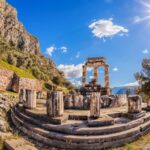
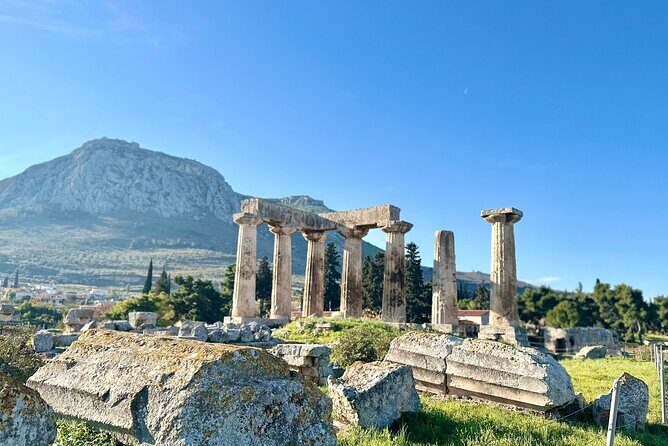
After the forum-type walk, you’ll shift toward monuments and viewpoints. The Temple of Apollo in Corinth is dated to around 550 BC and is described as one of the earlier Doric temples in both the Peloponnese and Greek mainland. The notes also point out something you can actually appreciate from a distance: rare monolithic columns for the ancient world.
Then comes Acrocorinth, the “Upper Corinth” acropolis: a fortress on a monolithic rock overlooking the city below. This is one of the stops where the defensive logic is the story. Acrocorinth’s secure water supply and fortress strength made it a last-line defense, controlling approaches into the Peloponnese.
If you like your history with clear cause-and-effect, this is it. From up high, you can see why a place like this mattered. Even if you don’t memorize dates, you’ll understand the purpose in minutes.
Practical tip: plan for steady walking and sun. Wear shoes you can trust and bring water even if you already have it in the car.
- All Day Cruise -3 Islands to Agistri,Moni, Aegina with lunch and drinks included
★ 5.0 · 4,958 reviews



Mycenae: Lion Gate and the Bronze Age That Still Looks Powerful
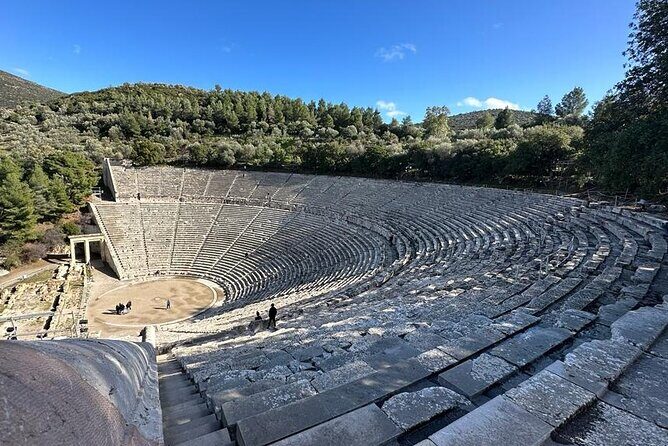
Then you’re in Mycenae, the fortified citadel associated with Agamemnon and the Mycenaean civilization. This is one of the best stops on the whole day if you enjoy archaeology that feels monumental. The plan gives you about an hour here, and I’d actually use that full hour to slow down and scan the walls and entrances, not just take quick pictures.
Mycenae gives you the Bronze Age vibe in big, readable chunks:
- Cyclopean walls that still look serious
- the famous Lion Gate
- the sense of a fortified system rather than a collection of random buildings
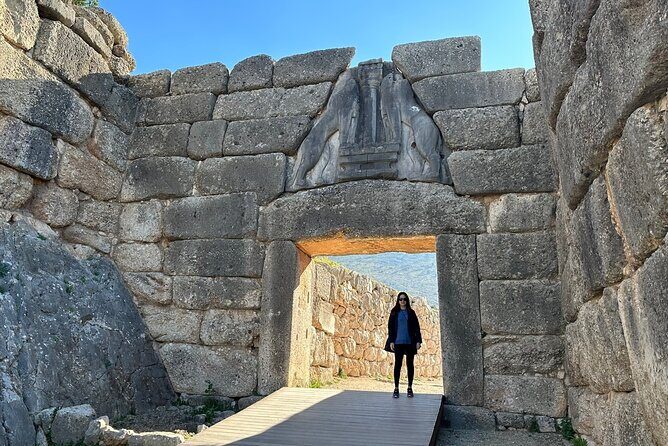
The Lion Gate stop is short but focused. It’s named for the relief sculpture above the entrance: two lionesses (or lions) in a heraldic pose. One of the coolest points from the provided details is that it’s described as the sole surviving monumental piece of Mycenaean sculpture and the largest prehistoric Aegean relief image that survived without being buried.
After that, there’s time for the Archaeological Museum of Mycenae. Even if you keep your museum time brief, it helps you label what you’ve just seen outside—especially if you want the tomb and wall story to make sense, not just look impressive.
Admission note: Mycenae’s main site is listed as free, while the museum is listed as not included.
Treasury of Atreus: A Tholos Tomb You Can Feel in Your Imagination
If Mycenae is about power, the Citadel and Treasury of Atreus is about architecture that signals power. This is a large tholos (beehive) tomb built around 1250 BC, linked to Agamemnon. The details you get here are specific: the stone lintel above the doorway is described as weighing about 120 tons, with approximate dimensions of 8.3 x 5.2 x 1.2 meters.
That’s the kind of number your brain has trouble visualizing, and that’s why seeing it matters. You don’t need to do the math; you just need to look up and understand how much stone, labor, and planning were involved.
The plan also notes it was mentioned by Pausanias in the 2nd century AD and was still visible in 1879 when Heinrich Schliemann discovered the shaft graves under the acropolis area. It’s a rare moment where multiple periods of history keep pointing back to the same place.
Admission note: this tomb stop is listed as not included.
Palamidi Castle and the 999-Step Payoff Over Nafplio
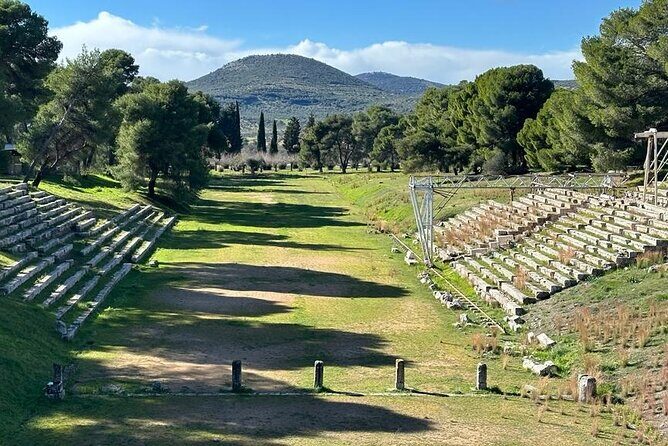
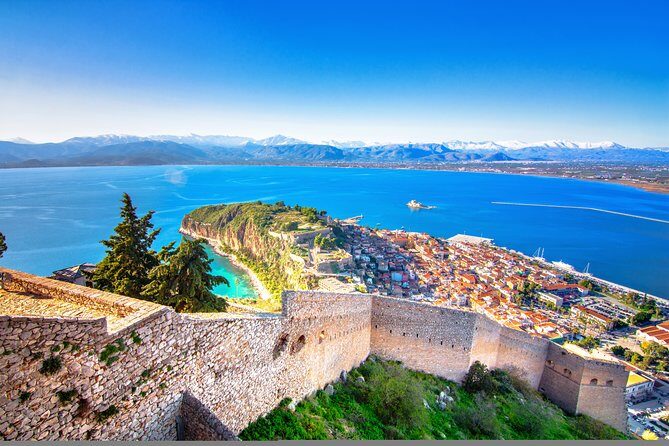
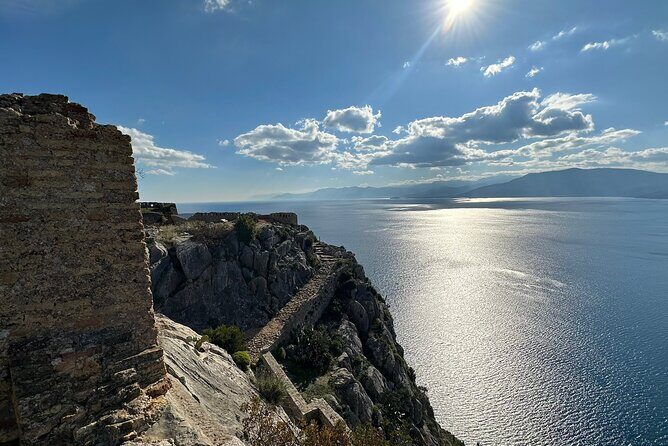
Now for one of the biggest “wow” moments: Palamidi Castle in Nafplio. It’s described as one of Greece’s best-preserved castles, sitting on a hill about 216 meters above the city. The Venetians built it during their second occupation, dated in the plan to 1686–1715.
The real reason people remember Palamidi is the climb. Locals say there are 999 steps to the top (the plan also mentions 913 steps in the winding stair from town to fortress, with over 1,000 steps to reach the top). Either way, this is not a casual stroll.
The payoff is the view: you get wide looks over the Argolic Gulf, the city of Nafplio, and the surrounding areas. Even if you’re not the type to chase viewpoints, this stop turns the day’s effort into something you can’t replicate in Athens.
Practical advice: wear grippy shoes and plan to slow down. The terrain includes steep, uneven ground in places, and you’ll want energy for the final photos.
Admission note: Palamidi is listed as not included.
Nafplio Old Town: Cobbled Streets, Venetians in the Details, and Lunch by the Sea
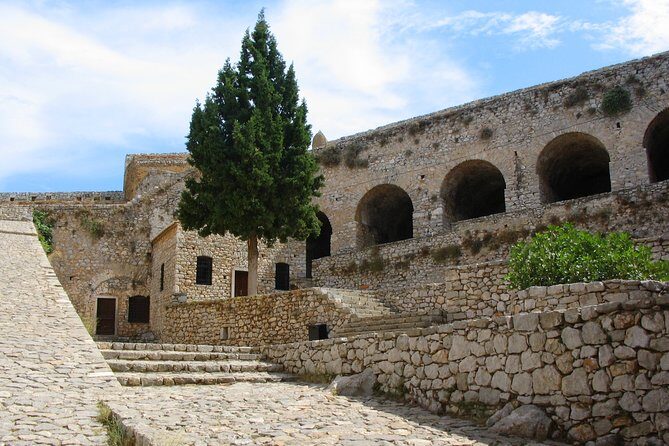
Nafplio is the part of the day that feels more like travel. Old Town is described with cobbled streets, doll-like mansions, and flowered balconies that can fill a weekend if you let them. From Syntagma Square, which is described as the zero point of the old town, the streets step upward and reconnect neighborhoods through stone stairways.
This is also where you’ll hear the city’s layered identity: Venetian, neoclassical, and oriental elements show up in architecture, not just in marketing. Nafplio is also noted as having served as the capital of Greece until 1834, which gives the town more weight than a quick postcard stop.
Lunch is scheduled at a traditional tavern by the sea, and that part is great if you want your day to end in comfort instead of rushing back to the car. The meal cost itself isn’t included, but the plan does set you up with a real pause rather than a random stop where you eat on the go.
Bourtzi and the Afternoon-to-Sunset Feel You’ll Want to Time
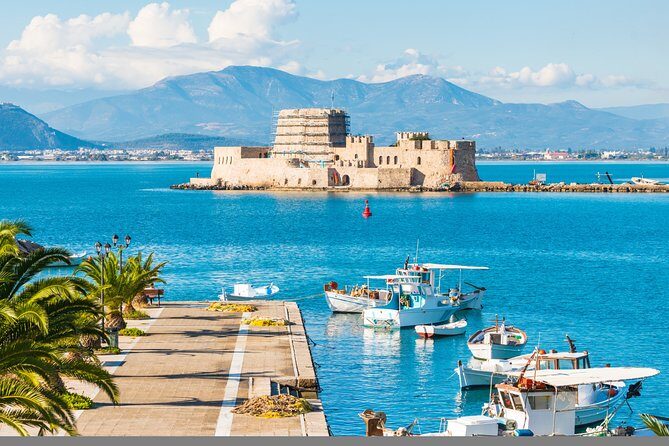
The small fortification called Bourtzi (on the islet of Agioi Theodoroi) is the kind of place that turns photos into memories. The plan says the Venetians built it in 1473 and it was called Castello dello Soglio. Later, the Ottomans used it as a prison, and much later it became a luxury hotel in the 1960s.
Today it’s a classic postcard setting, and the practical detail you’ll care about: you arrive by boat in less than 10 minutes. It’s not a long detour, so it works well inside a tight schedule.
Admission note: Bourtzi is listed as not included.
Acronauplia and the Lion of the Bavarians: Two Fast Stops With Big Stories
If you still have energy after Palamidi and Nafplio’s walkways, the last stretch includes two more story-heavy stops.
First is Akronafplia Fortress (Acronauplia), described as the oldest part of Nafplio. It says the arrival of Venetians and Franks turned it into part of the fortifications, and later some parts were used as a prison. The plan also notes that the view became a tourism benefit, leading to a hotel complex.
Then there’s the Lion of the Bavarians, a huge carved monument above Michael Iatrou Street. It’s credited to German sculptor Christian Ziegel, commissioned by King Louis (father of Otto). The monument is tied to Bavarian soldiers who died in Nafplio in 1833 of a typhoid epidemic, and the plan includes a local saying that points to what people ate.
These stops are shorter, but they help the day feel complete. By the time you see these, you’re not just collecting ruins—you’re seeing how later periods built symbols onto older ground.
How the Biblical Theme Actually Works Here
If you’re drawn to the tour because of the Bible connections, you’re not just getting name drops. The route links scripture to specific place traditions:
- Kenchreai ties to Acts 18:18 and Paul’s vow.
- Ancient Corinth ties to the public-setting story around Gallio and the Bema.
That means you can follow along without guessing. You’ll have physical anchors for the story. If you want to get even more out of it, skim Acts 18 beforehand so your brain already has the plot line before you stand in the places connected to it.
Price and Value: What Your Money Gets (and What It Doesn’t)
At $277.09 per person for a private, full-day drive, this can be good value if you care about comfort and guided interpretation while moving between sites. You’re paying for:
- door-to-door pickup and drop-off from Athens hotels, Airbnbs, or the port
- private vehicle comfort (WiFi, A/C, bottled water)
- an expert driver with historical storytelling in English
- a route that hits major anchors in one day
What’s not in the price is also important. Entrance fees aren’t included, and multiple sites are listed as ticketed. Also, the plan notes there isn’t a licensed guide accompanying you into archaeological sites. Your driver can give context, but you may still need to budget for paid site entry and any on-site presentation you choose to access.
So I’d treat this as a value option for people who want guidance and logistics handled, not as an all-inclusive ticket bundle.
Who This Tour Fits Best
This day is a good fit if you:
- want a private driver rather than joining a bus
- enjoy mixing major archaeological sites with faith-related place connections
- like photo stops with viewpoint payoff (especially Palamidi and Nafplio)
It’s less ideal if you:
- hate stairs or long walking days
- don’t want to manage additional entrance fees on the spot
Also, since this is a private tour by description, it’s smart to confirm what private means for your exact booking. The tour details promise that only your group participates, so if privacy matters a lot to you, ask the provider to confirm vehicle allocation for your date.
Should You Book This Private Corinth–Mycenae–Nafplio Day?
I’d book it if you want one focused day that covers Corinth Canal, Ancient Corinth, Mycenae, and Nafplio without spending your trip fighting logistics. The combination of Paul-linked stops, the scale of Mycenae, and the Palamidi climb makes it feel like more than a checklist.
If you’re traveling as a couple or small group and you’ll actually appreciate the storytelling (from drivers who have been highlighted such as Chris, Gianny, Yiannes, Costas, Michael, Dimitrios, or Ioannis), this can be a strong use of time. Just plan for entrance fees and comfortable shoes, and you’ll be set for a day that moves fast but makes sense.
FAQ
What is the duration of the tour?
The tour runs about 9 to 10 hours, depending on conditions and timing.
Where does the tour start and end?
It includes pickup from your Athens hotel, Airbnb, or the port, and ends back at the meeting point (with drop-off back to where you were picked up or another preferred point).
Is this tour private?
It’s described as a private tour, meaning only your group participates.
What languages are offered?
The tour is offered in English.
Are entrance fees included?
No. Entrance fees for attractions are not included.
Do I need to buy tickets in advance?
A mobile ticket is included, but site entry fees are not included in the tour price.
Do you provide pickup from airports?
Airport pickup and drop-off are not included, but an optional airport service is available for an additional cost.
What’s included in transportation?
You’ll travel in a modern first-class private vehicle with WiFi, A/C, and bottled water. Sedans are used for groups of 1–3, and mini vans for groups of 4–7.
Is lunch included?
Lunch stops are scheduled, but meal costs are not included.
What happens if weather is bad?
This experience requires good weather. If it’s canceled due to poor weather, you’ll be offered a different date or a full refund.


More Full-Day in Athens
- All Day Cruise -3 Islands to Agistri,Moni, Aegina with lunch and drinks included
★ 5.0 · 4,958 reviews

More Tour Reviews in Athens
- All Day Cruise -3 Islands to Agistri,Moni, Aegina with lunch and drinks included
★ 5.0 · 4,958 reviews