REVIEW · ATHENS
Athens Full Day Private Tour
Book on Viator →Operated by Xenon Travel Greece · Bookable on Viator
A long day in Athens, planned down to the minute. This private tour strings together the city’s biggest ancient icons plus Roman Athens and modern ceremony sights, with a driver who talks history as you ride. You also get onboard Wi-Fi and USB charging, so you can stay connected and keep your phone alive all day.
I especially like the no-stress transfers. Pickup and drop-off are built in from hotels/Airbnbs and the port, and the itinerary is adjustable if your priorities shift. One more strong point: most of the stops are short and free, so your paid time goes to the two real ticket anchors.
The one possible drawback is simple: the Acropolis and Ancient Agora admissions aren’t included. You’ll pay €50 per person to the driver on the day, and because the driver isn’t described as certified to escort you inside every site, you may want extra asking time (or a licensed guide if available) to go as deep as you want.
In This Review
- Key things that make this tour tick
- Door-to-door Athens: how the pickup shapes your day
- Price and value: what you pay for, and what you don’t
- The driver setup: what you’ll get, and how to get the most
- Acropolis and the surrounding “stage set” of ancient Athens
- Theatre of Dionysus: where drama had a home
- Herod Atticus Odeon: the “Roman amphitheater” vibe
- Propylaea and Parthenon: the entrance and the icon
- Temple of Athena Nike and Erectheion: smaller structures with sharper stories
- Olympian Zeus and Hadrian’s Gate: when Athens turns Roman
- Syntagma Square, Changing of the Guard, and the Unknown Soldier
- Unknown Soldier monument: why it’s more than a statue
- Mount Lycabettus and Panathenaic Stadium: views and marble history
- Mount Lycabettus: quick altitude, big payoff
- Panathenaic Stadium: modern Athens honoring ancient sport
- Ancient Agora and the Agora Museum: slowing down for context
- Monastiraki, Plaka, and Koukaki: your lunch hour and old-street Athens
- Timing that stays flexible: how to manage crowds and focus
- Who should book this tour, and who might want to mix it up
- Should you book this Athens Full Day Private Tour?
- FAQ
- What’s included in the tour price?
- Are Acropolis and Ancient Agora tickets included?
- Does the tour include lunch?
- Is there a licensed tour guide?
- How does the Changing of the Guard timing work?
- Can I cancel for a full refund?
Key things that make this tour tick
- Wi-Fi + USB charging keeps your plans, maps, and photos easy all day
- Door-to-door pickup and drop-off (port or your accommodation) saves time and hassle
- Driver-led context turns quick stops into a clear story as you move across the city
- Flexible timing helps you slow down for what you care about, not what the clock demands
- Most stops are free so you spend your paid focus on the major ticket areas
Door-to-door Athens: how the pickup shapes your day
This is the kind of Athens tour that starts working for you before you even leave your room. With pickup and drop-off from your hotel/Airbnb or the cruise port, you avoid the usual morning scramble. In a city where traffic and crowding can change how long everything takes, that matters.
You’ll ride in a luxury air-conditioned vehicle, and the tour is private, meaning your group is the only group in the car. That also makes it easier to work around your pace: you can stop for a photo, take a break, or adjust timing when something is busier than expected.
One practical bonus I like: the tour uses a mobile ticket. Even when your day is smooth, it’s nice to know you’re not relying on paper in a bag getting squished and forgotten.
You can also read our reviews of more private tours in Athens


Price and value: what you pay for, and what you don’t
At $205.58 per person for about 8 hours, the value comes from how much is bundled into the day: transport, Wi-Fi/USB power, bottled water, and a driver who provides historical background while you travel.
What’s not included is the two big admission items: Acropolis and Ancient Agora. Those are handled by the operator on the day—tickets are organized and you pay €50 per person directly to the driver. That means you don’t have to pre-purchase ahead of time, but you should still budget for it.
So what are you really buying with this price?
- You’re buying time (door-to-door transfers)
- You’re buying comfort (luxury air-conditioned vehicle, Wi-Fi, bottled water)
- You’re buying structure (a full-day route that hits major sites without you planning every turn)
- And you’re buying context (the driver keeps you informed as you ride)
If you’re only going to see Athens once, this is a strong setup. If you’re staying multiple days and want to wander slowly, you might pick and choose different neighborhoods instead. But for a single, high-impact day, the math often works.
The driver setup: what you’ll get, and how to get the most
This tour is led by an English-speaking driver with deep historical knowledge. That’s a big deal because you’re not just shuttled from point A to point B—you’re told what you’re looking at while you’re going.
There’s also a key limitation you should understand. The drivers are described as not certified to accompany you to any site. Translation: you might not get a fully guided indoor explanation everywhere. The tour notes that you can request a licensed tour guide depending on availability—if you want deeper narration inside specific monuments or museums, it’s worth asking.
On the plus side, the reviews included strong examples of drivers going beyond “drive and drop.” Names like Aristotle and Nasos come up repeatedly, and you can see what that means for your day: people describe the information as clear, personal, and full of small meanings you might miss on your own. Another name that shows up is Panos, plus George/Georgius, and Elisha—each described as flexible and tuned to what the group wanted.
Acropolis and the surrounding “stage set” of ancient Athens
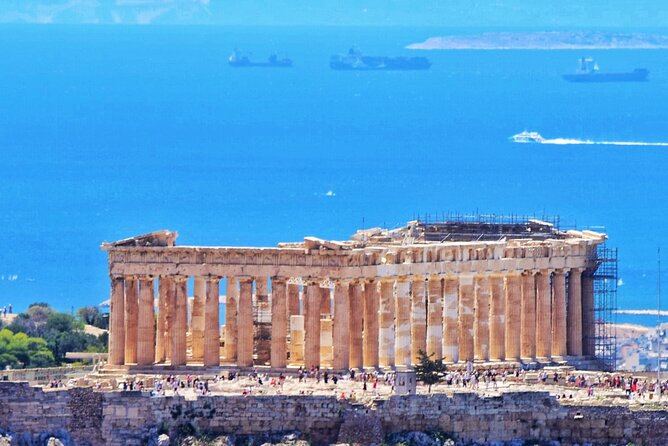
The day’s anchor is the Acropolis, where you’ll spend about 1 hour 30 minutes. This is the place Athens designed to look permanent—an ancient sanctuary that dominated the center of modern Athens. If you’ve ever seen the Parthenon on postcards, this is where that view becomes real scale.
Then the tour threads you through several nearby Acropolis-area landmarks that are quick but meaningful.
Theatre of Dionysus: where drama had a home
Next is the Theatre of Dionysus, about a 10-minute stop. This space is tied to Dionysus and to Attic drama, including Athens’ major festival tradition (the Great Dionysia). Even as a short stop, it helps you see that ancient Athens wasn’t only temples and politics—it was also public performance.
You can also read our reviews of more tours and experiences in Athens
- All Day Cruise -3 Islands to Agistri,Moni, Aegina with lunch and drinks included
★ 5.0 · 4,958 reviews




Herod Atticus Odeon: the “Roman amphitheater” vibe
You’ll also see the Herod Atticus Odeon for about 10 minutes. It’s described as the final great structure built in antiquity in the Acropolis area, from imperial times, and it holds at least 5,000 people. Even if you don’t sit in the seats, the scale gives you a feel for how the city used monumental architecture for community life.
Propylaea and Parthenon: the entrance and the icon
The Propylaea is the major gateway into the sacred area, another 10-minute stop. It’s framed as more than a simple entrance—built as a complex, harmonious public monument that represents the magnanimous nature of the Acropolis.
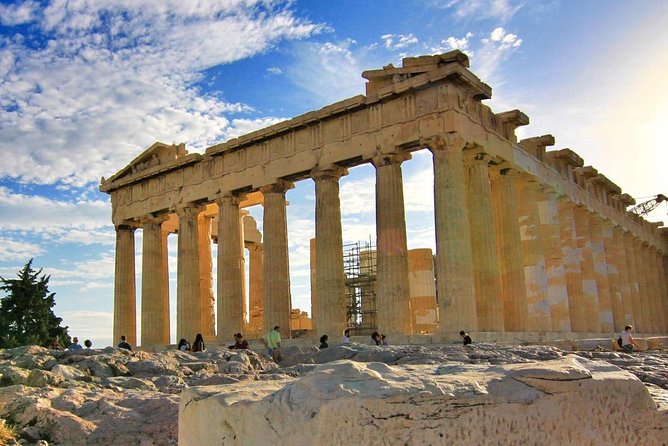
After that, you’ll reach the Parthenon for about 10 minutes. The facts in the tour description are a reminder of the speed and ambition: work began in 447 BC and the building was finished by 438 BC, with decoration work following until 432 BC. This is one of those sites where even a short stop can land, because it’s hard not to feel how intentional it was.
Temple of Athena Nike and Erectheion: smaller structures with sharper stories
Two more 10-minute stops keep the Acropolis day from feeling like one long “look at ruins” moment:
- Temple of Athena Nike: dedicated to Athena and Nike, described as the first full Ionic temple in the Acropolis (built around 420 BC).
- Erectheion: on the north side of the rock, tied to legend of the naming contest between Poseidon and Athena.
These are the stops that often make the day feel “designed” rather than “rushed.” If your driver’s explanations are strong (the reviews suggest that can happen), you’ll understand why each smaller temple matters.
Olympian Zeus and Hadrian’s Gate: when Athens turns Roman

After the Acropolis cluster, the tour brings in Roman-era Athens with two important waypoints.
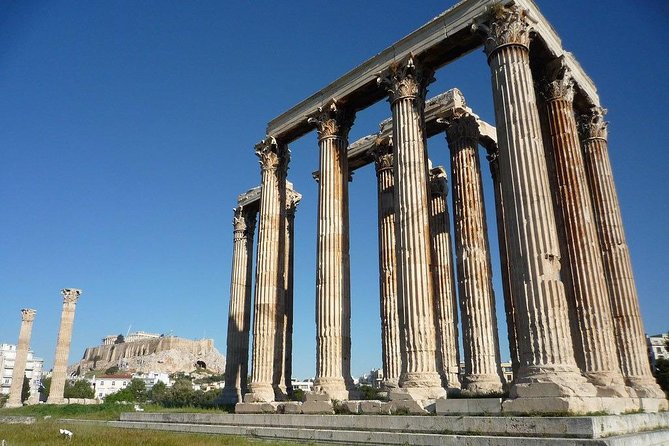
You’ll encounter the Temple of Olympian Zeus (also called the Olympeion). The description frames it as a temple built in honor of Zeus. Next is Hadrian’s Gate, a Roman arch created in 131 AD during Hadrian’s stay, and presented as an entrance to the Temple of Olympian Zeus.
Even if these are shorter stops, they do something smart: they show Athens evolving rather than staying frozen in one era. If you like seeing how cities layer time—Greek foundations, Roman additions—this section helps connect the dots fast.
Syntagma Square, Changing of the Guard, and the Unknown Soldier
The tour makes time for one of Athens’ most recognizable modern traditions: the Changing of the Guard at Syntagma in front of the Unknown Soldier monument.
This part is built around the fact that the ceremony runs every hour, and you’ll spend about 30 minutes here. The show itself lasts around 15 minutes. Two Evzones step forward, replace colleagues, and the routine includes an impressive gait as they stretch and move with choreography.
I like this stop because it’s not only a performance—it’s a way to see how national symbolism gets staged in public. And the timing works even if you’re not a “military tradition” person, because the ceremony is structured and easy to follow once you’re there.
Unknown Soldier monument: why it’s more than a statue
Right with the ceremony is the Monument to the Unknown Soldier, described as a reference point and tribute to Greek soldiers tied to two national celebrations: 25/3/1821 and 28/8/1940.
If you want to get more out of it, ask your driver what the ceremony symbolizes and how the uniform details fit the story. Reviews include examples of guides treating this moment as a highlight with extra meaning, not a quick photo stop.
Mount Lycabettus and Panathenaic Stadium: views and marble history
Mount Lycabettus: quick altitude, big payoff
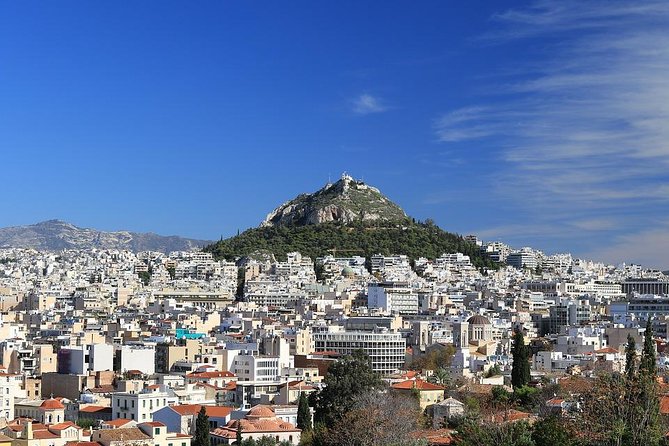
Next you’ll head to Mount Lycabettus for about 15 minutes. The description includes a myth connection involving Athena and a crow, plus a visible church at the top: Agios Georgios. The main reward is the line in the tour text about what you see from the summit—views over Athens and the Saronic Gulf.
This is a great mid-day or late-day reset. You get a break from the “standing inside ancient sites” feeling, and your eyes get the city scale.
Panathenaic Stadium: modern Athens honoring ancient sport
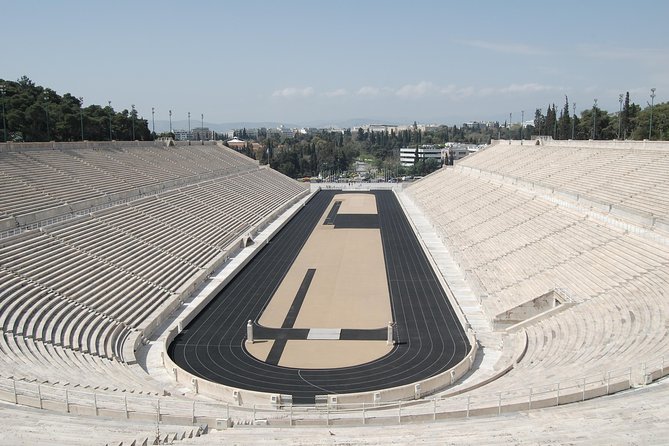
Then there’s Panathenaic Stadium (also Kallimarmaro) for about 30 minutes. It’s described as one of the most important cultural monuments in Athens, surviving in very good condition, and it ties directly to worship of Athena and the competitions held in her honor.
The stadium’s marble link is part of the story too: it was completed before the 6th century BC, but the final form with precious marble came later after a long timeline.
If you’re thinking about your photo plan, this is a good place to take a few shots with the city in the background, not only in-front-of-ruins framing.
Ancient Agora and the Agora Museum: slowing down for context
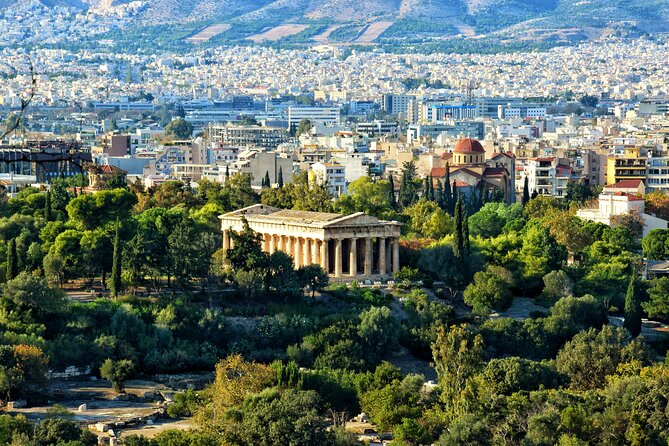
For many people, the Acropolis is the headline. The Ancient Agora is where the day becomes clearer.
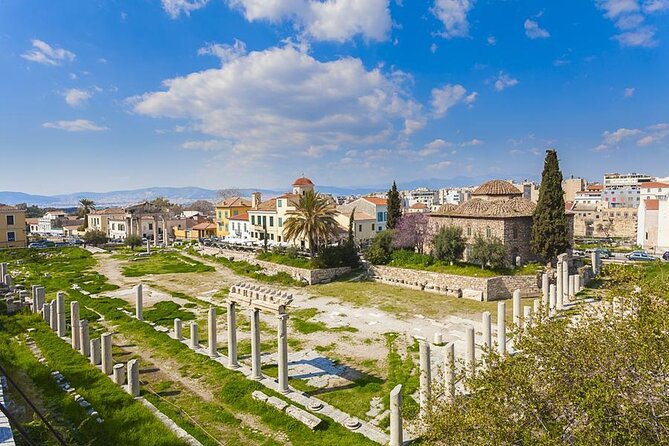
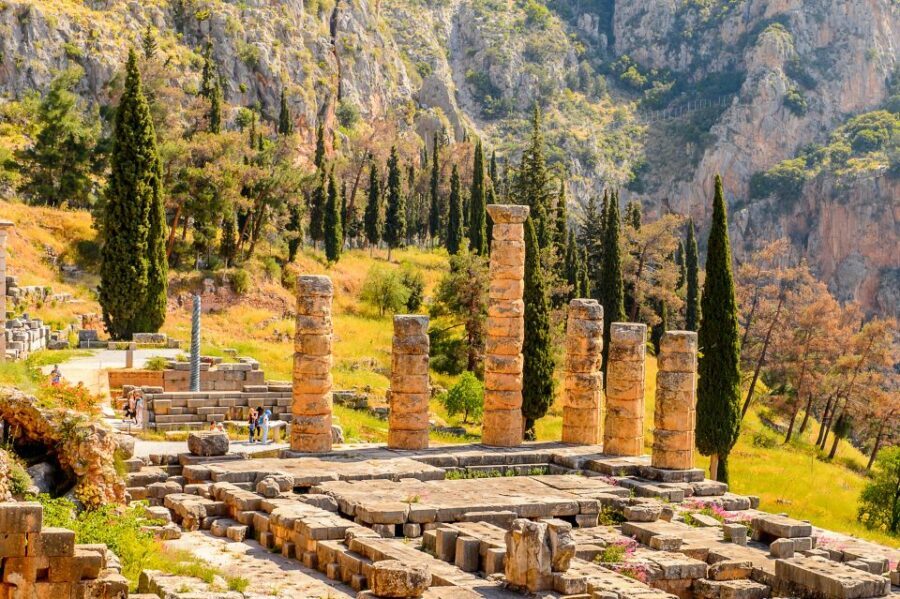
You’ll spend about 1 hour at Ancient Agora. It’s described as the focal point of public life—an open area that drew the attention of Athenians over and over again. If Parthenon-style monuments feel distant, the Agora is the “people lived here” story.
Then you’ll have about 15 minutes at the Museum of the Ancient Agora, shown as a place for discoveries connected to the institutions of the Athenian Republic. This matters because it gives you objects and details that make the plain spaces feel more real.
Important practical note: Agora admission is part of the €50 per person paid to the driver (not included upfront). So if you’re budget-conscious, this stop is where you’re paying for the most “tangible” learning.
Monastiraki, Plaka, and Koukaki: your lunch hour and old-street Athens
After the core historical sites, the tour shifts into neighborhood atmosphere.
You’ll pass through Monastiraki, with the meaning given in the description (small monastery) tied to the area’s older religious history. Then you’ll wander through the alleys of Plaka, described as the oldest neighborhood in Athens at the foot of the Acropolis, with neoclassical architecture, shops, and tavernas.
Then comes Koukaki for about 1 hour 30 minutes, framed as the moment to slow down and enjoy lunch in old Athens. Lunch itself is not included, but this is a built-in time slot to actually use a recommendation or pick a simple place without feeling like you’re on the clock.
This block is more than a break. It’s where Athens stops being a list of monuments and becomes a real day you can feel in your legs and senses.
Timing that stays flexible: how to manage crowds and focus
A private tour only works if it’s able to adapt. This one is described as having a customized itinerary and flexible timing. In practice, that means you can spend longer at what you care about and shorten what doesn’t hook you.
It also helps because Athens can get busy. One of the most repeated themes in the feedback is that guides timed things smartly and kept the pace comfortable, even when streets and entrances got crowded.
A simple tactic for you: at the start of the day, tell your driver what you want most (Acropolis, ceremony, views, Agora). Then be explicit about what you can skip. The tour is built for that kind of “I want the highlights, but not the stress.”
Who should book this tour, and who might want to mix it up
This tour is a great fit if:
- You want to see a lot of Athens in one day without planning logistics
- You like historical context as you ride, not just reading labels
- You appreciate comfort features like air-conditioning, Wi-Fi, and USB charging
It may not be ideal if:
- You want a fully licensed, site-by-site guide throughout every monument. The driver is described as not certified to accompany you inside sites, though a licensed guide can be requested depending on availability.
- You hate extra costs during the day. The €50 per person for Acropolis + Ancient Agora will appear.
If you have mobility needs, the tour notes that service animals are allowed and that most travelers can participate. Still, given that the day is long and you’ll move between multiple major sites, it’s wise to plan for breaks and a comfortable pace.
Should you book this Athens Full Day Private Tour?
Yes, if your goal is a high-coverage Athens day that feels organized, comfortable, and easy to manage. With door-to-door pickup, a private vehicle, Wi-Fi/USB power, and a route that hits Acropolis, the Agora, and the Changing of the Guard, you’re paying for fewer hassles and more clarity.
The decision gets even easier if you want a driver who can bring the sights to life. The feedback is strongly positive, including standout mentions of guides such as Aristotle and Nasos, along with others like Panos, George/Georgius, and Elisha.
The only real question is admissions and depth: you’ll pay extra for Acropolis and Agora, and if you crave heavy narration inside every site, ask about a licensed guide option early.
FAQ
What’s included in the tour price?
Transport in a luxury air-conditioned vehicle, pickup and drop-off from hotel/Airbnb or the port, Wi-Fi, bottled water, and USB charging. You also get skip-the-lines to purchase tickets, and the tour is run in English with a driver who provides historical information.
Are Acropolis and Ancient Agora tickets included?
No. Admission for Acropolis and Ancient Agora costs €50 per person, paid to the driver on the day. The tour notes there’s no pre-purchase required.
Does the tour include lunch?
Lunch is not included. The route includes time in Koukaki that’s meant for a lunch break.
Is there a licensed tour guide?
The driver is an English-speaking historical guide, but drivers are described as not certified to accompany you to any site. A licensed tour guide can be requested depending on availability.
How does the Changing of the Guard timing work?
The Evzones perform the Changing of the Guard every hour in front of the Unknown Soldier on Syntagma. The show lasts about 15 minutes, and the tour schedules about 30 minutes for this.
Can I cancel for a full refund?
Yes. Free cancellation is available if you cancel up to 24 hours in advance for a full refund. Less than 24 hours before the start time isn’t refundable.
If you tell me your travel month and whether you’re arriving by cruise or flying in, I can suggest a realistic start-time strategy for best light and fewer crowd headaches.



More Private Tours in Athens


More Tours in Athens



More Tour Reviews in Athens
- All Day Cruise -3 Islands to Agistri,Moni, Aegina with lunch and drinks included
★ 5.0 · 4,958 reviews