Thinking in Athens hits different. This philosophical walking tour turns major sites into mental workout stations, with multimedia presentations and speakers that connect ancient ideas to modern psychology. I especially like the way it uses real places (Theatre of Dionysus, Pnyx, Roman Agora) as discussion prompts, and I like that it keeps circling back to happiness, reason, and self-awareness. One drawback: it’s packed into about 2.5 hours, so you won’t linger long at any single stop.
The format is also smart for groups. You move mostly on foot around Athens’s central historic areas, you’re limited to a private group of up to six, and the route is built to keep you looking, listening, and talking. It’s offered in English, and it includes a mix of indoor-free outdoor viewpoints—plus at least one admission ticket that’s handled for you.
In This Review
- Key highlights before you go
- Why this Athens walk feels like thinking out loud
- Price for a small group: what you get for $90.11
- Your 11:00 start at Acropoli and how the circuit works
- Theatre of Dionysus and Herod Atticus: tragedy and persona
- Prison of Socrates: the allegory of the cave as a walkable lesson
- Democracy at the Church of Agios Dimitrios Loumbardiaris
- Philopappos Monument to Pnyx: happiness, eudaimonia, and big views
- Keramikos, Epicurus, and where Stoicism took shape
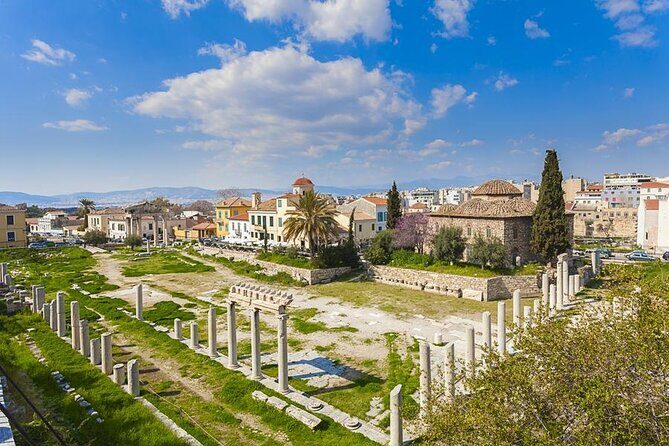
- Roman Agora, the meteorological station, and the Mnisikleous stairs lunch spot
- Lysikratous Square and Anafiotika: Apollo and Dionysus in the streets
- What makes this tour especially engaging: multimedia, pace, and interaction
- Tips to get the most from the walk
- Who this tour suits best
- Should you book this Philosophical Tour in Athens?
- FAQ
- How long is the Philosophical Tour in Athens?
- What time does the tour start, and where do you meet?
- What’s the price per person?
- Is this tour private?
- What language is the tour offered in?
- What if the weather is bad?
Key highlights before you go
- A philosophy-first route: tragedy, persona, the cave, democracy, and happiness all get paired with specific Athens landmarks.
- Private group, small size: only your group (up to six), so questions don’t get lost.
- Multimedia and short videos: speakers and visuals help ideas land faster than a lecture.
- Top viewpoints for a reason: Philopappos and Pnyx aren’t just pretty stops; they’re used for lessons on eudaimonia and well-being.
- Happiness schools in action: you’ll compare Plato/Socrates and Epicurus through what you’re seeing around the city.
- Lunch-friendly pacing: there’s a specific spot where the guide frames the atmosphere and calls it a good place for a midday bite.
Why this Athens walk feels like thinking out loud
This tour isn’t trying to be a standard “see the sites, take the photos, move on” loop. The real product is the way your guide turns each location into a question.
At Theatre of Dionysus Eleuthereus, you start with tragedy—called the birthplace of tragedy—and the idea that watching a tragic play was once seen as a kind of mental reset. From there, the tour threads through personality and mind (persona, animus, anima), then shifts into Plato’s big themes at the Prison of Socrates with the allegory of the cave. The day keeps returning to inner life: how you judge, how you reason, and how you steer your attention.
If you like thinking (even if you’re not a “philosophy person”), this works because it asks you to connect dots while you’re standing in the right spot. You get views along the way, but they’re used as anchors. You’re not just looking at Athens. You’re using Athens to think.
You can also read our reviews of more tours and experiences in Athens.


Price for a small group: what you get for $90.11
$90.11 per person is the kind of price that makes sense when you compare it to what you typically spend on a tour that includes a guide plus active teaching.
What helps here is that the tour is private for your group (up to six). That’s meaningful value: you can ask follow-ups without the usual “one question every five minutes” problem. And the structure is built around mostly outdoor stops with free admission tickets listed for several locations, so you’re not hit with extra site fees at every turn. Pnyx has an admission ticket included, which reduces friction.
The tour is also about time. Two hours and thirty minutes is long enough to build momentum, but short enough that you can still plan the rest of your day around a classic Athens itinerary.
Your 11:00 start at Acropoli and how the circuit works
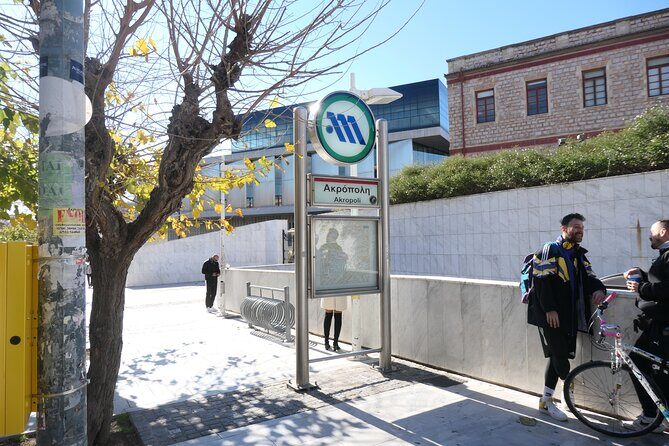
You meet at Acropoli, Athens 117 42, Greece at 11:00 am, and you return to the same meeting point at the end.
That matters because it keeps you from feeling trapped into a half-day far from where you’re staying. It also makes it easier to pair this with morning wandering later—or with an afternoon plan on the Acropolis side.
The tour runs about 2 hours 30 minutes, and the pacing is designed for walking plus short talks and short video segments. Several stops are described as brief (10–15 minutes), so you should expect movement. Think of it like guided conversation in a walkable Athens “classroom,” not like a museum tour where each room gets a long stay.
Also note the practical bits: it’s near public transportation, service animals are allowed, and most people can participate. If you’re sensitive to heat, plan on moving in short bursts between shady moments.
Theatre of Dionysus and Herod Atticus: tragedy and persona
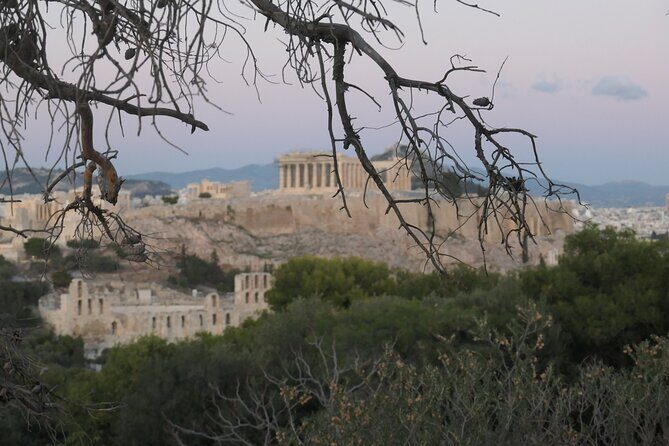
You begin outside Theatre of Dionysus Eleuthereus, the place linked to the birthplace of tragedy. This start sets the tone. You’re not beginning with a generic “history of Athens.” You’re beginning with why humans might have needed tragedy in the first place.
The guide connects this to modern psychology ideas—including Carl Jung—around the role of tragedy in helping you become your best self. The tour also mentions angles like Buddhism and evolution psychology in relation to the way people think and judge. Whether you agree with every frame or not, it’s a strong way to start because it treats art as therapy, not just entertainment.
Next comes Herod Atticus Odeon, one of the most famous open-air theaters. Here the focus shifts to personality concepts: persona, animus, and anima. The point isn’t to turn Athens into a psychology textbook. It’s to show that ancient culture constantly asked human questions, then gave them stories, characters, and stages.
Prison of Socrates: the allegory of the cave as a walkable lesson
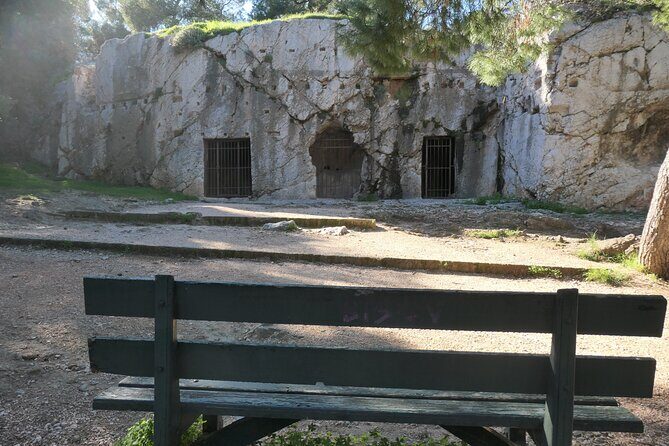
At the Prison of Socrates, the tour moves straight into Plato’s philosophy and the allegory of the cave.
This is where the tour becomes more personal, even if you came for the archaeology. The allegory is basically about perception—what you think is real, what you learned to trust, and how people resist change because it’s uncomfortable.
The practical win is that you’re not just hearing the allegory described. You’re hearing it while standing in a stop framed as tied to Socrates. That link makes it easier for you to hold the idea in your head: you can picture the cave as a metaphor for your own habits of thought.
If you enjoy hands-on mental models—concepts you can actually use in daily life—this part usually clicks.
- All Day Cruise -3 Islands to Agistri,Moni, Aegina with lunch and drinks included
★ 5.0 · 4,958 reviews






Democracy at the Church of Agios Dimitrios Loumbardiaris
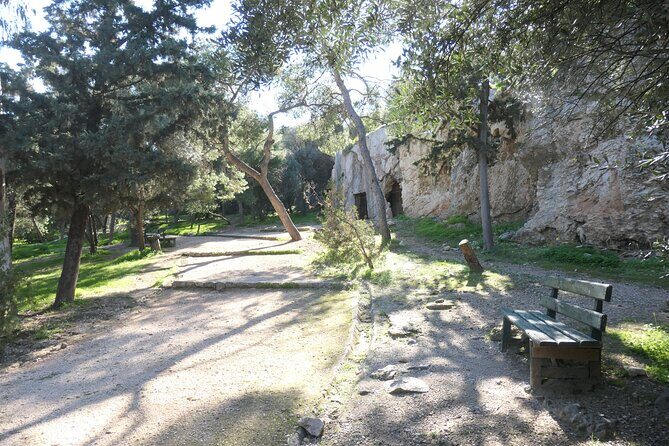
The tour pauses at Eglise D’agios Dimitrios Loumbardiaris, framed here as connected to the birth of democracy.
It’s a reminder that political ideas didn’t stay in meeting halls. They were embodied in civic spaces and public life. The guide uses this stop to connect Athens’s philosophical spirit to democracy as something enacted, not just discussed.
If you tend to see democracy as an abstract concept, this kind of stop helps it feel grounded. It’s also a nice pacing change: after the heavier mental themes, this moment brings you back to the city as a lived system of ideas.
Philopappos Monument to Pnyx: happiness, eudaimonia, and big views
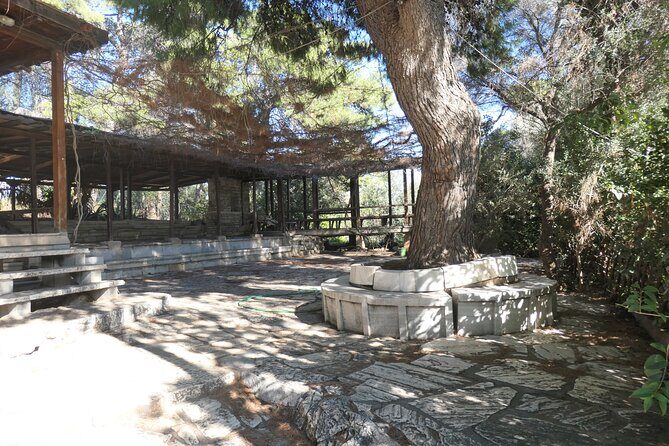
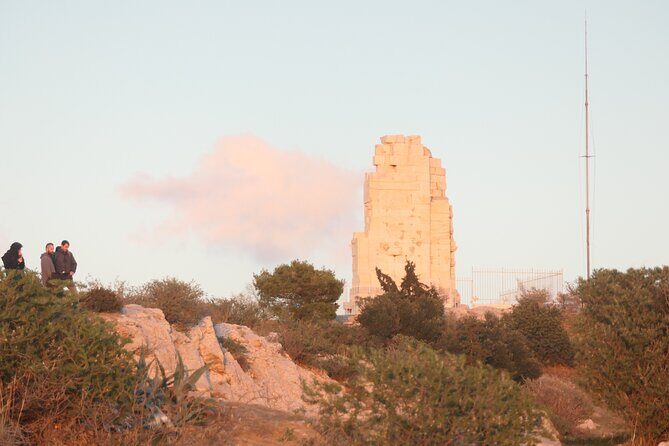
At Philopappos Monument, the tour leans into the payoff: the best view of the Parthenon and Acropolis, plus a framed discussion of happiness. The tour describes this as a highly energetic point in Athens, which fits how the guide uses it—as a place where the mind can actually breathe while you talk.
The guide ties the “recipe of happiness” to Plato and Socrates. That’s a clever choice because it gives you a concrete mental framework to carry through the rest of the route. You’re not just collecting sites; you’re tracking themes.
Then comes Pnyx, described as the assembly area of Athenian citizens. This is where the tour uses Aristoteles’s perspective of eudaimonia (blissful well-being) and also frames Pnyx as a secret place of Socrates. Admission ticket is included here.
This stop is a key reason to pick this tour. You get the viewpoint, and you get a reason for the viewpoint. Eudaimonia becomes less like a term and more like a question: what does a good life require, and how does your environment shape your thinking?
Keramikos, Epicurus, and where Stoicism took shape
Next is Keramikos Archaeological Site, the ancient cemetery of Athens. The tour ties this to Epicurian ideas of happiness (including the idea of Epicurus’s garden).
This is another smart lesson structure. You learn that different schools of philosophy can be about different things: reason, civic life, and also emotional calm. Epicurus is often misread as only pleasure-focused. In this format, the guide has space to connect the idea of happiness to a way of living, not just a single slogan.
The route also references where Stoicism was born and a broader “philosophy was born” framing that includes theater and democracy being executed for the first time. It also calls out the most beautiful street in Athens along the way.
Because the tour description for these elements is shorter here, you should treat this as a guided interpretation moment rather than a step-by-step history lecture. The value is that you get the big lines and then you keep moving to verify them with what you’re seeing.
Roman Agora, the meteorological station, and the Mnisikleous stairs lunch spot
At Roman Agora, the tour focuses on stoicism taught as a philosophy of life. This stop helps connect Stoicism from theory into daily behavior: what you do with discomfort, uncertainty, and change. You’re learning a framework, not just learning a date.
Then you hit a described highlight: the first meteorological station in the world. That’s a reminder that Athens wasn’t only about philosophy as conversation—it was also about observation and systems.
The tour then highlights the discussion point of the philosophers and mentions the atmosphere of the Mnisikleous stair, framed as the best place for lunch.
This is practical. You’ll likely want to grab food after the walk intensity builds. The key is that the guide is using the spot for atmosphere and conversation cues, so lunch doesn’t feel like an interruption. It feels like part of the day’s theme: thoughts, pauses, and a reset.
Lysikratous Square and Anafiotika: Apollo and Dionysus in the streets
At Lysikratous Square, the tour brings in an ideas-based stop tied to Nitze’s (Nietzsche-style) apollonian and dionysian sides of Athens.
This is one of those “if you care about ideas” moments. The Apollo/Dionysus contrast is about order versus impulse, clarity versus ecstasy, structure versus emotion. In a walking format, you can actually feel the contrast in the way a city moves—what looks composed, what looks chaotic, where you sense each mood in stone and street layout.
Finally you reach Anafiotika, described as feeling like a Cycladic island and called the second most energetic point in Athens. You’ll get the shift in vibe: more intimate lanes, that island-like feel, and a change from monumental viewpoints to smaller human-scale streets.
It’s a good ending note. You finish with atmosphere instead of only landmarks.
What makes this tour especially engaging: multimedia, pace, and interaction
This experience is built to keep you mentally active. It includes speakers and multimedia presentations, and the tour description repeatedly frames stops with “why” questions: why tragedy shaped judgment, why the cave matters, why democracy mattered, why happiness differs by school.
The best part, though, is the interaction style. The tour is private for up to six, so you’re not stuck listening while your group fades into silence. You can ask where an idea fits your life, and the guide can adjust the level based on what you care about.
Another engagement detail is the way the tour handles heat. Short breaks and selecting comfortable spots are part of how the tour keeps you going. That’s not a luxury detail in Athens; it’s the difference between a tour that feels enjoyable and one you rush through just to survive the weather.
Tips to get the most from the walk
A few practical moves will help you turn this into a memorable day:
- Wear comfortable shoes. This is a walking circuit with viewpoint stops and steps.
- Bring water. Even with breaks, you’ll be outside and moving for hours.
- If philosophy isn’t your usual topic, come anyway and treat it like prompts. The tour works best when you’re willing to think out loud.
- If philosophy is your thing, prepare questions. You’ll likely get more out of it by asking about happiness, self-awareness, or how tragedy and reason connect.
Also, plan your expectations. You’re not doing a deep museum day. You’re doing an ideas tour with Athens as the classroom.
Who this tour suits best
This tour is a great match for you if:
- you like philosophy that talks to real life, not just dates and names
- you enjoy psychology connections and modern relevance (the tour description explicitly links concepts like Jung, persona, and self-awareness)
- you want a guided walk that helps you see Athens differently in a short window
- you prefer a smaller private group where discussion stays alive
If you only want strict archaeology details or long time inside buildings, you might find the format too conversational and time-lean per stop. But if you’re the type who likes to leave with ideas you can use, this one is hard to beat.
Should you book this Philosophical Tour in Athens?
Book it if you want Athens to feel like a living argument about how to think and how to live. The price is reasonable for a private group, the route hits major landmarks tied to big philosophical themes, and the multimedia + speaker format keeps the lessons from turning into a slog.
Skip it if your ideal day is mostly quiet wandering or deep museum time. This tour is active, themed, and discussion-led. For many people, that’s exactly the point.
If you’re on the fence, think about your goal for the trip. If your goal is to see Athens and also leave with a sharper mind, you’ll likely love this.
FAQ
How long is the Philosophical Tour in Athens?
It lasts about 2 hours 30 minutes.
What time does the tour start, and where do you meet?
It starts at 11:00 am, meeting at Acropoli, Athens 117 42, Greece. The tour ends back at the meeting point.
What’s the price per person?
The price is $90.11 per person.
Is this tour private?
Yes. It’s private, with only your group participating, up to six people.
What language is the tour offered in?
The tour is offered in English.
What if the weather is bad?
This experience requires good weather. If it’s canceled due to poor weather, you’ll be offered a different date or a full refund.


More Tours in Athens

More Tour Reviews in Athens
- All Day Cruise -3 Islands to Agistri,Moni, Aegina with lunch and drinks included
★ 5.0 · 4,958 reviews