REVIEW · ATHENS
The best of Athens Piraeus Full-Day Private Shore Excursion
Book on Viator →Operated by Athens Shore Excursions · Bookable on Viator
Athens in one day needs a plan. This private shore excursion is built for maximum Athens without the herding-bus feel. I like that you get pickup from Piraeus and a full-day route that hits the big-name sights plus the city details that make Athens feel real. The one thing to weigh is that site and museum entry fees are not included, so you’ll want to plan for those costs ahead of time.
The day mixes famous landmarks with “you’re-there” moments: the Acropolis monuments, the Presidential Guard ceremony, and a genuine lunch break in Plaka. I also like that the group is small, up to 3, and you’re riding in an air-conditioned vehicle with an English-speaking professional who can explain what you’re seeing before you go in. One possible drawback: the schedule is active and you should have moderate fitness, since you’ll be walking and climbing at multiple stops.
Key detail from the experience: Michael (one of the drivers/hosts) was praised for being punctual, accommodating, and clear with the history, which matters a lot on a day when time is tight. If you want a day that feels personal rather than rushed, this format is a strong fit—just budget for admissions.
In This Review
- Key Highlights Worth Planning For
- Piraeus Pickup and the Coastal Drive Into Athens
- The Acropolis Approach: Gates, Views, and What to Notice
- Parthenon, Erechtheion, and the Karyatides Moment
- Admission Tip for the Acropolis Hill
- Syntagma Square and the Greek Guards at the Unknown Soldier
- Hellenic Parliament, the Old Royal Palace, and Marble Details
- Academy, University, and National Library: Athens’ Academic Street
- Old Parliament and Syntagma Square’s Meaning
- Plaka Free Time: Neighborhood of the Gods for Lunch
- Ancient Agora: A Marketplace That Never Really Left
- Acropolis Museum: Turn Stones Into Meaning
- Olympian Zeus and the Marble Stadium Finish
- Mount Lycabettus: City Views and a Peaceful Closing
- Price, Value, and What You’re Actually Buying
- Should You Book This Athens Piraeus Shore Excursion?
- FAQ
- Is pickup available from the cruise port in Piraeus?
- What time does the tour start?
- Is the tour fully private?
- Are entrance tickets included for the archaeological sites and museums?
- Can the tour driver accompany you inside archaeological sites?
- Is free cancellation available?
Key Highlights Worth Planning For
- Private, small-group format (up to 3) that keeps the day flexible
- Piraeus port pickup plus an air-conditioned ride along the coast into Athens
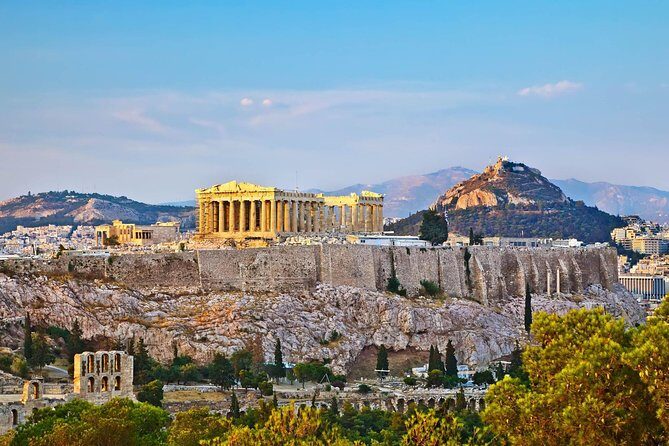
- Acropolis monuments in a logical order so each structure makes sense
- Changing of the Greek Guards timed for the top of the hour in Syntagma Square
- Plaka free time for lunch with an authentic neighborhood feel
- Lycabettus views to end the day with a calmer, higher perspective
Piraeus Pickup and the Coastal Drive Into Athens
Your day starts at 8:00 am at the Port of Piraeus, Terminal A (28 Akti Xaveriou Street, Port E11). From there, you’ll step outside the terminal exit door and look for your driver holding a sign with your name. It’s the kind of start that helps cruise passengers avoid the classic stress of finding each other in a busy port.
Then you’ll ride toward Athens with a coastal route along the Saronic Gulf. Even if you know Athens from photos, this approach gives you instant context: you see how close the city sits to the sea, and that makes the rest of the day feel less abstract. It’s also a good use of time because it’s scenic travel before the first big walking portion.
One practical note: the port is busy and cruise timetables are strict. If you’re on a cruise, make sure you’ve provided your ship and timing details at booking (docking, disembarkation, and re-boarding windows). That helps the operator plan the handoff so you don’t end up sprinting across time zones.
You can also read our reviews of more private tours in Athens

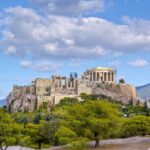

The Acropolis Approach: Gates, Views, and What to Notice
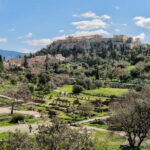
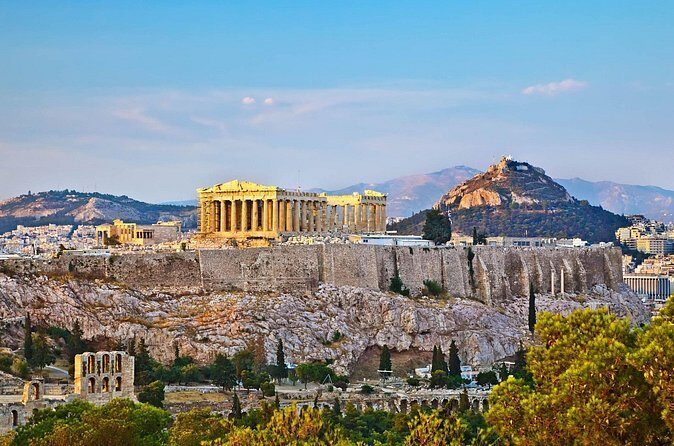
The tour jumps to the Acropolis area early, which is smart on a cruise day. Once you’re up on the rock, you’re in the place that defines classical Athens, but you’ll get more than postcard views if you know what to look for. Your guide’s job is to connect the buildings to the story of Athens after the Persian Wars and during the democratic era.
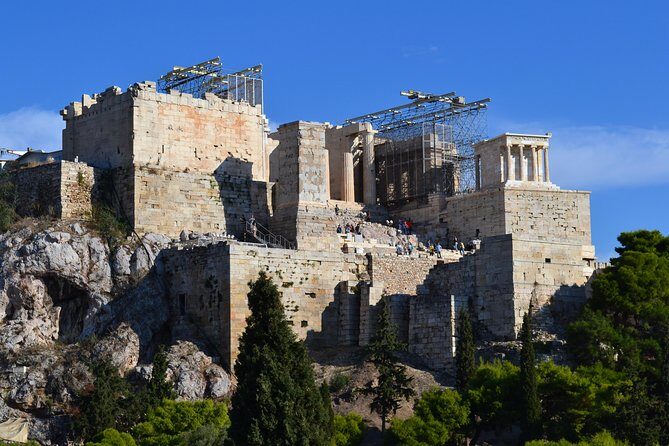
A short first stop focuses on the gateway area, including the Propylaea. Think of this as the grand entry that signals you’re stepping into a sacred precinct. The Propylaea has a layered history—parts were destroyed and later repaired—and that’s why the gate feels like more than a decorative wall. It’s also a good place to get your orientation before the main monuments.
From there, you continue along the southeast edge of the sacred rock to the Temple of Athena Nike. This stop is brief, but it’s worth it because it sits at a key point near the entrance bastion. The name Apteros Nike, or Wingless Victory, comes from the idea that the statue had no wings—so Victory would stay in Athens. When you picture it that way, the small temple location starts to feel meaningful.
Finally, you hit the Parthenon itself, which is the star of the whole hill. Even if you’ve seen the Parthenon a hundred times online, being there changes the scale. It’s built during the Periclean building program (mid-5th century BC), and the architecture is designed so the temple reads as perfectly proportioned from multiple angles. If you take a minute to stand still, you can feel how deliberate the design is.
Parthenon, Erechtheion, and the Karyatides Moment
The Parthenon stop is long enough to do more than rush photos. Your best move is to slow down and look at the way the temple’s forms guide your eye. It’s dedicated to Athena Parthenos, and the building program was supervised by architect and sculptor leadership tied to the era’s artistic direction. That’s why it doesn’t feel like a generic ancient temple—it feels like a statement of Athenian power and belief.
Then you’ll walk to the Erechtheion, the temple on the north side of the sacred rock. The Erechtheion is different in personality. Where the Parthenon is all big, clear lines, the Erechtheion has details that reward attention, including the Karyatides—the female statues used instead of columns.
This is the stop where people usually get the most “wait, that’s real?” reaction. The Karyatides are often seen as art objects, but on-site they read as architecture. The statues are part of the roof support system, which means they’re not just decoration. They’re structural, symbolic, and visually unforgettable in one package.
Also, the Erechtheion area is connected to local myth and worship, including the sanctuary setting tied to Erechtheus. If you want your Acropolis day to feel coherent, this is where the story thickens—because you’re no longer just seeing one monument. You’re seeing a whole sacred landscape with layers of purpose.
Admission Tip for the Acropolis Hill
Your tour driver can guide you and explain the sites, but entry tickets are not included. If you don’t have admissions ready, it can slow your flow. Pre-purchasing is strongly suggested because availability can be tight.
Syntagma Square and the Greek Guards at the Unknown Soldier
After the Acropolis, the day moves to modern Athens—and it does it in a way that feels like culture, not just sightseeing. The big moment here is the Changing of the Greek Guards at the Tomb of the Unknown Soldier. The ceremony happens every day at the top of the hour, so your timing matters.
This is where the day gets entertaining in a non-silly way. The Presidential Guard (Evzones) wears the traditional uniform, including the fustanella with 400 pleats, tied to the years of Ottoman occupation. The uniform is handmade by special craftsmen over about 80 days, which explains why the appearance is so precise and consistent.
The guards are also linked to the Tomb of the Unknown Soldier and the Presidential Guard’s responsibility at the Presidential Mansion area. You’ll be in Syntagma Square, where the Greek Parliament building and the memorial sit in the same visual frame, so it’s easy to understand why this square is treated like the center of modern civic life.
If you’re photographing, stand where you’re not blocking anyone else. The crowd can build quickly near ceremony time, and your goal is to watch first, shoot second.
You can also read our reviews of more tours and experiences in Athens
- All Day Cruise -3 Islands to Agistri,Moni, Aegina with lunch and drinks included
★ 5.0 · 4,958 reviews


Hellenic Parliament, the Old Royal Palace, and Marble Details

From the ceremony area, you’ll see the Hellenic Parliament building. It’s a major Athens landmark, but what makes it interesting is how directly it ties to the story of the modern Greek state. Originally, the building served as royal palace space—associated with Kings Otto and George I—and later it became the parliament and senate building about a century after construction.
You’ll also learn how the palace was placed on Boubounistra Hill, described as defendable and cooler, and how marble from Pentele was used. When you notice those specifics, the building stops being just “a big government building” and becomes part of Athens’ material history.
Next to this whole setup is a green break: the National Garden of Athens. Even if you’re not a garden person, this stop matters because it gives your legs a reset. The garden is a large green space—over 160,000 square meters—with more than 500 types of plants and trees collected from around the world. It was ordered by Queen Amalia in 1839 and renamed National Garden in 1923, after it opened to the public.
Academy, University, and National Library: Athens’ Academic Street
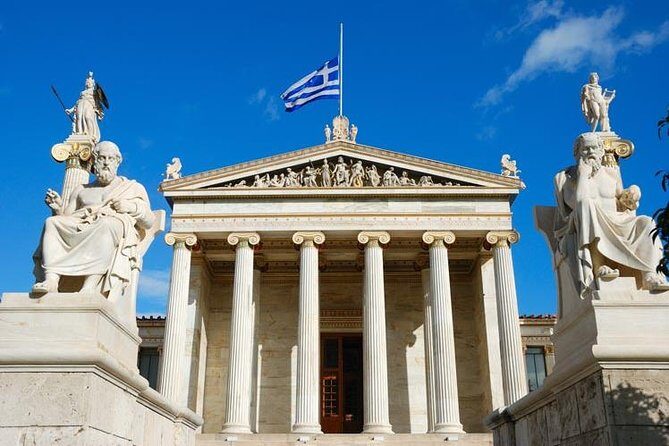
This portion of the day feels like Athens with the volume turned down a bit. You’ll pass key institutions that define the city’s formal “learning” identity: the Academy of Athens, the National and Kapodistrian University of Athens, and the National Library of Greece.
The Academy was founded by constitutional decree in 1926 as an Academy of Sciences, Humanities, and Fine Arts. The University was inaugurated in 1837 and described as the oldest higher education institution in the modern Greek state, also one of the earliest in the Balkans and Eastern Mediterranean. If you like seeing how a city organizes itself around ideas, this is a satisfying stretch.
Then there’s the National Library, part of the so-called neoclassical “trilogy” of Academy–University–Library. It’s built from 1887 to 1902, based on work by Danish architect Theophile Hansen, with supervision also tied to Ernest Ziller. If you’re the kind of traveler who notices doorways and stairways, this is a great place to do it without needing a museum ticket.
Old Parliament and Syntagma Square’s Meaning
You’ll also see the Old Parliament Building area connected with the National Historical Museum. It sits on Stadiou Street (Kolokotronis square) and focuses on modern Greece’s history—from Ottoman and Latin rule through the Greek War of Independence, liberation struggles, state creation, and political and social development up to the present day.
Even if you don’t go inside for a full museum session, the building itself is a big deal. It was founded in 1858 by Queen Amalia, designed by French architect François Boulanger, and it served as a permanent base for the National Assembly for decades. In 1935, parliament moved to the former palace on Syntagma Square (still in use today).
Syntagma Square itself is where you feel the core of Athens. It became central when Athens was chosen as the modern capital, and its name—Constitution Square—was given by King Otto on September 3, 1843 after an uprising. Standing there, you can see how politics, memory, and architecture are layered in the same space.
Plaka Free Time: Neighborhood of the Gods for Lunch

Then comes the part that most people actually remember: Plaka. This is the hillside neighborhood beneath the Acropolis that feels like a village inside the city. It’s known as the Neighborhood of the Gods, and you’ll see why once you’re walking the narrow cobblestone streets lined with tiny shops selling jewelry, clothes, and local ceramics.
You’ll also find sidewalk cafes and family-run tavernas that stay open late, which makes Plaka one of the easiest places to grab lunch without turning the day into a logistics problem. And nearby is Anafiotika, with its whitewashed homes that give an island vibe even though you’re still in Athens.
Your guide includes time for lunch here—about 1 hour 30 minutes. I like that the break is long enough to actually eat and walk a little, instead of just using the word free time and then watching the clock.
Ancient Agora: A Marketplace That Never Really Left
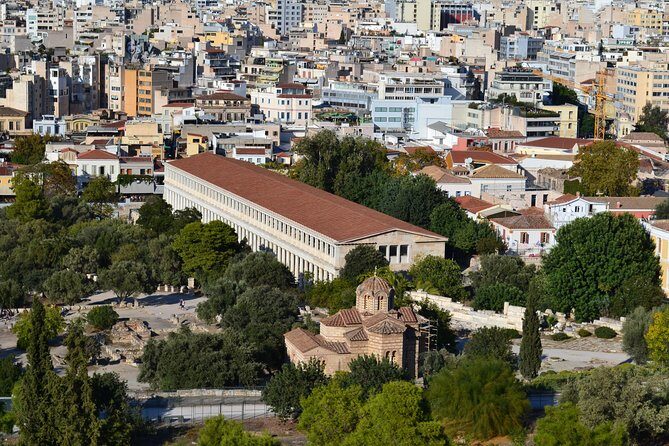
Next up is the Ancient Agora of Athens. This stop is shorter, around 40 minutes, but it’s meaningful because it’s one of the places where Athens kept reusing the same civic space for thousands of years. An agora isn’t just a market—it’s an assembly gathering place. In modern Greek, the word still means marketplace, which helps you connect ancient function to modern language.
What you can notice on the ground is that the area went through countless cycles of building, destruction, and rebuilding—about 5000 years of layers. The excavations today expose important functions from Archaic to Greco-Roman and Byzantine times, so it feels like walking through a timeline rather than one single ruins field.
Admission isn’t included here, so if you’re trying to keep the day fluid, you’ll want tickets or pre-purchased plans ready.
Acropolis Museum: Turn Stones Into Meaning
If you want your Acropolis day to click, the Acropolis Museum is where that happens. The museum focuses specifically on artifacts connected to the Acropolis site, housing items from the Greek Bronze Age through Roman and Byzantine Greece. It exists because the artifacts needed a home that matched what they came from—and the building is positioned about 300 meters from the Acropolis monuments.
The museum opening in 2009 followed an architectural competition in 2000, with the selected proposal linked to Bernard Tschumi and collaborator Michael Photiades. Even if you’re not into architecture, it’s helpful because you’ll spend more time understanding what you saw outside.
This stop runs about 1 hour 30 minutes, but admission isn’t included. If you’re the type who hates waiting, plan admissions in advance so you don’t lose half your museum time at the entrance.
Olympian Zeus and the Marble Stadium Finish
Southern Athens brings you to the sanctuary of Olympian Zeus (Olympeion). The site includes one of the greatest temples of Zeus, and ancient sources describe it as among the most famous marble buildings. There’s also mention of associated spaces like a temple of Apollo Delphinios and a tripartite building tied to older foundation stories.
Even with a limited visit, this stop broadens your sense of Athens beyond the Acropolis hill. It shows a different scale of worship—massive and city-wide in ambition.
Then you’ll see Kallimarmaro, the Panathenaic Stadium where the first modern Olympic games took place in 1896. It’s famous because it’s made of marble from Pentelic marble, the same kind associated with the Acropolis monuments and the temple of Zeus. A cool detail: the marble changes color based on daylight—cool in the morning and tending toward a bone gold tone in the afternoon.
This is a great “visual relax” stop. You can sit, take photos, and enjoy the fact that Greek culture keeps showing up through sports, design, and stone.
Mount Lycabettus: City Views and a Peaceful Closing
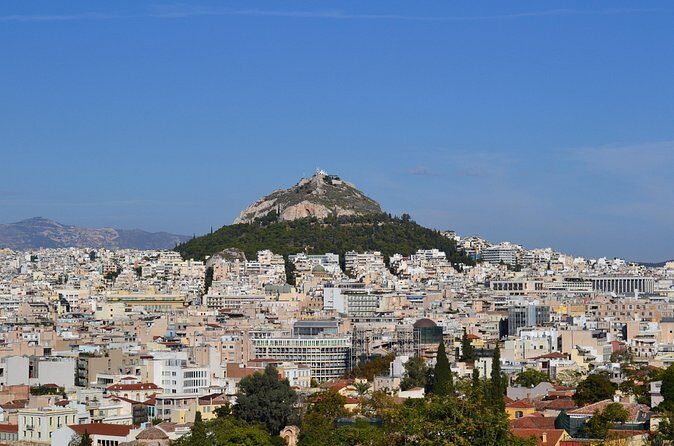
To wrap the day, the tour heads to Mount Lycabettus (Lykavitos Hill), the highest point in central Athens at about 277 m / 909 feet. You’ll get sweeping views of the city and coastline, and it’s also known as a place where many Athenians go to walk and escape the noise below.
The hill is accessible by foot, funicular railway, or car, and there’s a small chapel of Saint George at the top. The visit here takes about 1 hour 10 minutes, which is enough time to get views, take photos, and enjoy the contrast after the busy center.
After Lycabettus, you’ll be dropped back at the same place you were picked up.
Price, Value, and What You’re Actually Buying
This tour costs $499.74 per group up to 3, and it lasts about 8 hours. That price can look high until you break down what you get: private transport, hotel pickup and drop-off in Athens, Piraeus port pickup and drop-off, and an English-speaking professional who can talk you through the sites before you enter.
For small groups, this can be good value because you’re not paying per person for a larger shared vehicle. Also, having a single plan reduces the chaos of coordinating tickets, walking routes, and timing between stops—especially on a cruise day.
The tradeoff is that you’ll need to budget for admission fees at archaeological sites and museums, plus food and drinks. Also, the tour driver is not the same as a licensed state tour guide who can accompany you inside sites; if you want that, it may be available for an additional cost subject to availability.
I think this tour makes the most sense if you want one strong day that hits the classics (Acropolis, Agora, Museum) and the modern anchors (Syntagma ceremonies, Parliament area) without spending your energy on planning.
Should You Book This Athens Piraeus Shore Excursion?
Book it if you’re traveling as a couple or small group and want a day that feels personal rather than crowded. You’ll like it most if your priority list includes Acropolis monuments plus Syntagma Square and you want actual free time in Plaka for lunch. The private vehicle and clear timing (like the guards changing at the top of the hour) are exactly what you want when you’re on a cruise schedule.
Skip or reconsider if you don’t want to handle extra costs for admissions and you prefer a slower pace with fewer stops. The day covers a lot of ground, and you’ll do best if you’re comfortable with walking and climbing at historic sites.
FAQ
Is pickup available from the cruise port in Piraeus?
Yes. The pickup point is updated to Port of Piraeus, Terminal A, 28, Akti Xaveriou Street, Port E11. You’ll disembark and walk outside the terminal exit door, where the driver/guide waits holding a sign with your name.
What time does the tour start?
The start time is 8:00 am.
Is the tour fully private?
Yes. It’s a private tour/activity, and only your group participates.
Are entrance tickets included for the archaeological sites and museums?
No. Entrance fees are not included, so you’ll need tickets for the sites and museum stops.
Can the tour driver accompany you inside archaeological sites?
The driver/guide can guide you up to the point of entering. Drivers are not licensed to accompany you inside archaeological sites and museums according to the program, though a licensed state tour guide may be arranged for an additional cost subject to availability.
Is free cancellation available?
Yes. You can cancel for a full refund if you cancel at least 24 hours before the experience’s start time. Free cancellation applies under that rule.

More Private Tours in Athens


More Tours in Athens



More Tour Reviews in Athens
- All Day Cruise -3 Islands to Agistri,Moni, Aegina with lunch and drinks included
★ 5.0 · 4,958 reviews