REVIEW · ATHENS
Fast Private Athens Tour
Book on Viator →Operated by Jump Transfers · Bookable on Viator
Athens in under two hours, and you still feel caught up. This fast private tour is built for people who want the big-name sights without the stress of traffic or figuring out transit at every turn. You get pickup from your hotel and a driver who handles the logistics, so you can focus on the city.
I especially like the private, small-group feel (up to 4). The pacing is tight but not chaotic: short stops at major landmarks, enough time to orient yourself and take photos, then back on the road.
One thing to consider: it’s a quick-hit format. You’ll spend about 5 minutes per stop, so this is best for seeing and understanding the places, not for long museum time or slow wandering. Also, the tour requires good weather, which can affect what happens on the day.
In This Review
- Key highlights at a glance
- A 45–70 minute private Athens hit list you can actually use
- Starting with the Acropolis Museum: where artifacts make sense
- Pnyx: democracy on a hill, not in a textbook
- Hadrian’s Gate and the Roman road to power
- The Temple of Olympian Zeus: the waiting game that took centuries
- Panathinaiko Stadium: the marble stadium people still use
- Moving into Athens politics: Parliament, guards, and ceremonial Athens
- Libraries, squares, and the city grid you can feel
- Syntagma Square: the center point of modern Athens
- So what’s the real value of $118.35 for up to 4?
- Who should book this fast private tour?
- Should you book this fast private Athens tour?
- FAQ
- How long is the Fast Private Athens Tour?
- What does it cost and is it per person?
- Do you get picked up from your hotel?
- Is the tour offered in English?
- Are tickets needed for the stops?
- Is this tour private?
- Can babies and infants come along?
- What happens if weather is bad?
Key highlights at a glance
- Hotel pickup so you skip the scramble before you even start
- Driver-managed traffic that keeps the experience calm, especially in busy areas
- A private group for up to 4, ideal for couples, families, or a small circle
- 14 major Athens stops in roughly 45 minutes to 1 hour 10 minutes
- Free admission listed for each stop, useful for keeping costs predictable
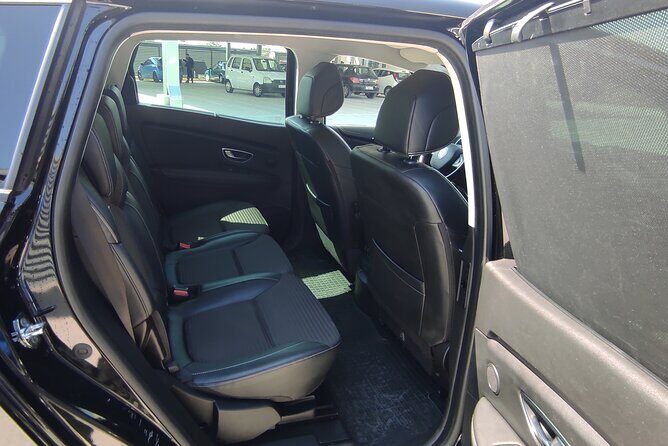
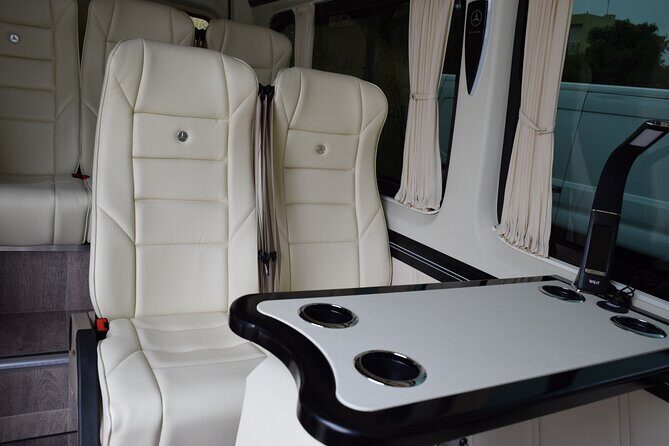
- Child-friendly option with infant seats available on request
A 45–70 minute private Athens hit list you can actually use
This is the kind of Athens tour that fits real life. You’re not signing up for a daylong commitment. Instead, you’re getting a guided route that strings together landmarks people plan whole itineraries around. The key value is pace plus comfort: quick, guided orientation without turning your afternoon into a puzzle.
The group limit matters too. With a private tour for up to 4, you don’t get swallowed by a crowd, and you can ask the sort of questions that only come up when you’re not listening over other people’s conversations. The tour is offered in English, and you’ll use a mobile ticket, which makes last-minute entry simpler.
It’s also a smart choice if you’re doing an Athens shore excursion. If your time is tight, a route like this helps you leave with a sense of the city’s layers—ancient, Roman, and modern—rather than just a handful of monuments.
Pricing-wise, it’s listed at $118.35 per group (up to 4). That’s often what makes private tours worth it here: when you split the cost across a small group, you’re paying for convenience and guided direction more than you’re paying for extra “stuff.” In a short format like this, that trade-off is usually a winner.
You can also read our reviews of more private tours in Athens


Starting with the Acropolis Museum: where artifacts make sense
The route begins at the Acropolis Museum, focused on finds from the Acropolis of Athens site. What makes this stop especially valuable— even with a short visit— is the museum’s purpose-built layout. It’s designed to house artifacts from the Greek Bronze Age through Roman and Byzantine periods.
A detail I’d highlight if you’re trying to understand why the museum exists: the museum was built to display what was found on the rock and around the slopes, and it even lies over parts of Roman and early Byzantine Athens. That gives you a helpful mental map while you’re in Athens: the city didn’t just change governments—it changed physical layers.
The museum’s timeline also gives you context. The museum was founded in 2003, opened to the public in 2009, and its galleries display more than 4,250 objects across 14,000 square meters. Even if you don’t have time for a full walk-through, a guided look at the right areas helps you connect what you see outside later.
Potential drawback: since the stop is about 5 minutes, don’t expect deep gallery time. Use it to build vocabulary: you’ll be better at recognizing what you’re looking at when you move to the next sites.
Pnyx: democracy on a hill, not in a textbook
Next up is Pnyx, a hill in central Athens where the Athenians held assemblies. This is one of those stops that clicks for people who like ideas as much as architecture. Pnyx matters because it dates back at least to 507 BC, and it’s tied to the early formation of democracy.
It’s located less than 1 kilometer west of the Acropolis and about 1.6 kilometers south-west of Syntagma Square. That distance detail helps if you’re trying to understand how Athens is “compact but layered.” When you’re in a city with big sights spread across hills and neighborhoods, being able to place where things sit makes everything feel less overwhelming.
The tour approach here is classic: quick orientation. You’ll get just enough to picture the assemblies happening on that slope, then move on before you lose momentum.
Hadrian’s Gate and the Roman road to power
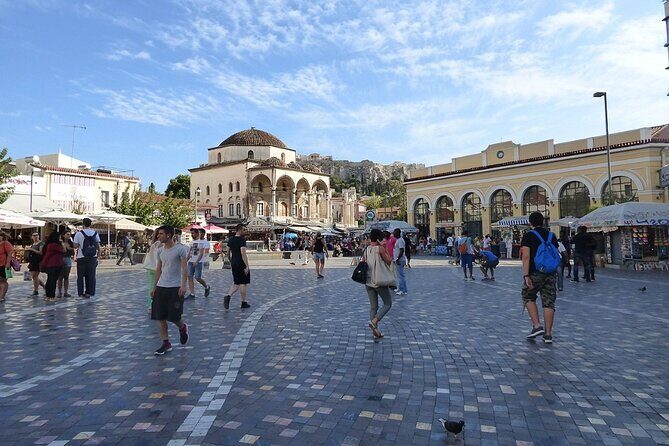
From Pnyx, you shift into Roman Athens with the Arch of Hadrian, often called Hadrian’s Gate. This is a monumental gateway that resembles a Roman triumphal arch, spanning an ancient road that connected the city center with structures on the east side, including the Temple of Olympian Zeus.
Here’s the kind of historical detail that makes this stop more than a photo stop. The arch is believed to have been built to mark Hadrian’s arrival and to honor him for benefactions to Athens, around the dedication of the nearby temple complex in 131 or 132 AD.
It’s also interesting that Hadrian had become an Athenian citizen nearly two decades earlier. The inscriptions on the arch are tied to the debate about whether they honor him as a Roman emperor or as an Athenian—another reminder that Athens was constantly re-framing who counted and why.
Potential drawback: you’ll only have about 5 minutes. If you want longer reading of inscriptions and stone details, this won’t be enough time on its own. Still, it’s a great setup for what comes next.
The Temple of Olympian Zeus: the waiting game that took centuries
The Temple of Olympian Zeus (often called the Olympieion) is the next stop, and it’s a big one for a reason. This was a colossal temple dedicated to Olympian Zeus, and construction began in the 6th century BC under Athenian tyrants—who wanted the greatest temple in the ancient world. It finally wasn’t completed until the reign of Roman Emperor Hadrian in the 2nd century AD, about 638 years after the project began.
That “it took forever” detail is exactly why I like this stop in a fast tour. It gives you a story arc you can carry: ambition, delays, regime changes, and then Roman completion. You can look at the remains and think, okay, this isn’t just a ruin—it’s a timeline written in stone.
During the Roman period, the temple included 104 colossal columns and was known for housing one of the largest cult statues in the ancient world. Even if you’re not seeing every reconstructed detail, you’re still getting the scale and the significance.
What to expect with the tour’s pace: short, guided orientation. You’ll want to have your phone camera ready, but also be ready for a quick “what you’re looking at and why it matters” explanation.
- All Day Cruise -3 Islands to Agistri,Moni, Aegina with lunch and drinks included
★ 5.0 · 4,958 reviews





Panathinaiko Stadium: the marble stadium people still use
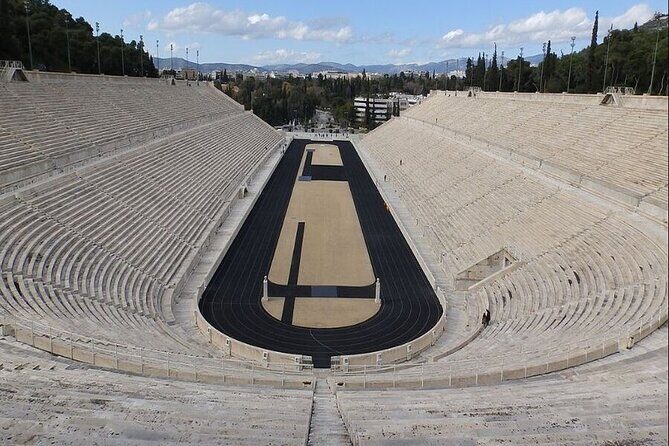
Then it’s Panathinaiko Stadio (Kallimarmaro), and yes, the main fact people remember is true: it’s the only stadium in the world built entirely of marble. That alone is a reason to stop, because it’s unusual even by Athens standards.
The site began as a racecourse, built by Athenian statesman Lykourgos (Lycurgus) around 330 BC, mainly for the Panathenaic Games. Later, it was rebuilt in marble by Herodes Atticus (a Roman senator from Athens), and by 144 AD it reached a capacity of 50,000 seats.
Christianity changed the stadium’s role, and it was largely abandoned. But then the modern world re-discovered it: excavations began in 1869, the Zappas Olympics were held in 1870 and 1875, and after refurbishment it became the venue for the opening and closing ceremonies of the first modern Olympics in 1896. It also hosted 4 of the 9 sports contested in 1896, and it was used again as an Olympic venue in 2004. In modern Athens, it’s also the finishing point of the annual Athens Classic Marathon.
Potential drawback: because the stop is short, you’ll likely just get a quick sense of the stadium’s story. If you want to go deeper, you’d need longer than a fast tour. But for most visitors, this is enough to appreciate why the stadium feels different from the ruins around it.
Moving into Athens politics: Parliament, guards, and ceremonial Athens
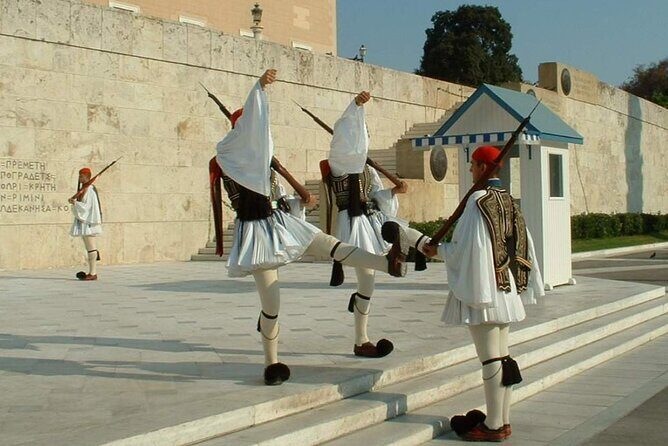
After the stadium, the tour turns toward modern civic Athens.
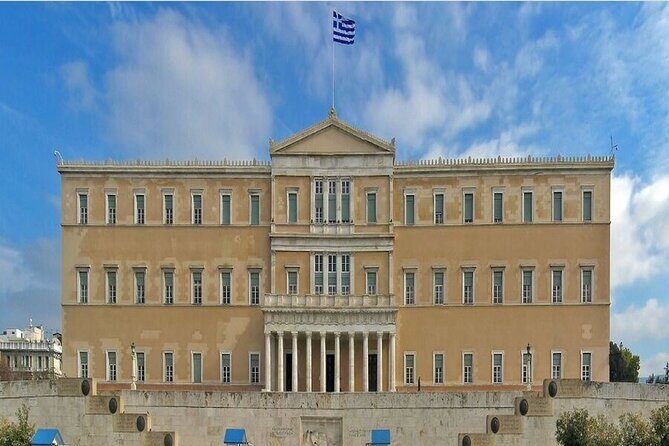
First is the Hellenic Parliament, located in the Old Royal Palace and overlooking Syntagma Square. It’s Greece’s unicameral legislature and the supreme democratic institution representing citizens through elected Members of Parliament. This is a great stop for understanding modern Athens geography: you can see how the big political square sits beside the national institutions.
Next is a short stop at Evzones, the Presidential Guard. This is one of those Athens moments that many people like best because it feels alive and instantly recognizable. The Evzones guard the Tomb of the Unknown Soldier and the Presidential Mansion. Their uniform developed from clothing tied to klephts who fought during the Ottoman occupation of Greece. The standout item is the fustanella, a kilt-like garment.
If you’re traveling with kids, this part can be a win. The tour data notes infant seats available on request, and the ceremonial nature of the Evzones tends to be visually easy for young visitors to understand.
Then the route moves to The Academy of Athens, Greece’s national academy and highest research establishment, established in 1926. It operates under Greece’s Ministry of Education and traces its founding principle to Plato’s historical academy.
Finally in this civic stretch, you also pass the National and Kapodistrian University of Athens, founded by royal decree of Otto in the 1836/1837 period and in continuous operation since May 3, 1837. The tour listing also highlights the scale: more than 40,000 undergraduate students and more than 2,000 teaching and research staff.
What this section does well: it balances classical Athens with modern Athens. You’re not just seeing monuments; you’re seeing institutions—where decisions get made and where education lives.
Libraries, squares, and the city grid you can feel

Next is the National Library of Greece, the main public library in Athens. It was founded in 1832 by Ioannis Kapodistrias, with a mission centered on collecting, organizing, describing, and preserving evidence of Greek culture and intellectual production. Even if you don’t go inside, it’s a good pause for a city that often gets pigeonholed as only about ruins.
Then you’re in the squares zone.
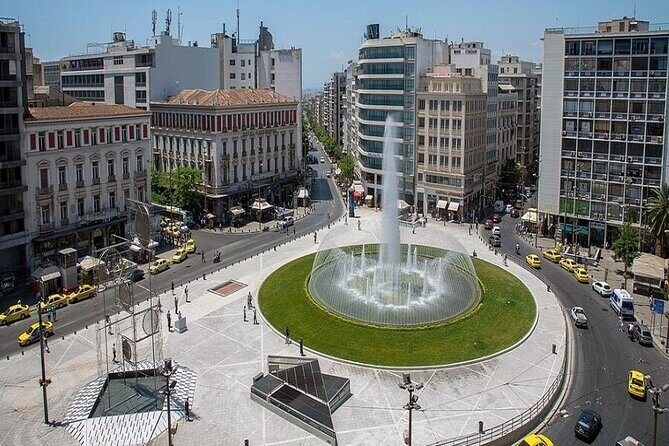
You stop at Omonia Square (Concord Square), a major traffic hub and shopping area. It’s served by Omonia metro station and sits at an intersection of six main streets: Panepistimiou, Stadiou, Athinas, Peiraios, Agiou Konstantinou Street, and 3rd Septemvriou Street. This is a useful stop because it shows where Athens’ downtown energy concentrates.
You also pass by Klafthmonos Square, nicknamed the crying square. The name comes from a vignette in the magazine Hestia, based on dismissed civil servants gathering in protest outside the Ministry of Finance (now demolished). It’s a reminder that modern Athens has its own stories of politics and public frustration, not just ancient debates.
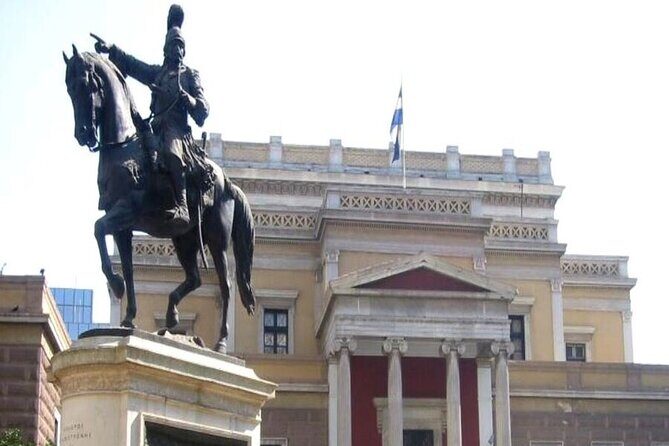
Next is the National History Museum (Old Parliament) at Stadiou Street. This is the house that held the Greek Parliament between 1875 and 1935, and before that it was connected to Alexandros Kontostavlos, an Athenian magnate and politician. After Athens became the capital in 1833, King Otto selected it as a temporary residence until the Royal Palace was ready. It also hosted the National Assembly after the 1843 Revolution forced Otto to grant a constitution.
A fire in October 1854 destroyed the house, and the new building began in August 1858 on plans by French architect François Boulanger, with the foundation laid by Queen Amalia. Even if your stop is brief, this one gives you a strong thread: today’s institutions sit on top of earlier political eras.
Syntagma Square: the center point of modern Athens
The tour ends at Syntagma Square (Constitution Square), the central square of Athens. It’s named after the constitution Otto was obliged to grant after a popular and military uprising on 3 September 1843. It sits in front of the 19th-century Old Royal Palace, which has housed the Greek Parliament since 1934.
This is also the neighborhood’s center of commercial activity and Greek politics. And practically, it’s built for visitors: the metro station underneath connects lines 2 and 3, and there are tram and bus terminals above.
For you, this ending stop is useful because it’s easy to get oriented. If you’re continuing on your own after the tour, Syntagma is one of the most practical places to do that.
So what’s the real value of $118.35 for up to 4?
Let’s do the practical math. You pay $118.35 per group for up to four people. That means the cost per person drops fast once you share it—especially on a trip where you’re already paying for paid entry tickets and transport.
You’re also paying for something hard to replicate quickly: a structured, English-language route that moves you efficiently between ancient and modern landmarks. Instead of spending time choosing routes, waiting on transit, and negotiating with traffic, you get a driver who handles the driving. In a city like Athens, that’s not a small deal.
Add in the fact that the listed stops show admission ticket free time for each location. That doesn’t mean everything is instantly free everywhere, but it does suggest you can visit these particular points without adding extra paid entry fees during the tour itself. Combined with the short duration, it helps keep your day predictable.
The other value is clarity. Each stop has a theme—democracy, Roman power, architectural ambition, modern institutions—and you’re given enough context to connect what you see.
Who should book this fast private tour?
This tour fits best if you:
- Have limited time and want a high-coverage orientation in under 1.5 hours
- Prefer a private group over crowds
- Want something that works for Athens shore excursions
- Travel with children and want an option that can include infant seats on request
It may not fit as well if you:
- Want a deep museum day (this pacing is brief by design)
- Need a flexible schedule for long stops at only a couple locations
- Know your plans depend on perfect weather, since the tour requires good weather
Should you book this fast private Athens tour?
If you’re trying to get your bearings fast, I’d say yes—especially if you’re traveling in a small group of up to four. The combo of hotel pickup, an English-speaking private format, and a route that touches 14 major sights makes it a strong value for people with tight schedules.
Book it when you want understanding more than time. Don’t book it when your goal is to linger for hours. If that sounds like your trip, this is one of the easiest ways to feel like you saw Athens, not just passed through it.
FAQ
How long is the Fast Private Athens Tour?
The tour is listed as approximately 45 minutes to 1 hour 10 minutes.
What does it cost and is it per person?
It’s $118.35 per group (up to 4 people).
Do you get picked up from your hotel?
Yes. The tour offers pickup from your hotel or apartment.
Is the tour offered in English?
Yes. The tour is offered in English.
Are tickets needed for the stops?
The tour listing shows Admission Ticket Free for each stop.
Is this tour private?
Yes. It’s a private tour/activity, and only your group participates.
Can babies and infants come along?
Infant seats are available on request, making it a child-friendly option.
What happens if weather is bad?
The experience requires good weather. If it’s canceled due to poor weather, you’ll be offered a different date or a full refund.


More Private Tours in Athens


More Tours in Athens

More Tour Reviews in Athens
- All Day Cruise -3 Islands to Agistri,Moni, Aegina with lunch and drinks included
★ 5.0 · 4,958 reviews