REVIEW · ATHENS
First Cemetery of Athens Walking Tour
Book on Viator →Operated by Urban Athens Collective · Bookable on Viator
Death has great art here.
This is a 3-hour Athens walk that turns the First Cemetery of Athens into a living open-air history lesson, with sculpture, funerary customs, and 19th-century monuments explained by an art historian guide. You also get a guided route through the nearby Mets district and up Arditos Hill, so it’s not just graveyards and go-home-it’s-a-day.
I like the way the guide connects the city-making story of Athens becoming the capital to why a new cemetery was needed in the first place. I also love that you’re not shuffled through at speed; the vibe stays respectful, and guides such as Hercules and Ellania are praised for mixing art, archaeology, and real questions from the group. One consideration: it’s still a walking tour in all weather, so bring comfortable shoes and expect time outdoors.
In This Review
- Key highlights you’ll care about
- Why the First Cemetery works better than a normal sightseeing stop
- Starting near the Temple of Olympian Zeus: the city’s big decision
- Anapafseos and the approach to the main entrance
- Logginou Cemetery (First Cemetery of Athens): tomb styles, artists, and a quiet mood
- Mets coffee stop, Arditos Hill, and ending near Syntagma
- Value and practical logistics for a $65.06 art-and-walk tour
- What to wear and how to get the most out of a cemetery walk
- Should you book the First Cemetery of Athens walking tour?
- FAQ
- How long is the First Cemetery of Athens walking tour?
- What does the tour cost?
- Is the tour offered in English?
- Where do we meet for the tour?
- Where does the tour end?
- What’s included in the price?
- Are there admission fees for the stops?
- Is food included?
- Does the guide talk about whether the cemetery is haunted?
- What is the cancellation policy?
Key highlights you’ll care about
- Art historian-led look at funerary sculpture, tomb styles, and how people practiced life-and-death rituals in Greece
- Logginou Cemetery (First Cemetery of Athens) as a calm mix of ornate graves, churches, and green space
- Walking link to Athens neighborhoods via Mets and up Arditos Hill for a more local feel
- Story stops before the cemetery near the Temple of Olympian Zeus and the Anapafseos entrance
- A guided question you’ll hear: whether the cemetery is haunted or not
- Small-group / your group only, plus bottled water and a mobile ticket
Why the First Cemetery works better than a normal sightseeing stop
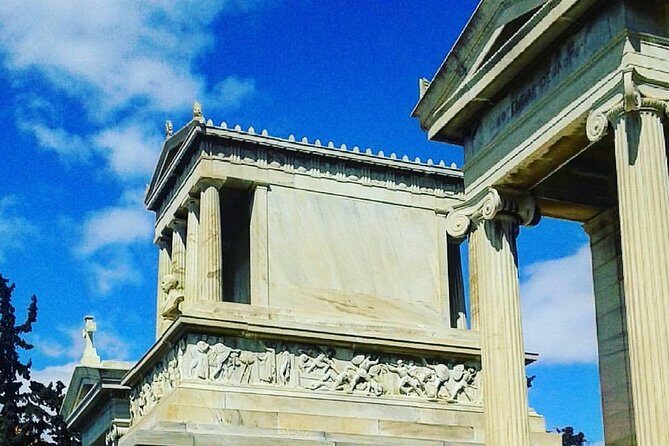
The First Cemetery of Athens, also associated with the Logginou cemetery complex, doesn’t play at being spooky. It plays at being art and memory. That’s the difference. You’re standing in a park-like space with churches, green areas, and highly ornamental tombstones, while your guide translates what you’re seeing into context: who these people were, how they wanted to be remembered, and what the sculpture choices say about the era.
The big win here is the art historian framing. Tombs can turn into background scenery fast. With this kind of guide, you start noticing styles, materials, and symbolism you’d otherwise miss. And because the cemetery includes a wide mix of Greek public figures—artists and poets, actors, politicians, and even former prime ministers—you get the feeling that Greece is telling its own story in stone.
You’ll also learn that this is a cemetery shaped by modern Athens history. Opened in the 19th century, it became the final resting place for people connected to the new capital’s cultural and political life. Instead of treating it like a random stop on a map, the tour helps you understand why it exists right where it does.
You can also read our reviews of more walking tours in Athens



Starting near the Temple of Olympian Zeus: the city’s big decision

The tour kicks off near Στρατηγού Μακρυγιάννη 7, and it begins with a walk-past moment around the Temple of Olympian Zeus. Even if you’ve seen photos of the temple, this first stretch gives you the political and historical reason for what comes next.
You’ll hear how the decision that Athens would be Greece’s capital shaped major building plans—and why that fed into the need for an official cemetery for the new city. That may sound like a “timeline lecture,” but the way it’s handled matters: it sets up the cemetery as a civic project, not just a place for individual families.
If you care about the connection between urban planning and daily life, this opening is a strong hook. If you prefer purely visual stops with no background talk at all, you might want to take breaks mentally while the guide lays the foundation.
Anapafseos and the approach to the main entrance
Next, you head toward Anapafseos, whose name links to the idea of rest. That matters because the tour doesn’t treat tomb sculpture as decoration only. It ties it to funerary customs—what mattered to people in antiquity, and how Greek ideas about life and death shaped what got carved, built, and preserved.
At this stage, you’re still close enough to the start that your eyes can reset. You’re looking at sculpture, thinking about ceremony and meaning, and preparing for the shift into Logginou’s main grounds. The Anapafseos approach is basically your warm-up: the guide primes you to notice the language of stone.
A practical note: this is still a walking route with city streets and crossings. Plan your pace. Your shoes will thank you later when you’re deeper in the cemetery’s paths.
Logginou Cemetery (First Cemetery of Athens): tomb styles, artists, and a quiet mood
The heart of the tour is the First Cemetery of Athens itself, where you’ll spend about 2 hours. This is where the guide’s art-and-history role really earns its fee.
Here’s what makes this section special:
You’ll see the setting first: a sprawling, green space with multiple churches and gravestones that go far beyond simple markers. Then you’ll move to the main and well-known tombs near the gate area, where the guide explains how 19th-century sculpture shows different styles and choices—what seems solemn, what seems ornate, and how families used art to shape memory.
You’ll also learn who’s buried here. The cemetery is famous for Greek luminaries across creative and political life—artists and poets, actors, politicians, and former prime ministers. That lineup changes your attention. Instead of thinking only about “the dead,” you start thinking about the living impact these people had, and why their monuments reflect that.
One part I appreciate in this tour format is how it blends respect with storytelling. In other words, the cemetery feels like a calm sanctuary rather than a set piece. The goal isn’t to sensationalize. It’s to help you read the place.
And yes, you’ll get the question most people whisper at places like this: is the cemetery haunted? The tour includes a guided discussion of whether it’s haunted or not. Even if you’re not into ghost stories, that’s still useful. Legends often point to how a community talks about death—so you’re hearing culture, not just scare tactics.
Potential drawback for this cemetery portion: it’s easy to get “tomb fatigue” if you’re expecting quick hit monuments. But that’s exactly why the guide matters. Without context, graveyards can feel repetitive. With context, each stop becomes a new clue.
Mets coffee stop, Arditos Hill, and ending near Syntagma
After the cemetery, the tour shifts gears to the neighborhood feel of Athens. You’ll continue toward the Mets district for a coffee stop. Food and drinks are not included, so treat it as a chance to recharge rather than a meal deal. Still, I like having a structured break after a heavy walking-and-reading part of the day.
Then comes the uphill section: the tour includes walking up Arditos Hill. That’s the kind of detail that can make or break the comfort level of the day. If you’re the type who hates hills, pace yourself early. If you’re okay with a steady uphill climb, you’ll enjoy the slow change in perspective as the neighborhood path rises.
The walk winds up toward Synagma Square, with the tour ending at Zappeion Hall on Leof. Vasilissis Olgas. It’s a smart finish point because you end near major transit and central Athens energy. You can turn the evening into anything from dinner plans to a relaxed wander.
- All Day Cruise -3 Islands to Agistri,Moni, Aegina with lunch and drinks included
★ 5.0 · 4,958 reviews




Value and practical logistics for a $65.06 art-and-walk tour

At about $65.06 per person for roughly 3 hours, you’re paying for three things: time, expert interpretation, and a route that strings together distinct parts of Athens.
If you tried to do this on your own, you’d manage the walking. But you’d likely miss the art-historian reading of tomb styles, funerary customs, and the links between Athens’ capital status and the cemetery’s creation. The bottled water and professional guide also make this feel designed for comfort rather than pure “self-guided stamina.”
A small-group feel (and in at least one model, your group only) is also a value point. In a cemetery, your questions matter more. If you’re curious why certain tombs look the way they do, a larger crowd can shut down dialogue. Here, the format supports a more respectful, personalized pace.
Language-wise, the tour is offered in English, which keeps the explanations accessible and helps you actually connect the sculpture to the story you’re hearing.
What to wear and how to get the most out of a cemetery walk
This is one of those tours where a little prep makes a big difference.
Wear comfortable shoes with grip. You’re moving through a cemetery environment and city sidewalks, and you’ll want stability more than fashion. Bring clothes appropriate for the weather since it operates in all weather conditions. Athens can shift fast—so dress like you plan to be outside for the whole stretch.
Also, go into it with the right mental mode. This isn’t a checklist tomb run. It’s a “look longer” experience. When the guide points out a sculpture style or explains a funerary practice idea, give yourself a moment to actually see it. The best part is when you catch yourself noticing details without needing the next explanation.
Finally, if you’re thinking of skipping the coffee stop: don’t. Not because it’s included, but because it’s timed right after the cemetery. You’ll feel better for the uphill walk afterward.
Should you book the First Cemetery of Athens walking tour?

Book it if you want Athens with context, not just coordinates. The combination of an art historian guide, a serious-but-not-morbid look at Logginou’s ornate tombs, and a neighborhood walk through Mets and up Arditos Hill makes this a high-return day.
I’d skip it if you dislike cemetery visits in general, or if you want a strictly low-walking, minimal-explanation tour. At its best, this experience asks you to slow down and read the place.
If you’re the type who loves sculpture, symbolism, or how history shows up in everyday city spaces, this one is an easy yes.
FAQ
How long is the First Cemetery of Athens walking tour?
The tour lasts about 3 hours.
What does the tour cost?
The price is $65.06 per person.
Is the tour offered in English?
Yes, it is offered in English.
Where do we meet for the tour?
The meeting point is Στρατηγού Μακρυγιάννη 7, Athina 117 42, Greece.
Where does the tour end?
The tour ends at Zappeion Hall, Leof. Vasilissis Olgas, Athina 105 57, Greece.
What’s included in the price?
The tour includes bottled water and a professional art historian guide, along with a mobile ticket.
Are there admission fees for the stops?
The listed stops have admission ticket free notes, so the tour is set up without paid entry fees for those points.
Is food included?
No. Food and drinks are not included, though there is a coffee stop during the walk.
Does the guide talk about whether the cemetery is haunted?
Yes. You’ll learn whether the cemetery is haunted or not as part of the experience.
What is the cancellation policy?
You can cancel for a full refund up to 24 hours in advance of the experience start time.




More Walking Tours in Athens


More Tours in Athens


More Tour Reviews in Athens
- All Day Cruise -3 Islands to Agistri,Moni, Aegina with lunch and drinks included
★ 5.0 · 4,958 reviews