One day can feel like several centuries. This private route strings together the Isthmus Canal, the heights of Acrocorinth, and the Bronze Age powerhouse of Mycenae without you dealing with car hire or tight public-transport schedules.
I like that you get real convenience built in: hotel pickup/drop-off and a private driver means you can focus on the sights. I also like the practical extras that make long hours more comfortable, like onboard Wi-Fi, bottled water, and refreshing wipes.
One thing to plan for: the day is long (about 8 hours), and while key stops are covered, some parts like the archaeological museum visits and lunch cost extra since entrance fees and food aren’t included.
In This Review
- Key highlights to watch for
- Door-to-door from Athens: what the private pickup changes
- Isthmus Canal and Ancient Diolkos: engineering you can feel
- Acrocorinth and the Upper Peirene fountain: a fortress over the gulf
- Ancient Corinth: Temple of Apollo, Agora, and the Bema where Paul stood
- The Archaeological Museum: artifacts that fix the story in place
- Temple of Apollo: early Doric and those rare monolithic columns
- Agora and Bema: city life plus the moment Apostle Paul addressed Corinthians
- Lechaion Road and St. Paul’s church mosaic
- Lunch time: the village-style terrace breaks the pace
- Corinth village stroll: souvenirs with less pressure
- Mycenae: Lion Gate, Cyclopean walls, and the Treasury of Atreus
- Royal Palace time is short—so pick what matters
- Museum of Ancient Mycenae: gold grave goods
- How the timing works in real life (and how to not feel rushed)
- Price and value: what $299.78 per person really includes
- Should you book this Athens-to-Mycenae private day trip?
- FAQ
- How long is the Private Tour of the Isthmus Canal, Ancient Corinth & Mycenae from Athens?
- Is this tour private or shared with other travelers?
- Do I get pickup from my hotel in Athens?
- Are entrance fees included for the sites and museums?
- Is there Wi-Fi and water during the tour?
- Do I get a licensed guide to accompany me inside the sites?
Key highlights to watch for
- Private driver, real flexibility: the schedule is structured, but you can typically take a little extra time where it matters most to you
- Isthmus Canal + Ancient Diolkos: you’ll connect the modern canal story to the ancient overland transport trackway
- Acrocorinth fortress views: a dominant acropolis over Corinth, with remnants like the Temple of Aphrodite traces and Frankish-era fortification
- Ancient Corinth in one sweep: Temple of Apollo, the Agora and Bema area, Roman-era layers, and the St. Paul church mosaic
- Mycenae’s signature hits: Lion Gate, Cyclopean walls, the Treasury of Atreus, and the Mycenae museum’s gold grave goods
- Comfort for a full day: Wi-Fi on board, cold water, and drivers who prioritize safety and not rushing you
Door-to-door from Athens: what the private pickup changes
This is a true private day, not a bus tour. Your driver meets you right at your hotel lobby or apartment entrance, and you’re returned there at the end of the day. That matters in Athens, where finding parking near historic areas can be a headache, and where daylight can vanish faster than you expect.
The vehicle is described as a private first-class car, and you also get a few “small but big” comfort perks: bottled water, refreshing wipes, and onboard Wi-Fi. For a long driving day, Wi-Fi helps keep your maps and translation apps working, plus it’s handy for storing photo directions or checking opening times if something changes.
Most days you’re also in good hands with the driver. From the details shared in bookings, drivers like Nikos and Gregory are credited for being friendly, arriving early, knowing where to stand for photos, and keeping the day calm instead of rushed. If you care about good photo angles at places like the canal overlook or the acropolis viewpoints, that local positioning can save time and frustration.
One more practical note: there’s a skip-the-line ticket service on request. That can help you move faster at busy entrances, but entrance fees themselves are not included, so you’ll want to budget for that separately.
You can also read our reviews of more private tours in Athens


Isthmus Canal and Ancient Diolkos: engineering you can feel
The day’s first major “wow” is the Corinth Canal area. Even if you’re not an engineering person, it’s hard not to get pulled in here. The canal is tied to 19th-century ambitions and the way the region’s geography could either block or shortcut Mediterranean shipping routes.
What makes this stop more interesting than a quick photo break is the connection to ancient transport. You’ll also visit Ancient Diolkos, a paved trackway that helped boats move overland across the Isthmus of Corinth. It’s one of those “same problem, different solutions” stories: the ancient method handled the bottleneck directly, and the canal later did it with modern construction.
If you like interpreting ruins and monuments, this stop is a strong start because it sets the pattern for the rest of the day. You’re not just sightseeing. You’re seeing how people solved location and trade problems, first with engineered pathways and later with monumental urban centers.
Practical tip: wear sunscreen and bring water. Even with shaded moments, canal-area viewpoints can be exposed, especially in summer.
Acrocorinth and the Upper Peirene fountain: a fortress over the gulf
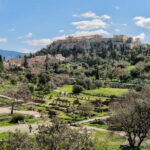
Next comes Acrocorinth, the acropolis of ancient Corinth. The whole place sits on a monolithic rock, towering above the surrounding area, so you’re naturally drawn to the skyline and the scale. This is one of those sites where the views are part of the archaeology.
Acrocorinth isn’t presented as one single era. You’ll see how the site functioned over time, with a system of three circuit walls reinforced by towers. And there are visible traces of specific historical layers:
- Temple of Aphrodite traces on the highest peak
- a Frankish Tower at the southwest edge, connected to later fortification
- preserved remains of churches, mosques, houses, fountains, and cisterns
That mix is useful for you because it helps you read the site like a timeline. Even if you don’t have every detail memorized, you can still understand that this was a strategic stronghold repeatedly valued and rebuilt.
From there, you’ll stop near Upper Peirene Fountain. It’s a small stop time-wise, but it helps you connect the fortress area to myth and water supply. Peirene Spring is described as a gift of Asopus to Sisyphus, and you can see why springs mattered so much when hills and walls controlled movement.
A short scenic stop at Geraneia adds another layer: views of the Corinthian gulf and the southwest coast of the Peloponnese. This is the kind of break that makes the later archaeological walking feel more doable.
Ancient Corinth: Temple of Apollo, Agora, and the Bema where Paul stood
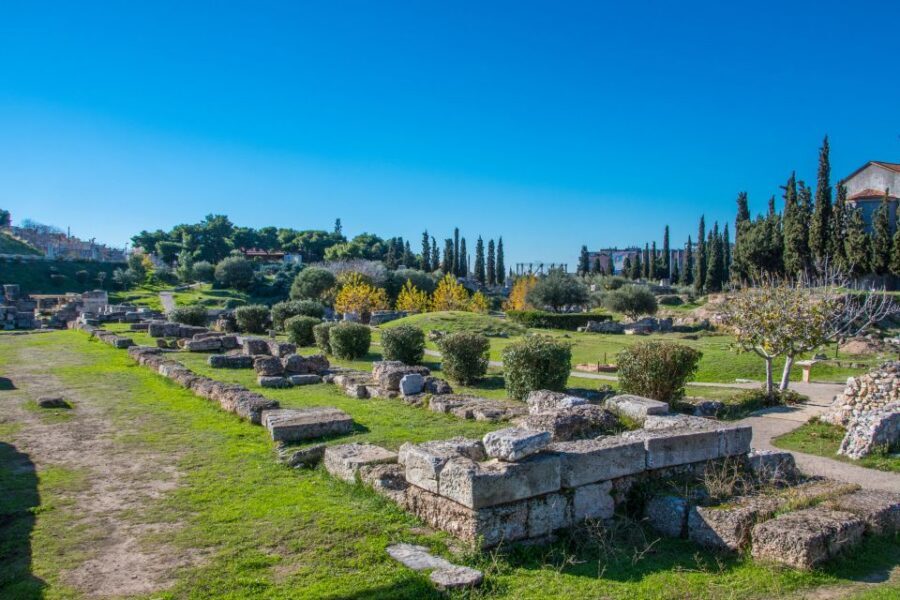
Ancient Corinth is the heart of the day, and it’s where you’ll spend a long enough stretch to actually piece together the city. You’ll move from the archaeological museum to several major zones—Temple of Apollo, Agora, theater and odeon/Asklepieion areas, and the Lechaion road—plus you’ll visit St. Paul’s church with its mosaic mural.
The Archaeological Museum: artifacts that fix the story in place
The museum contains artifacts from the local site and nearby areas. It’s one of the best “high-density” ways to understand Corinth quickly, because you’re not trying to imagine everything from ruins alone.
You’ll see themes that match the site: items tied to daily life and cult, and the kinds of objects that make ancient city life feel concrete.
- All Day Cruise -3 Islands to Agistri,Moni, Aegina with lunch and drinks included
★ 5.0 · 4,958 reviews




Temple of Apollo: early Doric and those rare monolithic columns
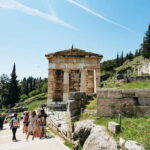
The Temple of Apollo is described as one of the earliest Doric temples in the Peloponnese and the Greek mainland, around 560 BCE, with monolithic columns. If you’re used to seeing later Doric temples, this one gives you a sense of how Greek architecture evolved.
Agora and Bema: city life plus the moment Apostle Paul addressed Corinthians
The Agora area covers a large rectangular space with central shops, small temples, and altars, plus the Bema—the podium area associated with Apostle Paul addressing the Corinthians in 52 AD.
This combination is powerful for your visit because it turns “ruins” into “settings.” You’re not only looking at stone remains. You’re imagining civic gatherings, commercial activity, and public speech from a known historical period.
Lechaion Road and St. Paul’s church mosaic
The Lechaion road runs toward the port area at Lechaion, facing the gulf. Then St. Paul’s church offers a different kind of connection: the mosaic mural depicting Saul’s vision as he traveled to Damascus to persecute Christians. It’s not a museum piece; it’s a visual reminder of how later religious history latched onto the Corinth story.
Practical tip: if you like mosaics, give St. Paul’s church a little extra attention. It’s a calm pause after the bigger walkways and it helps the whole day feel cohesive.
Lunch time: the village-style terrace breaks the pace
There’s time carved out for lunch described as a “village style” meal on a terrace overlooking the archaeological site and the Temple of Apollo. Food and drinks are not included, but this is one of those built-in moments that can make the day feel less like a checklist and more like an actual outing.
If you want maximum comfort, grab water early and pace yourself for the afternoon Mycenae drive.
Corinth village stroll: souvenirs with less pressure
After the main site, you’ll have about an hour at Corinth itself for village-style shops and handmade souvenirs.
This is a useful buffer. You’re likely sun-tired and walk-tired after Ancient Corinth, and it’s nice to have a low-effort way to wrap up the day’s first half—browsing instead of standing in ticket lines.
If shopping isn’t your thing, use the time to reset: slow photos, a snack if you missed lunch, and a quick look for local crafts you can actually bring home.
Mycenae: Lion Gate, Cyclopean walls, and the Treasury of Atreus
Mycenae is the second “big day” destination, reached after a drive. If you love standout iconic archaeology, this part delivers.
You’ll get:
- Grave Circles A and B, royal cemeteries just outside the main citadel area
- Cyclopean Walls, built from huge limestone boulders
- the Royal Palace complex, including domestic apartments, Throne Room Suite, Grand Staircase, and officer areas
- Lion Gate, the main entrance to the Bronze Age citadel
- the Treasury of Atreus (a tholos/beehive tomb around 1250 BC)
- the Tomb of Clytemnestra (also a tholos type tomb from around 1250 BC)
Even without a guide inside every zone, the layout helps you understand what you’re seeing: who lived here, where power showed up, and how monumental tombs reinforced that power.
Royal Palace time is short—so pick what matters
The palace portion is listed as about 30 minutes, and you can’t do everything. If you’re the type who wants to read every sign, that time can feel tight. If you focus on the structure’s major spaces—like the Grand Staircase or Throne Room concept—you’ll leave with a better mental map.
Museum of Ancient Mycenae: gold grave goods
Then there’s the Mycenae Archaeological Museum, also about 30 minutes. This is where you’ll see the famous gold grave goods, burial masks, jewelry, weapons, worship idols, and frescoes.
This museum stop is the best “fast learning” tool in the Mycenae block. It translates the monumental stones into artifacts you can actually picture in use.
Practical tip: if your priority is Mycenae, you’ll likely enjoy focusing on the citadel entrance (Lion Gate), then the tombs (Treasury of Atreus and Clytemnestra), and finally using the museum to anchor the Bronze Age story.
How the timing works in real life (and how to not feel rushed)
This tour runs about 8 hours. In that time, the itinerary packs in a lot: canal, fortress, fountain, two major ancient zones in Corinth, then Mycenae’s citadel and museum.
The good news: the private format usually means you’re not stuck waiting for a whole group to reboard. In the feedback I saw, drivers like Nikos and Gregory were praised for letting people decide how much time they needed at each stop and for keeping things safe and unhurried even on hot days.
Your job is to choose your priorities before you get in the car:
- If you love views and fortress walls, spend extra time at Acrocorinth and Geraneia
- If you want city life context, make sure you catch the Agora/Bema area and St. Paul’s mosaic
- If Mycenae is the main goal, keep your energy for Lion Gate to Treasury of Atreus, then use the museum as your final “wrap-up” learning moment
Also, pay attention to the order. Mycenae is later in the day. If you tend to run out of steam after a few hours in the sun, it’s smart to treat the morning as your “set up,” and then decide in advance what you’ll treat as must-see in the afternoon.
Price and value: what $299.78 per person really includes
At about $299.78 per person, this isn’t a budget deal. But it is aimed at value through convenience and time.
What’s included:
- Fully private tour with a professional driver
- Hotel/Port pickup and drop-off (within Athens for your accommodation)
- Private first-class vehicle
- Wi-Fi on board
- Bottled water and refreshing wipes
- Skip-the-line ticket service on request
- English-speaking (and multi-lingual) driver support
What’s not included:
- Entrance fees to the sites
- Food and drinks
- Tips & gratuities
- A licensed tour guide who would accompany you into sites and museums (available on request as an additional cost)
So the value math comes down to this: you’re paying for driver time, a private vehicle, and a structured day that removes many headaches (parking, route planning, and waiting). If you’re traveling with a partner or small group, private transport can start to feel more reasonable than it first appears, especially when you add up taxi rides, parking stress, and time lost between places.
If you’re trying to keep costs tight, you’ll want to budget for entrance tickets and lunch upfront so the day stays fun instead of surprising.
Should you book this Athens-to-Mycenae private day trip?
I’d book this if you want a one-day sampler that still feels substantial. It’s a strong match for first-timers who want to understand how Corinth and the Mycenaean world connect to trade routes, power, and later historical memory through places like the Bema and St. Paul’s church mosaic.
You’ll especially like it if:
- you hate car hire and want an actual driver for a full day
- you care about getting enough time for multiple major stops
- you appreciate practical comfort (Wi-Fi, water, wipes) on a long outing
- you want flexibility so you can slow down for photos and views at Acrocorinth and the canal
I’d think twice if:
- you prefer going slow and reading everything at every site
- you’re very budget-focused once you factor in entrance fees and lunch
- you want a licensed guide inside all museums and ticketed sites (this option does not include that by default)
If you book, plan your priorities in advance and tell your driver what you want most. The format is built for that.
FAQ
How long is the Private Tour of the Isthmus Canal, Ancient Corinth & Mycenae from Athens?
The tour is listed at about 8 hours.
Is this tour private or shared with other travelers?
This is a private tour. Only your group participates.
Do I get pickup from my hotel in Athens?
Yes. Pickup and drop-off are included from your chosen hotel, Airbnb, or apartment in Athens. Your driver meets you at the lobby, and for an Airbnb you’ll coordinate entry with the driver.
Are entrance fees included for the sites and museums?
No. Entrance fees are not included. Skip-the-line ticket service is available on request.
Is there Wi-Fi and water during the tour?
Yes. There is Wi-Fi on board, plus bottled water and refreshing wipes.
Do I get a licensed guide to accompany me inside the sites?
Not included. A licensed tour guide can be added on request for an additional cost.
More Private Tours in Athens


More Tours in Athens

More Tour Reviews in Athens
- All Day Cruise -3 Islands to Agistri,Moni, Aegina with lunch and drinks included
★ 5.0 · 4,958 reviews