REVIEW · ATHENS
Athens: Acropolis & Plaka Neighborhood Private Walking Tour
Book on GetYourGuide →Operated by WARMPENGUIN · Bookable on GetYourGuide
Athens feels closer up here. I love that this tour is led by a state-accredited licensed archaeologist expert, so you’re not just looking at stones, you’re learning what the place meant. I also love the option to add Plaka, with small lanes, artisan shops, and everyday Athens right after the big monuments. The only catch: the Acropolis has steps and uneven surfaces, so it’s not a great fit for mobility limitations.
I’ve especially liked the way guides keep the visit moving and usable in the heat. Eva, for example, is known for excellent German and for paying attention to shade and pacing, so you’re not stuck in the sun or standing around for no reason. Christina is another guide name that shows up with praise for making the stories click, and for giving smart tips for what to do next in Athens.
Because it’s a private group, you get questions answered in real time and the pace can match your energy. Do note the practical stuff: Acropolis admission is not included, and skip-the-line help is tied to what you request (it can be purchased on request after booking).
In This Review
- Key things I’d plan around
- Starting at Makrigianni 7: the easy way to meet up
- Acropolis monuments with a licensed archaeologist: Dionysus to the Parthenon
- Theatre of Dionysus: where plays began
- Defensive walls and ancestor engineering
- Propylaea and the Athena-glint moment
- Temple of Athena Nike: a mythology lesson you can walk through
- Parthenon: masterpiece, but explained
- Erechtheion and the Poseidon vs. Athena struggle
- How much time you’ll spend
- Odeon of Herodes Atticus: seeing a still-used theater
- Plaka on foot: 3,000 years in small streets and artisan shops
- Off-the-path lanes and real shopping stops
- Monuments in daily life
- Optional food stops in Plaka: Greek coffee, souvlaki, pies, and sweets
- Price and ticket reality: does $163 per person make sense?
- Who should book this Acropolis & Plaka private tour (and who shouldn’t)
- Practical tips so you enjoy it instead of rushing it
- Should you book this Acropolis & Plaka private tour?
- FAQ
- What meeting point is used for this tour?
- Do I need Acropolis admission tickets?
- Is skip-the-line entry included?
- How long is the tour?
- What languages are available for the live guide?
- Is there a food option during the Plaka part?
Key things I’d plan around
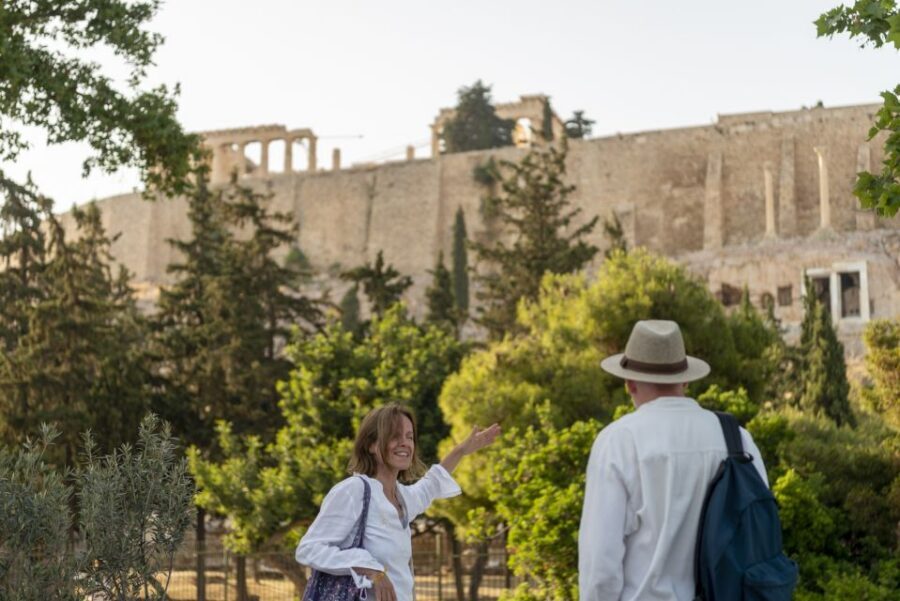
- Licensed archaeologist guide at the center of it: you’ll get clear explanations, not generic sound-bites.
- Myth and politics tied to the actual ruins: Dionysus to Athena, with the “why” behind the stone.
- A smart, human pace: guides work hard to keep things efficient and comfortable in the sun.
- Plaka as a real neighborhood: you’ll walk beyond the postcard streets into side lanes and local shops.
- Food option built for real schedules: Greek coffee or mountain tea, souvlaki, savory pies, and sweets.
- Flexible ending: you can keep exploring Plaka on your own, or get help finding your next stop.
Starting at Makrigianni 7: the easy way to meet up
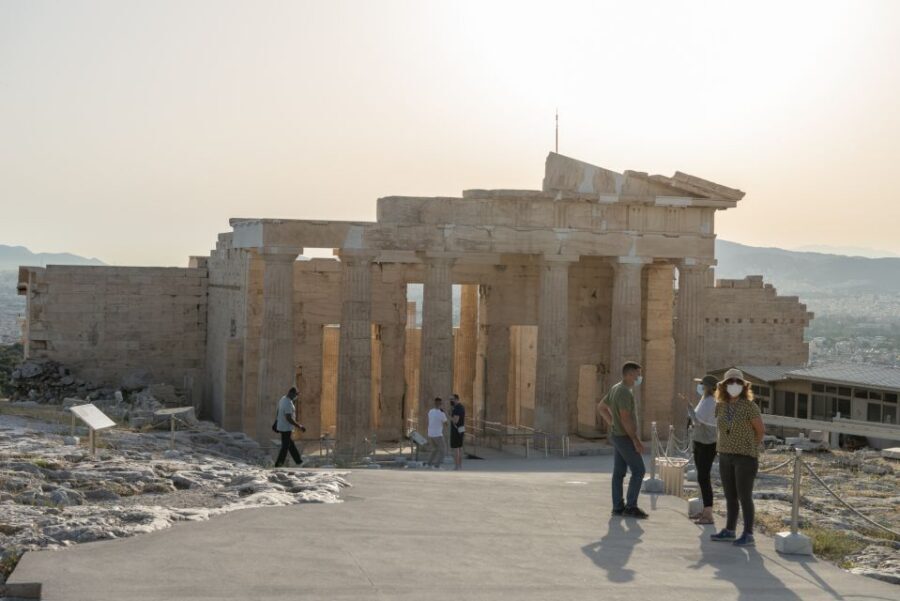
Meet at Makrigianni 7, close to the Acropolis Museum. Your guide will have a sign with your name, so you can spot them without playing street-bingo in front of a busy entrance.
Why this start matters: it keeps the first part of the tour smooth. The Acropolis area can feel chaotic if you’re trying to coordinate tickets, entry times, and where to stand. Here, you’re guided from the jump, which is especially helpful if you’re visiting during a busy season.
You’ll also be reminded early that the Acropolis is not a flat museum floor. Plan for steps and uneven ground, and wear shoes you’d actually trust on ancient rock. If you’re traveling with kids, this is also where a good guide earns their money: they keep the energy up and the stops short enough that nobody melts into misery before you reach the Parthenon.
If you’re the type who likes good photos, arriving ready helps too. The best pictures usually come when you’re not rushed and you know where to position yourself for the light and the view.
You can also read our reviews of more walking tours in Athens


Acropolis monuments with a licensed archaeologist: Dionysus to the Parthenon
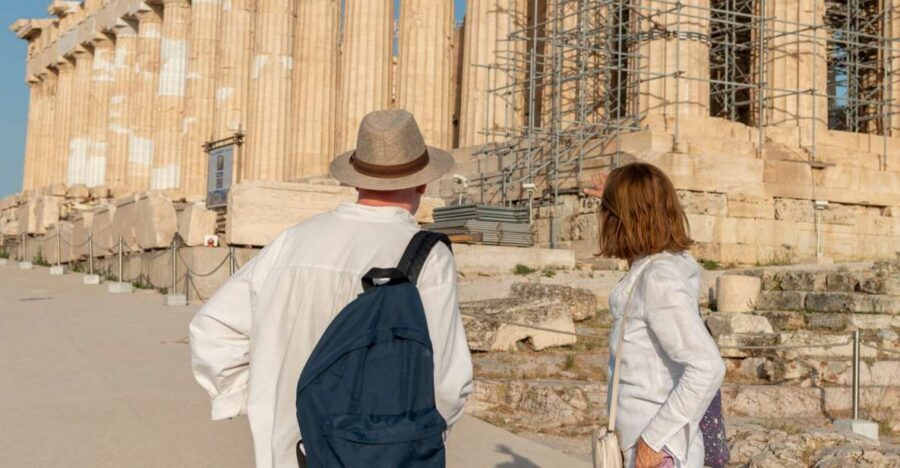
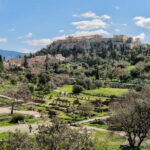
The heart of the tour is the Acropolis, and what makes it work is the way your guide connects each stop. You’re not just marching from one landmark to another. You’re building a mental map of Athens—religion, theater, power, and myth—layered onto the ruins you see in front of you.
Theatre of Dionysus: where plays began
You’ll start with the Theatre of Dionysus, described as the world’s oldest, and it sets the tone fast. This is the place where some of Ancient Greece’s famous plays were first performed about 3,000 years ago.
Even if you don’t know Greek drama, this stop clicks because it’s physical. You can stand and imagine the crowd and the stage. A licensed archaeologist guide helps you translate what you’re seeing into what it was for.
A practical note: you’ll want to keep your expectations realistic. Theatre ruins aren’t the kind of place where you “picture everything” instantly. That’s normal. The value here is that the guide helps you form the picture quickly, without turning it into a lecture.
Defensive walls and ancestor engineering
Next comes a story many people miss: the 5-meter-thick defensive walls built not by classical Greeks, but by their ancestors about a thousand years earlier.
This is a good example of why a trained guide matters. It gives depth to the Acropolis beyond the usual postcard view. Athens wasn’t only about art and philosophy. It was also about survival and strategy.
Propylaea and the Athena-glint moment
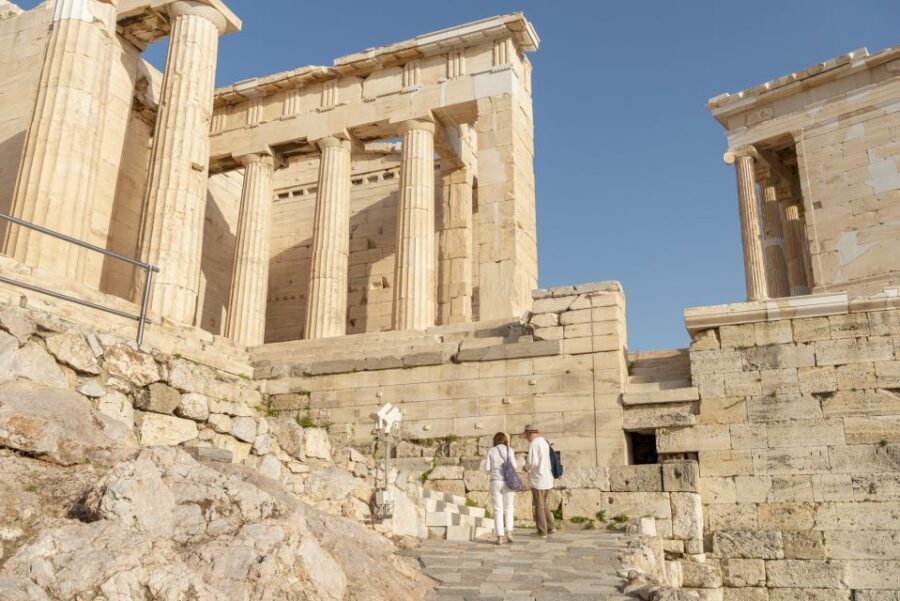
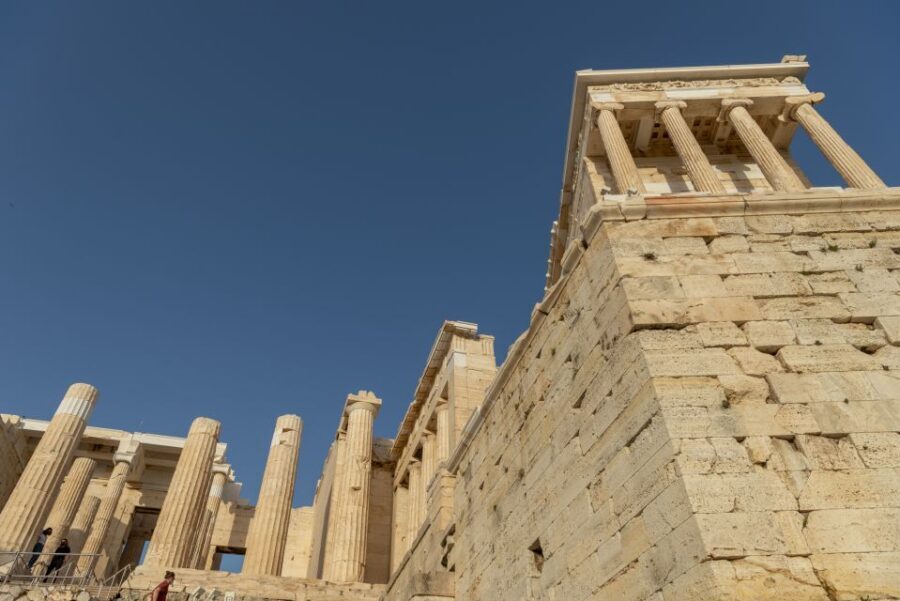
Then you move to the huge entrance area, the Propylaea. Your guide explains how the sun would have glinted from the bronze spear tip of a statue of Goddess Athena that once stood there—something sailors leaving from Cape Sounion about 70 km away might have seen as a final visual before going off to war and trade.
Take this as a guided “visualization.” It’s not just trivia. It helps you understand why the Acropolis was placed and designed the way it was: it was meant to be seen, remembered, and felt.
If you like stories with a strong sense of time and motion, this is one of the best moments.
You can also read our reviews of more private tours in Athens





Temple of Athena Nike: a mythology lesson you can walk through
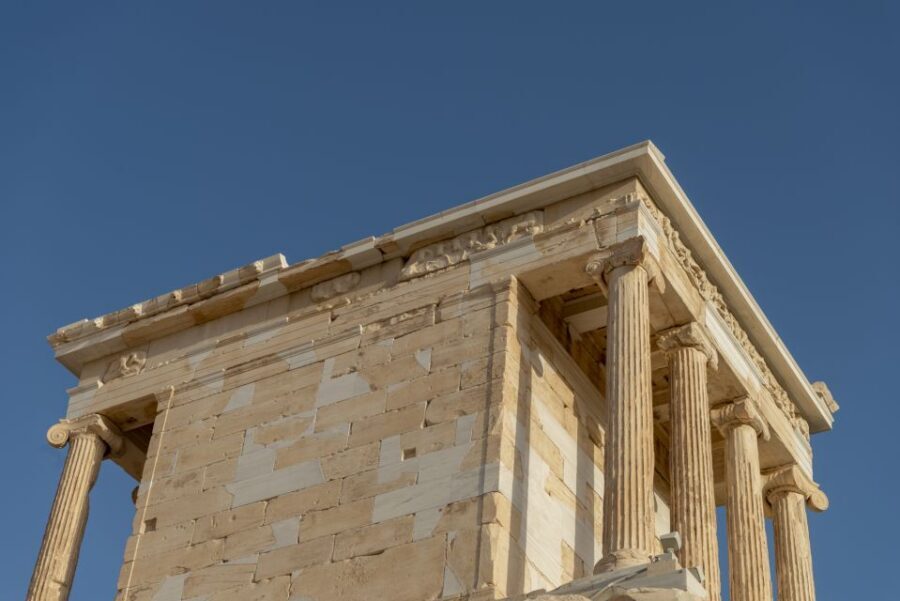
The Temple of Athena Nike is next, and this stop is short but focused. It’s a reminder that Athena wasn’t just an emblem—she was tied to victory and power, and the guide brings the meaning into the details you can actually see.
Parthenon: masterpiece, but explained
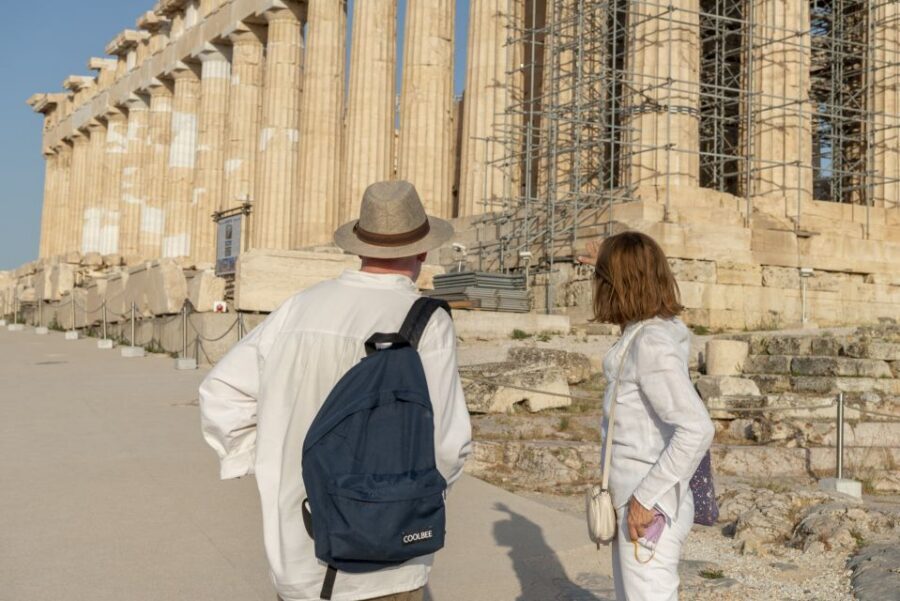
The Parthenon gets its own guided focus. This is where you’ll hear how the building functions as both an artwork and a political statement.
A good guide won’t just list facts. They’ll explain why certain choices were made and what the Parthenon was meant to communicate to the people of Athens and to visitors.
Erechtheion and the Poseidon vs. Athena struggle
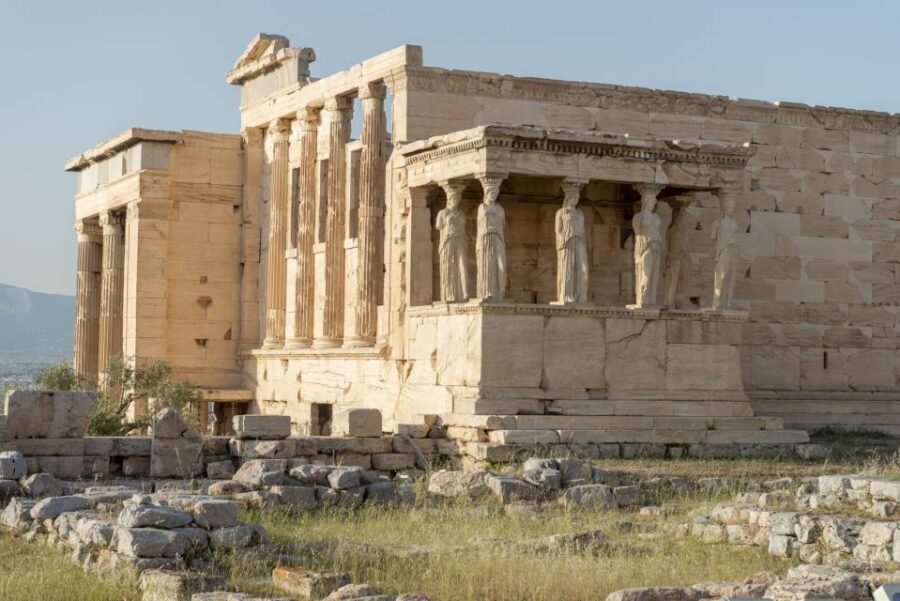
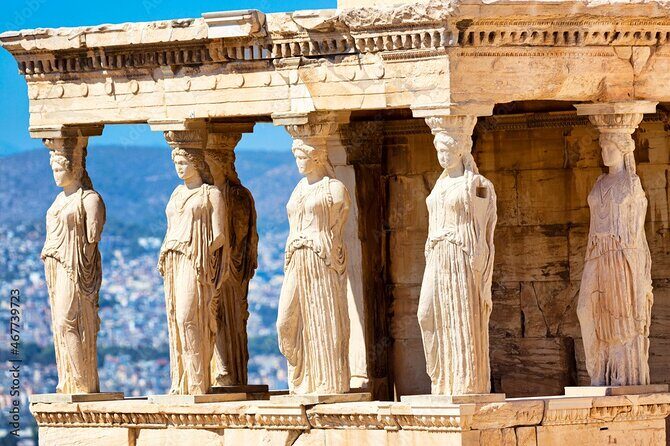
Then comes the Erechtheion, where mythology plays out: the struggle between Poseidon and Athena. This is another place where the story makes the architecture easier to read.
If you’ve ever felt lost at big ruins, this is the fix. The guide anchors you. Instead of only asking what you’re looking at, you can ask why it matters.
How much time you’ll spend
The Acropolis part is built for focus, with guided segments around each key area. You won’t feel like you’re being dragged through slow pacing. Instead, you get enough time at each stop to understand it and still keep momentum.
That pacing is important because the Acropolis can drain you if you’re standing too long in the wrong spot. And yes, guides like Eva are praised for watching shade and keeping movement practical. You’ll feel the difference if they’re doing it right.
Odeon of Herodes Atticus: seeing a still-used theater
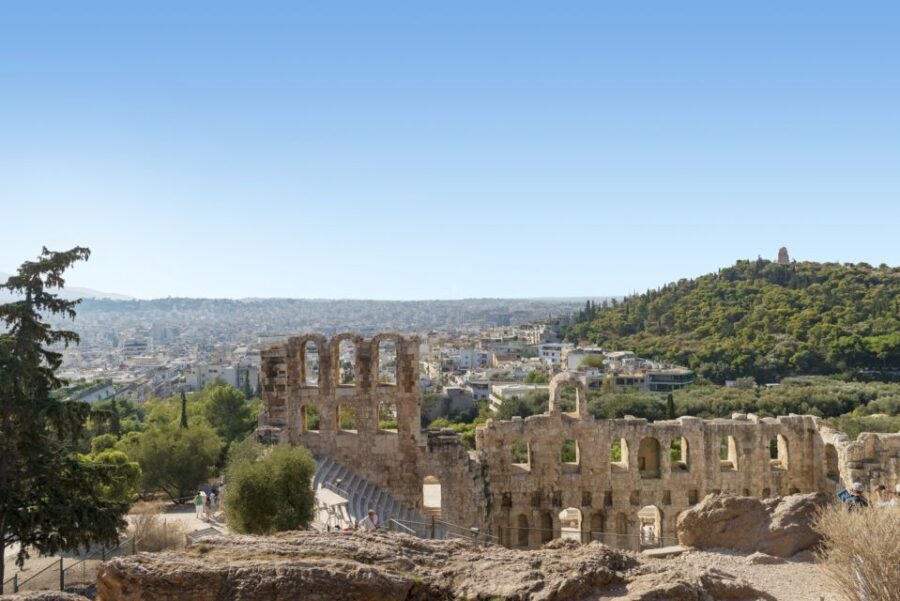
After the Parthenon area, the tour guides you down through olive trees to the Odeon of Herodes Atticus Theater.
This stop has a simple advantage: it’s not totally dead. It’s still in use each summer. Even if you don’t catch a performance, you can feel the “continuing life” idea.
Why I like this moment on tours: it’s a reset. The Acropolis can feel like a complete world of stone above you. The descent changes the mood. The guide can help you connect what you just learned about Dionysus and theater to what you see here.
It also helps with photos and pacing. The view angle and the movement down the hill can make you appreciate how the city sits below the ancient complex.
Plaka on foot: 3,000 years in small streets and artisan shops
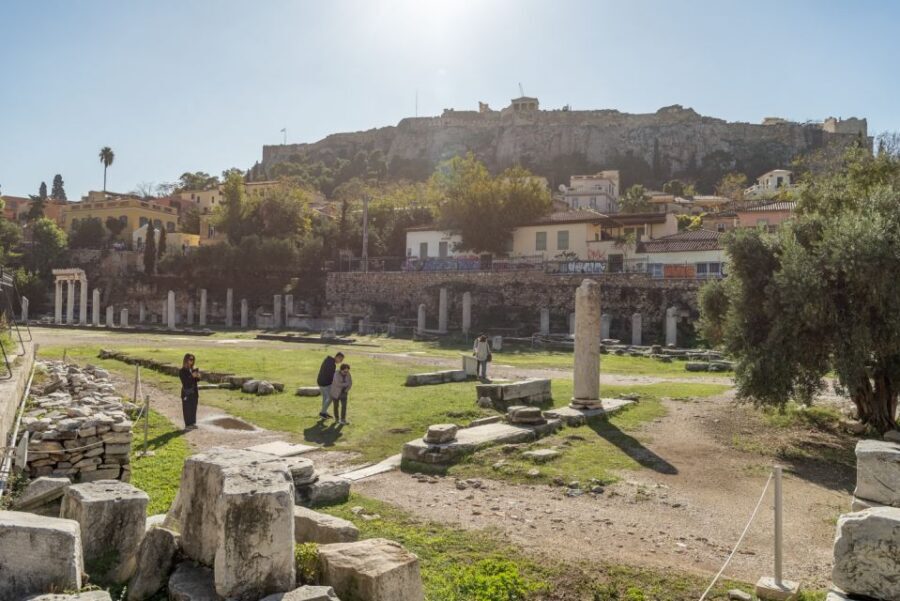
Once you leave the Acropolis zone, you shift into the neighborhood feel of Plaka. Here’s the key idea your guide will keep returning to: Plaka hasn’t been an empty historical set. It’s been continuously inhabited since ancient times.
You’ll walk through streets where you can trace ancient Greek to Roman to Byzantine layers across roughly 3,000 years. That’s the kind of time span that sounds abstract until you’re walking it.
Off-the-path lanes and real shopping stops
Plaka is famous, but you’re not limited to the busiest lanes. You should expect small streets and side corners, plus stops that mix practical browsing with cultural context.
The tour is designed to pass shops that sell things you’ll actually recognize as local craft: artisan jewelry, local eateries, and markets where you can see how the neighborhood functions today. You’ll also notice basic souvenir stalls, but your guide tends to steer you past the automatic tourist stuff and toward what feels more local.
This part is also where your guide’s personality matters. A good one gives you a quick map of the district’s “shape,” so you don’t feel turned around afterward.
Monuments in daily life
As you walk, you’ll pass monuments from multiple periods. This is where the tour stops being only about Ancient Greece and becomes about Athens as a living city.
Even if you’re not a museum person, this neighborhood walking segment can be the most satisfying part. It gives you that feeling of having seen where locals might actually wander between errands and coffee.
And at the end, you can either stay to explore Plaka on your own or have your guide help with directions back to Makrigianni 7 depending on the option you choose.
Optional food stops in Plaka: Greek coffee, souvlaki, pies, and sweets
If you choose the food option, it works best when you treat it like a bonus, not the main event. You’ll get classic tastes that match the neighborhood walking: Greek coffee or mountain tea, souvlaki, traditional savory pies, and sweet or cake delicacies.
Why this adds value: it gives you a break from the sun and the walking without forcing you into a long sit-down meal. It also helps families. With kids, the best tours are the ones that let everyone experience Athens in short, manageable hits.
One practical thought: if you’re the type who hates tasting menus and slow dining, the food option should still feel light. The tour is built around sightseeing first, with food as a supportive add-on.
Price and ticket reality: does $163 per person make sense?
At $163 per person for a private tour that can run 1.5 to 3 hours, you’re paying for three things:
1) a trained, licensed archaeologist guide,
2) a private group setup, and
3) guided time at the right monuments instead of figuring it out alone.
The big value point is the guide. Many people can stand in front of the Parthenon and take photos. Fewer people can understand what they’re seeing in a way that connects myth, theater, politics, and building design. That’s what you’re buying with a licensed expert.
Now the practical “watch outs”:
- Acropolis admission costs extra. You need tickets in hand before the tour.
- Skip-the-line access is tied to what you request. If you want it, you’ll need to ask after booking.
So the best way to judge value is simple: if you want more than a photo walk—and you want the Acropolis explained by someone trained to interpret it—this price can feel fair. If you’re on a tight budget and you’re happy reading a guidebook and buying tickets yourself, you might choose a cheaper option.
But for first-time Athens visits, or for people who like to understand the “why,” this tends to be money well spent.
Who should book this Acropolis & Plaka private tour (and who shouldn’t)
This tour fits well if you:
- want a structured Acropolis visit with myth and meaning, not just landmarks,
- like walking neighborhoods and learning how a historic district lives today,
- enjoy private pacing, especially with kids or a group with mixed interests,
- would benefit from a guide who keeps things practical and comfortable in the sun.
It may not fit if you:
- have mobility limitations, since the Acropolis includes steps and uneven ground,
- want a long, unbroken timeline with hours of sitting and slow museum-style reading.
It’s also worth considering the option choices. There’s an Acropolis-only version that ends in the Acropolis for more photo time and views, which can suit you if you want extra time up top and plan the Plaka later on your own.
Practical tips so you enjoy it instead of rushing it
Here’s how I’d set yourself up for a smooth day.
- Wear comfortable walking shoes with grip. The Acropolis terrain is not forgiving.
- Bring a water bottle and consider sun protection. A guide can help with shade, and you’ll feel that effort when pacing stays thoughtful.
- If you care about photos, ask early where to stand for views before the crowd thickens. Good guides help you avoid wasted attempts.
- Prepare one or two questions in your head. Even a simple one like What is the Parthenon trying to say helps your guide aim the story at your interests.
Finally, pace your expectations. This tour compresses a lot of major sites into a short window. The goal is understanding and momentum, not slow wandering for hours in one spot.
Should you book this Acropolis & Plaka private tour?
I’d book it if you want your Athens first impression to be guided and meaningful. The combination is smart: big-ticket monuments up top, then a neighborhood walk in Plaka where Athens feels lived-in.
This is especially a good choice when:
- you’re traveling with kids (the pace and storytelling style tend to work),
- you want an archaeologist to explain the myths and why the buildings matter,
- you’d rather spend your time learning than trying to decode the Acropolis on your own.
Skip it if you’re mostly photo-shopping and you don’t need much interpretation, or if mobility is an issue due to steps and uneven surfaces.
If you do book, do one thing for yourself: plan your Acropolis tickets ahead, and message early if you want skip-the-line help. Then show up ready to walk. Athens rewards effort, and this tour is built to make that effort count.
FAQ
What meeting point is used for this tour?
The meeting point is Makrigianni 7, Athina 117 42, near the Acropolis Museum. Your guide will be holding a sign with your name.
Do I need Acropolis admission tickets?
Yes. You should ensure you have admission tickets with you before the tour. Acropolis ticket costs are not included.
Is skip-the-line entry included?
The tour includes skip-the-line in concept, but skip-the-line tickets can be purchased on request after booking. If you want that option, message after booking.
How long is the tour?
The duration is 1.5 to 3 hours, depending on the option you choose.
What languages are available for the live guide?
The guide is available in German, English, Italian, and Greek.
Is there a food option during the Plaka part?
Yes. If you select the food option, you can get traditional food tastings in Plaka, including items like Greek coffee or mountain tea, souvlaki, savory pies, and sweet/cake delicacies.



More Walking Tours in Athens

More Tours in Athens


More Tour Reviews in Athens
- All Day Cruise -3 Islands to Agistri,Moni, Aegina with lunch and drinks included
★ 5.0 · 4,958 reviews