REVIEW · ATHENS
BEST 7-Day CLASSICAL GREECE: Corinth Olympia Delphi Meteora more!
Book on Viator →Operated by WARMPENGUIN · Bookable on Viator
Seven days, one ancient-world storyline. This tour works because it strings together Greece’s biggest classical hits in a smooth, no-stress rhythm: Acropolis + Museum in Athens, then down into the Peloponnese, and back up through Delphi and Meteora. I also really love the Temple of Poseidon at sunset timing, because it turns a long day into a perfect, dramatic finish. One thing to plan for: entrance fees are not included, and your driver can’t enter archaeological sites for you unless you add a licensed guide.
This is a private tour, built around your group and your pace. You’ll have comfortable stays (minimum 4-star or boutique) with breakfast, plus a professional English-speaking driver who’s with you throughout the day. The value is strongest if you want organized transportation and flexibility on sightseeing without having to map everything out yourself.
In This Review
- Key Highlights You’ll Care About
- How This 7-Day Classical Greece Plan Actually Feels
- Athens Start: Acropolis, Museum, Parliament, and the Marble Marathon
- Acropolis and its temples
- Acropolis Museum
- Syntagma and the Evzones
- Panathenaic Stadium and Zeus
- Sunset Temple of Poseidon
- Peloponnese Day Two: Corinth Canal, Ancient Corinth, and Mycenae’s Power Walls
- Corinth Canal and engineering history
- Ancient Corinth
- Mycenae: Lion’s Gate to the Treasury of Atreus
- Nafplio: lunch and a stroll with sea views
- Epidaurus, Mystras, and Sparta: Healing Centers, Byzantine Ruins, and Hard Training
- Epidaurus Theatre and the Sanctuary of Asklepios
- Mystras (Mystras): Byzantine UNESCO ruins
- Sparta: lunch plus ruins, museum, and olive oil
- Olympia to the Gulf: Zeus, the Olympic Tunnel, and Venetian-Style Ports
- Olympia: training, competition, and flame symbolism
- Rion-Antirion Bridge and the engineering mood
- Nafpaktos old port
- Galaxidi for an evening that feels less like Delphi overflow
- Delphi and Hosios Loukas: The Oracle’s Stage and Byzantine Frescoes
- Delphi: Apollo, terraces, and the myth engine
- Delphi Archaeological Museum
- Hosios Loukas: UNESCO-listed Byzantine monastery
- Arachova lunch and views before Meteora
- Meteora on Sandstone Pillars: Monasteries and Mountain-Top Quiet
- Thermopylae and the Return: Leonidas’ Battle and a Coastal Break
- Veroia morning stop
- Thermopylae and the Visitor’s Center
- Kamena Vourla for lunch or a break
- Price and Value: What $4,144.61 Covers and What It Doesn’t
- Driver-Explainer vs Licensed Archaeological Guide
- Practical Tips So You Don’t Feel Rushed
- Should You Book This Classic Greece Tour?
- FAQ
- Are entrance fees included?
- Do I get a guide during archaeological site visits?
- Is pickup from the airport included?
- What type of hotels are included?
- What transportation do I use during the tour?
- Is lunch included?
- Can the tour be customized?
- How does ticketing work?
- What is the cancellation policy?
Key Highlights You’ll Care About
- Private transportation all week: sedan or van/Sprinter options, so you’re not fighting transfers or schedules.
- Big-name sites in one trip: Acropolis, Corinth, Mycenae, Epidaurus, Olympia, Delphi, Meteora, Thermopylae.
- Hotel comfort included: 4-star or boutique hotels with breakfast to keep mornings easier.
- Driver for history, guides for entry: your driver can explain on the way, but licensed site guides can be added.
- Sunset payoff: Temple of Poseidon is timed as a standout final stop.
- Optional switches built in: you can add guides at select sites, and some stops can be omitted if you choose.
How This 7-Day Classical Greece Plan Actually Feels
Think of this trip as a guided route through the classics, but without the usual group-tour chaos. You’re not waiting around at every stop for 20 other people to come back from the gift shop. It’s just your group and a driver, moving you between Athens, the Peloponnese, and Central Greece.
The trade-off is simple: it’s a full week. You’ll spend real time in the car moving from one highlight to the next. If you like seeing a lot, that’s great. If you want totally slow travel, you might feel packed in.
The other big choice is guidance. Your tour driver is English-speaking and can tell you what you’re looking at, but the driver can’t go into archaeological sites. If you want someone to take you through the sites themselves, you’ll need to add expert licensed archaeological guides for one or more locations.
You can also read our reviews of more tours and experiences in Athens


Athens Start: Acropolis, Museum, Parliament, and the Marble Marathon
Day one is Athens in the best order: first the ancient powerhouses, then the modern city anchors, then the coastline finale.
Acropolis and its temples
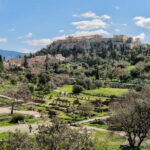
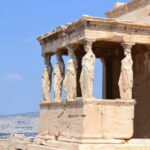
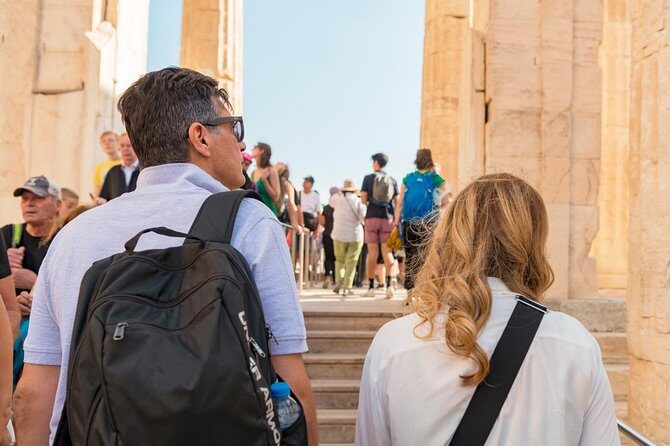
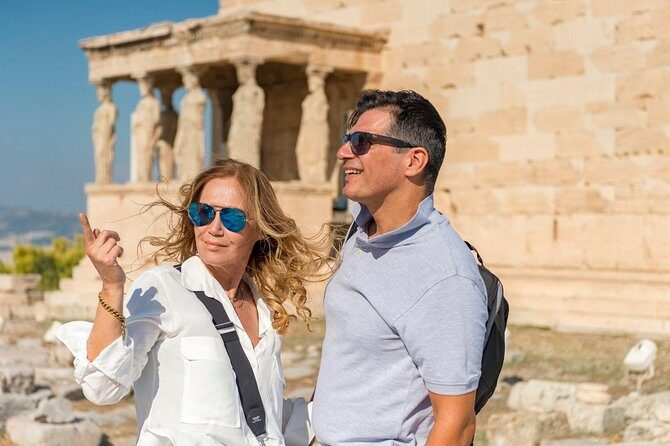
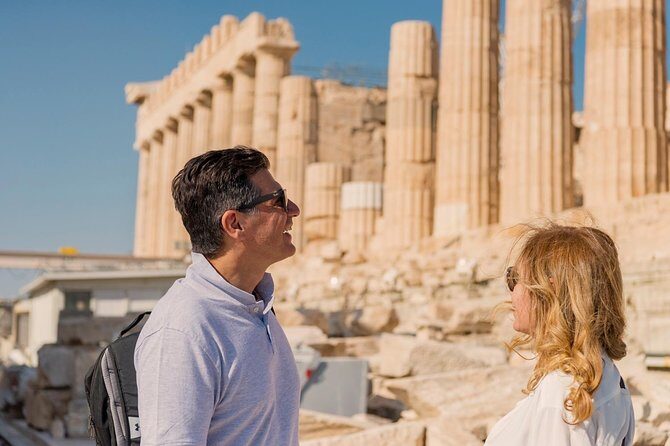
You’ll visit the Acropolis and key temples, including the Parthenon, Temple of Nike, and the Erechtheion. You also stop at the Herodes Atticus Theatre, which gives you a sense of how Greek architecture wasn’t only about temples. It was also about space for performance and civic life.
Practical note: this is the kind of place where entry tickets matter. Since entrance fees aren’t included, you’ll want to budget for it so you don’t get snagged at the gate.
Acropolis Museum
Next comes the New Acropolis Museum, adjacent to the hill. It’s built to help you connect what you see outdoors with the artifacts pulled from the site. Even if you’ve seen photos of the Acropolis before, the museum changes how you read the stones.
Syntagma and the Evzones
Syntagma Square is quick, but it has a payoff: you’ll see the changing of the guard ceremony at the tomb of the unknown soldier. The Evzone guards in their traditional uniform make this stop feel like a snapshot of living Athens, not just ancient ruins.
- All Day Cruise -3 Islands to Agistri,Moni, Aegina with lunch and drinks included
★ 5.0 · 4,958 reviews



Panathenaic Stadium and Zeus
Then you move to the Panathenaic Stadium (Kallimarmaro), famous as the only stadium in the world built entirely of marble. It’s tied to the Marathon ending, which gives the whole area a sporting, almost modern emotional angle.
After that, you’ll stop at the Temple of Zeus Olympius, a colossal dedication to Zeus, once linked to the seven wonders story. You’ll also see the Arch of Hadrian near it, a classic Roman-era marker tucked into the Athenians’ urban fabric.
Sunset Temple of Poseidon
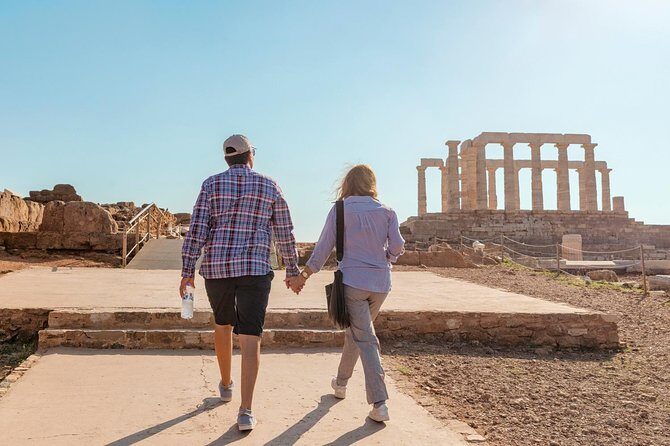
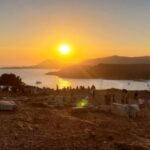
The day ends with the Temple of Poseidon on a cliff by the Athens Peninsula. The timing is the point: it’s especially beautiful at sunset, and it’s a meaningful legend stop because it was imagined as the last sight sailors saw leaving port and the first thing they saw when returning.
If you’re choosing just one “wow” moment to savor, this is a strong candidate.
Peloponnese Day Two: Corinth Canal, Ancient Corinth, and Mycenae’s Power Walls

Once you leave Athens, the tone shifts from city history to city-state history. Day two is about power centers and big infrastructure, with a seaside break built in.
Corinth Canal and engineering history
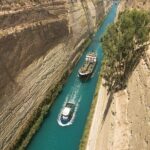
A short stop at the Corinth Canal gives you context for why the Peloponnese feels like a separate world. It’s not an ancient temple kind of moment, but it’s a reminder that geography and engineering have always shaped how Greeks moved and traded.
Ancient Corinth
Then you visit Ancient Corinth (Archaia Korinthos), strolling through remains of a major city with temples, markets, and fountains. You’ll also get the layered story that includes Romans and St. Paul. That mix matters because it helps you see Corinth as more than a set of rocks; it was a lived crossroads.
Mycenae: Lion’s Gate to the Treasury of Atreus
Next is Mycenae, one of the key stepping stones in the development of ancient Greece. The big draw here is scale: you pass through the wide city walls and enter through Lion’s Gate to Agamemnon’s throne room, then explore the palace buildings.
There’s also time for the Treasury of Atreus nearby and the on-site modern museum with artifacts uncovered from the site. That museum piece is useful because you’re not guessing what the place meant—you can connect ruins to objects.
Nafplio: lunch and a stroll with sea views
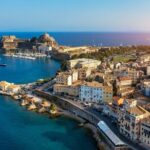
You end with lunch in Nafplio, a medieval and historical port city. The views toward the Venetian castle of Bourtzi add instant atmosphere, and the old city feel gives you space to browse craft shops and boutiques. If you want a break from standing in archaeological heat, Nafplio’s waterfront pace is a smart reset.
Epidaurus, Mystras, and Sparta: Healing Centers, Byzantine Ruins, and Hard Training
Day three is where the trip spreads out in time periods. You go from ancient healing to medieval power, then to Sparta’s disciplined reputation.
Epidaurus Theatre and the Sanctuary of Asklepios
At Epidaurus, you’ll visit the UNESCO-listed Sanctuary of Asklepios, home to what’s described as the first healing center of the ancient world. The star stop is the theatre of Epidaurus, with the world-famous acoustics. You can even test those acoustics with a poem or a song, which is fun if you’re game.
This is a “slow down and listen” site. You can rush it, but you’ll get more from it if you take a moment to feel how the architecture works.
Mystras (Mystras): Byzantine UNESCO ruins
After that, you go to Mystras, an 800-year-old ruins site and UNESCO location tied to Byzantine power. You’ll see palaces, residences, churches, monasteries, workshops, streets, and fortifications. It’s not a single monument; it’s a whole layered cityscape.
This stop is also a good reminder that classical Greece didn’t vanish. It changed hands, styles, and religions over centuries, and the stone keeps that story.
Sparta: lunch plus ruins, museum, and olive oil
You spend time in Sparta for lunch and explore the town’s ancient ruins and museum. The olive oil museum adds a more practical, everyday angle to what Sparta was known for, and it gives you something lighter to do between major archaeological sites.
Olympia to the Gulf: Zeus, the Olympic Tunnel, and Venetian-Style Ports
Day four is big-hitter ancient Greece plus a change of scenery on the way to Delphi.
Olympia: training, competition, and flame symbolism
Olympia is one of the most magical places in Greece, and you’ll see why. You’ll visit the archaeological site tied to the Olympic Games of antiquity, including where athletes trained and the tunnel they passed through to emerge into the stadium.
You’ll also see the Temple of Zeus and Hera, and the Olympic Flame lit there. The workshop of Phidias is part of what gives the site depth, and there’s an extensive museum with masterpieces from Olympia.
If you’re an “I want context” person, Olympia is a great match because it links architecture to real cultural rituals.
Rion-Antirion Bridge and the engineering mood
Then you cross the Rion-Antirion Bridge. The tour frames it as one of the longest suspension bridges in the world, and it’s a cool visual break after ancient stone.
Nafpaktos old port
Next up is Nafpaktos Old Port, described as Venetian and picture-postcard beautiful. It’s a solid lunch break stop, and it’s also a chance to reset your legs without the stress of squeezing another major ruin visit.
Galaxidi for an evening that feels less like Delphi overflow
Finally, you reach Galaxidi, a seaside village near the ancient port of Delphi. It’s positioned as a more relaxed evening option away from the more mass tourist feel. The emphasis is on wandering through streets, having cafes and local restaurant time, and eating something authentic with sea views.
This is one of those planning choices that makes the tour feel less like a checklist.
Delphi and Hosios Loukas: The Oracle’s Stage and Byzantine Frescoes
Day five is about two different eras of sacred power: ancient prophecy at Delphi and Byzantine artistry at Hosios Loukas.
Delphi: Apollo, terraces, and the myth engine
You visit Delphi on wide terraces along the hillside. The key ancient pieces you’ll cover include the 4th-century BC temple of Apollo, where the Oracle spoke prophecies. You’ll also see structures connected with the myth and ritual world, including the Castalian spring of mythology.
You’ll have time for the theatre, treasury buildings, temples of Athena, and the gymnasium where athletes prepared before the Pythian games. It’s not just ruins; it’s a whole system of religion, politics, and spectacle stacked on a hillside.
Delphi Archaeological Museum
The Delphi Archaeological Museum matters because it helps you read the site through objects. It includes finds reaching back to at least 1500 BC and pieces associated with the 4th-century BC peak period. Some highlighted works include the Naxos Sphinx, twin Kouroi, and the Bronze Charioteer.
Even if you mostly care about the outdoors, museums like this often turn “pretty stones” into a story you can follow.
Hosios Loukas: UNESCO-listed Byzantine monastery
You’ll also stop at the Monastery of Hosios Loukas, an important and well-preserved Byzantine monastery that’s UNESCO listed. The emphasis here is architecture and frescoes, and there’s an optional element: you can choose to omit this site if you prefer.
That’s smart. After Delphi’s density, Hosios Loukas can feel like a different kind of museum—more artistic and interior—so it’s good you’re not forced into it.
Arachova lunch and views before Meteora
Then you stop in Arachova for lunch. The focus is local craft shops and views over the olive-filled Pleistos river valley before continuing to Kalambaka, the jumping-off point for Meteora.
If you want a practical “food and shopping pause,” this is it.
Meteora on Sandstone Pillars: Monasteries and Mountain-Top Quiet
Meteora is the day that changes your brain’s perspective. You’re still dealing with Greece’s religious and historic streak, but the setting is dramatic rock pillars and clifftop monasteries.
You ascend to monasteries built on sandstone formations up to 1,312 feet high. The remaining monasteries date from the 14th century, and you’ll visit at least two of the most outstanding ones. The tour normally includes the Grand Meteora Monastery and then options like Varlaam or Agiou Stefanou.
Even if you’re not a big monastery person, Meteora is worth it because the physical engineering of the places is part of the story. It’s architecture that had to fight the landscape for attention.
After that, you’ll pause in Kalambaka for a traditional lunch in one of the town’s main squares, then you’re ready for the final return south.
Thermopylae and the Return: Leonidas’ Battle and a Coastal Break

Day seven gives you a clean historical closing chapter, then a softer landing back toward Athens.
Veroia morning stop
You start with a visit to Veroia in the morning. This is a smaller start compared to the big classical zones, and it helps keep the day from feeling like a nonstop marathon.
Thermopylae and the Visitor’s Center
Next is Thermopylae. You’ll see the monument and enter the newly built Visitor’s Center, which recreates the battle where King Leonidas led the 300 Spartans in 480 BC.
This kind of visitor center can be a helpful bridge between what you see outdoors and what you’re supposed to remember about the story.
Kamena Vourla for lunch or a break
Then you stop at Kamena Vourla for lunch or a break along the sea before turning back toward Athens.
That last coastal pause helps take the edge off the long drive and gives you time to reset before you wrap up.
Price and Value: What $4,144.61 Covers and What It Doesn’t
The headline price is $4,144.61 per person, and for a private seven-day route like this, the number makes sense when you look at what’s included.
You’re covered for:
- Private transportation (sedan/minivan/Sprinter depending on package and group size)
- A professional English-speaking tour driver
- Minimum 4-star or boutique hotels with breakfast
- A structured plan that takes you to major classical sites without you coordinating every transfer
What you should mentally subtract from that total:
- Entrance fees to the sights (these are explicitly not included)
- Licensed archaeological guides, unless you add them (your driver can explain en-route but can’t enter sites)
So the real value equation is this: if you’ll want the ease of a private car plus the hotel comfort built in, you’ll feel like you’re paying for reduced hassle. If you plan to add guides everywhere and pay all entrance fees, your total will climb, but you’ll also get more time inside and more context.
Driver-Explainer vs Licensed Archaeological Guide
Here’s an important practical distinction. Your tour driver can provide context while you’re on the road and during transfers, but they cannot enter archaeological sites. That means if you want someone standing with you at the key points—explaining details, managing pacing, answering questions while you’re physically inside—you’ll want to add expert licensed guides for one or more sites.
This is also why the option to explore independently vs upgrade with a guide can change how the week feels. With a guide, you’ll likely spend more time understanding. Without one, you’ll move quicker and rely on your own reading and the driver’s on-the-spot explanations when possible.
Practical Tips So You Don’t Feel Rushed
You’ll enjoy this tour most if you travel with realistic energy. You’re seeing major sites across multiple regions, so comfort matters.
- Wear comfortable shoes you can use for uneven ground and lots of stairs (especially with places like Acropolis areas and Meteora).
- Bring a light layer; coastal stops and higher elevations can feel cooler even when cities feel warm.
- Keep a close eye on entrance-ticket planning. Since fees aren’t included, you’ll want to handle them smoothly so the day doesn’t stall.
- If you have dietary needs, use the built-in lunch option carefully. Lunch can be added later, vegetarian dishes are available, and you should inform them of allergies if lunch is included in your package.
And one more small note: the tour is private, so you can tailor your pace to your group’s energy level. That’s the difference between “a lot of stops” and “too many stops.”
Should You Book This Classic Greece Tour?
Book it if you want a smart, efficient classical route with private transportation, comfortable hotels with breakfast, and strong “big-name site” coverage from Athens through the Peloponnese to Delphi and Meteora.
Consider passing or customizing if you’re the type who hates driving between stops, or if you’re determined to do only free external viewpoints and skip paying for site access. This tour is designed for real visits, not just looking from afar.
If you decide to go, one of the best ways to get your money’s worth is to choose where you’ll spend extra time with licensed guides. Picking the most important sites for you to understand deeply can turn an already full week into a memorable story you can actually follow.
FAQ
Are entrance fees included?
No. Entrance fees are not included, and you should budget separately for the sights.
Do I get a guide during archaeological site visits?
Your driver can explain things while you travel, but the driver cannot enter archaeological sites. Expert licensed archaeological guides are available on request at one or more sites.
Is pickup from the airport included?
Pickup is offered on request, including from the airport and areas outside Athens, but it may require a supplement.
What type of hotels are included?
You get comfortable stays at minimum 4-star or boutique hotels, with breakfast included.
What transportation do I use during the tour?
Transportation depends on the package and group size. Options include a Superior Class Sedan, Mercedes Minivan, or Sprinter, and upgrades are available in the Gold and Platinum packages.
Is lunch included?
Lunch is not automatically included, but you can add it later on request. Some booking options include lunch, and vegetarian dishes are available.
Can the tour be customized?
Yes. The experience is described as personalized and flexible, and you can choose options like adding licensed guides or including or omitting some sites such as Hosios Loukas.
How does ticketing work?
The tour includes a mobile ticket.
What is the cancellation policy?
You can cancel for free up to 24 hours in advance of the experience for a full refund. If you cancel less than 24 hours before the start time, the amount paid is not refunded.


More 7-Day Experiences in Athens
More Tour Reviews in Athens
- All Day Cruise -3 Islands to Agistri,Moni, Aegina with lunch and drinks included
★ 5.0 · 4,958 reviews