REVIEW · ATHENS
The Acropolis Walking Tour with a French Guide
Book on Viator →Operated by Athens Walks Tour Company · Bookable on Viator
The Acropolis makes more sense with a guide. I like the skip-the-line entry plus a French guide (often archaeologist-led), so the story starts immediately at the top. I also love the concrete stops on the Parthenon, the gateway Propylaea, and the Temple of Athena Nike, tied to real design choices and big Athens ideas. One watch-out: it’s outdoors and there’s lots of sun exposure, so plan for a slower pace if you’re bringing kids or anyone who needs frequent breaks.
For about two hours, you’ll walk the main spine of the site without a sprint, in a small group (max 20) with microphones so the commentary stays clear. The meeting point is Porinou 5 (easy to reach by public transport), and you end near Areopagus, which is handy for continuing your Athens walk.
In This Review
- Key highlights that make this tour worth it
- What you’re really paying for: guide time plus entrance access
- Porinou 5 meeting point and a smooth start to the Acropolis climb
- Stop 1: Acropolis viewpoint, the name, and how the “citadel-city” works
- Stop 2: Parthenon spotlight, Athena’s role, and the missing marbles story
- Propylaea gateway: the monumental entrance that changes your viewpoint
- Temple of Athena Nike: early Ionic style and what to look for
- Time, heat, and pacing for a 2-hour walk
- Price and logistics: is $80.64 a good deal here?
- Who should book the French-led Acropolis walking tour
- Should you book it or skip it?
- FAQ
- Is the entrance ticket included, and do I skip the line?
- How long is the Acropolis walking tour with a French guide?
- Where do I meet for the tour?
- What sites do we visit during the tour?
- Is the tour in French?
- What fitness level do I need?
- Are there free tickets for some visitors?
- What if the weather is bad?
Key highlights that make this tour worth it
- Skip-the-line access keeps your time focused on the ruins, not the queue
- French-speaking archaeology narration connects buildings to the why behind their placement
- Parthenon context beyond photos including what it was for and the story of missing marbles
- The Theatre of Dionysus thread links the Acropolis to the origins of theater
- Propylaea as the turning point where the Acropolis journey feels intentional
- Temple of Athena Nike in Ionic detail with a look at how style signals power and belief
What you’re really paying for: guide time plus entrance access
At $80.64 per person, the big value is that you’re not just buying entry tickets. You’re buying a licensed French-speaking guide plus skip-the-line tickets, which matters at the Acropolis where time and patience can get expensive fast.
What I like about this format is that the guide isn’t treating the site like a checklist. The tour is built to help you see how the complex works as a plan: where you’re standing in relation to the Parthenon, how you move through the gateway approach, and why certain temples feel like they’re speaking to specific moments in Athens’ civic and religious life.
If you’ve ever toured the Acropolis solo and thought, I see the big stuff, but I don’t really get it, this is the fix. You’ll still admire the views—but you’ll also understand what you’re looking at, and why it was placed exactly there.
You can also read our reviews of more walking tours in Athens


Porinou 5 meeting point and a smooth start to the Acropolis climb
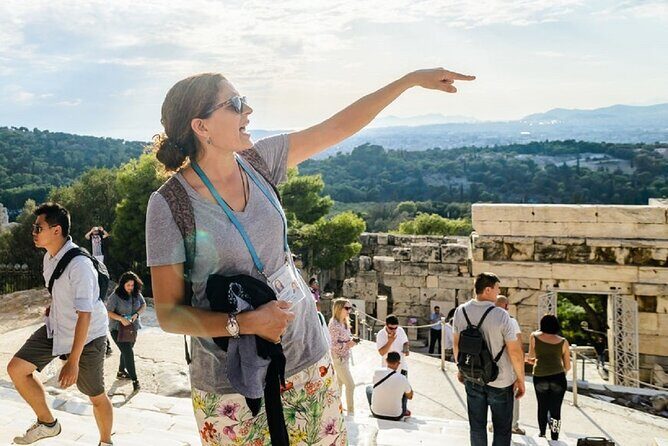
You meet at Porinou 5, Athina 117 42, and the tour ends at Areopagus. That end point is useful: it puts you on the lower slopes again, so you can transition back toward the city without repeating the hard climb.
One practical win: the tour operator lists it as near public transportation, and the walking portion is designed around getting you into position for each stop without wandering. You also get microphones, which is a small detail that makes a big difference when you’re trying to hear commentary over wind, footsteps, and other groups.
Two more things to keep in mind. First, you’ll want good walking shoes because the Acropolis is uneven. Second, the tour runs outdoors for its full duration—one reason it can feel intense in the middle of the day.
Stop 1: Acropolis viewpoint, the name, and how the “citadel-city” works
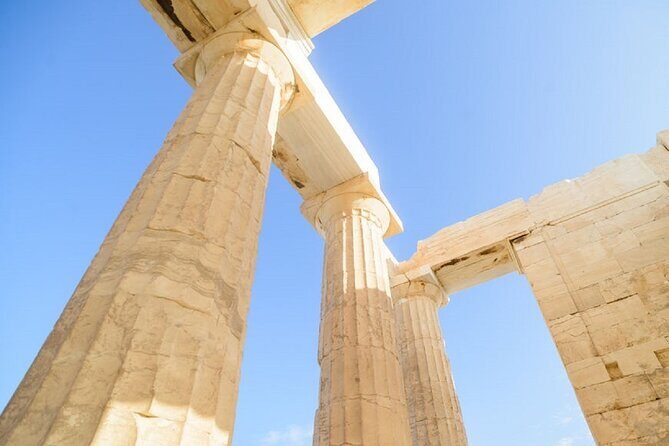
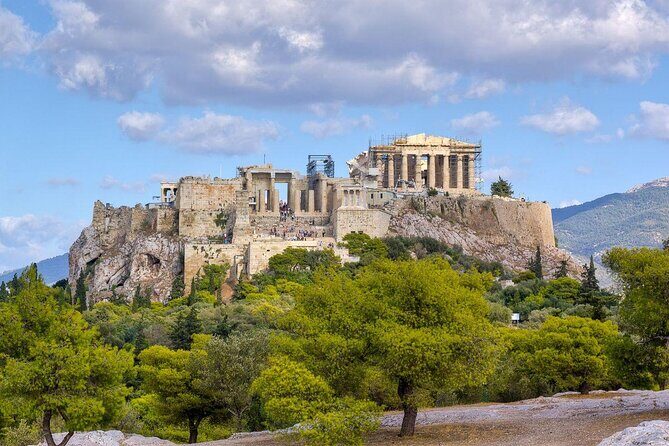
Your first stop is the Acropolis itself—an ancient citadel on a rocky outcrop above Athens, made of multiple important buildings. The guide frames it as more than a single monument. This is where you start understanding the Acropolis as a designed place, with the Parthenon as the headline but not the only story.
You’ll also get a quick linguistic anchor: the word acropolis comes from Greek akron (high point) and polis (city). That helps you visualize why the Greeks chose this location—elevation mattered for both visibility and symbolism.
This is also where themes start stacking up. Expect connections to the life of Athens, including the development of ideas like public spectacle. The tour specifically points toward the origins of theater at the Theatre of Dionysus, which gives you a more complete picture of what these “holy spaces” meant to a society, not just what they looked like.
The main potential downside here is pacing under the sun. You may spend a full hour in the open, absorbing a lot of information, so bring water and a hat if you’re even slightly heat-sensitive.
Stop 2: Parthenon spotlight, Athena’s role, and the missing marbles story
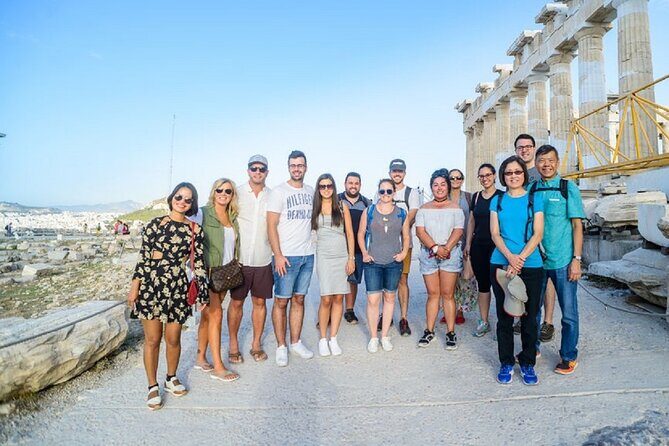
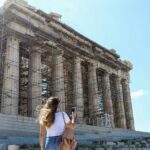
Next you zero in on the Parthenon, a temple dedicated to Athena, Athens’ patron. Construction began in 447 BC, during the city’s peak power—so the building isn’t just religious. It’s political messaging in stone.
Here’s where a guide earns their fee. Instead of treating the Parthenon as an icon, the commentary helps you read it as design. You’ll look at the building as part of the broader Acropolis plan and understand why certain choices mattered.
A key talking point on this tour is the issue of missing marbles. When you’re standing in front of the Parthenon, it’s easy to assume the ruins are just damage from time. The guide helps you understand that what you see is also shaped by history—what remains, what’s gone, and what that absence means when you try to interpret the original message.
Time-wise, you’re at this stop for about 45 minutes, which is enough to get past first-glance wow and into real understanding. If you’re the type who loves architectural details and symbolism, this is your moment.
Propylaea gateway: the monumental entrance that changes your viewpoint
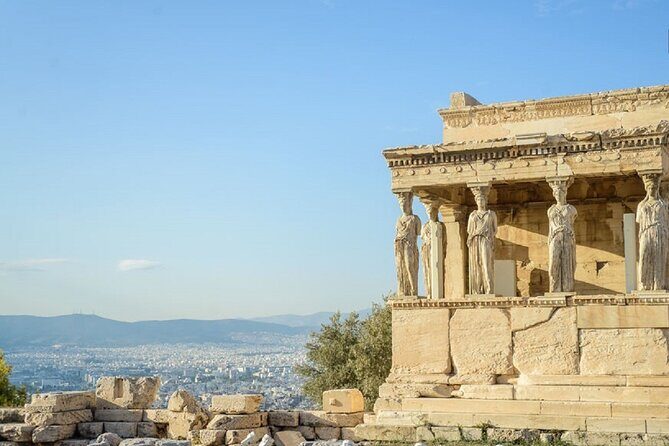
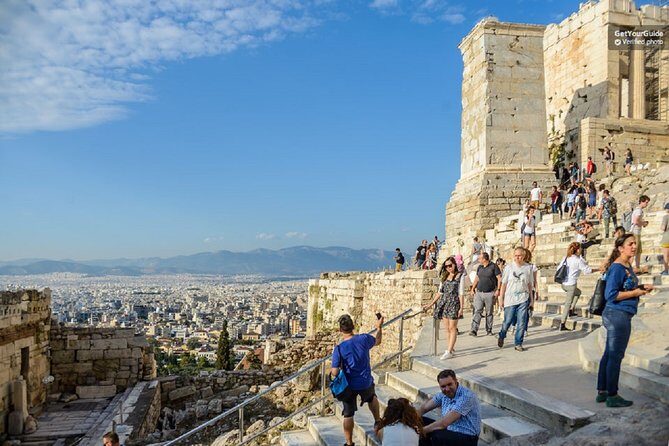
Then comes Propylaea, the grand gateway that serves as the entrance to the Acropolis. In Greek architecture, a propylaea is a monumental passage into a sacred space, and seeing it on foot changes how you experience the site.
This stop is short—about 15 minutes—but it’s strategically placed. The gateway gives you a “before and after” feel: you’re transitioning from the city-facing approach into the heart of the citadel. Even if you know the Parthenon is the centerpiece, Propylaea explains why you don’t just see it instantly. You’re meant to arrive with the right sense of order and purpose.
The best part of a guided moment like this is that it prevents the classic mistake: walking past the gateway and only remembering the main temple. Here, you learn to treat Propylaea like part of the story, not just a photo backdrop.
If you’re traveling on the more limited-attention side, the short length is a plus. You won’t be stuck at one spot too long before moving on.
You can also read our reviews of more guided tours in Athens


Temple of Athena Nike: early Ionic style and what to look for
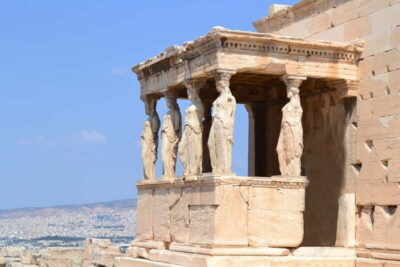
The tour also includes the Temple of Athena Nike. It was built around 420 BC and is noted as the earliest fully Ionic temple on the Acropolis. That matters because Ionic style isn’t just decoration—it’s a readable language of form.
Compared with the Parthenon, this stop helps you shift from scale to detail. Ionic architecture has its own visual rhythm, and the guide’s explanation makes it easier to spot how the style communicates meaning. It also keeps the tour from becoming one-note: you get variation in both subject and architectural character.
If you love temples that feel more intimate than colossal, you’ll probably enjoy this stop. It’s still on the Acropolis, still tied to Athena, but it offers a different kind of attention—closer study, smaller visuals that reward you when you’re standing still long enough.
One practical consideration: this stop is still part of the outdoor route. If you book a hot daytime slot, this is another stretch to manage with water and shade planning.
Time, heat, and pacing for a 2-hour walk
The tour lasts about 2 hours. That’s a sweet spot for the Acropolis: long enough to connect buildings into a coherent route, short enough that you’re not stuck for half a day.
The bigger variable is temperature and comfort. The site can feel brutal in full sun, and some people find that a nonstop, explanation-heavy pace doesn’t work well for children or anyone who wants frequent question time. On the flip side, the tour format with microphones helps you keep up without leaning forward and squinting.
If your schedule allows it, consider timing your visit to reduce heat and crowd stress. One practical tip from the experience is that an evening slot can feel calmer, with less heat and fewer people around.
Don’t underestimate the walking. Even though the route is focused, you’ll still do a fair bit of uphill terrain and standing time. Moderate fitness is the stated baseline, and it makes sense: the Acropolis is not flat.
Price and logistics: is $80.64 a good deal here?
For $80.64, the tour is priced in line with what you’re getting: licensed French guide time plus entrance tickets and skip-the-line access. That’s not just convenience. It’s also an efficiency win—your guide can start teaching right away instead of waiting in public queues.
Add the small-group limit (max 20), plus microphones, and the overall feel tends to be more “guided walk” than “guided crowd herding.” That’s part of the value: you spend less energy figuring out what to do next and more on learning what you’re seeing.
Also worth noting for value-hunters: EU citizens under 25 can have free entrance with a passport. If you qualify, you might compare the base value of the guide portion versus entrance savings, but either way, interpretive guidance at the Acropolis is usually the difference between seeing ruins and actually reading them.
Who should book the French-led Acropolis walking tour
This is a strong match for you if you:
- want a structured route across the Acropolis instead of drifting
- enjoy explanations tied to Athens’ culture and civic life (theatre, religion, politics)
- like architecture you can actually recognize and name after the walk
- prefer hearing history in French from a licensed specialist
It might be less ideal if you:
- need frequent shaded pauses or lots of time for questions
- dislike long stretches of standing and sun
If you’re a first-time Acropolis visitor, you’ll likely feel the biggest payoff. The site is famous, but it’s also easy to misunderstand without a guide to connect the pieces.
Should you book it or skip it?
Book it if you want the Acropolis to make sense as a working complex—Parthenon, gateways, and Ionic temple details—without wasting time in lines. The combo of skip-the-line entry and an expert French-speaking guide is the main reason this tour feels like good value at $80.64.
Skip it only if your priorities are purely scenic and you’re comfortable with a more self-directed approach. If that’s you, you can still enjoy the views, but you’ll miss the way the route explains why the stones were placed and what the missing pieces mean.
FAQ
Is the entrance ticket included, and do I skip the line?
Yes. The tour includes skip-the-line entrance tickets, so you don’t have to wait in the standard entry lines.
How long is the Acropolis walking tour with a French guide?
It runs for about 2 hours (approx.).
Where do I meet for the tour?
You meet at Porinou 5, Athina 117 42, Greece, and the tour ends at Areopagus, Athens 105 55, Greece.
What sites do we visit during the tour?
You’ll stop at the Acropolis, the Parthenon, the Propylaea gateway, and the Temple of Athena Nike.
Is the tour in French?
Yes. It’s a licenced French speaking tour guide.
What fitness level do I need?
The tour is designed for travelers with a moderate physical fitness level.
Are there free tickets for some visitors?
Yes. Entrance tickets for European Union citizens under 25 can be free with a passport shown.
What if the weather is bad?
This experience requires good weather. If it’s canceled due to poor weather, you’ll be offered a different date or a full refund.

More Walking Tours in Athens


More Tours in Athens


More Tour Reviews in Athens
- All Day Cruise -3 Islands to Agistri,Moni, Aegina with lunch and drinks included
★ 5.0 · 4,958 reviews