REVIEW · ATHENS
The Highlights of Athens Private Shore Excursion 8 Hours
Book on Viator →Operated by Athens Tours Greece · Bookable on Viator
The Acropolis hits hardest with context. This private shore day strings together the big-name sights with the key background you’d otherwise miss, especially on the Acropolis hill and in the new museum. I love the Parthenon moments, and I love how the Acropolis Museum explains what you’re seeing on the rock. One watch-out: entrance tickets aren’t included, and several stops involve stairs and smooth marble surfaces.
You’ll get round-trip transportation from Piraeus (or your hotel in Athens) and the advantage of a private, English-speaking driver who can manage timing and traffic. The schedule is full, so it’s not a lazy day, but it’s a strong way to see a lot in one visit without feeling lost.
In This Review
- Key Things I’d Pay Attention To
- A Private 8 Hours of Athens: What You Really Get
- Piraeus Pickup and the Saronic Gulf Drive: Starting in the Right Place
- The Acropolis Stops You Can’t Skip (Propylaea to Erechtheion)
- Propylaea: The Monumental Gate Framing Your Entrance
- Temple of Athena Nike: Wingless Victory With a Story
- Parthenon: Built for Democracy at Its Height
- Erechtheion and the Karyatides Porch: When Columns Become People
- From Parade Route to Everyday Athens: Changing Guards at Syntagma
- Hellenic Parliament and the Unknown Soldier
- Changing of the Guards: What to Watch
- Plaka’s Village Streets and the Agora’s 5,000-Year Core
- Plaka: Lunch Freedom Under the Acropolis
- Ancient Agora: The Marketplace as a City Engine
- Acropolis Museum: Why It Completes the Acropolis
- Zeus, Pentelic Marble, and the Kallimarmaro Olympic Echo
- The Olympieion Area (Sanctuary of Olympian Zeus)
- Kallimarmaro: The Marble Stadium That Still Feels Athletic
- Mount Lycabettus: The Best High-View Finale
- Price and Logistics: When This Tour Is Worth It
- Should You Book This Athens Shore Excursion?
- FAQ
- What is the duration of the Athens private shore excursion?
- How much does it cost, and what group size is it for?
- Is pickup included, and where does it start for cruise passengers?
- Is hotel pickup included for people staying in Athens?
- Is the tour offered in English?
- Are entrance fees to archaeological sites and the museum included?
- Are food and drinks included?
- Does the English-speaking guide stay with you inside archaeological sites and museums?
- Is it a private tour?
- Can I cancel for a full refund?
Key Things I’d Pay Attention To
- Private, up-to-3 group format that helps your day feel flexible instead of chore-like
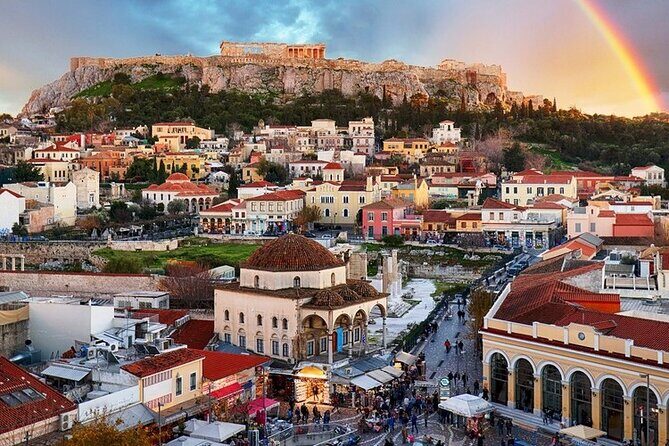
- Acropolis + Acropolis Museum so the story follows you from hilltop to artifacts
- Syntagma Square Evzones ceremony timing built into the route for a must-see spectacle
- Plaka free time that lets you choose lunch and wander at your own pace
- Marble-heavy walking where good grip shoes matter more than you think
- Daylight-dependent marble views at Kallimarmaro, where the color shift is part of the experience
A Private 8 Hours of Athens: What You Really Get
This is a classic “greatest hits” Athens day, but with two things that make it more useful than a checklist tour: you get personal attention, and you get the story in the right order. The day starts near the sea at Piraeus, then climbs into the political and artistic heart of ancient Athens at the Acropolis. Later, you pivot back into modern Athens at Syntagma Square for the Changing of the Guards, then flow into neighborhoods and museums that help everything make sense.
You’re also buying convenience. You don’t have to figure out buses, parking, or how to sequence stops around crowds. Instead, you ride in an air-conditioned vehicle and focus on seeing, walking, and taking photos. And because it’s private (up to 3 people), the pacing is easier to manage for small groups.
The main downside is simple: you’ll be on your feet. Even though time at each stop is set, the Acropolis and Agora areas naturally involve stairs and uneven footing. Bring shoes that grip, and plan to slow down where the surfaces look slick.
You can also read our reviews of more private tours in Athens


Piraeus Pickup and the Saronic Gulf Drive: Starting in the Right Place
If you’re arriving by cruise, the pickup point is Port of Piraeus, Terminal A (Port E11, Akti Xaveriou Street 28). You’ll disembark and walk outside the terminal exit door where the driver is waiting with a name sign.
Once you’re in the car, the early part of the day matters. The route goes along the coastal road of the Saronic Gulf, with a chance to take in the Piraeus area and the Athens Riviera from the window. It’s a smart start because it helps you “place” Athens geographically—this isn’t just an ancient site day. It’s Athens as a working port city that has grown into a modern capital beside the sea.
A practical note: Piraeus is close to Athens (about 12 km / 7 miles), so you don’t lose half your time fighting travel logistics. That proximity is part of what makes an 8-hour shore excursion work.
The Acropolis Stops You Can’t Skip (Propylaea to Erechtheion)
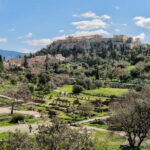
The Acropolis is the headliner, and this itinerary doesn’t just pass the camera-ready points. It walks you through the sequence of monuments that define what the ancient Athenians built after their victory against the Persians and the flourishing that followed under Pericles.
Propylaea: The Monumental Gate Framing Your Entrance
You start with the Propylaea, the monumental gateway complex. What I like here is that it acts like a visual “setup.” You’re not just walking into ruins—you’re walking through a deliberate architectural experience. The Propylaea’s design uses Pentelic marble, and the entrance is framed in a pie-shaped layout that feels engineered for ceremonial arrival.
This stop is short, but it’s useful. It gives you a sense of scale before you reach the Parthenon area.
Temple of Athena Nike: Wingless Victory With a Story
Next is the Temple of Athena Nike at the southeast edge of the sacred rock. This is one of those stops that becomes more interesting the moment you learn the meaning. Athena Nike is tied to the idea of Wingless Victory—the cult statue was described as wingless so victory wouldn’t leave Athens.
There’s also a good “how to read ruins” lesson: the preserved early foundations and altars sit under and around the later classical structure. Even without long museum-style explanations, that layering helps you understand why the Acropolis looks like it does.
You can also read our reviews of more tours and experiences in Athens

Parthenon: Built for Democracy at Its Height
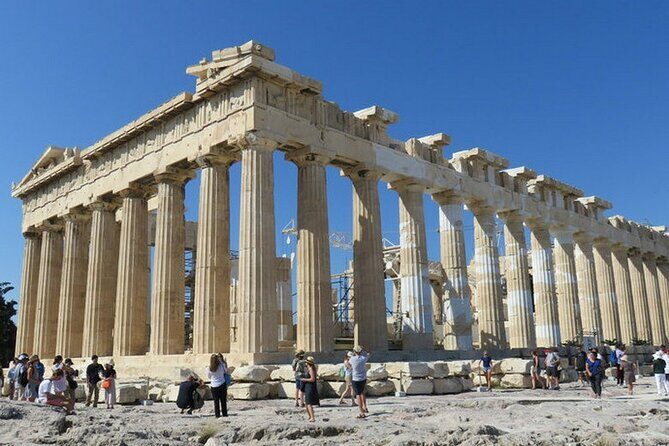
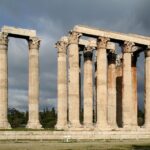
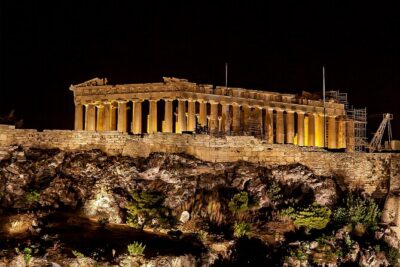
Then comes the big one: the Parthenon. The time here is about 45 minutes, and that’s the moment most people want. It’s dedicated to Athena Parthenos and built in the Periclean era, with construction dated 447–438 BC.
A few details matter because they change how you look at the building:
- Architects tied to the project include Iktinos and Kallikrates
- Pheidias supervised the building program and conceived the sculptural decoration
- The Parthenon is designed as a double peripteral Doric temple, with innovations in its execution
Here’s my practical advice: don’t try to memorize everything. Use that time to locate the key elements you’ll later recognize again in the museum—columns, sculptural themes, and the “why this was built” feeling of power and precision.
Erechtheion and the Karyatides Porch: When Columns Become People
The Erechtheion is on the north side of the sacred rock and dates to 421–406 BC. I love this stop because it breaks the monotony of stone geometry. The building includes the famous Karyatides—six female statues that function like columns supporting the roof.
Important context: some of the originals are in museums (including the Acropolis Museum and the British Museum), while the figures on the building are casts. Even if you don’t know that beforehand, the statues make the structure feel human and theatrical—like the Acropolis is still putting on a show.
If you’re traveling with kids, older relatives, or anyone who struggles with stairs: this is where you should take the walking slow. One specific thing I’d plan for is that marble surfaces can be slippery, and some areas are not ideal for strollers.
From Parade Route to Everyday Athens: Changing Guards at Syntagma
After the Acropolis, the day shifts into modern Athens with the Evzones and the ritual at Syntagma Square. This part of the tour is easy to enjoy because it’s visual, timed, and completely different from ancient stone.
Hellenic Parliament and the Unknown Soldier
You’ll pass the Hellenic Parliament, a building with a long royal-to-government story. It began life as the palace of King Otto and King George I, then became the Parliament and Senate building about a century after construction. The area around it is tied to Piraeus-to-Athens contrast: centuries of power moving from throne rooms to modern democracy.
You’ll also visit the Tomb of the Unknown Soldier, guarded by the Evzones. The tomb is a war memorial sculpted between 1930 and 1932 by Fokion Rok. It’s guarded in the slow-motion ceremonial style that many visitors notice immediately—because the guards are actually standing still for long periods, which is part of the pacing of the ritual.
Changing of the Guards: What to Watch
Changing of the guard ceremonies are described at the presidential mansion and the tomb area. The schedule includes an hourly sentry change with slow motion, and the Sunday ceremony includes an event timing of 11:00 (with a military band marching from behind the Parliament).
My advice: stand where you can see the movement without blocking foot traffic. The show is short enough that you want a clear view, but you also don’t want to spend energy fighting for position.
Plaka’s Village Streets and the Agora’s 5,000-Year Core
This is one of the best combinations you can build into a day: Plaka for the feel-good Athens vibe, then the Ancient Agora for the brainy center of city life.
Plaka: Lunch Freedom Under the Acropolis
Plaka is described as a “village-like” neighborhood under the Acropolis slope, with narrow cobblestone streets, small shops, sidewalk cafés, and family-run tavernas that tend to stay open late. It also connects visually to Anafiotika, with whitewashed homes that give an island-like vibe.
You get about 1 hour 30 minutes here as free time for lunch and wandering. This is your chance to stop pretending you have perfect control. Let the streets pick your next photo.
If the weather turns or crowds build, don’t force a long walk. Use the time to eat well and keep moving. In Athens, a flexible plan beats a rigid one.
Ancient Agora: The Marketplace as a City Engine
Then you head to the Ancient Agora of Athens, located northwest of the Acropolis. This place functioned as an assembly and gathering hub—what “agora” means in both ancient and modern Greek usage as a meeting place and marketplace.
What makes it interesting is the time depth. The area stayed active for about 5,000 years, with layers of rebuilding. Today, excavations distill those layers, showing functions across Archaic through Greco-Roman and Byzantine times.
You’ll spend about 40 minutes here, and I’d use that time to pick one “zone” to look at instead of trying to see everything. The Agora rewards focus.
Acropolis Museum: Why It Completes the Acropolis
Timing-wise, the Acropolis Museum works as the day’s reset. After you’ve walked the monuments, you can now see the artifacts with context and scale you couldn’t fully grasp outside.
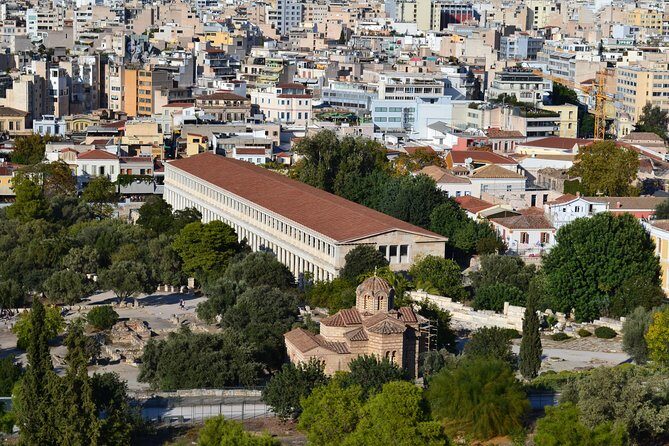
The museum was built to house artifacts from the Acropolis site, spanning from Greek Bronze Age through Roman and Byzantine Greece. The building design came from a 2000 competition, with Bernard Tschumi and Greek collaborator Michael Photiades. The museum sits about 300 meters from the monuments and opened in 2009.
You’ll have about 1 hour 30 minutes. That’s enough to:
- spot sculptural pieces that match what you saw on the hill
- get a clearer sense of how the Acropolis was decorated and used
- understand what’s been moved to other museums, and why
Practical tip: if you’re sensitive to crowds, go slower at the most popular rooms. Also, keep your phone ready—this is one of those museums where photos help you remember details later on the street.
Zeus, Pentelic Marble, and the Kallimarmaro Olympic Echo
After the museum, the route continues through south Athens landmarks tied to major ancient traditions.
The Olympieion Area (Sanctuary of Olympian Zeus)
You’ll pass the sanctuary of Olympian Zeus, located between the Acropolis and the Ilissos river. It’s tied to the story of a massive temple complex and includes features associated with Apollo Delphinios. Even if you don’t spend long here, the area helps connect the dots between the Acropolis and the broader religious landscape of Athens.
Kallimarmaro: The Marble Stadium That Still Feels Athletic
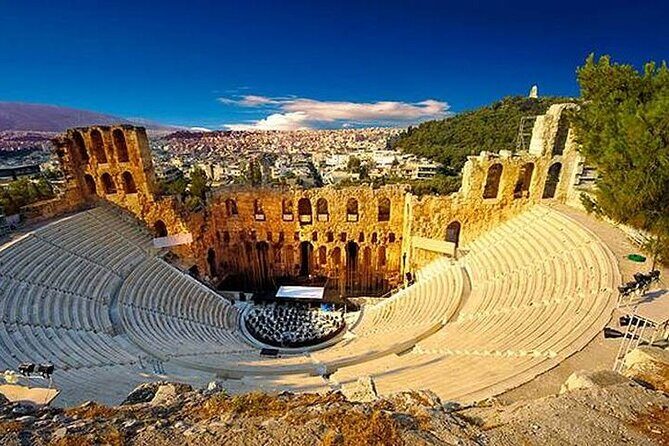
Next is Kallimarmaro, also known as the Panathenaea stadium. This is the stadium made from marble, specifically Pentelic marble. It’s famous as the site connected with the first modern Olympic games in 1896.
One detail I’d actually use when planning your photo moments: Pentelic marble changes color in daylight. The description says it can be cooler-toned in the morning and shift toward a bone-gold look later. It also notes that monuments on the Acropolis and the Temple of Zeus used the same Pentelic marble, so you can see how materials tie different parts of the city together.
You’ll have about 15 minutes—short, but enough for a walk around, a few photos, and a sense of the stadium scale.
Mount Lycabettus: The Best High-View Finale
To close the day, you go up to Mount Lycabettus (Lykavitos Hill), the highest point in central Athens at 277 meters / 909 feet. This stop is about 1 hour 10 minutes.
The big payoff is the city view: you get a sweep over central Athens and toward the coastline. The hill also has green areas and a small chapel of Saint George. Access options include walking, a funicular railway, or car—though this tour handles transportation and then you’ll go up to enjoy the view.
My practical advice: plan to take a slower pace here. If you’ve already climbed at the Acropolis, you’ll want steady footing and a few pauses. This is one of those times when people remember the day most, because it’s not just ruins and ceremonies—it’s the modern Athens skyline laid out like a map.
After the visit, you’ll be dropped off at the same spot where you were picked up for this segment.
Price and Logistics: When This Tour Is Worth It
At $407.41 per group (up to 3) for about 8 hours, the real value depends on who’s in your group.
If you have 3 people, the cost per person drops quickly, and you’re basically buying:
- private round-trip transport (Piraeus pickup/drop-off or hotel pickup/drop-off)
- an air-conditioned vehicle
- a driver who provides English-language guidance up to site entry
That’s important: the driver can share history and manage the day, but isn’t licensed to accompany you inside archaeological sites and museums. Entrance fees are also not included. The tour provides time at each site, but ticketing is still on you.
So my rule of thumb is simple:
- If you hate ticket lines and time-wasting, this tour often feels worth it because the schedule is tight and guided.
- If you’re alone or only two people, you should compare your total with what you’d pay for separate private transport plus tickets plus museum time.
Also, pre-purchase tickets when you can. The tour suggests doing so because there’s a chance you won’t find availability.
Should You Book This Athens Shore Excursion?
Yes, if you want the best one-day Athens mix: Acropolis monuments, the Acropolis Museum, Plaka lunch time, and the Evzones ceremony—all in a single private day with transport handled for you.
It’s also a good fit if you’re coming from a cruise and want to avoid the stress of figuring out how to connect sites efficiently. You’ll likely feel the day is packed, but not random.
I’d skip it (or at least adjust expectations) if your group has limited tolerance for walking stairs and slick marble surfaces. The Acropolis and related sites are not designed for easy rolling-software movement, so you’ll want sturdy shoes and patience.
FAQ
What is the duration of the Athens private shore excursion?
The tour is approximately 8 hours.
How much does it cost, and what group size is it for?
It costs $407.41 per group, for up to 3 people.
Is pickup included, and where does it start for cruise passengers?
Yes. Cruise ship pickup is at Port of Piraeus, Terminal A (28 Akti Xaveriou Street, Port E11). The driver waits outside the terminal exit door with a sign.
Is hotel pickup included for people staying in Athens?
Yes. Hotel pickup and drop-off in Athens are included.
Is the tour offered in English?
Yes. The tour is offered in English.
Are entrance fees to archaeological sites and the museum included?
No. Entrance fees are not included.
Are food and drinks included?
No. Food and drinks are not included.
Does the English-speaking guide stay with you inside archaeological sites and museums?
The driver provides guidance and knowledge up to the point where you enter sites, but drivers are not licensed to accompany you inside. A licensed tour guide can be arranged for an extra cost depending on availability.
Is it a private tour?
Yes. It’s a private tour/activity, and only your group participates.
Can I cancel for a full refund?
Free cancellation is available up to 24 hours in advance for a full refund.


More Private Tours in Athens


More Tours in Athens



More Tour Reviews in Athens
- All Day Cruise -3 Islands to Agistri,Moni, Aegina with lunch and drinks included
★ 5.0 · 4,958 reviews