REVIEW · ATHENS
Biblical Corinth Taste Faith & History with wine & Oil Tasting
Book on Viator →Operated by Yomadic.Tours & Transfers · Bookable on Viator
Corinth can feel like a time machine. In about 5 hours, you’ll connect the Biblical Corinth story with major ruins, plus real food culture through optional tastings. I especially like the small-group setup with pickup in Athens and the way the day flows past the big highlights instead of waiting around. I also like that you can add wine and oil tasting without turning the whole trip into a classroom. One drawback to plan for: the top sites can occasionally close for special events, so your main ancient stop may shift depending on the day.
The logistics are also set up to be easy: you ride in a modern private vehicle with WiFi, A/C, and bottled water, and your driver drops you back where you started. You’ll still need to budget for site entrance fees and your meal, since those aren’t included.
In This Review
- Key Takeaways Before You Go
- Corinth Taste & Faith: Why This Day Trip Works
- Getting Picked Up in Athens and Staying Comfortable
- The Corinth Canal and the Diolkos: How Ships Beat the Big Detour
- Watch for Timing
- Isthmia, the Isthmian Games, and the Paul Connection
- Archaeological Museum of Isthmia: What to Look For
- Tip
- Ancient Corinth: The Core Ruins, Apollo, and That Lunch Window
- A Practical Caution About Site Closures
- The Archaeological Museum of Corinth: Smaller, Focused, Helpful
- Acrocorinth: The Fortress View That Makes the Whole Day Click
- Wine and Oil Tasting: Add-Ons Worth Choosing Carefully
- Price and Value: What You Pay, What You Still Need to Budget
- Who This Tour Suits Best (And Who Might Skip It)
- Should You Book This Corinth Taste & Faith Tour?
- FAQ
- How long is the Corinth Taste & Faith & History tour?
- What does the tour cost?
- Is pickup offered, and where does the tour start?
- Is the tour private or small group?
- Is the tour available in English?
- What’s included in the price?
- Are entrance fees included?
- What optional tasting options are available?
- Is an optional licensed tour guide available?
- Are meals included?
- FAQ
- Is cancellation free?
- What happens if the weather is bad?
Key Takeaways Before You Go
- Private, small-group transport: just your party in a luxury sedan or mini van (up to 7).
- Corinth Canal + diolkos story: a surprising ancient solution to avoid circumnavigating the Peloponnese.
- Faith and context: the day links the Isthmian games area to the Apostle Paul and early Christian presence there.
- Museum time that’s worth it: you see specific artifacts tied to temples, harbor life, and votive offerings.
- Acrocorinth viewpoints: the fortress above the isthmus gives you the big-picture geography fast.
- Tastings are optional: wine is a small add-on; the oil tasting package costs more, so choose based on your priorities.
Corinth Taste & Faith: Why This Day Trip Works

Corinth is one of those places where the geography matters. The isthmus makes a natural choke point between mainland Greece and the Peloponnese, and that’s exactly why ancient powers fought over it and why merchants loved it. When you connect that setting with Paul’s letters and the later Roman rebuilding, the sites stop feeling random.
This tour is built around that idea: move through the key points that explain Corinth’s commercial power, its religious life, and its later history after destruction in the 2nd century BC. Then, you finish with Acrocorinth, where the views make the entire peninsula feel graspable.
You’re not stuck in one long walk either. The pacing is a mix of short stops (like the canal and diolkos) and longer time for the ancient core and the fortress above.
You can also read our reviews of more food & drink experiences in Athens



Getting Picked Up in Athens and Staying Comfortable
Your day starts with pickup in central Athens areas like hotels or Airbnbs, and the tour ends back at your starting point. It’s a small-group private format, not a big bus shuffle. That matters for two reasons.
First, you waste less time. When you’re in a mini van or sedan, you’re not chasing a roaming crowd. Second, the day feels more flexible. If you want a photo pause or need a quick bathroom break, your driver can usually adjust within reason.
Inside the vehicle you get the practical stuff: A/C, WiFi, and bottled water. If you’re traveling in warmer months, that simple comfort can be the difference between enjoying the ruins and spending the day overheated and cranky.
The Corinth Canal and the Diolkos: How Ships Beat the Big Detour
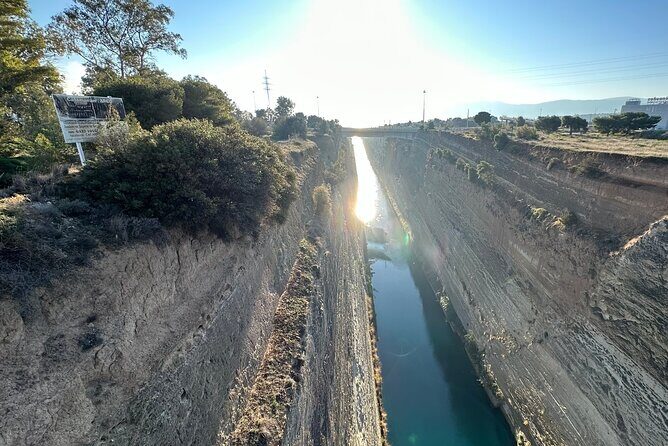
The tour begins with the Corinth Canal, which slices across the narrow isthmus to connect two seas. The canal is relatively modern in execution, but the concept is ancient in spirit. Before the canal existed, ships effectively had to take a long detour around the Peloponnese, adding distance and risk.
This is where the story gets fun: you don’t just see the canal. You also get the background of the ancient “workaround” called the diolkos. Think of it as a paved trackway where ships could be moved overland across the isthmus on wheeled platforms. It’s the kind of engineering you would expect from people who were serious about saving time and money.
Why I like starting here: it gives you the map in your head before you visit ruins. You understand why Corinth mattered even before you see a column or a museum case.
Watch for Timing
These early stops are short by design. That’s efficient, but it means you’ll want your camera ready if you’re the type who likes slow, linger-and-look photography.
Isthmia, the Isthmian Games, and the Paul Connection
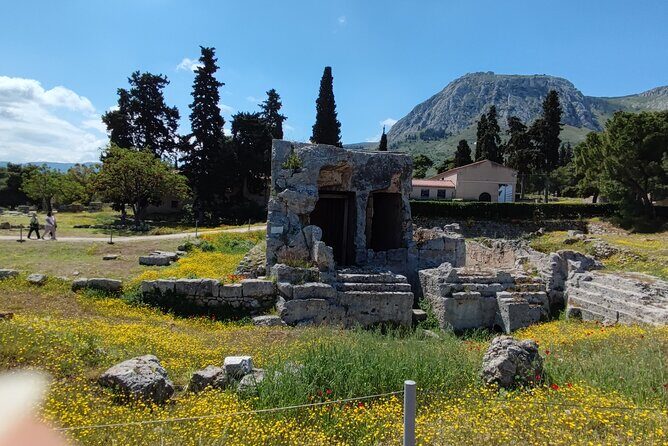
After the canal and diolkos story, you head toward Isthmia. This area is tied to the Isthmians, a major set of athletic games in the ancient world—second in importance only to the Olympics at Olympia.
What makes this stop more than sports trivia is the connection to the Apostle Paul. The tour explains that Paul was present in the Isthmian region in connection with the games, working as a tent maker. The point is simple and strong: early Christianity didn’t start in a vacuum. It grew in real places where people gathered, worked, and listened.
This stop is also a good breather. The pacing here is calmer than the big ruin core, and it sets up the rest of the day’s “faith meets everyday life” approach.
You can also read our reviews of more historical tours in Athens



Archaeological Museum of Isthmia: What to Look For
The Archaeological Museum of Isthmia is a short visit, but it includes some surprisingly specific items that help you picture the harbor and sacred spaces around the sanctuary.
A few highlights to keep an eye out for:
- A marble pediment dated to the late 7th century BC, linked to an early temple setting.
- The Kechreon glass findings: colored sections found submerged and described as reminiscent of stained glass. The scenes include harbor views, animals and plants, and figures connected to famous names like Homer and Plato.
- An imperial statue type of Zeus from the mid-2nd century BC.
- An epinician stele featuring a portrait connected to a Corinthian musician, Lefkios Cornelius.
- Votive offerings, including animal figurines like a golden bull.
Even if museums aren’t your favorite thing, this one is useful because it translates what you’d otherwise see as “old rocks” into daily life, worship, and trade.
Tip
If you like museums, give yourself a bit of time before and after to read just the most relevant display labels. The payoff comes when you connect what you see here with what’s later in Ancient Corinth and Acrocorinth.
Ancient Corinth: The Core Ruins, Apollo, and That Lunch Window
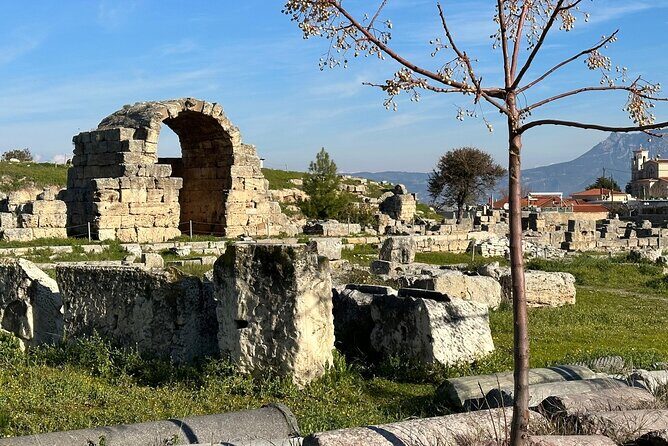
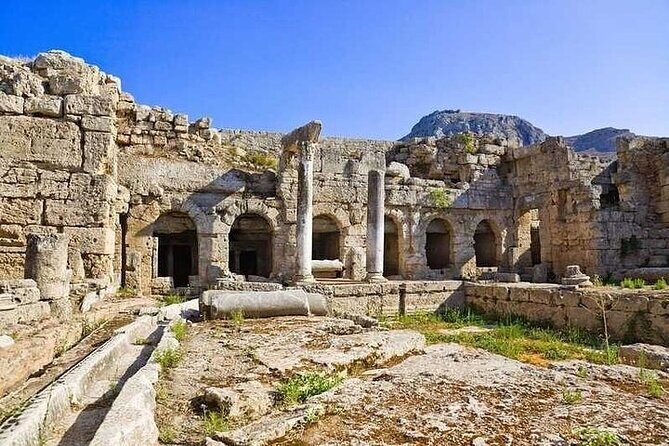
This is the big historical center of the day: Ancient Corinth (Archaia Korinthos). Corinth was once one of Greece’s major city-states, with a population described as about 90,000 in the 400 BC era. The Romans destroyed the city in 146 BC, built a new city later in 44 BC, and the area became a provincial capital.
For Christians, Corinth matters because of Paul’s letters: First and Second Corinthians. The tour also ties Corinth into Paul’s missionary travel stories and references later descriptions of Greece by Pausanias.
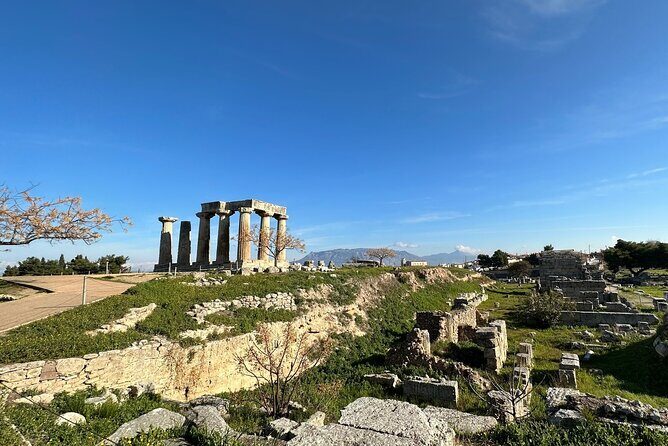
In the site experience, you’ll also see time allocated for the Temple of Apollo, constructed around 550 BC (with monolithic Doric columns described as rare for the era). Even in ruins form, it helps explain how sacred spaces sat inside civic life.
Then you get a chunk of free time for lunch and shopping. That’s smart for pacing because it prevents the day from turning into a nonstop march. Just be ready to choose quickly if you’re hungry when the time opens—this is a 5-hour outing, so you can’t expect a long meal break.
A Practical Caution About Site Closures
One important real-world consideration: the biggest ancient stop can occasionally be affected by filming or special events. If that happens, the tour may need to adjust. The lesson for you is simple: check the day-of situation if you’re traveling during a high-profile filming period.
The Archaeological Museum of Corinth: Smaller, Focused, Helpful
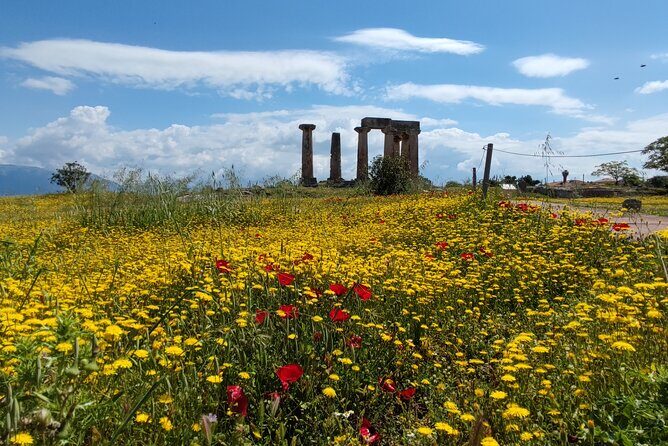
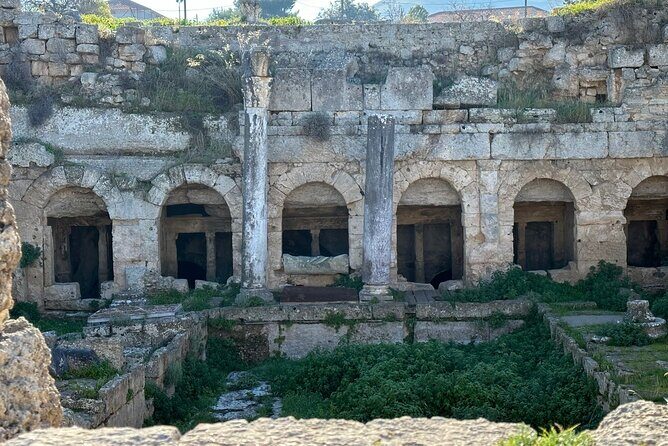
After the ancient ruins segment, you visit the Archaeological Museum of Ancient Corinth, which was constructed in the early 1930s with the purpose of displaying excavations from the site. It sits within the archaeological complex.
The museum connects the dots to places you’re going to recognize, like:
- Hadgimoustafa spring
- Lechaion Road
- Basilica
- Fountain of Peirene
- Stoa, Agora
- Odien
This is one of those museum stops that works best if you already saw part of the ruins. You’ll likely find it easier to understand the layout when the museum reminds you how the site fit together—public spaces, sacred areas, and the roads that fed commerce.
Acrocorinth: The Fortress View That Makes the Whole Day Click
You end with Acrocorinth, often called Upper Corinth—built on a monolithic rock above the ancient city. The big idea is military and practical. Acrocorinth had a secure water supply and acted as a repeated last line of defense, controlling movement into the Peloponnese through the isthmus.
From a traveler’s standpoint, this is where the day stops being a list and becomes a picture. You can see why Corinth was strategically irresistible: it’s hard to control the route into the peninsula without watching the high ground.
Your time here is about half an hour, which is short, but enough to:
- get your bearings fast
- enjoy the main viewpoint
- take the photos that show the geography
If you want the best photos, arrive ready—comfortable shoes help too, since you’ll likely move over uneven ground.
Wine and Oil Tasting: Add-Ons Worth Choosing Carefully
This “Taste & Faith” concept includes optional tasting extras, but the costs are clearly separate from the base tour price.
Here are the add-ons listed:
- Wine Tasting: €15 per person
- Oil Tasting finger food: €80 per person
So how do you decide?
- If you want a light, fun cultural stop without blowing your budget, the wine tasting is the more approachable add-on.
- If you’re a serious foodie or olive-oil fan, the oil tasting can be worth it, but it’s also the bigger spend. I’d only add it if you genuinely enjoy tasting and comparing flavors.
Either way, the tastings fit the day because they tie back to the themes of Corinth: agriculture, trade, and daily life around sanctuaries.
Price and Value: What You Pay, What You Still Need to Budget
The base price is $190.46 per person for an approx. 5-hour private tour in a luxury vehicle. This price covers the human and logistical heavy lifting:
- English-speaking driver well-versed in Greek history
- pickup and drop-off in Athens areas
- modern private transportation (WiFi, A/C, bottled water)
- fuels and tolls
What it does not cover:
- entrance fees for attractions, listed as €15.00 per person (and the archaeological site of Ancient Corinth is also listed as €15)
- your meal (lunch costs aren’t included)
- any optional licensed tour guide (listed as €140 per person)
- optional tastings (wine €15, oil €80 finger food)
So is it good value? For me, it comes down to whether you value private pacing and time efficiency. If you’d rather not deal with bus schedules and big crowds, the transport-focused price makes sense. If you’re comfortable DIY-ing and you’re willing to build your own day around the sites, you might spend less on a rental and tickets. But you’d also take on the planning, timing, and navigation.
Also note: it’s often booked around a month in advance (on average 38 days). If your travel dates are fixed, booking ahead is smart.
Who This Tour Suits Best (And Who Might Skip It)
This tour is a strong fit if you want:
- a private day trip with easy pickup in Athens
- a clear mix of faith context and ancient ruins
- short, targeted museum time instead of a huge all-day museum marathon
- a viewpoint finish at Acrocorinth
It may be less ideal if:
- you expect all sites to be fully open regardless of special circumstances
- you want a long, unhurried lunch break
- you dislike tasting add-ons and want the trip to be strictly sightseeing (you can skip them)
Should You Book This Corinth Taste & Faith Tour?
If you’re doing Athens and want one day that teaches you how Corinth actually worked—where the routes were, why the city mattered, and how faith connects to the places—this tour makes it easy. The private transport, the short museum visits with real artifacts, and the Acrocorinth payoff are a practical recipe for a memorable day.
Just budget for entrance fees and lunch. And if your dates fall on a day when major sites might be affected, be ready for a possible adjustment.
If that sounds fine, book it and enjoy the day at a human pace.
FAQ
How long is the Corinth Taste & Faith & History tour?
The duration is listed as approximately 5 hours.
What does the tour cost?
The price is listed as $190.46 per person.
Is pickup offered, and where does the tour start?
Yes. Pickup is offered from Athens Hotel, Airbnb residence, or the Port. You’ll also be dropped back at the end of the activity.
Is the tour private or small group?
It’s described as a private tour/activity, and only your group participates. It also uses a luxury mini van capacity up to 7 pax.
Is the tour available in English?
Yes. The tour is offered in English.
What’s included in the price?
Included items are an English-speaking tour driver well-versed in Greek history, pickup/drop-off, transportation via modern first-class private vehicle, WiFi, A/C, bottled water, and fuel/tolls.
Are entrance fees included?
No. Entrance fees for attractions are listed as €15.00 per person, and the Archaeological Site of Ancient Corinth is also listed as €15.00 per person.
What optional tasting options are available?
Wine tasting is €15 per person. Oil tasting finger food is €80 per person.
Is an optional licensed tour guide available?
Yes, a licensed tour guide is optional upon request depending on availability, with an extra cost of €140.00 per person.
Are meals included?
Lunch stops are scheduled, but meal costs are not included.
FAQ
Is cancellation free?
Yes, free cancellation is available up to 24 hours in advance for a full refund.
What happens if the weather is bad?
This experience requires good weather. If it’s canceled due to poor weather, you’ll be offered a different date or a full refund.


More Historical Tours in Athens
More Food & Drink Experiences in Athens



More Tour Reviews in Athens
- All Day Cruise -3 Islands to Agistri,Moni, Aegina with lunch and drinks included
★ 5.0 · 4,958 reviews