REVIEW · ATHENS
Walk through the history of Athens
Book on Viator →Operated by Greca Travel · Bookable on Viator
Athens stops are usually either monuments or museums. This one strings them together into a walkable story of the city—from Panepistimiou Avenue’s neoclassical buildings to the edge of the Acropolis. I like that it doesn’t treat Athens as one thing; you get today’s streets alongside the big set pieces.
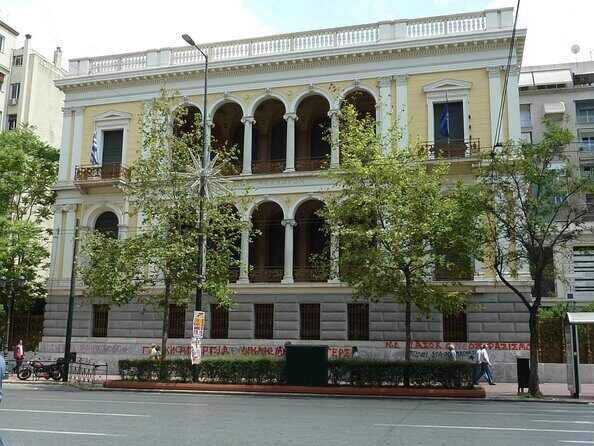
My first big win is the focus on the neoclassical side of Athens—not just the ancient sites people rush to. From Panepistimiou Avenue to the Hellenic Parliament, the tour helps you read the city’s architecture as part of its modern identity.
One thing to watch: a couple of key moments need extra time and the right tickets. The Acropolis archaeological site ticket is not included, and at least one stop involves an admission ticket that you’d need to buy if you want to go inside.
In This Review
- Key Highlights I’d Put on Your Must-Do List
- Price and Logistics That Actually Matter
- Meeting Point at Titania Hotel, Ending by Acropolis Metro
- Numismatic Museum Area and Panepistimiou Avenue’s Neoclassical Facelift
- Syntagma Square and the Hellenic Parliament Moment
- Kallimármaro Stadium: The White Marble Stadium With Olympic DNA
- Zappeion and the Modern Olympics Building Still in Use
- Temple of Olympian Zeus: Hadrian’s Statue and the Scale of Zeus
- Finishing at the Acropolis Metro: Your Quick View + Real Next Steps
- What the Guides Can Make Better Than the Script
- Small Group Size: Comfort, Questions, and Less Waiting
- Possible Drawback: Times, Attendance, and Ticket Gaps
- Value Check: What You’re Getting for $31.13
- Who Should Book This Walk
- Should You Book This Athens Walk?
- FAQ
- Is the Acropolis archaeological site ticket included?
- How long is the Athens walk?
- What language is the guide or assistant in?
- Where does the tour start and end?
- Is this tour a small group?
- Can I cancel for free?
Key Highlights I’d Put on Your Must-Do List
- Neoclassical Trilogy feel: Panepistimiou Avenue landmarks set the tone before you reach the monumental classics.
- Syntagma Square timing: you get a window to watch the changing of the guard at the Hellenic Parliament.
- Kallimármaro Stadium views: see the white-marble stadium linked to the first Modern Olympic Games.
- Zappeion relevance today: a building originally designed for the modern Olympics that still hosts events.
- Temple of Olympian Zeus with Hadrian’s context: the scale and the story of Hadrian next to Zeus.
- Acropolis finish with a view: you end near the Acropolis Metro Station for easy onward exploring.
Price and Logistics That Actually Matter

This tour costs $31.13 per person and runs about 2 hours 30 minutes. For a route that hits multiple major sights in one go, the price feels aimed at giving you efficient value rather than a slow, sit-down experience.
It’s also sold as a small group (maximum 14 travelers), which usually means you spend less time waiting around. The tour uses a mobile ticket, so you’re not scrambling for paper when you arrive.
Just keep your expectations grounded: it’s a walking tour with short stops. That’s great for orientation and context, but it’s not built for long museum time.
You can also read our reviews of more walking tours in Athens


Meeting Point at Titania Hotel, Ending by Acropolis Metro
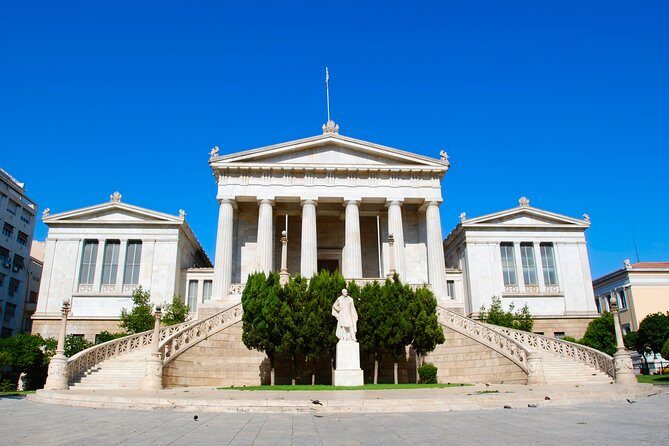
The start point is at Titania Hotel Athens on Panepistimiou 52. The finish is at Acropoli Metro Station, near the pedestrian street Dionysiou Areopagitou.
That ending matters. You’re not shipped back across town after the last photo; you can keep going right where people want to be—toward the Acropolis area and the nearby neighborhood streets.
You should also know the tour includes an assistant in Spanish or English based on your selection. If you care about asking questions, having a guide who can handle your language is a real quality-of-life upgrade.
Numismatic Museum Area and Panepistimiou Avenue’s Neoclassical Facelift
The tour kicks off in the zone of Panepistimiou Avenue, where you’re surrounded by impressive neoclassical buildings. The stop spotlights several landmarks in the same orbit, including the Numismatic Museum, the Archaeological Company Building, the Catholic Church of St. Dionysius, the Athens Ophthalmological Hospital, and the Central Bank of Greece building.
This is a smart opening. If your Athens experience has mostly focused on ancient ruins, this section reframes the city as something that kept evolving—architecturally and politically—long after antiquity.
The only catch is the wording around admission: there’s a note that a ticket is not included for this stop. In other words, plan on seeing the area and buildings, not necessarily entering the museum unless you buy the ticket yourself.
Syntagma Square and the Hellenic Parliament Moment
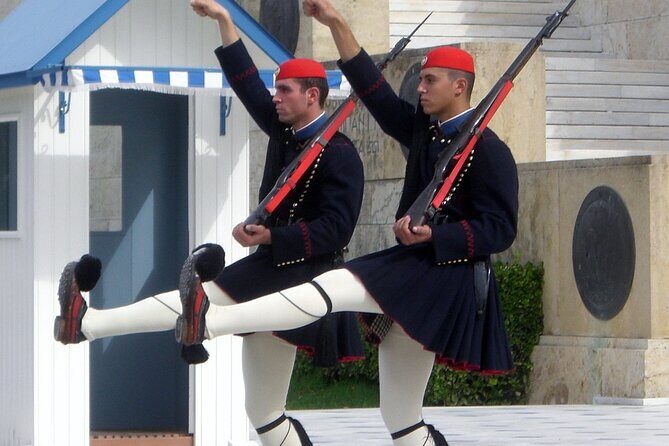
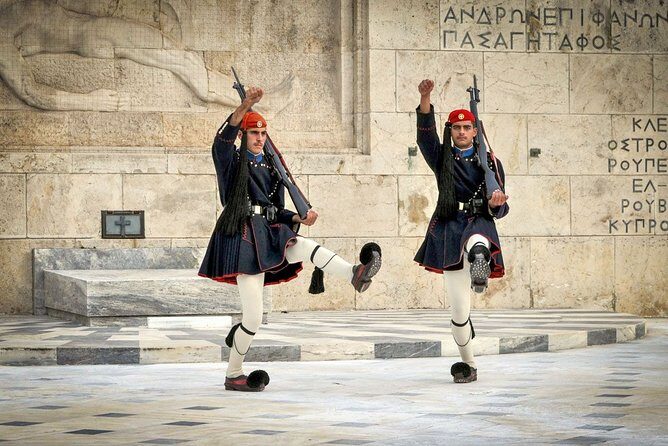
Next you reach Syntagma Square, the seat of the Hellenic Parliament. You get time to watch the changing of the guard with their traditional soldiers.
This stop works even if you’re not into ceremonies. It’s one of those Athens experiences that quickly gives you a feel for modern civic life, right in the middle of the city’s high-traffic heart.
Also, because the timing is short, treat it like a snapshot. Bring your attention to details like posture and uniforms, not like you’re waiting for a long show.
Kallimármaro Stadium: The White Marble Stadium With Olympic DNA

Then comes a panoramic look at Kallimármaro Stadium, also called the good marble. This stadium is famous for hosting the first edition of the Modern Olympic Games, and it’s described as the only stadium in the world built entirely in white marble.
Even if you don’t go inside, the view helps you connect Olympic history to Athens in a tangible way. It’s not just a logo on a postcard; it’s a physical reminder that modern traditions in Greece lean on real spaces.
Time here is brief—about 10 minutes—but it’s enough to orient yourself before moving on to the next Olympics-linked building.
You can also read our reviews of more historical tours in Athens



Zappeion and the Modern Olympics Building Still in Use
At Zappeion, you see the idea of a building created specifically for the modern Olympics. It’s also still used today for official and private ceremonies and meetings.
This is one of those stops that rewards you if you like how the past remains functional. It’s not a ruin or a dead monument; it’s a working civic space that keeps the Olympic connection alive.
The drawback is the same as the rest of the tour: it’s short. If you want a deep read on the building, you’ll likely do that on your own after the tour rather than during this walk.
Temple of Olympian Zeus: Hadrian’s Statue and the Scale of Zeus
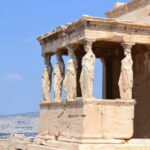
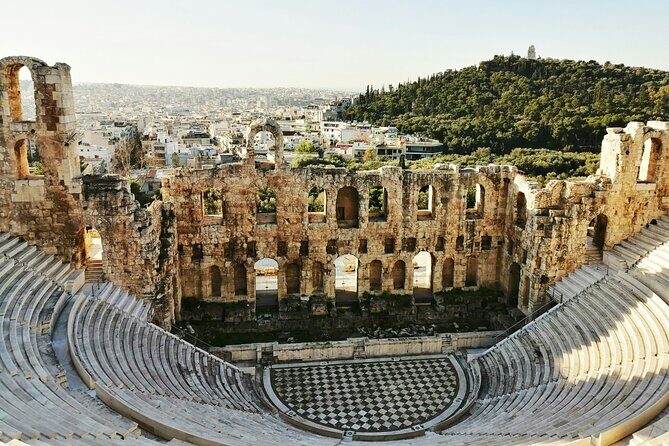
As you approach the end, you pass the Temple of Olympian Zeus. The story here includes Emperor Hadrian erecting a statue of himself near a monumental Zeus statue described as about 13 meters high, decorated with gold and ivory, in the image of the one sculpted by Phidias.
This stop is best for your imagination. Even from the surrounding area, you’re getting a sense of scale and power, and the Hadrian detail gives you a political lens—how Roman rulers staged themselves next to Greek artistic legends.
Admission is noted as not included for this part, so don’t assume you’re entering the archaeological zone at this stage. You’re more in the passing-and-framing mode than the full-site mode.
Finishing at the Acropolis Metro: Your Quick View + Real Next Steps
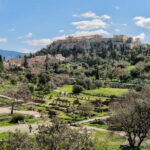
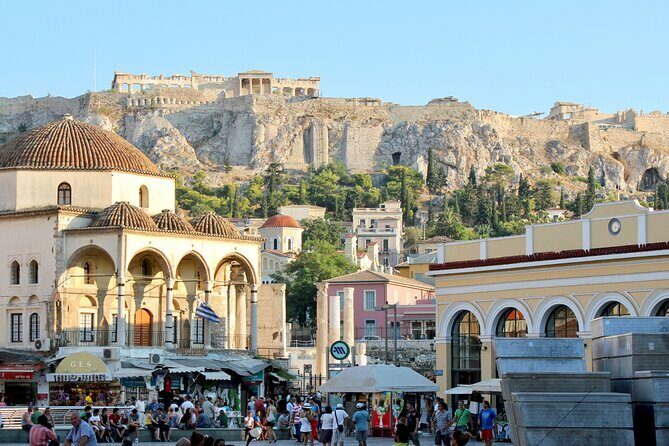
The tour concludes at Acropolis Metro Station, close to Dionysiou Areopagitou. From here, you can take in a view of the Acropolis crowned by the Partenón, then sort out what you want to do next.
After the tour, you have options. You can keep exploring the Acropolis or its museum, or you can wander toward Plaka, stop for lunch at a taberna, and shop for typical souvenirs in the neighborhood.
This structure is practical: you finish with a strong view and then decide your level of effort for the rest of the day. If you plan to do the full Acropolis visit, this tour becomes a launchpad; if you’re more casual, it still gives you a coherent sense of what you’re looking at.
What the Guides Can Make Better Than the Script
The tour is built around landmarks, but the experience quality depends heavily on the guide. One praised guide, Magdalene, was described as spectacular in the way she explained history and made it feel alive, along with giving a broader view of Plaka.
Another guide, Jenni, earned strong notes for pacing and flexibility, including adapting when a group included a young child. That’s important because short stops can get stressful with kids or anyone with mobility limits, and a good guide can keep the flow from turning into a scramble.
There’s also a signal that the best sessions include real Q&A and clear storytelling. One review highlighted a guide who was a good historian and answered questions well, which is exactly what you want from an architecture-and-history route like this.
Small Group Size: Comfort, Questions, and Less Waiting
With a maximum of 14 travelers, you’re less likely to feel lost in a huge line. That matters because your stops are designed for quick orientation—10-minute windows at several locations.
If you like asking why a building exists or what a detail means, the smaller size is your friend. You can usually get answers without feeling like you have to shout over everyone else.
The flip side is simple: in smaller groups, if something goes off schedule, it can feel more noticeable. That leads to the main consideration below.
Possible Drawback: Times, Attendance, and Ticket Gaps
This tour has a short, efficient rhythm, so punctuality is not optional. One person’s experience involved a problem with not showing up at the meeting point, which is a useful reminder to confirm details before you head out and keep your phone accessible.
There’s also a ticket gap to plan around. The tour notes that tickets are not included for at least one museum stop and for the Acropolis archaeological site, so you’ll want to avoid arriving assuming everything is covered.
If you’re the kind of traveler who hates dealing with tickets on the day, factor that into your schedule. If you’re okay buying a ticket when needed, this tour will feel smoother.
Value Check: What You’re Getting for $31.13
For $31.13 over roughly 2.5 hours, you’re paying for guided context across multiple top areas: Panepistimiou Avenue neoclassical buildings, Syntagma Square, Olympian Zeus territory, and the Acropolis-view finish. You’re also getting the convenience of a mobile ticket and a group that stays small.
It’s not a full-day Acropolis immersion, and it’s not a museum pass. Instead, it’s an orientation tour that helps you build a mental map before you spend more time with the big sites on your own.
That makes it a good value if you like structure and narrative. If you prefer wandering without a plan, you might feel boxed in by the short stops.
Who Should Book This Walk
This tour is a great fit if you want Athens in layers: neoclassical modern Athens plus the dramatic ancient anchors. It’s also a solid choice for first-timers who want to understand what they’re seeing, not just where the photos happen.
It can work for families too, as shown by the positive note about adapting for a group traveling with a 16-month-old. If you’re traveling with little ones or anyone who needs gentler pacing, you should still expect short stops rather than long hangs around one site.
If your trip style is purely deep museum time or purely Acropolis ticket time, you may find this tour a warm-up rather than the main event.
Should You Book This Athens Walk?
I’d book it if you want a guided storyline that connects architectural Athens with the big-name sights—fast, clear, and practical. The ending by Acropolis Metro is a smart way to keep your day flexible, especially if you might want to continue into Plaka for lunch and browsing.
I would hesitate if Acropolis site time is your top priority and you hate handling tickets separately. In that case, you’d probably want an option that includes entry or a plan that gives you enough time to do the Acropolis at full pace after the tour.
FAQ
Is the Acropolis archaeological site ticket included?
No. Tickets to the Acropolis archaeological site are not included.
How long is the Athens walk?
The duration is about 2 hours 30 minutes.
What language is the guide or assistant in?
You can select Spanish or English, and the assistant will match your selection.
Where does the tour start and end?
It starts at Titania Hotel Athens (Panepistimiou 52) and ends at Acropoli Metro Station near Dionysiou Areopagitou.
Is this tour a small group?
Yes. The tour has a maximum of 14 travelers.
Can I cancel for free?
Yes. You can cancel for a full refund up to 24 hours before the start time. The experience also notes it requires good weather.


More Historical Tours in Athens
More Walking Tours in Athens

More Tour Reviews in Athens
- All Day Cruise -3 Islands to Agistri,Moni, Aegina with lunch and drinks included
★ 5.0 · 4,958 reviews