
REVIEW · ATHENS
Acropolis Museum E-Ticket and Multilingual Audio Guide
Book on Viator →Operated by Clio Muse Tours · Bookable on Viator
Ancient Athens starts with a phone. This Acropolis Museum experience is built around a prebooked e-ticket and a downloadable audio guide, so you can walk in, find your rhythm, and study the artifacts without waiting on a slow-moving line.
I especially love the way the audio tour is designed for your own pace, with stories that tie the exhibits together instead of leaving you with only labels. I also like that the content can work offline, including an interactive map so you’re not juggling roaming charges while you’re hunting down the next gallery.
The main drawback is also the biggest reality check: you need the right smartphone and a little prep time to download the Clio Muse app and the audio ahead of your visit. If your phone is low on battery or you show up without the offline stuff ready, the experience can turn stressful fast.
In This Review
- Key highlights worth your time
- What You’re Really Paying For at the Acropolis Museum
- Skip-the-Line Entry: The Part That Saves Your Trip
- Downloading Clio Muse: How to Avoid Tech Stress
- Inside the Museum: How the Audio Tour Helps You Navigate
- Archaic Gallery: Monsters, Heroes, and the Human Body
- Parthenon Gallery: The Frieze, the Procession, and Myth as Movie-Frames
- The Smart Order for First-Time Visitors: Check the Third Floor Videos
- The Underground Area: Old Athens Beneath the Museum
- Price and Value: Is $40.32 a Good Deal for This Format?
- Timing Your Visit: How Long You Should Plan
- Who This Fits Best (And Who Should Consider Other Options)
- Should You Book This Acropolis Museum E-Ticket and Audio Guide?
- FAQ
- Do I need a live guide for this Acropolis Museum visit?
- Is the audio guide available offline?
- What do I need to use the audio tour on my phone?
- How does entry work with the e-ticket?
- Can I cancel and get a refund?
- What is the realistic time to plan for?
Key highlights worth your time

- Skip-the-line e-ticket: your ticket is scanned right at the expedited entry flow
- Offline audio tour with map: download once, then wander even with weak or no signal
- Smart storytelling through the galleries: Archaic Gallery first, then the Parthenon story in sequence
- No pickup point confusion: you start at the Acropolis Museum and end back there
- You can skip sections: the tour is built so you can focus on what grabs you
What You’re Really Paying For at the Acropolis Museum

At $40.32 per person, this is not a bargain ticket. But it’s also not priced like a full guided tour with a person shepherding you from room to room. What you’re buying is time and clarity.
The museum itself is the draw: you’re stepping into one of Greece’s most important collections tied directly to the Acropolis. The challenge is that the museum is popular, so even the smartest plan can get wrecked by lines and crowding. This e-ticket + offline audio setup helps you dodge the slow part and spend your energy on the objects.
Duration is listed as about 1 hour 30 minutes, but you shouldn’t treat that as a hard cap. The museum rewards a longer visit, especially if you pause for details, go back up to catch something you missed, or take time with the underground area beneath the museum.
You can also read our reviews of more tours and experiences in Athens



Skip-the-Line Entry: The Part That Saves Your Trip

The single biggest practical win is direct access with a scanned e-ticket. After you download your ticket (either printed or on your phone), you head to the expedited line and get scanned. That means less time standing around while other people figure out their phones, their emails, and their batteries.
There’s also a nice “no mystery” factor: you start at the Acropolis Museum address on Dionysiou Areopagitou 15 and you end back there. No pickup van. No confusing transfer. You show up, you scan, you walk in.
One more thing I’d take seriously: plan for the museum security check. It’s smart to travel light, since the venue asks you to avoid large bags and luggage to reduce delays.
Downloading Clio Muse: How to Avoid Tech Stress
This tour runs on your smartphone, with audio designed for Android and iOS. It’s not compatible with Windows phones, and older devices aren’t supported (including iPhone 5/5C or older, older iPod Touch models, and iPad 4th gen or older, plus iPad Mini 1st gen).
So the core tactic is simple: download before you go.
Here’s what you should do ahead of your visit:
- Download the Clio Muse app and the audio tour, plus your ticket access
- Make sure you have enough storage space (about 100–150 MB)
- Check your email for the instructions and promo code, including the spam folder
- Charge your phone fully
If you wait until you’re at the museum, you risk running into weak signal zones, slow downloads, or app issues right when you want to walk in. Offline content is the solution, but it only helps if you prepare it first.
Also note the tour supports offline use, and you can listen online or offline. The offline interactive map is especially useful when you want to move efficiently between floors without roaming charges.
Inside the Museum: How the Audio Tour Helps You Navigate
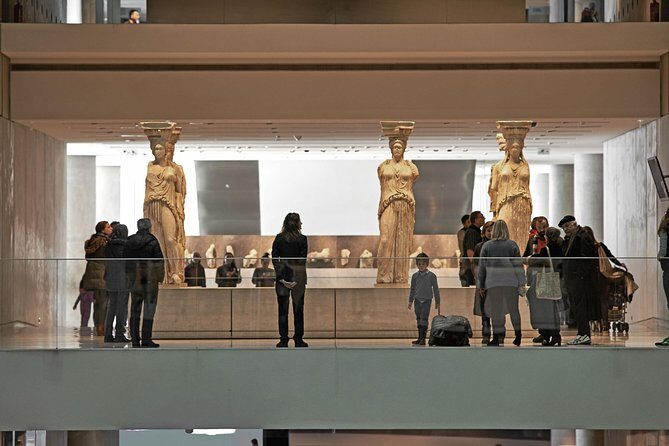
The tour is self-guided and you won’t have a live guide. That matters. Instead of someone pointing and explaining in real time, the app becomes your coach: it tells you what you’re looking at, why it mattered, and where to go next.
The audio tour is structured to keep you moving logically through the museum galleries. It starts with the Archaic Gallery, then moves you toward the Parthenon Gallery, and the content is tied to major themes like democracy’s cultural roots, civic rituals, and myth as visual storytelling.
You’ll also be happy with the fact that you can skip sections. If the line of thought isn’t grabbing you, you’re not stuck. You can jump to the next point and still keep your bearings.
Archaic Gallery: Monsters, Heroes, and the Human Body
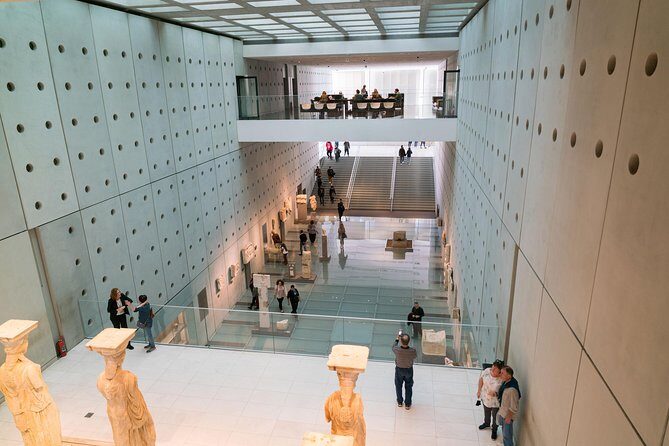
Your visit kicks off in the Archaic Gallery, where the museum shifts from “pretty sculptures” to a bigger question: how Athens’ world developed into the culture that shaped democracy.
The audio tour pushes you to look carefully at details. It focuses on iconic themes like monsters, heroes, gods, and especially how artists depicted the human body. That might sound academic, but it’s actually the easiest way to understand why these figures feel so powerful even today.
What I like about this opening is the way it teaches you how to read the art:
- Look at body proportions and poses
- Notice symbolic characters and what they represent
- Track how styles evolve across time
If you enjoy visual storytelling, this first part sets you up so the Parthenon-area scenes don’t feel random. They feel connected.
You can also read our reviews of more guided tours in Athens




Parthenon Gallery: The Frieze, the Procession, and Myth as Movie-Frames

Next you move into the Parthenon Gallery, and the audio tour goes straight for the heart of the museum. This is where you learn about the Panathenaic Procession—pieces of that story are built into the Parthenon’s frieze.
The frieze is not just decoration. It’s a civic narrative. The audio helps you connect what you see to the idea of public ritual and identity. Once you understand that, the figures stop being isolated sculptures. They become a sequence.
Then the tour expands into the drama of Greek myth as seen on the metopes and pediments. You’ll hear about big-name stories like:
- The birth of goddess Athena
- The battle of the Centaurs
These myth scenes are the kinds of images you’ve probably seen in books. The audio value is that it explains the visual logic: why this scene is placed where it is, and how Greeks used myth to talk about the world—power, order, and the human condition.
The Smart Order for First-Time Visitors: Check the Third Floor Videos

One practical tip that’s easy to miss: the third floor has two video presentations. They can make your visit click faster because they provide context before you get deep into the objects.
If you’re a first timer, I recommend you go up there earlier rather than later. Think of it as assembling the picture on the puzzle box before you start fitting the pieces.
Even if you don’t watch every second, the videos help you understand what the museum is trying to do overall: show you the Acropolis story through what was found, what survived, and what it meant.
The Underground Area: Old Athens Beneath the Museum

Don’t skip the excavated area under the museum. This is one of the most memorable parts because it grounds everything you’re seeing above it.
You’ll be able to visit an archaeological site in the open-air pavilion beneath the museum. It’s included with admission, and it adds a different kind of perspective: not just statues and architectural fragments, but the physical traces of daily life and earlier structures.
If you’re the type who likes “how people lived” more than “how people posed,” this stop is a great balance. It also helps you pace out the museum. After you’ve stared at enough marble and carved stone, it’s refreshing to switch to a setting that feels closer to real lived space.
Price and Value: Is $40.32 a Good Deal for This Format?
For $40.32, you get:
- Admission to the Acropolis Museum
- A prebooked e-ticket delivered by email
- A self-guided audio tour through the Clio Muse app
- Offline content, including an interactive map
The best value here is time saved and friction reduced. Instead of spending your precious museum minutes solving ticket problems, you go straight to scanning. Instead of relying on slow reading of labels, you get short guided context while you walk.
But here’s the honest tradeoff. If you want a real-time back-and-forth, or if you hate audio narration while walking, you may feel like this is money spent on a substitute for a live guide. For some people, the audio can feel annoying or repetitive. For others, it’s exactly the right pace because it lets you skip what you don’t care about.
My practical take: this is worth it if you want structure plus freedom. If you prefer silence and only reading plaques, you might be just as happy with a regular entry ticket.
Timing Your Visit: How Long You Should Plan
The tour is about 1 hour 30 minutes on paper. For a realistic plan, I’d treat it as:
- 1.5 hours for the main gallery sequence with audio
- Add extra time for going back to reread details
- Add time for the third floor videos and the underground area
A good strategy is simple: start with the audio flow, then let your curiosity decide when to slow down. If you feel rushed, it’s usually because you showed up late in the day or you tried to do everything at museum speed.
Going earlier tends to help. When you’re in first wave conditions, you can actually read the exhibits instead of just moving your feet.
Who This Fits Best (And Who Should Consider Other Options)
This works well if you:
- Like having guidance but still want control
- Want to avoid long lines and confusing ticket moments
- Enjoy myth and architecture as stories, not just facts
- Travel with teens or family who can handle a phone-based guide
It might not be ideal if you:
- Strongly prefer a live human guide
- Want full coverage of every tiny exhibit (the audio is designed to keep you moving rather than touch every display)
- Expect the audio to work perfectly without downloading ahead
One more practical point: you should bring headphones if you want the audio experience to land. The ticket and tour won’t hand you gear.
Should You Book This Acropolis Museum E-Ticket and Audio Guide?
Book it if your priorities are easy entry, offline confidence, and a guided path through the Archaic and Parthenon galleries. This is one of those Athens experiences where the “museum is great” part is only half the story. The other half is how you handle time and attention while crowds swell.
Skip the booking (or at least reconsider the format) if you know you don’t like audio guidance while walking, or if you hate any setup steps on travel day. This experience rewards prep. Download early, charge your phone, and check your email instructions before you go.
If you do that, you’ll get a calmer, more understandable visit to the Acropolis Museum’s biggest ideas: how art evolved, how civic ritual looked in stone, and how myth turned into public storytelling.
FAQ
Do I need a live guide for this Acropolis Museum visit?
No. This is a self-guided experience. You’ll use the smartphone audio tour instead of a live guide.
Is the audio guide available offline?
Yes. The experience includes offline content, including an offline interactive map, designed to help you avoid roaming charges.
What do I need to use the audio tour on my phone?
You need an Android or iOS smartphone. The audio tour is not compatible with Windows phones, and it’s not compatible with certain older Apple devices listed in the details.
How does entry work with the e-ticket?
You’ll receive the e-ticket by email. Before you arrive, download your ticket access to your phone (or print it). At the museum, proceed to the expedited line for your ticket to be scanned.
Can I cancel and get a refund?
No. This experience is non-refundable and can’t be changed for any reason.
What is the realistic time to plan for?
The tour duration is about 1 hour 30 minutes, but you may want extra time for videos on the third floor and the archaeological area beneath the museum.




More Guided Tours in Athens
More Tickets in Athens



More Tour Reviews in Athens
- All Day Cruise -3 Islands to Agistri,Moni, Aegina with lunch and drinks included
★ 5.0 · 4,958 reviews