REVIEW · ATHENS
Small-Group Women History in Ancient Greece Walking Tour
Book on Viator →Operated by Culture Hunters · Bookable on Viator
Forget Athens the usual way. This 2-hour Athens walk spotlights women in ancient Greece, weaving myths like Athena and Penelope into real stories of figures such as Sappho, Aspasia, and Agnodice. I love the small-group feel (max 12) and the way guide Maelle turns regular street-view locations into a clear storyline about daily life, not just famous ruins.
One thing to plan for: this route is not recommended for mobility issues, since you’ll be walking on uneven city sidewalks for the full time.
You start in lively Monastiraki and end at Philopappos Hill with one of the best Acropolis viewpoints—finished under trees when the weather plays nice.
In This Review
- Key highlights before you go
- Women’s History in Ancient Greece walking tour: the idea that actually changes your Athens
- Monastiraki to Hadrian’s Library: starting with where Athens meets real life
- Marriage, Eros, and the goddess Athena at key sacred corners
- Dioskouron women-only festival: where rules become visible
- Ancient Agora and Areopagos: women in public life and on the edge of punishment
- Pnyx and Philopappos Hill: democracy without women voting, then the muses as a finale
- Price, small-group format, and why this is good value at $44.71
- Who should book this Athens women’s history walk
- Should you book this women history tour in Athens?
- FAQ
- How long is the Small-Group Women History in Ancient Greece walking tour?
- How large is the group?
- How much does it cost?
- Where do I meet the guide, and where does the tour end?
- What stops will we see during the walk?
- Are there any paid admissions included?
- Do I need a printed ticket?
- Is it accessible for people with mobility issues?
- What happens if the weather is bad or I need to cancel?
Key highlights before you go

- A women-only lens on Athens that connects everyday life to major myth figures like Athena, Penelope, and Pandora
- Hadrian’s Library stop focusing on education for girls and women in ancient Athens
- The Dioskouron women-dedicated festival where you get a sense of what was allowed—and what wasn’t
- Ancient Agora from outside the site to understand women’s role in public life without a long archaeological visit
- Areopagos + women’s rights under threat with a story tied to a death sentence
- Philopappos Hill finale with Hill of the Muses vibes and an Acropolis view to close the walk
Women’s History in Ancient Greece walking tour: the idea that actually changes your Athens
If your Athens days already include the big classics, this tour is the missing piece. Instead of treating women as footnotes, you get them as the main thread—mythic and real—linking love, marriage, education, public presence, and power back to specific spots in the city.
The big win here is how the walk is structured. You’re not just hearing facts while you stand around. Maelle tells stories that let you picture daily routines and social rules: who could speak up, who had access to schooling, what “public life” meant, and how even famous women had to work within (or around) strict limits.
You also get a small-group pace. That matters because women’s history can be heavy, and you’ll likely have questions. A group of up to 12 makes it easier to keep the tone conversational instead of lecture-mode. And yes, you’ll hear some themes that still feel familiar today—without turning the past into a modern soap opera.
Potential drawback? Because this is a walking tour with multiple stops, it moves at a steady tempo. You’ll want comfortable shoes and the patience to read the city like a map, not just as scenery.
You can also read our reviews of more walking tours in Athens



Monastiraki to Hadrian’s Library: starting with where Athens meets real life
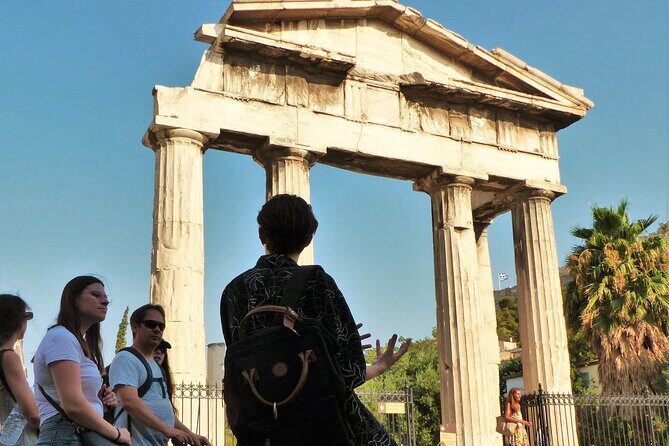
You meet on Pl. Monastirakiou 2, in the heart of Monastiraki. It’s a practical start: easy to find, and right where you can feel Athens as a living city rather than a museum. Since the tour is about daily life, starting in a busy neighborhood makes sense. You’re mentally switching gears from sightseeing to history-as-habit.
From there, you head to Hadrian’s Library, with a stop time of about 10 minutes. This is where the tour sets an important theme early: education for girls and women in ancient Athens. It’s the kind of topic that can get glossed over in standard ancient-history walks, because people often jump straight to politics or architecture. Here, you get a specific angle—what learning might have looked like, and why it mattered.
Even if you don’t know much about the topic ahead of time, this stop gives you a foothold. Education is a doorway into everything else the tour covers: marriage expectations, social standing, and how some women managed to push beyond what society wanted for them.
What I’d watch for during this stop: let the guide’s framing do the work. Try not to treat Hadrian’s Library like an isolated sightseeing stop. It’s the first link in a chain about how women’s roles were shaped—then sometimes changed.
Marriage, Eros, and the goddess Athena at key sacred corners

After Hadrian’s Library, the walk turns to more intimate subjects—marriage, love, and myth—by using a church stop and then a gate tied to Athena.
Stop 3 is the Holy Church of the All-Great Taxiarchs and the Virgin Mary Gregorousa, around 15 minutes. It’s not a random detour. The point here is how marriage is described and understood in both ancient Athens and ancient Sparta, and how the concept of EROS fits into those expectations. You’ll hear stories that connect relationship norms to social control and gender roles. The big takeaway is that love in Greek culture isn’t just romantic. It’s also political, moral, and enforced by rules.
Stop 4 is the Gate of Athena Archegetis, also about 15 minutes. Here the tour narrows in again: married life for women in Athens and Sparta, plus myths linked with Athena. Athena isn’t just name-dropping. The guide uses her to help you see how divine stories were part of cultural conversation—about wisdom, power, and the kinds of virtues a society rewards.
This portion works well because it doesn’t separate “myth” from “history.” You start to notice how stories about goddesses and heroes shaped how people talked about real people—especially women. It’s also one of the spots where questions tend to pop up, since marriage and love are topics everyone thinks they know, until a guide adds the ancient angle.
Possible drawback for some people: these stops can feel emotionally pointed compared with purely monumental sightseeing. If you’re expecting smooth, light entertainment, this section may hit harder than you planned. But it’s also exactly what makes the tour memorable and different.
Dioskouron women-only festival: where rules become visible

Next comes a stop that sounds like a footnote—until it isn’t. Stop 5 is Dioskouron, about 10 minutes, focused on a mysterious ancient festival dedicated exclusively to women.
This is one of those moments that changes how you think about participation. We tend to imagine ancient gender rules as fixed walls: men here, women there. But a women-only festival suggests another reality: women weren’t simply excluded from meaning. They had spaces—however limited—where they mattered, gathered, and celebrated.
Maelle’s storytelling helps you read this festival as more than trivia. You’ll connect it to broader themes from earlier stops: education, marriage expectations, and the social boundaries women navigated. In a short stop, you still walk away with a strong sense of how society made room for women in certain contexts while restricting them elsewhere.
If you like your history to show the human side of old societies—rituals, emotions, and roles—this is a highlight. And because the stop is brief, it doesn’t weigh down the tour.
Ancient Agora and Areopagos: women in public life and on the edge of punishment
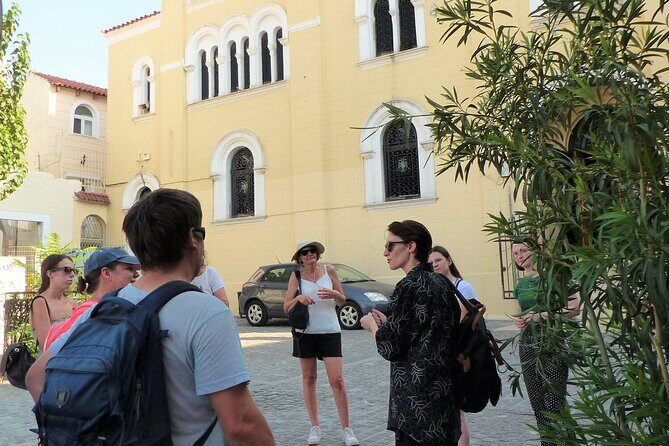
Stop 6 is the Ancient Agora of Athens, about 15 minutes. Here you get the marketplace concept—the center of public life. But the tour’s focus is specifically women in that public space: their role, and what daily life could look like for female slaves or courtesans in the city.
One practical detail: there’s no entrance into the archaeological site here. You see the area from outside, so you’re not stuck with another ticketed visit. That helps keep the tour at a clean 2-hour pace while still giving you context.
What’s valuable about this stop is that it frames “public life” as something women did not fully control, even when they were present. You get the sense that visibility wasn’t the same thing as power. And by connecting that to earlier discussions of marriage and education, the Agora stop feels like a logical result, not a random location.
Then you move to Stop 7: Areopago (the Areopagus), around 10 minutes. This is where the atmosphere shifts. The guide brings you to the place where the worst sinners were trialled in ancient times, and you hear an inspiring story of a woman who risked a death sentence to change women’s rights.
This is a powerful moment in the tour because it turns all the earlier constraints into stakes. It’s one thing to learn about social restrictions. It’s another to see how those restrictions could become deadly—and how courage could still exist inside the system.
If you’re the kind of person who likes your tours to include both thought and emotion, this is where you’ll feel the tour’s heart. And if you’re bringing a teen or someone who’s skeptical about “old history,” this is also the section with the highest potential to grab attention.
You can also read our reviews of more historical tours in Athens




Pnyx and Philopappos Hill: democracy without women voting, then the muses as a finale

Stop 8 is Pnyx, around 15 minutes. This is the setting where democracy all began, with only men citizens voting. The contrast is the point. You’ll get the idea that political systems can be historic and impressive while still being deeply unfair—and that women were excluded from the voting booth.
The tour doesn’t leave you there. It connects the exclusion to a woman who influenced politics during Athens’s Golden Age. Even if you only catch one figure’s name, the takeaway lands: influence existed, but it didn’t always come through official ballots.
Stop 9 is your finish at Philopappos Hill, around 10 minutes. This is the Hill of the Muses, with inspiration tied to the way Athenians connected ideas and myth to daily life. And yes, you end with an amazing view of the Acropolis. The meeting-point description also notes the viewpoint quality and that it’s near the center, plus easy metro access if you want to connect to other sights.
This ending matters. After a tour that is mostly about restrictions and control, the view gives you breathing space. Also, one review detail that matches the vibe: the tour often finishes under trees, which is a welcome relief if the city is hot or bright.
Price, small-group format, and why this is good value at $44.71

At $44.71 per person for a roughly 2-hour small-group walk, the value here is not that it’s cheap. The value is that you’re paying for a very specific theme and a very specific kind of guide work.
You’re not buying a generic “see the city” route. You’re buying a storyline centered on women’s lived experience—myth included, but always tied back to everyday rules: who learns, who marries, who participates, who speaks, and who suffers consequences.
The small-group size (max 12) helps you get more than a standard lecture. It’s built for Q&A and for pace control. Group discounts can also make it easier for pairs or friends to justify booking.
You’ll also appreciate the ticket simplicity. The tour uses mobile tickets, and the listed stops indicate free admissions at each location. Plus, at the Ancient Agora stop, there’s no entry required into the archaeological site since you view it from outside. That helps keep the experience smooth.
Timing matters too. The average booking happens about 37 days in advance, which is a polite hint that popular slots can fill. If you’re traveling in peak season or have fixed plans, I’d book earlier rather than gambling on last-minute availability.
Who should book this Athens women’s history walk
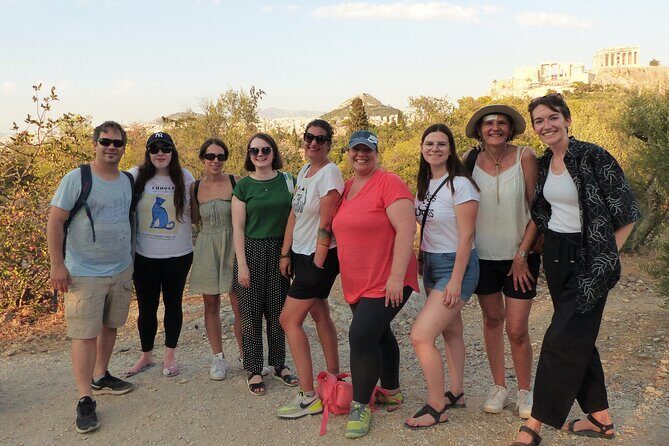
Book this if you want Athens history that feels human and specific. It’s especially good for:
- People who already saw the “main monuments” and want the missing gender-focused perspective
- Anyone interested in mythology tied to real social expectations (Athena, Penelope, Pandora, plus real figures like Sappho and Aspasia)
- Small-group walkers who like a guide who can answer questions and explain why a site matters
- Parents who want something that doesn’t talk down to teens; the mix of myth, politics, and rights has real appeal for younger minds too
Skip it if:
- You have mobility limitations that make uneven sidewalks hard
- You need a fully relaxed, stop-and-chat pace with lots of sitting time
Should you book this women history tour in Athens?
Yes, if you want a different Athens experience than the usual checklist. This walk is built to connect the dots between myths, social rules, and women’s roles—from education and marriage to public life, courts, and politics. It’s also a smart first-day or second-day choice because it gives you a lens you can carry into the rest of your trip.
If your priority is only architecture or only major battlefield-level political history, you might find the theme heavy at times. But if you want context for everyday people and the kinds of power women had—or couldn’t have—this tour is a strong bet.
FAQ
How long is the Small-Group Women History in Ancient Greece walking tour?
The tour lasts about 2 hours.
How large is the group?
The group is limited to a maximum of 12 travelers.
How much does it cost?
It costs $44.71 per person.
Where do I meet the guide, and where does the tour end?
You meet at Pl. Monastirakiou 2, Athina 105 55, Greece. The tour ends at Philopappos Hill, Φυλής 215, Athina 117 41, Greece.
What stops will we see during the walk?
You’ll visit Monastiraki, Hadrian’s Library, the Holy Church of the All-Great Taxiarchs and the Virgin Mary Gregorousa, the Gate of Athena Archegetis, Dioskouron, the Ancient Agora of Athens (seen from outside), Areopago, Pnyx, and finish at Philopappos Hill.
Are there any paid admissions included?
The stops listed show admission tickets as free. At the Ancient Agora of Athens stop, there’s no entrance to the archaeological site—you’ll see it from outside.
Do I need a printed ticket?
No. The tour uses a mobile ticket.
Is it accessible for people with mobility issues?
It is near public transportation, and most people can participate, but it is not recommended for travelers with mobility issues.
What happens if the weather is bad or I need to cancel?
The experience requires good weather. If it’s canceled due to poor weather, you’ll be offered a different date or a full refund. There’s free cancellation up to 24 hours in advance for a full refund.


More Walking Tours in Athens


More Tours in Athens




More Tour Reviews in Athens
- All Day Cruise -3 Islands to Agistri,Moni, Aegina with lunch and drinks included
★ 5.0 · 4,958 reviews